inter-island shipping problems
pp. 72-73 · Read in the full issue
Ships
Fiji launches big attack on its inter-island shipping problems
There are more than 300 islands in the Fiji archipelago, and the hub of all shipping activity is the capital Suva, in the south-eastern corner of Viti Levu, the group’s main island.
Although most of the larger islands have recently been endowed with airstrips, the light type of aircraft used can cater only for a limited number of passengers and virtually no freight, so that in most cases, the outer islands continue to rely on ships as their only link with the outside world.
The government shipping line, which at last count had 48 ships of various types and sizes at its disposal, forms the base of the inter-island communi cations network. However, Captain M. Joy, director of the Marine Department, pointed out that the government line is
a non-profit organisation and
caters mainly for governmental
needs, carrying government cargo to the islands, ferrying officials or providing medical assistance to the islands where a resident doctor is not avail able. The carrying of passen gers or commercial cargo is
generally discouraged by the
imposition of high fares or freight rates, leaving this area to the numerous commercial operators.
There are two major inter
island shipping companies,
Wong Shipping Co, and Hasan Raza Co, plus a large number of smaller companies, many of them operating their one and
only ship. Seventy commercial
ships are presently registered
with the Suva Harbour Auth ority, from small traditional
sloops and missionary ships to
the largest inter-island general
cargo vessel, the Komaiwai of 50 m overall (net tonnage: 182 tonnes, gross tonnage: 460 tonnes). The total amount of cargo shipped in and out of Suva by the commercial oper ators alone during 1978 was 150 105 tonnes.
While the commercially operated ships on the inter island runs come in all shapes
and sizes, the government fleet is gradually opting for a stan
dard design, a fairly simple
task as most of the ships are built locally, by the govern ment shipyard in Walu Bay, Suva. For general cargo work, the landing craft type appears to be ideally suited for the Fijian inter-island trade. The shipyard in Walu Bay has built four landing craft type ferry boats so far, all in the Kaonitoni class, although each craft had certain modifications. The latest addition to the govern ment fleet is the Katavatu of 33.50 m overall, breadth mou lded 8 m, depth loaded 1.80 m and a draught of 1.30 m. With an 80-tonne cargo capacity, it is smaller than its predecessors, being equipped with two GM 8V engines of 230 hp each. The yard’s manager, Mr Apenisa, is of the opinion that the landing craft type vessel is the best sol ution for Fiji’s present needs.
The government has an ambitious development pro gramme under way, building roads, airstrips and water supply systems in the outer
islands. The landing craft type of vessel is able to carry all types of building materials plus the heavy plant necessary for this kind of work to islands with no docking and/or load
ing facilities.
Another landing craft vessel is planned for 1980, while at present the government ship yard is completing a suction dredger, a large steel pontoon, and has started work on a stan dard island trader. This trader is the second to be built in the Mataisau class, a 35 m general cargo vessel, which will have a carrying capacity of 100 tonnes.
Although more landing craft type vessels will be added to the government fleet, conven tional type vessels of 150-200
gross tonnage will have to be kept in operation for supplying those islands where the use ofl the LC type is not practical and freight has to be brought
ashore by lighter.
The government had set high hopes on a return to sail for some vessels and a first trading schooner, the Cagidonu, was launched in Suva in November 1978. Unfortunately, the Cagidonu is in every respect a compromise, being neither sailing vessel nor motorboat, its masts serving mainly as decor ations as the master and his crew do not really know how to sail the ship, even if sails were made available to them
Nevertheless, Captain Joy
seems undaunted by this fail-
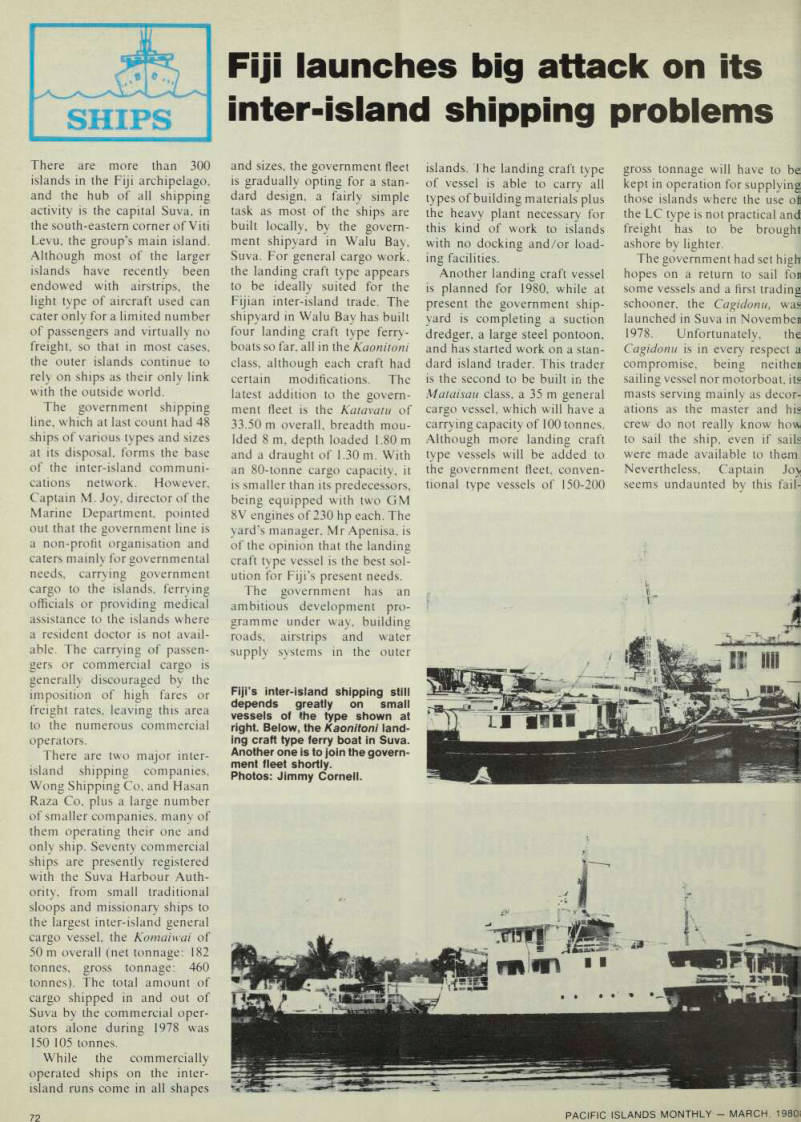
Fiji’s inter-island shipping still depends greatly on small vessels of the type shown at right. Below, the Kaonitoni land ing craft type ferry boat in Suva.
Another one is to join the govern ment fleet shortly.
Photos: Jimmy Cornell.
ure and looks forward to the day when at least some of his [ships will be able to make use of the free wind rather than the ever more costly fuel. Fiji lies in the path of the south-east tradewinds, but, like so many other Pacific nations, the pre sent generation of sailors have [lost their sailing skills, and
[although a feasible proposition
in practical terms, a return to ■sail in the inter-island trade seems just a remote dream.
Jimmy Cornell.
Firefighter
Tug For Fiji
A tug, which can fight fires and deal with oil slicks, has been christened in Suva by Mrs Waniqolo Vakatora, wife of the Minister for Tourism.
Transport and Civil Aviation, Mr Tomasi Vakatora.
The tug, on charter to Port Services Ltd, which is jointly
operated by the Fiji Port Auth
ority, Burns Philp and Howard Smith Ltd. has been named Cumu, which is the Fijian name for a fish of the leather jacket species and also means push’. Cumu’s main job will be he berthing of ships but it can ilso discharge 6533 litres of vater a minute on a fire and :arries 10 247.2 litres of foam olution.
Cumu is 31.86 m overall with draught of 4.4 m and a range f 3000 nautical miles.
Solomon Is.
Suys Loader
olomon Islands Copra Board ; taking delivery of a series of ortable elevators and
niploaders.
The machines, which are 7.5 m long, can load 2000 75 g bags of copra an hour to a oint on a ship 8 m from the harf edge and 8 m above it.
They were designed and
lanufactured by an Australian
)mpany, McNiece Engineers ty Ltd.
Iauru’S Two
Lew Ships
auru’s Local Government ouncil has just spent SUS 3
lillion to buy two fishing
issels and lay the foundations
>r the tiny island republic’s
first commercial fishing fleet.
The vessels, bought by the council from Peru, will be called A ustin Bernicke and Vic tor Eoaoe to honour the mem ory of two recently deceased members of the council.
The identical 700-tonne vessels will be fitted with the most up-to-date equipment, enabling them to ‘see’ schools of fish from several miles away.
Sonar devices have already been fitted during a visit by the ships to American Samoa.
They can also be used as
tuna longliners.
Edwin Tsitsi, who rep resented the council in Peru for delivery of the vessels, says that each has a haul capacity of 540 tonnes of fish.
It was reported that the people of Übenide and Buada, the constituencies of the two late councillors for whom the ships have been named, were planning festivities to mark the ships’ arrival in Nauru.
N. Marianas’
New Ferry
Northern Marianas has a new ferry service provided by the 38 m Marianas Queen, plying between Saipan and Tinian.
The vessel is expected later to serve Rota and the northern islands as well.
Marianas Queen can trans port up to 12 motor cars, or a mix of large vehicles, as well as 400 passengers.
Owner Elias Okamura of Saipan said he bought the 14year-old ferry in Japan for SUSBB 000. Dry dock work and a complete repaint cost an ad ditional $5O 000.
Jeff Busha, chief of the com
monwealth’s transportation
and communication services, welcomed the Marianas Queen as a significant addition to transportation facilities.
Radar
Upgrade?
New radar equipment which is claimed to give the scanning facilities of an ocean liner to small ships has been launched in London.
The 10 kW power equip ment is almost twice as power ful as conventional small boat radars. It is produced in two
models, one with an 0.9 m aerial and another with an aerial of 1.2 m. Aerials are designed to withstand winds of up to 100 knots.
The equipment is said to have a range of more than 150 km.
The manufacturers, Decca Radio Ltd, expect considerable interest in the product among owners of medium-size and small craft all over the world.
In Brief
JULIAN Joy of the Pacific Forum Line delivered a paper on ‘Future Trends in Pacific Trading’ at the recent Pacific Ports Association Annual Con ference held in Rarotonga, Cook Islands.
KIRIBATI copra will be car ried to Europe in Polish ships following an agreement be tween the Kiribati Copra Co operative Society and the Polish Shipping Line. First shipment of copra under the new agreement was loaded aboard the PSL vessel Mahan Buczek late last year.
THE New Guinea Express Line is taking delivery of 65 insulated containers manufac tured by George & Ashton Ltd, Dunedin, New Zealand.
THE FIJI Ports Authority has
appointed Chai Hon Yoong,
46, of Singapore, as its ports engineer. Mr Chai, who was a senior civil engineer with the Port of Singapore Authority, is in Fiji on a two-year second ment and joins his countryman, Loh Heng Kee, who is director of the Fiji Ports Authority.