Islands photos
pp. 69-71 · Read in the full issue
Tropicalities
The State Dept,
has been told ...
The 1979 award for anti-US- State-Department invective went not, as in years past it might have, to Moscow’s Pravda, and still less, in these days of US-China friendliness, to the Peking People's Daily.
It goes instead to the Manila based Mead, Meade, Meads Family Association, an organ isation which presides over the fate of the wait for it Re
public of Morac-Songhrati-
Meads, which wait for it again lays modest claim to all the islands of the Pacific.
In an open letter to US Sena ;or Frank Church, chairman of he Senate Relations Com nittee, a copy of which was ent to PIM by MMMFA sec tary, Philip Lord Meads, the issociation says: ‘We have pre viously written to you about he so-called Treaty of Friend hip between the United States nd a non-existent country by be name of Tuvalu. The same ondition obtains in regard to
nother State Department
nsmo-Fantasy called the reaty of Friendship between te United States and the non xistent country called Kiribati .. As usual the State Depart ment noncompetents, con irmists and maleducateds ave acquiesced to the British lit accompli - for fear of being olated or impugned as a “de abilising bureaucrat”, and ave crawled over each other • endorse the declaration of dependence of the non dstent country called by unm anned persons the “Gilbert lands” ... ‘ln agreeing to the said treaty e State Department traitors r en had the unmitigated gall throw away the long
anding claim of sovereignty
the United States to many of e islands cited in the pre mie- This action again shows bat we have been proclaim g for years - the State epartment has become a
decadent bureaucracy,
downgrading the United States without the approval of the
people through any refer
endum or plebiscite or even the Congress. It is in a state of In stitutional Treason against the American people. ‘For your information, Sir, the islands cited in the pre amble of the proposed Treaty of Friendship with the non existent country called Kiribati are owned by the Meads Fam ily. We had hoped that the United States would maintain its claimed sovereignty but since it hasn’t and refuses to fulfil its responsibilities to the US Constitution and the American people, please understand that the American Meads Family has no intention of recognising any pretended sovereignty of the Kiribati- Gilbert Islands over the afore cited Meads Family islands, which also includes many in the so-called Gilbert Islands, which have been under the subjugation of the British Crown for many years. This means of course that the Meads Family recognises the sover eignty of the Republic of Morac - Songhrati - Meads thereover, which country recognises the property rights of American citizens.
The Republic of Morac- Songhrati-Meads, to our best knowledge, claims all the islands in the Pacific in a clear cut and absolutist manner that will prevent the Russians, the Japanese, the Chinese from
ever gaining any control or position in this area. ‘As the chief of foreign pol icy in the Senate, it is in your own intelligent self-interest, as well as that of the US Govern ment, to support and co operate with the republic in every way possible. It is not logical to expect that country to wait at the altar forever. Sooner or later other great powers will recognise its great power and assets and begin to court it. If that should happen, then the US is lost again holding an empty bag filled with holes
Islands photos
at NZ Museum
In a remarkable exhibition, New Zealand’s National Art
Gallery recently displayed a
selection of photographs taken in Samoa, Tonga and Fiji late last century. The photographs came from the New Zealand National Museum’s large Pa cific Islands negative collec tion.
The exhibition, which was exciting and somewhat un usual, ran from December 15 to February 10.
A total of 35 photographs were displayed, products of Thomas Andrew, the Burton Brothers and their successors, Muir and Moodie. These were
all professionals, working from
studios in Apia or Levuka.
The Burton Brothers trav elled around the Pacific with the intention of selling a selec tion of photographs in New Zealand, where they had already built up an impressive reputation.
Little is known about Thomas Andrew, apart from the fact that he had a studio in Apia. Of his 170 negatives held in the National Museum, almost all are Samoan portraits and scenes.
Of the Burton Brothers and the Muir and Moodie team, around 400 negatives of Pacific shots were listed in their cata logue. Only 160-odd survive
today.
The negatives are eight and a half inches by six and a half, and not in good condition.
However, the Museum experts were able to produce prints of
outstanding quality for the
exhibition.
Among the photographs was an 1884 print of the Wesleyan Church in Nukualofa and one entitled ‘Native Girls, Rotuma c. 1899’.
An 1884 print of the Fiji Times office is featured, as is an 1889 print of the fire-walkers at
Mbenga.
The Samoan photographs by
Thomas Andrews are outstand ing for the detail and the action they contain. His portraits also
leave a lasting impression.
Of his political themes, the exhibition includes an 1899
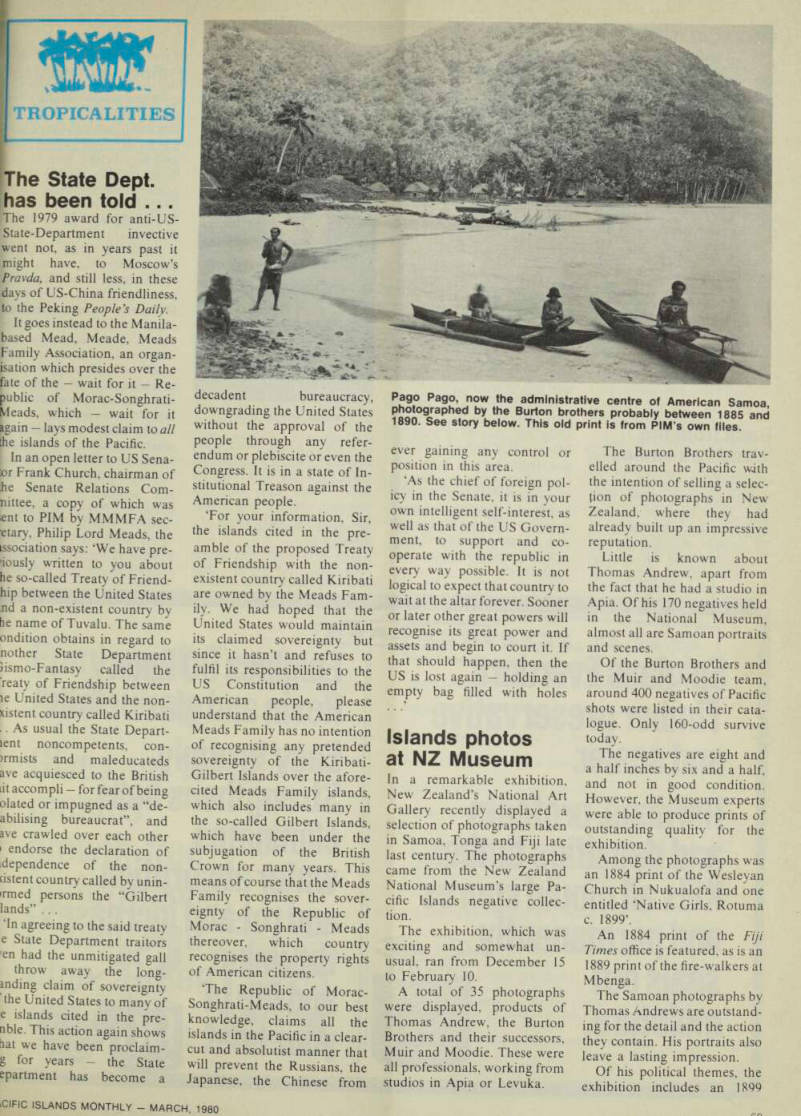
Pago Pago, now the administrative centre of American Samoa, photographed by the Burton brothers probably between 1885 and 1890. See story below. This old print is from PlM’s own files.
shot of a Samoan brigade opposing Mata’afa. and the various military activities at Mulinuu around 1899. There is
an outstanding picture entitled
‘Ceremonial Firings at American Take-over, Pago Pago. American Samoa 1904'.
An 1899 Burton Brothers print is memorable for its cap tion; ‘The Fair “Saumatani" (the Samoan Beauty with the
Languishing Eyes) and Mr
Bloomfield. Pago Pago, American Samoa’.
New Zealand’s Alexander Turnbull Library also has extensive Samoan photo graphic files, although the bulk of the material is related to the New Zealand take-over in 1914. - Mike Field
Back from the
‘dead’, all smiles
One day late last year I was sit ting at my desk in the PIM office when I got the message that a gentleman wanted to see me outside in the reception area. It appeared that we had wrongly reported him to be dead! I gripped the edge of my
desk, closed my eyes, and steeled myself for what is one of the real nightmares of the
journalist’s trade dealing
with people who have been prematurely killed off. Visions
of possible legal action against
the magazine swirled before me as I took one last gulp of my afternoon tea and went out to face the music.
And what music it was! I met
a smiling, charming chap
called Arthur Wordie whom I took to be about 70 (he is actu ally in his early 80s). He was treating the whole affair as if it were one of the funniest things that had happened to him in years. Far from thinking of suing us. he almost seemed ready to pay us a fee for giving him such a great giggle.
He explained that a friend at his bowling club had brought along the May 1979 issue of PIM in which in the People sec tion (p5O) his old mate Pat Carter had referred to him as ‘the late Arthur Wordie’. His
bowling colleague had
specially equipped himself
with a bunch of cut flowers for Arthur, ‘while you can still smell them’.
Arthur and Pat had been out
of touch for a long time and be cause of Arthur’s advancing years, and the fact that he hadn’t heard from him, Pat assumed wrongly that Arthur had gone off and ‘joined the
majority’.
The item about Pat Carter, long-time executive and founding shareholder of East-
West Airlines, concerned ‘twoi firsts and a 60th' in his long: life; the ‘6oth’ was his 60th tripe to Papua New Guinea ini March last year on the occasion! of Air Niugini’s farewell recep tion for its former general man ager Bryan Grey, and the two ‘firsts’ the fact that he is the holder of the first share issued in East-West Airlines in 1946. and that he sold the first ticket his company issued in 1947, to a Tamworth man, ‘the late Arthur Wordie’.
This is the second time I’ve been reported dead,’ Arthur told me with some enthusiasm ‘I used to be in the motor trade and a trade magazine alsc wrote me off a few years back Can't imagine why I attraci that kind of publicity. It’s a bit like pointing the bone, but i doesn’t worry me . ..’
All Arthur wanted us to dc was to set the record straight! which we do happily. He alsc hoped Pat Carter would reac it.
As for myself. I’d like tc thank Arthur Wordie for one of the pleasantest little inter views I’ve had in 30 years oi
journalism. Malcolm
Salmon
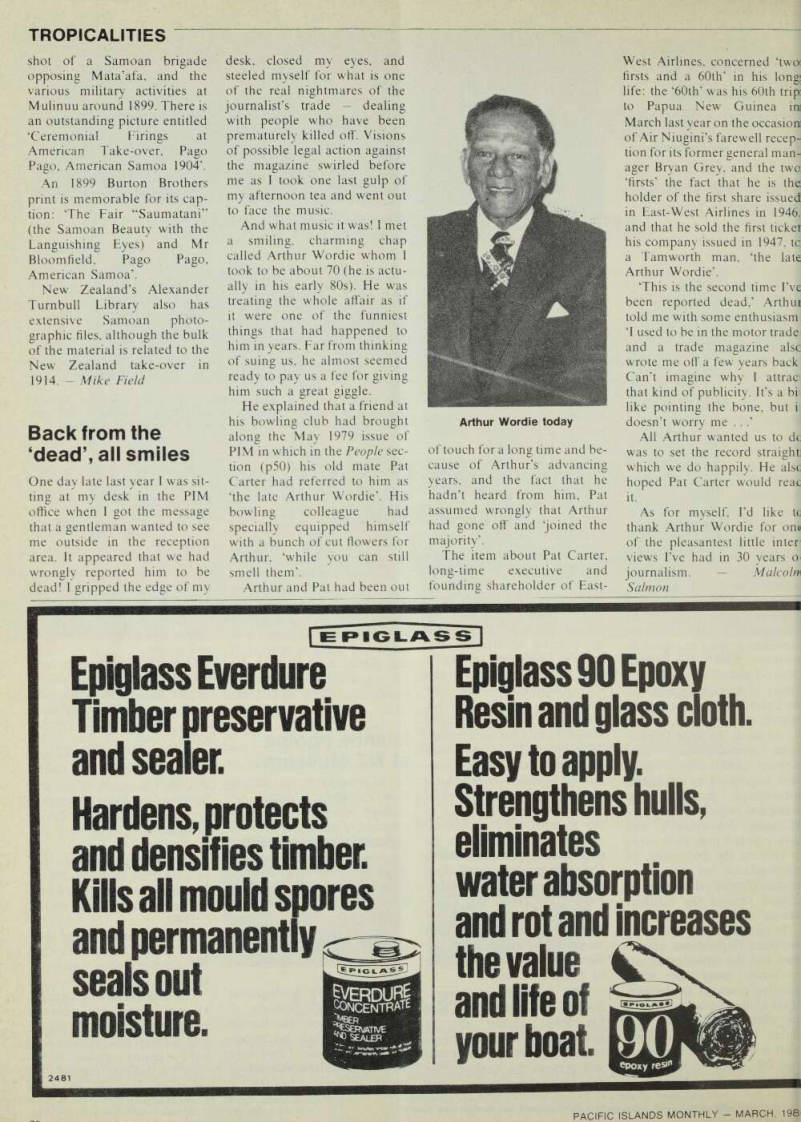
Arthur Wordie today
Polynesians
losing their skills
I The Polynesians, recognised as iexperts in traditional navi
gation, are in danger of losing
[their navigational skills, says a [former pilot with Air Pacific.
I The ex-pilot, who is also a
[medical practitioner and a
navigator, is Doctor Maxwell (Johnston, who has been doing volunteer work at Western Samoa’s National Hospital.
Dr Johnston, who is working his way from the South Pacific to North America, and, in between-times, climbing the mountains on Savaii, said the ancient peoples of Oceania used the stars, the sun. birds, ocean-swell patterns and cloud formations to navigate over great distances. But, today, the
young people were no longer
interested in acquiring tra
ditional lore, which, over the centuries, has been handed down from father to son.
It is an oral tradition. The Polynesians have for centuries transmitted traditional knowl edge by word of mouth, refus ing to commit their knowledge
to writing because they would
then lose esteem, a family’s honour being reflected in the amount of lore stored by the
family head.
But, says Dr Johnston, the young people, versed in mod ern ways of living and travel, are not interested in the tra ditional ways so that knowl edge is dying with those who have preserved it over the cen turies.
Dr Johnston, who graduated as a medical practitioner at the University of Otago (NZ) flew with Air Pacific (Fiji Airways) in the 19605.
In NZ, maybe
but not in Fiji!
According to ex-Police Inspec
tor Dr A. Moodie, secretary of the New Zealand Police As sociation, Polynesian men won’t wear the lavalava in New Zealand’s streets because they have been forced to ‘knuckle under’ to the dominant
European culture.
Just to prove that he wasn’t knuckling under to anyone, he wore a caftan, a long garment which looks like a maternity gown, to the Melbourne Cup
races. Far from being dis couraged by the wolf whistles and cries of ‘I like your dress, darling’, Dr Moodie is con templating wearing skirts and dresses. It’s all part of his con cern at the growing intolerance of people against those who won’t conform to the norm.
His comments anent the Polynesians in New Zealand wouldn’t wash in Fiji, however.
The Fijian sulu isn’t likely to go out of fashion, and the New Zealander, or the Melbourne racegoer, who greeted a Fijian man with T like your dress, darling’, would get a thick ear.
When a proposal was made in the 1960 s to ‘britch’ the Fijian police constables, and make them drop their serrated sulus in favour of shorts, there was a storm of protests. The idea, and not the sulu, was
dropped very quickly.
PNG’s ‘Think
Tank’going well
Papua New Guinea’s National Library, a year old on October 30, is rapidly gaining a world wide reputation for its unique
collection of Papua New Guineana, and recognition as the main repository for materials published anywhere in the world about Papua New Guinea or by Papua New Guineans, T . ...
H an , mde P en de"“ otthe people of Aus -3 la d 15 attracting a large ° f . users a " d v,sltors 3nd ltsse 7‘ ces are used “““ffr.by scholars, scien p ’. h ‘ stona " s and " nter s. , P 6 lrom the United States, i! apan 3nd anada as well as prom neighbouring islands have been consulting its vari “V“ lle< f ions ’ op b °oks, films, P enodlcals and documents, as b e h p ll , ! h no h reStriC,lon °” al,bou g h ’ because m u eb of > be col eet, ° n 15 rare , and valuabl «- Ca " “ > ‘ he ‘‘ brary buildm g’
The Reference Library is
developing rapidly and there
are now large collections of books from Britain, the United States, Canada and Japan. The National Library collection
expanded significantly recently
with the transfer to it of the li brary of the Prime Minister’s
Department