Guam has already, and will de
pp. 60-63 · Read in the full issue

velop further, a broader base than is possible for the new US ‘free association’ territories.
But I foresee that Guam will want more room to move through a better political ar rangement, and can be ex pected to aim towards constitutional talks with the US a view which Governor Paul Calvo was inclined to confirm during a talk I had with him in his office.
Governor Calvo is person able, astute, and himself a suc cessful businessman, his family being involved in such varied
pursuits as hardware supply,
real estate, travel, insurance and leisure interests.
He sees Guam’s economy being built on a wide base which includes development of
agriculture, fishing and
manufacture; on expanded tourism; but most importantly on the development of Guam as a firm, politically-sound platform for international
companies doing business in
Asia and the Pacific Islands, including the South Pacific.
Situated centrally within a few hours flying time of Japan,
Hong Kong, the Philippines
and Australia, Guam, for American big business es pecially, has the advantage of being part of the US financial and economic system with di rect communications with Hawaii and the US mainland.
Mike McClure, executive director of the Guam Growth Council, explained to me later: ‘Many big US businesses have become disillusioned at having their Asia offices in places like Tokyo, Taiwan and Manila.
It’s become very expensive to keep executives, staff and their families there, and those places are not all politically stable.
Guam is safe, all the US banks are now here, we’ve got
warehousing and good fast
communications, and staffs and families have an environ ment they can feel at home in.
From Guam you can service the Pacific in every direction.’
Some big multi-nationals have already started to move to Guam or have declared their interest in a move; others are being identified and ap
proached by the Growth Coun cil, which is one of many similar councils throughout the US whose purpose is to harness government and business expertise in the interests of
development.
The Guam Council has a board of seven, five business men and two government officials, using volunteer com mittees. Mike McClure pre dicts that moves will accelerate when the US develops closer trade ties with the Republic of China, because Guam is a key point on what will be the ship ping and air lanes between the US and China.
Guam is clearly moving
away from an economy that was based on retail sales in the
shops, dependent on customers
with money to spend.
There are many pointers to the healthier development of the Guam economy. The work force is increasing, with offers of jobs in the classifieds having doubled recently. (But 10 per cent of the workforce is still imported.) The legal firms are busy, which is always an accu
rate barometer. There is a new daily newspaper. The ‘brain drain’ of people to the US i: slowing because of the greate; opportunities on the islandl Tourism has picked up, witH now a dozen airlines flying through Guam and more to come, and 1979 was the firs; good year for the hotels. People still don’t like paying taxes, ano manage to avoid them, but the
drug scene has improveo
thanks to good community ano government efforts, and the end of the war.
James McDonald, presidenj of the Guam Chamber o( Commerce, can see Guanr developing closer economic ties with the rest of the Pacific Islands, but with the nearby Northern Marianas pan ticularly. ‘Both of us are small and rather than compete ii makes sense for us to worl: together for a stronger econr omy,’ he says. He adds thar Guam has learned a lot fronr
seeing the economic problem:
of the Trust Territory islands having helped train a lot oc their leaders.
Although the Japanese still
have business interests in Guam which can be expected to grow, Taiwan Chinese and others are now making an impact on Guam business.
Many people see the Chinese as much shrewder (one group has an eel farm, exporting eels to Japan). But there is also
Greek shipping money, Arab
and Hong Kong money in
Guam. As one government official said, ‘You see the upfront people, but you don’t always see the backing behind
them’. Others have obviously
seen the business opportunities that Guam is about to offer.
Agricultural and other Jevelopment of Guam’s own resources are not likely to be lindered by problems of land ownership. The Federal and 3uam governments each own i third of Guam’s land, and the emaining third is freehold, fhe Guam Government’s land :an be leased for agricultural nirposes. Some is to be devel >ped for an orchard plantation )f tropical fruits for Japanese fujiro Kuwabara, who runs a hriving tropical fruit juice and
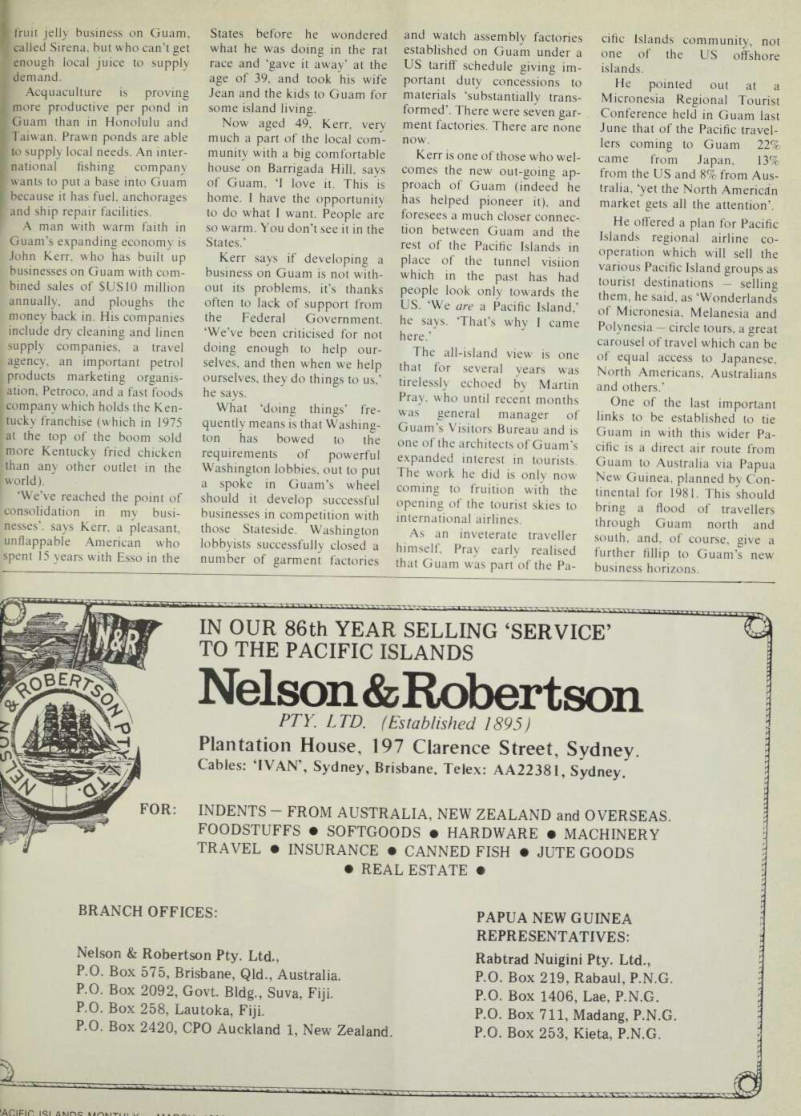
Old and new can be seen side-by-side in Agana, Guam’s developing capital and business centre. Here the Chease building in the background contrasts with walls left by the Spanish occupation. Photo: Paul Addison.
I fruit jelly business on Guam.
I called Sirena. but who can’t get enough local juice to supply demand.
Acquaculture is proving more productive per pond in Guam than in Honolulu and Taiwan. Prawn ponds are able I to supply local needs. An inter national fishing company f wants to put a base into Guam f because it has fuel, anchorages and ship repair facilities.
A man with warm faith in Guam’s expanding economy is John Kerr, who has built up businesses on Guam with com bined sales of SUSIO million
annually, and ploughs the
money back in. His companies include dry cleaning and linen
supply companies, a travel
agency, an important petrol
products marketing organis
ation. Petroco, and a fast foods [company which holds the Ken tucky franchise (which in 1975 at the top of the boom sold more Kentucky fried chicken than any other outlet in the world). ‘We’ve reached the point of consolidation in my busi nesses’. says Kerr, a pleasant, unflappable American who spent 15 years with Esso in the
States before he wondered what he was doing in the rat race and ‘gave it away’ at the age of 39, and took his wife Jean and the kids to Guam for some island living.
Now aged 49, Kerr, very much a part of the local com munity with a big comfortable house on Barrigada Hill, says of Guam. ‘I love it. This is home. I have the opportunity to do what I want. People are so warm. You don’t see it in the States.’
Kerr says if developing a business on Guam is not with out its problems, it’s thanks often to lack of support from the Federal Government. ‘We’ve been criticised for not
doing enough to help our
selves, and then when we help ourselves, they do things to us,’ he says.
What ‘doing things’ fre
quently means is that Washing ton has bowed to the requirements of powerful Washington lobbies, out to put a spoke in Guam’s wheel should it develop successful businesses in competition with those Stateside. Washington
lobbyists successfully closed a
number of garment factories
and watch assembly factories established on Guam under a US tariff schedule giving im portant duty concessions to materials ‘substantially trans formed’. There were seven gar ment factories. There are none now.
Kerr is one of those who wel comes the new out-going ap proach of Guam (indeed he has helped pioneer it), and foresees a much closer connec tion between Guam and the rest of the Pacific Islands in place of the tunnel visiion which in the past has had people look only towards the US. ‘We are a Pacific Island,’ he says. ‘That’s why I came here.’
The all-island view is one that for several years was
tirelessly echoed by Martin
Pray, who until recent months was general manager of Guam’s Visitors Bureau and is one of the architects of Guam’s expanded interest in tourists.
The work he did is only now coming to fruition with the opening of the tourist skies to international airlines.
As an inveterate traveller
himself. Pray early realised
that Guam was part of the Pa
cific Islands community, not one of the US offshore islands.
He pointed out at a Micronesia Regional Tourist Conference held in Guam last June that of the Pacific travel lers coming to Guam 22% came from Japan, 13% from the US and 8% from Aus tralia, ‘yet the North American market gets all the attention’.
He offered a plan for Pacific Islands regional airline co operation which will sell the various Pacific Island groups as tourist destinations selling them, he said, as ‘Wonderlands of Micronesia, Melanesia and Polynesia circle tours, a great carousel of travel which can be of equal access to Japanese, North Americans, Australians and others.’
One of the last important links to be established to tie Guam in with this wider Pa cific is a direct air route from Guam to Australia via Papua New Guinea, planned by Con tinental for 1981. This should bring a flood of travellers through Guam north and south, and, of course, give a further fillip to Guam’s new business horizons.