horizons
p. 59 · Read in the full issue
Guam widens her economic horizons
Trade
Winds
By Stuart Inder
The Territory of Guam, whose major claim to recog nition has hitherto been based on the tourist-brochure slogan that it’s ‘where America’s day
begins’, is finally finding its
own place in the sun. It’s no longer to be considered a re mote US outpost in the Pacific, a brief stopover en route to some place important. Guam is now an island with a heart and a pulse of its own.
Visiting the island recently for the first time in seven years I was impressed by a new drive,
a new forward-looking,
outward-looking atmosphere.
There is a stronger economy being formulated on a base of its own. The boom and bust Jays, when Guam was utterly it the mercy of outside events, tppear to be over.
When I was last there, Guam vas in the middle of one of its xioms. It lasted from 1969 to 1974. People were then still spending US reparations noney received for the 1962 ty
coon. tourism was building
rom Japan, and Japanese nvestors were flooding in to consolidate their share in the lew market. New hotels and
stores went up, with'Japanese lettering, and street signs and notices started to become bi lingual. The Vietnam war was oh, and the big bombers based on Guam, from where they
made daily bombing runs,
were supported by a vast popu lation of free-spending person nel and dependent families.
The dollar reigned. As a duty free port, prices of many luxur ies were low; few residents troubled to pay their taxes; there was work if you wanted it, and now drugs, too, if you wanted them and many of the young did.
But then came 1975. Viet nam was over in April, and the Army and Navy cut back. The first oil crisis knocked the bot tom out of the Japanese tourist barrel. Japanese investors who
had paid too much anyhow for their hotels and other leisure industry businesses became disillusioned, or simply went to the wall. There followed two years of depression.
These gave numbers of people on Guam time to do
some thinking and planning.
Not merely politicians, but businessmen of all back grounds, anxious to see Guam have an economic base better
able to understand the shocks.
One of the good things that came out of this has been the
greater participation by the
local people, the Chamorros, in Guam’s business development.
The Chamorros have long comprised the basic fabric of Guam’s government, with 52% of Guam’s Chamorro work force receiving Federal or local pay cheques, but in the com mercial world they had been considered the office furniture.
Now more Chamorros are coming to the fore, and in a fortnight on Guam and nearby Saipan I detected a new nationalism.
The Guamanians have noted with close interest the rise of nearby Island states,
starting with the independent
Republic of Nauru, whose busy fleet of jet aircraft can be seen almost every day on the island.
Then came the rise of their own
people on Saipan who
formed themselves into the Commonwealth of the North ern Marianas, followed by the people of the Marshalls,
Ponape, Truk. Yap, Kosrae.
and Palau, all winning for themselves guarantees of full self-government in free associ ation with the US, and offers of bountiful no-strings hand outs from the US treasury.
As an unincorporated terri tory of the US, Guam is begin ning to see itself politically as being attached to a steam engine in a jet age. Economi cally there is little doubt that
Japanese capital runs Sirena, a thriving fruit juice manufacturer
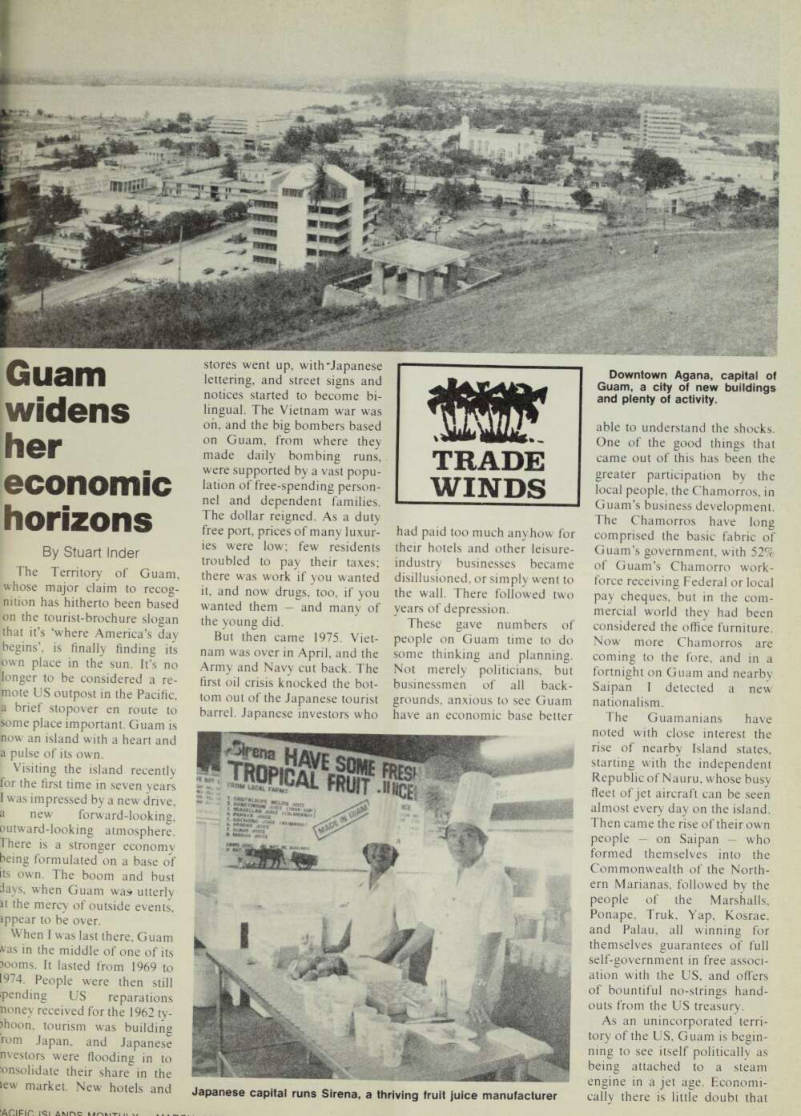
Downtown Agana, capital of Guam, a city of new buildings and plenty of activity.