Aid: What the U.S.
p. 38 · Read in the full issue
is doing and where and what it costs
The following story and statistics have been provided by the South Pacific Regional Development Office of the US Agency for International Develop ment (AID). The office was recently established within the US Embassy in Suva, as an important aspect of the general upgrading of US relations with the region. PlM’s particular thanks go to Robert V. Craig, Sr, US South Pacific Regional Development Office.
The US role in the South Pa-
cific is quite appropriately
and quite consciously that of a minor donor supplementing and filling in between the major bilateral and multilateral programmes already in place in the area.
The US Agency for International Development programmes now in operation in the South Pacific and those which are planned are aimed primarily at specific groups of rural people on the lower end of the economic spectrum. The major area of US concern has been that of addressing appro-
priate training and educational
problems in the South Pacific, The magnitude of US aid is insufficient to solve the entire
problem - if, indeed, there is a total solution. But it does serve to stimulate and encourage Island governments which are addressing the prob lem.
It is hoped that some AID projects will serve' as pilots for host country activities. This has already been the case in Papua New Guinea where govera ment initiatives have been partly inspired by the work of two US private and voluntary organisations working in that country assisted by USAID grants.
The US interest in the South Pacific island peoples has been expressed in the following three ways; 1. The US Peace Corps: For more than a decade, the United
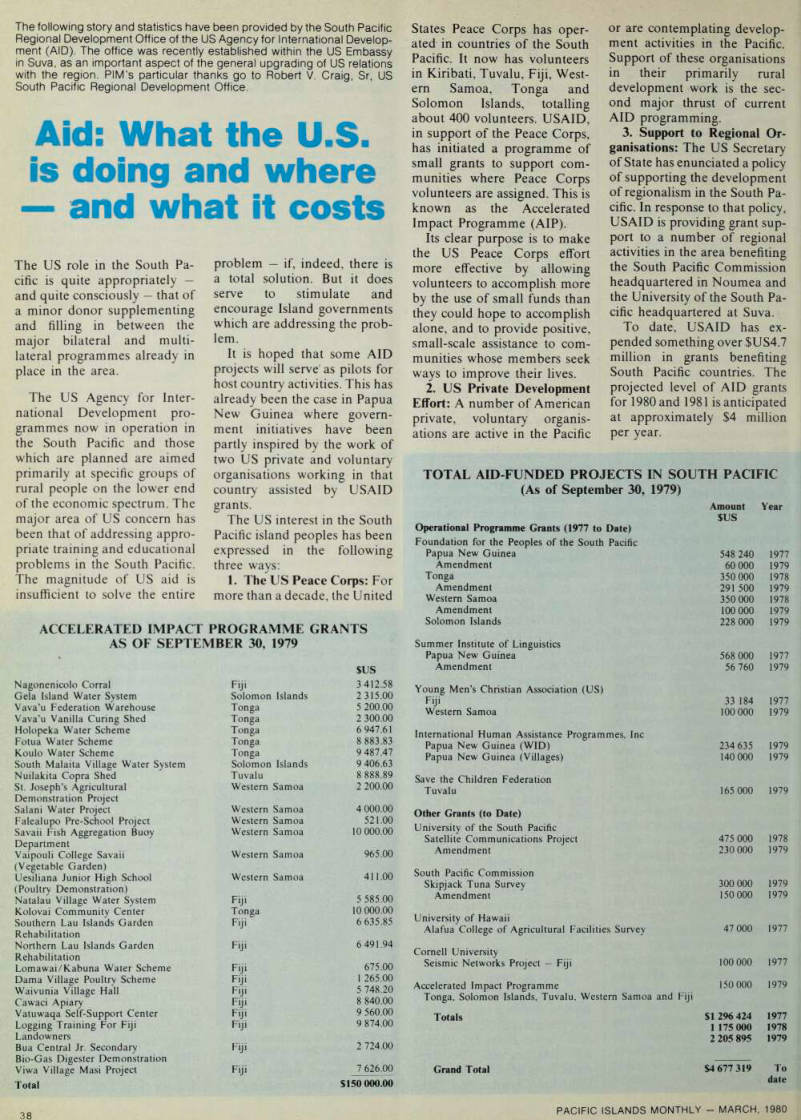
Accelerated Impact Programme Grants
As Of September 30, 1979
States Peace Corps has operated in countries of the South Pacific. It now has volunteers in Kiribati, Tuvalu, Fiji, Westera Samoa, Tonga and Solomon Islands, totalling about 400 volunteers. USAID, in support of the Peace Corps, has initiated a programme of small grants to support communities where Peace Corps volunteers are assigned. This is known as the Accelerated
Impact Programme (AIP).
Its clear purpose is to make the US Peace Corps effort
more effective by allowing
volunteers to accomplish more by the use of small funds than
they could hope to accomplish
alone, and to provide positive, small-scale assistance to communities whose members seek ways to improve their lives. 2. US Private Development Effort: A number of American
private, voluntary organis-
ations are active in the Pacific
or are contemplating develop
ment activities in the Pacific.
Support of these organisations
in their primarily rural development work is the sec ond major thrust of current
AID programming.
3. Support to Regional Or ganisations: The US Secretary of State has enunciated a policy
of supporting the development
of regionalism in the South Pa cific. In response to that policy, USAID is providing grant sup port to a number of regional activities in the area benefiting the South Pacific Commission headquartered in Noumea and the University of the South Pa cific headquartered at Suva.
To date, USAID has ex pended something over SUS 4.7 million in grants benefiting South Pacific countries. The projected level of AID grants for 1980 and 1981 is anticipated at approximately $4 million per year.
Total Aid-Funded Projects In South Pacific
(As of September 30, 1979)
Nagonenicolo Corral
Fiji $US 3 412.58 Gela Island Water System Solomon Islands 2 315.00 Vava’u Federation Warehouse
Tonga
5 200.00 Vava’u Vanilla Curing Shed
Tonga
2 300.00 Holopeka Water Scheme Tonga 6 947.61 Fotua Water Scheme Tonga 8 883.83 Koulo Water Scheme Tonga 9 487.47 South Malaita Village Water System Solomon Islands 9 406.63 Nuilakita Copra Shed St. Joseph’s Agricultural Tuvalu 8 888.89 Western Samoa 2 200.00
Demonstration Project
Salani Water Project Western Samoa 4 000.00 Falealupo Pre-School Project Western Samoa 521.00
Savaii Fish Aggregation Buoy
Western Samoa 10 000.00 Department
Vaipouli College Savaii
Western Samoa 965.00
(Vegetable Garden)
Uesiliana Junior High School Western Samoa 411.00 (Poultry Demonstration) Natalau Village Water System Fiji 5 585.00 Kolovai Community Center Tonga 10 000.00 Southern Lau Islands Garden
Fiji
6 635.85 Rehabilitation Northern Lau Islands Garden
Fiji
6 491.94 Rehabilitation Lomawai/Kabuna Water Scheme Fiji 675.00 Dama Village Poultry Scheme
Fiji
1 265.00 Waivunia Village Hall Fiji 5 748.20 Cawaci Apiary Fiji 8 840.00 Vatuwaqa Self-Support Center Fiji 9 560.00
Logging Training For Fiji
Fiji
9 874.00 Landowners Bua Central Jr. Secondary
Fiji
2 724.00 Bio-Gas Digester Demonstration Viwa Village Masi Project Fiji 7 626.00 Total $150 000.00
Operational Programme Grants (1977 to Date) Foundation for the Peoples of the South Pacific Papua New Guinea Amendment
Tonga
Amendment Western Samoa Amendment Solomon Islands Amount $US 548 240 60 000 350 000 291 500 350 000 100 000 228 000 Year 1977 1979 1978 1979 1978 1979 1979 Summer Institute of Linguistics Papua New Guinea Amendment 568 000 56 760 1977 1979 Young Men’s Christian Association (US)
Fiji
Western Samoa 33 184 100 000 1977 1979 International Human Assistance Programmes, Inc Papua New Guinea (WID)
Papua New Guinea (Villages)
234 635 140 000 1979 1979 Save the Children Federation Tuvalu 165 000 1979 Other Grants (to Date) University of the South Pacific Satellite Communications Project Amendment 475 000 230 000 1978 1979 South Pacific Commission
Skipjack Tuna Survey
Amendment 300 000 150 000 1979 1979 University of Hawaii
Alafua College of Agricultural Facilities Survey
47 000 1977
Cornell University
Seismic Networks Project — Fiji 100 000 1977
Accelerated Impact Programme
Tonga, Solomon Islands, Tuvalu, Western Samoa and Fiji 150 000 1979 Totals $1 296 424 1 175 000 2 205 895 1977 1978 1979 Grand Total $4 677 319 To date