with a U.S. background
p. 37 · Read in the full issue
‘FSP’ -an active aid body with a U.S. background
The most active private volun tary organisation (PVO) work ing in the Pacific region today is the Foundation for the Peoples of the South Pacific
(Fsp).
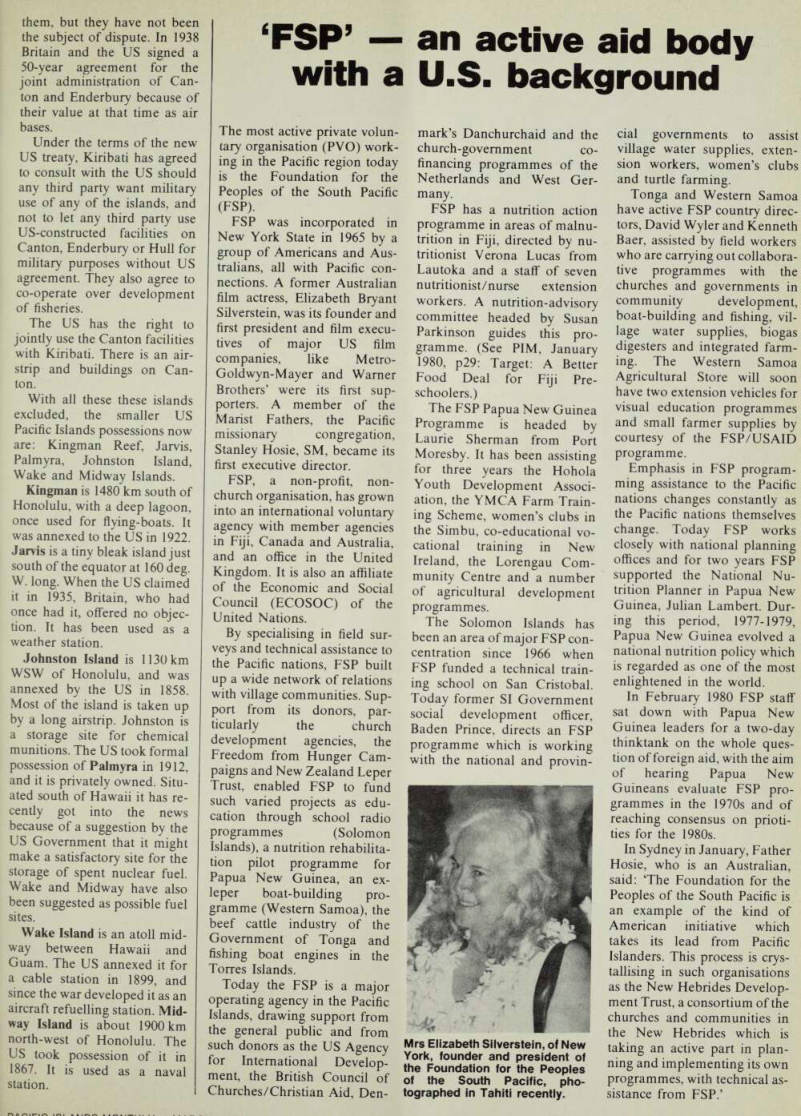
FSP was incorporated in New York State in 1965 by a group of Americans and Aus tralians, all with Pacific con nections. A former Australian film actress, Elizabeth Bryant Silverstein, was its founder and first president and film execu tives of major US film companies, like Metro- Goldwyn-Mayer and Warner Brothers’ were its first sup porters. A member of the Marist Fathers, the Pacific
missionary congregation,
Stanley Hosie, SM, became its first executive director.
FSP, a non-profit, non church organisation, has grown into an international voluntary agency with member agencies in Fiji, Canada and Australia, and an office in the United Kingdom. It is also an affiliate of the Economic and Social Council (ECOSOC) of the United Nations.
By specialising in field sur veys and technical assistance to the Pacific nations, FSP built up a wide network of relations with village communities. Sup port from its donors, par ticularly the church development agencies, the Freedom from Hunger Cam paigns and New Zealand Leper Trust, enabled FSP to fund such varied projects as edu cation through school radio programmes (Solomon Islands), a nutrition rehabilita tion pilot programme for Papua New Guinea, an ex
leper boat-building pro
gramme (Western Samoa), the beef cattle industry of the Government of Tonga and fishing boat engines in the Torres Islands.
Today the FSP is a major operating agency in the Pacific Islands, drawing support from the general public and from such donors as the US Agency for International Develop ment, the British Council of Churches/Christian Aid, Den
mark’s Danchurchaid and the
church-government co
financing programmes of the Netherlands and West Ger many.
FSP has a nutrition action programme in areas of malnu trition in Fiji, directed by nu tritionist Verona Lucas from Lautoka and a staff of seven nutritionist/nurse extension workers. A nutrition-advisory committee headed by Susan Parkinson guides this pro gramme. (See PIM, January 1980, p 29: Target: A Better Food Deal for Fiji Pre schoolers.) The FSP Papua New Guinea Programme is headed by Laurie Sherman from Port Moresby. It has been assisting for three years the Hohola Youth Development Associ ation, the YMCA Farm Train ing Scheme, women’s clubs in the Simbu, co-educational vo cational training in New Ireland, the Lorengau Com munity Centre and a number of agricultural development programmes.
The Solomon Islands has been an area of major FSP con centration since 1966 when FSP funded a technical train ing school on San Cristobal.
Today former SI Government social development officer, Baden Prince, directs an FSP programme which is working with the national and provin-
cial governments to assist village water supplies, exten sion workers, women’s clubs and turtle farming.
Tonga and Western Samoa have active FSP country direc tors, David Wyler and Kenneth Baer, assisted by field workers who are carrying out collabora tive programmes with the churches and governments in
community development,
boat-building and fishing, vil
lage water supplies, biogas
digesters and integrated farm
ing. The Western Samoa Agricultural Store will soon have two extension vehicles for visual education programmes and small farmer supplies by courtesy of the FSP/USAID programme.
Emphasis in FSP program ming assistance to the Pacific nations changes constantly as the Pacific nations themselves change. Today FSP works
closely with national planning
offices and for two years FSP supported the National Nu trition Planner in Papua New Guinea, Julian Lambert. Dur ing this period, 1977-1979, Papua New Guinea evolved a national nutrition policy which is regarded as one of the most enlightened in the world.
In February 1980 FSP staff sat down with Papua New Guinea leaders for a two-day thinktank on the whole ques tion of foreign aid, with the aim of hearing Papua New Guineans evaluate FSP pro grammes in the 1970 s and of reaching consensus on priori ties for the 1980 s.
In Sydney in January, Father Hosie, who is an Australian, said: The Foundation for the Peoples of the South Pacific is an example of the kind of American initiative which takes its lead from Pacific Islanders. This process is crys tallising in such organisations as the New Hebrides Develop ment Trust, a consortium of the churches and communities in the New Hebrides which is taking an active part in plan ning and implementing its own programmes, with technical as sistance from FSP.’
Mrs Elizabeth Silverstein, of New York, founder and president of the Foundation for the Peoples of the South Pacific, pho tographed in Tahiti recently.