The Bishop
pp. 35-36 · Read in the full issue
Hawaii
As Symbol
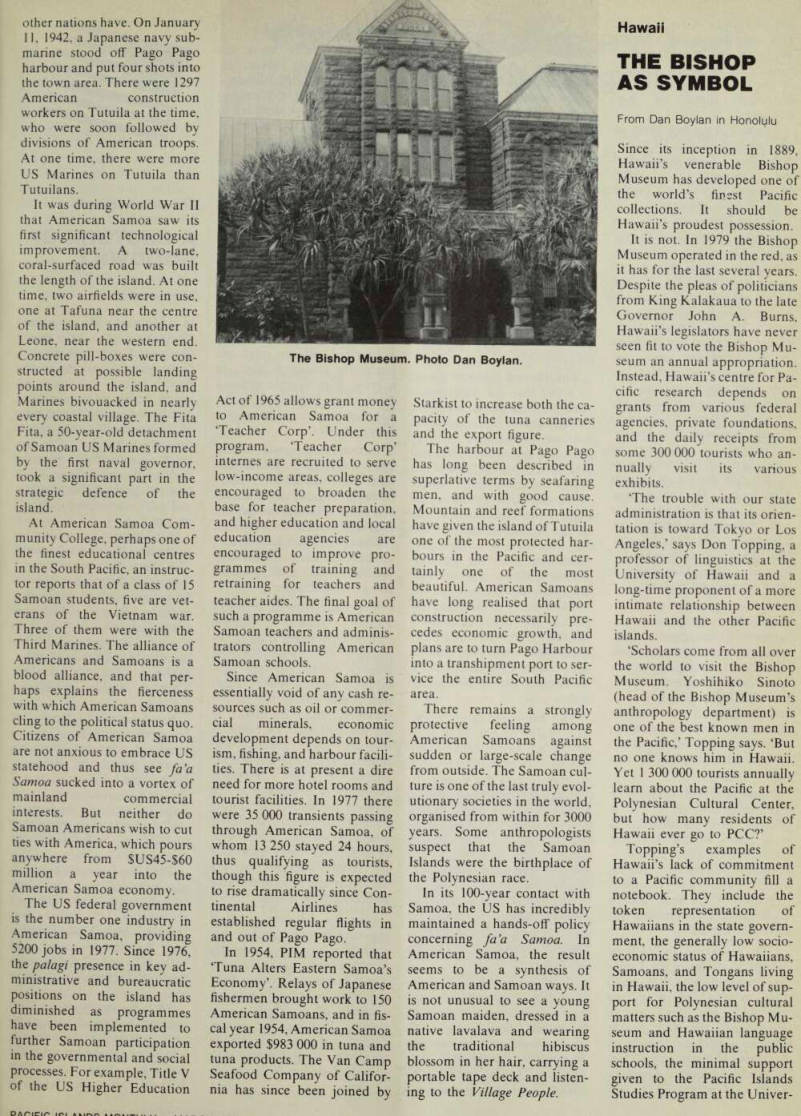
From Dan Boylan in Honolulu Since its inception in 1889, Hawaii’s venerable Bishop Museum has developed one of the world’s finest Pacific collections. It should be Hawaii’s proudest possession.
It is not. In 1979 the Bishop Museum operated in the red, as it has for the last several years.
Despite the pleas of politicians
from King Kalakaua to the late Governor John A. Burns, Hawaii’s legislators have never seen fit to vote the Bishop Mu seum an annual appropriation.
Instead, Hawaii’s centre for Pa cific research depends on grants from various federal
agencies, private foundations,
and the daily receipts from some 300 000 tourists who an nually visit its various exhibits. ‘The trouble with our state administration is that its orien tation is toward Tokyo or Los Angeles,’ says Don Topping, a professor of linguistics at the University of Hawaii and a long-time proponent of a more intimate relationship between Hawaii and the other Pacific islands. ‘Scholars come from all over the world to visit the Bishop Museum. Yoshihiko Sinoto (head of the Bishop Museum’s
anthropology department) is
one of the best known men in the Pacific,’ Topping says. ‘But no one knows him in Hawaii.
Yet 1 300 000 tourists annually leant about the Pacific at the Polynesian Cultural Center, but how many residents of Hawaii ever go to PCC?’
Topping’s examples of
Hawaii’s lack of commitment to a Pacific community fill a notebook. They include the token representation of Hawaiians in the state govern ment, the generally low socio economic status of Hawaiians,
Samoans, and Tongans living
in Hawaii, the low level of sup port for Polynesian cultural matters such as the Bishop Mu seum and Hawaiian language instruction in the public schools, the minimal support given to the Pacific Islands Studies Program at the Univer
sity of Hawaii, the use of the Hawaiian Islands as a store house for armed nuclear war heads, and the state’s sanction of continued boijibings of the Hawaiian island of Ka hoolawe.
Topping is no less harsh in his criticism of the Hawaiian population. T am appalled at the ignorance of local Hawaiians of the rest of the South Pacific,’ he says.
Myron Thompson is a local Hawaiian. He is one of the over 70 000 Hawaiians and part- Hawaiians who make up approximately 10% of the state’s population. He is also a trustee of the Bishop Estate, the
state’s largest private land
owner whose income supports the Kamehameha School for the education of children of Hawaiian ancestry, and a special assistant for the Pacific Islands to Hawaii’s Governor
George Ariyoshi. ‘The Gover
nor’s made it clear that he wants to develop Hawaii’s pos ition within the Pacific Islands
community,’ Thompson says.
‘lt’s true that in the past we’ve had a stronger identification with Japan, China, and Korea.
But there’s a resurgence of interest among Hawaiians in their origins and culture. ‘lt’s not just an Hawaiian renaissance,’ Thompson con tinues. ‘lt’s a renaissance of Pa cific peoples. It’s a renaissance of Maoris, Tongans, Cook Islanders. We have a sense of shared identity. I find that 30 seconds into a conversation with a Maori or a Samoan or any other Pacific Islander, I can lock-in to what they’re say
ing.’
Thompson will need those communication skills. He is
charged with coordinating a
joint effort by the US ‘flag
properties’ in the Pacific Hawaii, American Samoa, Guam, and the Northern Marianas to seek money from the US government for development aid.
The quickening of official Hawaii’s interest in the Pacific has been motivated in no small part by new federal money allocated for the region.
Hawaii and the other Pacific Islands, a 1978 publication of the state’s Department of Plan
ning and Economic Develop
ment, says as much: ‘A new
US Agency for International Development (AID) pro gramme for the region is being developed to supplement the long-standing US commitment to the South Pacific Commis sion . . . More and more high level US officials are taking an interest in the (South Pacific).
Hawaii, as a repository of Pa cific Islands expertise, will be called upon more and more to assist in these forward-looking national programmes for the Pacific. As a state of the Union, Hawaii cannot, of course, con
duct an independent foreign
policy towards the Pacific. But it can and should help US
policy-makers formulate
national policy towards the re gion, and participate in its im plementation.’
The Hawaii planners go on to argue that the state stands ready to lend aid to the other Pacific islands in agriculture, tourism, alternative energy sources, communications, and free trade zones. Indeed, as this report is written, the University of Hawaii’s College of Tropical
Agriculture and the University
of the South Pacific are about to announce a co-operative agreement whereby the Uni versity of Hawaii will adminis ter SUSS million in US aid to the University of the South Pa cific. However pecuniary Hawaii’s renewed interest in the Pacific community may be, its claim as ‘a repository of Pa cific Islands expertise’ is solidly based.
The Bishop Museum main tains a staff of 200, 30 to 40 of whom are professional scien tists at work on various projects in Hawaii and the Pacific. Its collections include rare and old
books, original manuscripts,
and botanical specimens deal ing with Melanesia, Micronesia, and Polynesia.
Edward Creutz, the museum’s director, sees it as the ‘outpost of the United States in the Pa cific with a mission to show the cultural and scientific side of the US to the other Pacific
peoples’.
Since it opened its doors in 1960, the federally funded East-West Center has provided grants of varying types to students from every island group in the Pacific. The entire educated class of some Pacific islands have taken their de
grees at the University of Hawaii on East-West Center grants. In recent years the centre has greatly reduced di rect grants to Pacific Islanders.
But the word out of Washing ton is to give more attention to the Pacific, so the centre is arranging a conference for
Spring, 1980.
On Oahu’s north shore,
Brigham Young Universi
ty/Hawaii enrols approxi
mately 450 students from Tonga, Samoa, New Zealand, Fiji and the Marshall Islands in short, from wherever Mor mon missionaries have evan gelised in the Pacific. The Mormon college also operates the 17 ha Polynesian Cultural Center. Its re-created
Polynesian villages offer the
tourist the chance to dance in a grass skirt, sample coconut meat, or be frightened by the flapping tongue and spear of a Maori warrior.
Honolulu’s two local news papers, the morning Advertiser and the afternoon Star- Bulletin, regularly carry fea tures and editorials about the Pacific. The Advertiser’s editor
in-chief, George Chaplin, and
its associate editor, John Grif fin, have both travelled exten sively in the Pacific.
The University of Hawaii’s Pacific Islands Studies
Program publishes a directory
listing 115 Pacific-related courses offered at the uni
versity’s Manoa Valley cam
pus. It also names 187 faculty members, from historians to marine biologists to horticul turalists, whose teaching and research relate to the Pacific Islands. The Program publishes a newsletter which informs its readers of visiting Pacific Islanders, or academic positions opening in the area,
of significant views expressed
by recent speakers at the university and of local research projects on the Pacific.
Hawaii’s Pacific Island expertise is considerable, but even the state’s greatest booster would admit that a lack of commitment and focus have characterised Hawaii’s role as a member of a Pacific com
munity. Perhaps the combi
nation of an Hawaiian renaissance and Uncle Sam’s abundant dollars will change all that.