Politics Of
pp. 33-35 · Read in the full issue
American Samoa
Synthesis
From Keith Coplin in Pago Pago In the early 19705, when the US Department of Interior sought to implement a proposal for popular elections in American Samoa, voters there rejected the proposal by a plebiscite three times in three successive years. It was not until August 1976, after vigorous campaign ing on the part of local matais (chiefs), that American Samoans agreed to elect a governor, thus ending a 77-year tradition of palagi (white) rule.
The Samoans’ distrust of local rule is based on the 3000year-old heart’s truth which is the bedrock of their society, fa’a Samoa, the Samoan Way.
A native governor is bound by
fa’a Samoa to help his family,
and in Samoa, that can be as many as 500 people; thus there was an understandable fear among Samoan voters that a Samoan governor would nat urally tend toward nepotism.
Another legitimate fear was that whereas a palagi executive officer would at least be deal ing with other palagi when
attempting to secure budget
funds for American Samoa, a Samoan would, most likely, be a stranger in a strange land.
American Samoa finds itself in an odd position during a time of world-wide decolonisa
tion and bankrupt imperialism.
The overwhelming majority of
Samoan Americans favour the political status quo. Of their four viable political options,
remaining an unincorporated
US territory is favoured by an estimated 90% of the elec torate. There is a smattering of support for statehood, and some support for reunification with Western Samoa, but only the young people favour independence. The local power structure seems to understand the realpolitik of American Samoa’s strategic and econ omic importance in the world.
It is significant that no American ships have ever fired on the island of Tutuila, the main island in the American Samoa Group. The ships of
other nations have. On January 11, 1942, a Japanese navy sub marine stood off Pago Pago harbour and put four shots into the town area. There were 1297 American construction workers on Tutuila at the time, who were soon followed by divisions of American troops.
At one time, there were more US Marines on Tutuila than Tutuilans.
It was during World War II that American Samoa saw its
first significant technological
improvement. A two-lane, coral-surfaced road was built the length of the island. At one time, two airfields were in use, one at Tafuna near the centre of the island, and another at Leone, near the western end.
Concrete pill-boxes were con
structed at possible landing
points around the island, and Marines bivouacked in nearly every coastal village. The Fita Fita, a 50-year-old detachment of Samoan US Marines formed by the first naval governor, took a significant part in the strategic defence of the island.
At American Samoa Com
munity College, perhaps one of
the finest educational centres in the South Pacific, an instruc tor reports that of a class of 15 Samoan students, five are vet erans of the Vietnam war.
Three of them were with the Third Marines. The alliance of Americans and Samoans is a blood alliance, and that per
haps explains the fierceness
with which American Samoans cling to the political status quo.
Citizens of American Samoa are not anxious to embrace US statehood and thus see fa’a Samoa sucked into a vortex of mainland commercial interests. But neither do Samoan Americans wish to cut ties with America, which pours anywhere from SUS4S-$6O million a year into the American Samoa economy.
The US federal government is the number one industry in American Samoa, providing 5200 jobs in 1977. Since 1976, the palagi presence in key ad ministrative and bureaucratic positions on the island has diminished as programmes have been implemented to further Samoan participation in the governmental and social processes. For example, Title V of the US Higher Education
Act of 1965 allows grant money to American Samoa for a ‘Teacher Corp’. Under this program, Teacher Corp’ internes are recruited to serve low-income areas, colleges are encouraged to broaden the base for teacher preparation, and higher education and local education agencies are encouraged to improve pro grammes of training and retraining for teachers and teacher aides. The final goal of such a programme is American Samoan teachers and adminis trators controlling American Samoan schools.
Since American Samoa is essentially void of any cash re sources such as oil or commer cial minerals, economic
development depends on tour
ism, fishing, and harbour facili ties. There is at present a dire need for more hotel rooms and tourist facilities. In 1977 there were 35 000 transients passing through American Samoa, of whom 13 250 stayed 24 hours, thus qualifying as tourists, though this figure is expected to rise dramatically since Con tinental Airlines has
established regular flights in
and out of Pago Pago.
In 1954, PIM reported that ‘Tuna Alters Eastern Samoa’s
Economy’. Relays of Japanese
fishermen brought work to 150 American Samoans, and in fis cal year 1954, American Samoa exported $983 000 in tuna and tuna products. The Van Camp Seafood Company of Califor nia has since been joined by
Starkist to increase both the ca pacity of the tuna canneries and the export figure.
The harbour at Pago Pago has long been described in superlative terms by seafaring men, and with good cause.
Mountain and reef formations have given the island of Tutuila one of the most protected har bours in the Pacific and cer tainly one of the most beautiful. American Samoans have long realised that port construction necessarily pre cedes economic growth, and plans are to turn Pago Harbour into a transhipment port to ser vice the entire South Pacific area.
There remains a strongly protective feeling among American Samoans against
sudden or large-scale change
from outside. The Samoan cul ture is one of the last truly evol utionary societies in the world, organised from within for 3000 years. Some anthropologists suspect that the Samoan Islands were the birthplace of the Polynesian race.
In its 100-year contact with Samoa, the US has incredibly maintained a hands-off policy concerning fa’a Samoa. In American Samoa, the result seems to be a synthesis of American and Samoan ways. It is not unusual to see a young Samoan maiden, dressed in a native lavalava and wearing the traditional hibiscus blossom in her hair, carrying a portable tape deck and listen ing to the Village People.
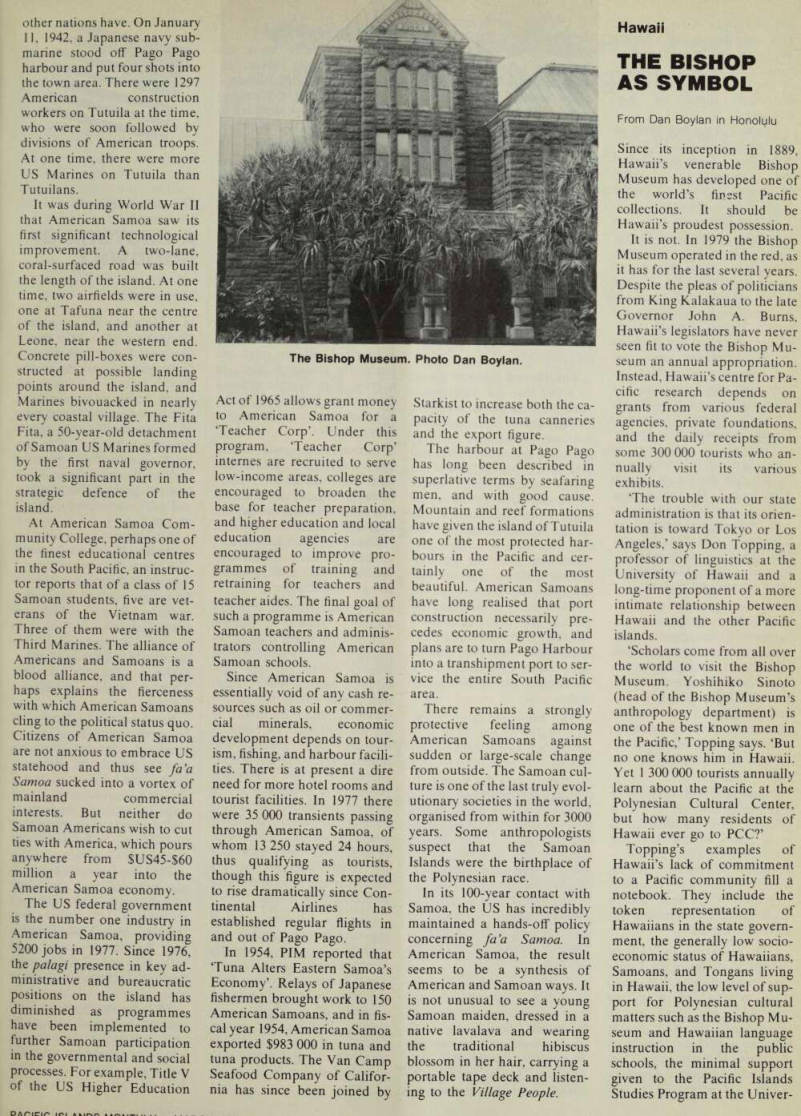
The Bishop Museum. Photo Dan Boylan.