of Americans
pp. 22-23 · Read in the full issue
Eastern Polynesia Wave upon wave of Americans
By Marie-Therese and Bengt Danielsson, in Papeete
Of all the countless popa’a (the word the Tahitians have coined to denote white foreigners) who have been washed up, like drifting seeds and nuts, on the shores of the lush islands in Eastern Polynesia, a high percentage, if not most, have always been Americans. The most obvious explanation the proximity, and the 'slooping’ Pacific, facilitating down wind voyages from California is not entirely satisfying, since the movement began when this state had no population to speak of and had not yet become part of the Union. So let us rather attribute it to what is usually and quite vaguely called ‘the American pioneering spirit’. However this may be, for more than 200 years the Yankees have been arriving in the islands, in wave upon wave, each one throwing up a new variety of the genus homo americanus.
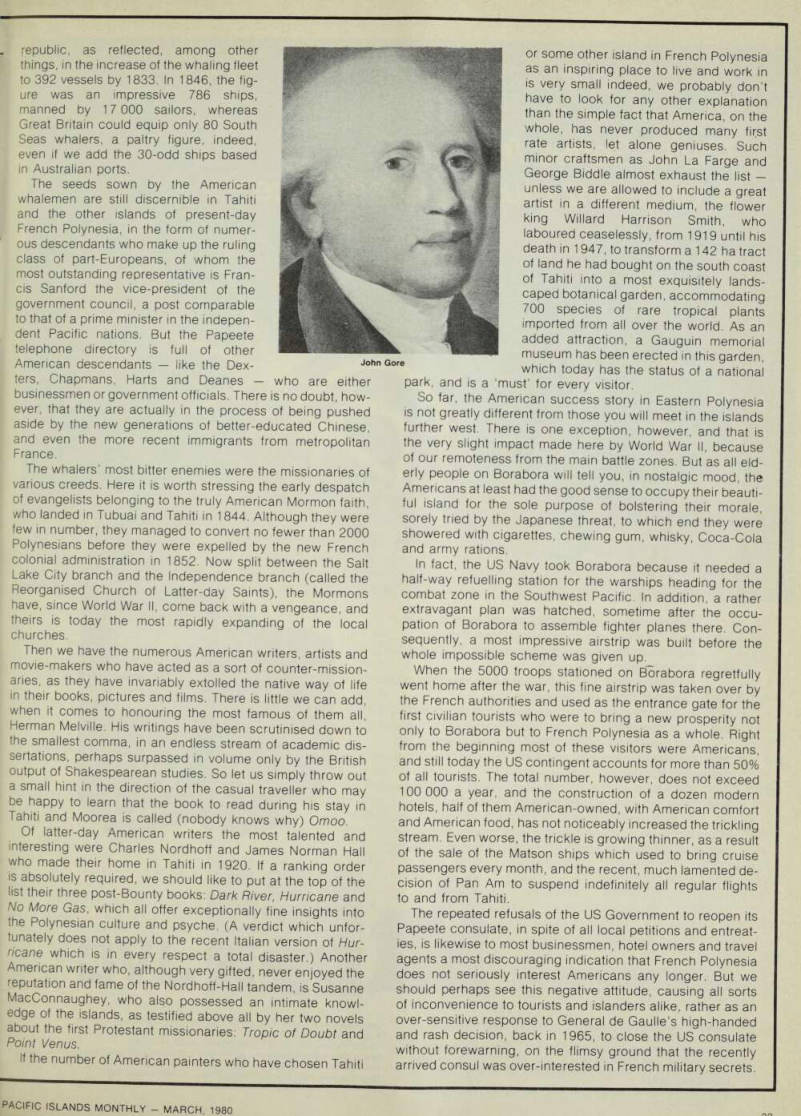
The first American arrived in Tahiti even before 1776 and was thus formally an Englishman. His name was John Gore and he was one of the master’s mates on the Dolphin, when Samuel Wallis discovered the island in 1767. Incredibly enough, this was Gore’s second circumnavigation of the globe, as he had already two years earlier served under Commodore Byron, who was less lucky, since he sighted only a few worthless atolls. Because of his previous experiences and his personal qualities, Gore, now promoted to third lieutenant, was again chosen by Captain Cook to accompany him during his first voyage. Having become a favourite of Joseph Banks, he missed the second voyage, but returned once more with Cook to Tahiti in 1777, during the third voy age. His supreme moment came, when, after the deaths of Cook and Clerke, he took over the expedition and sailed the two ships back to England by then a foreign country for him.
Incidentally, the US bicentenary committee badly missed the opportunity to honour this remarkable and completely for gotten American, who, after Cook’s death, was the world’s foremost authority on the Pacific. Another American explorer who has been allowed to slip into oblivion is Charles Wilkes, the commander of the scandal-plagued US Exploring Expedi tion, 1838-42, which did a particularly fine job of surveying and gathering information about the little-known Tuamotu islands.
In the meantime, Eastern Polynesia had become not only the happy hunting ground for American whalemen but their favourite playground as well. Since it took several years to fill all the barrels in the hold with oil, the crews were now and then sent ashore for what the modern US navy prudishly calls Test and recreation’. The preferred vacation spots were, of course, islands with a safe anchorage, plenty of provisions and an abundance of warm, willing women, and this meant above all the Society and the Marquesas islands.
In 1811, the number of American whalers operating in the Pacific was 53, well below the British figure. Many were de stroyed during the 1812-15 war by the far superior Royal Navy, but then again the famous Captain Porter captured about a dozen English ships and moreover built a fortified village on Nukuhiva of which he formally took possession.
After the war, trade and industries flourished in the young
republic, as reflected, among other things, in the increase of the whaling fleet to 392 vessels by 1833. In 1846, the fig ure was an impressive 786 ships, manned by 17 000 sailors, whereas Great Britain could equip only 80 South Seas whalers, a paltry figure, indeed, even if we add the 30-odd ships based in Australian ports.
The seeds sown by the American whalemen are still discernible in Tahiti and the other islands of present-day French Polynesia, in the form of numer ous descendants who make up the ruling class of part-Europeans, of whom the most outstanding representative is Fran cis Sanford the vice-president of the government council, a post comparable to that of a prime minister in the indepen dent Pacific nations. But the Papeete telephone directory is full of other American descendants like the Dex
ters, Chapmans, Harts and Deanes who are either businessmen or government officials. There is no doubt, how ever, that they are actually in the process of being pushed aside by the new generations of better-educated Chinese, and even the more recent immigrants from metropolitan France.
The whalers’ most bitter enemies were the missionaries of various creeds. Here it is worth stressing the early despatch of evangelists belonging to the truly American Mormon faith, who landed in Tubuai and Tahiti in 1844. Although they were few in number, they managed to convert no fewer than 2000 Polynesians before they were expelled by the new French colonial administration in 1852. Now split between the Salt Lake City branch and the Independence branch (called the Reorganised Church of Latter-day Saints), the Mormons have, since World War 11, come back with a vengeance, and theirs is today the most rapidly expanding of the local churches.
Then we have the numerous American writers, artists and movie-makers who have acted as a sort of counter-mission aries, as they have invariably extolled the native way of life in their books, pictures and films. There is little we can add, when it comes to honouring the most famous of them all, Herman Melville. His writings have been scrutinised down to the smallest comma, in an endless stream of academic dis sertations, perhaps surpassed in volume only by the British output of Shakespearean studies. So let us simply throw out a small hint in the direction of the casual traveller who may be happy to learn that the book to read during his stay in Tahiti and Moorea is called (nobody knows why) Omoo.
Of latter-day American writers the most talented and interesting were Charles Nordhoff and James Norman Hall who made their home in Tahiti in 1920. If a ranking order is absolutely required, we should like to put at the top of the list their three post-Bounty books: Dark River, Hurricane and No More Gas, which all offer exceptionally fine insights into the Polynesian culture and psyche. (A verdict which unfor tunately does not apply to the recent Italian version of Hur ricane which is in every respect a total disaster.) Another American writer who, although very gifted, never enjoyed the reputation and fame of the Nordhoff-Hall tandem, is Susanne MacConnaughey. who also possessed an intimate knowl edge of the islands, as testified above all by her two novels about the first Protestant missionaries: Tropic of Doubt and Point Venus.
If the number of American painters who have chosen Tahiti
or some other island in French Polynesia as an inspiring place to live and work in is very small indeed, we probably don’t have to look for any other explanation than the simple fact that America, on the whole, has never produced many first rate artists, let alone geniuses. Such minor craftsmen as John La Farge and George Biddle almost exhaust the list unless we are allowed to include a great artist in a different medium, the flower king Willard Harrison Smith, who laboured ceaselessly, from 1919 until his death in 1947, to transform a 142 ha tract of land he had bought on the south coast of Tahiti into a most exquisitely lands caped botanical garden, accommodating 700 species of rare tropical plants imported from all over the world. As an added attraction, a Gauguin memorial museum has been erected in this garden, which today has the status of a national
park, and is a ‘must’ for every visitor.
So far, the American success story in Eastern Polynesia is not greatly different from those you will meet in the islands further west. There is one exception, however, and that is the very slight impact made here by World War 11, because of our remoteness from the main battle zones. But as all eld erly people on Borabora will tell you, in nostalgic mood, the Americans at least had the good sense to occupy their beauti ful island for the sole purpose of bolstering their morale, sorely tried by the Japanese threat, to which end they were showered with cigarettes, chewing gum, whisky, Coca-Cola and army rations.
In fact, the US Navy took Borabora because it needed a half-way refuelling station for the warships heading for the combat zone in the Southwest Pacific. In addition, a rather extravagant plan was hatched, sometime after the occu pation of Borabora to assemble fighter planes there. Con sequently, a most impressive airstrip was built before the whole impossible scheme was given up.
When the 5000 troops stationed on Borabora regretfully went home after the war, this fine airstrip was taken over by the French authorities and used as the entrance gate for the first civilian tourists who were to bring a new prosperity not only to Borabora but to French Polynesia as a whole. Right from the beginning most of these visitors were Americans, and still today the US contingent accounts for more than 50% of all tourists. The total number, however, does not exceed 100 000 a year, and the construction of a dozen modern hotels, half of them American-owned, with American comfort and American food, has not noticeably increased the trickling stream. Even worse, the trickle is growing thinner, as a result of the sale of the Matson ships which used to bring cruise passengers every month, and the recent, much lamented de cision of Pan Am to suspend indefinitely all regular flights to and from Tahiti.
The repeated refusals of the US Government to reopen its Papeete consulate, in spite of all local petitions and entreat ies, is likewise to most businessmen, hotel owners and travel agents a most discouraging indication that French Polynesia does not seriously interest Americans any longer. But we should perhaps see this negative attitude, causing all sorts of inconvenience to tourists and islanders alike, rather as an over-sensitive response to General de Gaulle’s high-handed and rash decision, back in 1965, to close the US consulate without forewarning, on the flimsy ground that the recently arrived consul was over-interested in French military secrets.
John Gore