Honolulu
pp. 19-22 · Read in the full issue
Cook Islands
Far Away
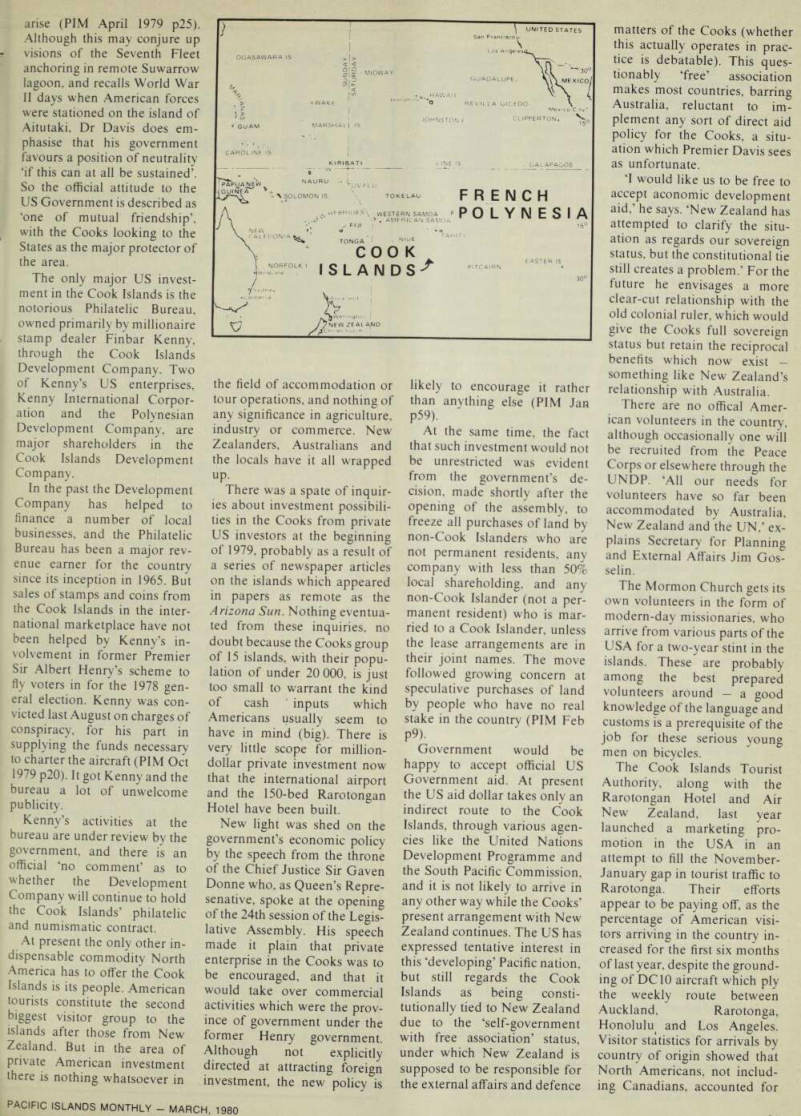
From Karen Garner-Williams in Rarotonga The attitude of the Cook Islands Government towards the Government of the United States is ambivalent. On one hand Premier Tom Davis and his colleagues view the US as the Big Brother of the South Pacific region in defence affairs, but on the other they share a Pacific-wide disap proval of American plans to dump nuclear waste on its island territories. ‘Everybody would like the Pacific to be a neutral zone,’ says Dr Davis. ‘However, if there is an emergency in which the Cook Islands is threatened along with other Pacific coun tries, the Cook Islands would welcome the protection of the parties to the ANZUS treaty and will offer whatever facilities and other assistance it can.’ In fact, it’s not so long ago that Dr Davis was down in
Wellington offering forces, and
real estate with deepwater har bours and airfields, to New Zealand foreign affairs officials should an emergency
arise (PIM April 1979 p 25).
Although this may conjure up visions of the Seventh Fleet anchoring in remote Suwarrow lagoon, and recalls World War II days when American forces were stationed on the island of Aitutaki, Dr Davis does em phasise that his government favours a position of neutrality ‘if this can at all be sustained’.
So the official attitude to the US Government is described as ‘one of mutual friendship’, with the Cooks looking to the States as the major protector of the area.
The only major US invest ment in the Cook Islands is the notorious Philatelic Bureau,
owned primarily by millionaire
stamp dealer Finbar Kenny, through the Cook Islands
Development Company. Two
of Kenny’s US enterprises, Kenny International Corpor ation and the Polynesian
Development Company, are
major shareholders in the Cook Islands Development
Company.
In the past the Development
Company has helped to
finance a number of local businesses, and the Philatelic Bureau has been a major rev enue earner for the country since its inception in 1965. But sales of stamps and coins from the Cook Islands in the inter national marketplace have not
been helped by Kenny’s in
volvement in former Premier Sir Albert Henry’s scheme to fly voters in for the 1978 gen eral election. Kenny was con victed last August on charges of conspiracy, for his part in supplying the funds necessary to charter the aircraft (PIM Oct 1979 p2O). It got Kenny and the bureau a lot of unwelcome
publicity.
Kenny’s activities at the bureau are under review by the government, and there is an official ‘no comment’ as to whether the Development Company will continue to hold the Cook Islands’ philatelic and numismatic contract.
At present the only other in
dispensable commodity North
America has to offer the Cook Islands is its people. American tourists constitute the second biggest visitor group to the islands after those from New Zealand. But in the area of private American investment there is nothing whatsoever in
* ia c j the field of accommodation or tour operations, and nothing of any significance in agriculture. industry or commerce. New Zealanders, Australians and the locals have it all wrapped U There was a spate of mquirles about investment possibilities m the Cooks from private US investors at the beginning of 1979, probably as a result of a series of newspaper articles on the islands which appeared in papers as remote as the Arizona Sun. Nothing eventuated from these inquiries, no doubt because the Cooks group of 15 islands, with their population of under 20 000, is just too small to warrant the kind of cash inputs which Americans usually seem to have in mind (big). There is very little scope for milliondollar private investment now that the international airport and the 150-bed Rarotongan Hotel have been built.
New light was shed on the government’s economic policy by the speech from the throne of the Chief Justice Sir Gaven Donne who, as Queen’s Represenative, spoke at the opening of the 24th session of the Legislative Assembly. His speech made it plain that private enterprise in the Cooks was to be encouraged, and that it would take over commercial activities which were the province of government under the former Henry government,
Although not explicitly
directed at attracting foreign
mvestment, the new policy is
, likely to encourage it rather than anything else (PIM Jan P 59).
At the same time, the fact that such investment would not be unrestricted was evident from the government’s de cision, made shortly after the opening of the assembly, to freeze all purchases of land by non-Cook Islanders who are not permanent residents, any company with less than 50% local shareholding, and any non-Cook Islander (not a per manent resident) who is mar ried to a Cook Islander, unless the lease arrangements are in their joint names. The move followed growing concern at speculative purchases of land by people who have no real stake in the country (PIM Feb p 9).
Government would be happy to accept official US Government aid. At present the US aid dollar takes only an indirect route to the Cook Islands, through various agen cies like the United Nations Development Programme and the South Pacific Commission, and it is not likely to arrive in any other way while the Cooks’ present arrangement with New Zealand continues. The US has expressed tentative interest in this ‘developing’ Pacific nation, but still regards the Cook Islands as being consti tutionally tied to New Zealand due to the ‘self-government with free association’ status, under which New Zealand is supposed to be responsible for the external affairs and defence
matters of the Cooks (whether this actually operates in prac tice is debatable). This ques tionably ‘free’ association makes most countries, barring Australia, reluctant to im plement any sort of direct aid policy for the Cooks, a situ ation which Premier Davis sees as unfortunate.
T would like us to be free to accept aconomic development aid,’ he says. ‘New Zealand has attempted to clarify the situ ation as regards our sovereign status, but the constitutional tie still creates a problem.’ For the future he envisages a more clear-cut relationship with the old colonial ruler, which would give the Cooks full sovereign status but retain the reciprocal benefits which now exist something like New Zealand’s relationship with Australia.
There are no offical Amer ican volunteers in the country,
although occasionally one will
be recruited from the Peace Corps or elsewhere through the UNDP. ‘All our needs for volunteers have so far been accommodated by Australia, New Zealand and the UN,’ ex
plains Secretary for Planning
and External Affairs Jim Gos selin.
The Mormon Church gets its own volunteers in the form of modern-day missionaries, who arrive from various parts of the USA for a two-year stint in the islands. These are probably among the best prepared volunteers around a good knowledge of the language and customs is a prerequisite of the job for these serious young men on bicycles.
The Cook Islands Tourist
Authority, along with the
Rarotongan Hotel and Air New Zealand, last year launched a marketing pro motion in the USA in an attempt to fill the November- January gap in tourist traffic to Rarotonga. Their efforts appear to be paying off, as the percentage of American visi tors arriving in the country in creased for the first six months of last year, despite the ground ing of DC 10 aircraft which ply the weekly route between
Auckland, Rarotonga,
Honolulu and Los Angeles.
Visitor statistics for arrivals by country of origin showed that North Americans, not includ ing Canadians, accounted for
12.5% of total arrivals, second after the inevitable droves of New Zealanders.
But the 1000-odd Americans were relatively unobtrusive.
Tourist Authority manager lan Fogelberg puts it this way: ‘There is no doubt that the American tourists who come here are not the archetypal loud, camera-toting “Yankee Tourist” types. They tend to be a little more adventurous, defi nitely in the upper end of the income bracket, quite inter ested and well-mannered, usually well travelled, and looking for a different experi ence.’ This off-the-beaten track image is the one that the promoters are pushing in the
Usa.
Despite its long isolation
from the major travel routes, a fair number of Americans have managed to find their way to the Cook Islands and are now
living, working and marrying
locally. Many of these are the
predictable refugees from what
they consider to be the undesirability of the American way of life. Since the time of Charles Wells Banks, who ab sconded to the Cook Islands with $2O 000 in cash from the San Francisco branch of the Wells Fargo Bank, where he worked as a clerk until 1886, Americans have been ‘getting away from it all’ in this spot which is even more distant than
legendary Tahiti.
One of the better known of these is the artist Rick Welland, who has lived in Rarotonga since the early 1960 s and earns his bread painting local land scapes and island maidens.
There is a sprinkling of Americans working in the pub lic service and in business, and they appear to integrate with ease into the local community.
Cook Islanders certainly do not regard them as a group, although it would be a fairly accurate generalisation to say that Cook Islanders tend to be very accepting of outsiders, judging them on their merits.
American involvement in the Cooks is minimal in com parison to its role in many other Pacific countries, a situ ation that is applauded by many islands residents.
Whether this will continue to be the case remains to be seen.
Already the Cook Islands
imports ‘a little bit of every thing’ from the USA. while, conversely, exports from the Cooks to the US have been negligible, apart from a tiny amount of handcrafts and the occasional dance troupe. A
new and encouraging sign
appeared however last Decem ber when the US Department of Agriculture approved the entry into the USA of Cook Islands freyh pineapple, taro and tarua. The items are the first from a list of Cooks pro duce sent to the USDA by Dr Davis to be given the go-ahead.
A spokesman for the Cooks
Ministry of Agriculture de
scribed the development as ‘a useful start’, and voiced the hope that other products would gain right of entry. He men tioned pawpaw in particular
(PIM Feb p 59).
It is perhaps interesting to note that Dr Davis lived in the USA for nearly 20 years, work ing in space medicine. Dr Davis describes the USA as ‘a country whose greatest virtue, in my personal opinion, is its freedom to allow individual endeavour... it allows per sonal initiative to blossom whether it be in business, in academic life, or in social re
lationships. but particularly in
placing high value on individual ability and endeavour.’
Ironically, he sees Cook
Islanders beginning to adopt
one of the less desirable characteristics of the American way of life, which is very much bound up with achievement and self-reliance namely, higher stress. He maintains that the individual Cook Islander is
quick to perceive opportunities
for advancement, citing the considerable local involvement in the tourist industry and the recent boom in market garden ing, and he mentions the high value which is placed on edu cation as a means to greater achievement. ‘Per unit of population I believe we have one of the highest percentages of professionally and tech nically trained people in the Pacific,’ he told me. implying that stress is a natural concomi tant.
Still, here in the Cooks, it is a far cry from life in downtown Honolulu or even Pago Pago.
No doubt most people hope it will stay that way.