Deaths
p. 73 · Read in the full issue
of Islands People
Carlos Garcia
Camacho
tarlos Garcia Camacho, 55, [the last appointed governor of puam (1969-70) and the first elected governor of the island 1971-1974), died at the Medi al Center of the Marianas, juam, in December. Gov. 2amacho, a dentist, made three trips to Vietnam where he
delivered Christmas greetings
from folks at home via video tape to Guamanians in American military units in the war zone.
The son of the late Judge Felix Camacho, he is survived by his mother, his widow Lourdes, six sons and a daught er. Carlos Camacho was one )f the founders of the Republi :an Party on Guam, and is not o be confused with the gover tor of the Northern Marianas, vho has the same name.
Akaita Ponga
At Virua, Mangia, Cook Islands, in late November 1979.
Mrs Akaiti Ponga had lived all her life on Mangia. She is sur vived by her husband Akaiti, and 15 children. She was the loving grandmother of more than 60 grandchildren, 50 great grandchildren and two great
great grandchildren.
Rex Mortimer
In Sydney, Australia, on December 31, aged 53. Pro fessor Mortimer held the chair of political studies at the
University of Papua New
Guinea for the three years 1974-76. At the time of his death he was an associate pro fessor in the Department of Government and Public Ad ministration at the University
of Sydney.
Brahamanand Ragh
Vanand
Brahamanand Raghvanand,
former member of the Fiji Legislative Council and a leader of the Indian com
munity in Fiji, aged 87. After
education in Fiji and New Zealand he joined the Fiji civil service and became Assistant Native Lands Commissioner under the late Ratu Sir Lala Sukuna.
Lesatele Rapi
Western Samoa’s longest serv ing Member of Parliament, Lesatele Rapi, died suddenly in December after collapsing out side the Fono House at Mulinuu. His death at the National Hospital at the age of 70 came on the 68th birthday of his brother, Vaai Kolone, also an MP. He began his parliamentary career in 1948, and had served as Minister of Public Works and Minister of Lands and Survey, and was Minister of Broadcasting when he died. He leaves a widow, Tiresa, and 12 children.
Kau Mapu
Holder of the title of Tearikivao Putokotoko Pareraka Mataiapo, and direct descendant of several Ariki families, suddenly at his home on Aitutaki in the Cook Islands on November 20 at the age of 72. He was in the Public Works for 21 years and served as rep resentative of Aitutaki in par liament for 43 years.
He gave SPC
its thrust
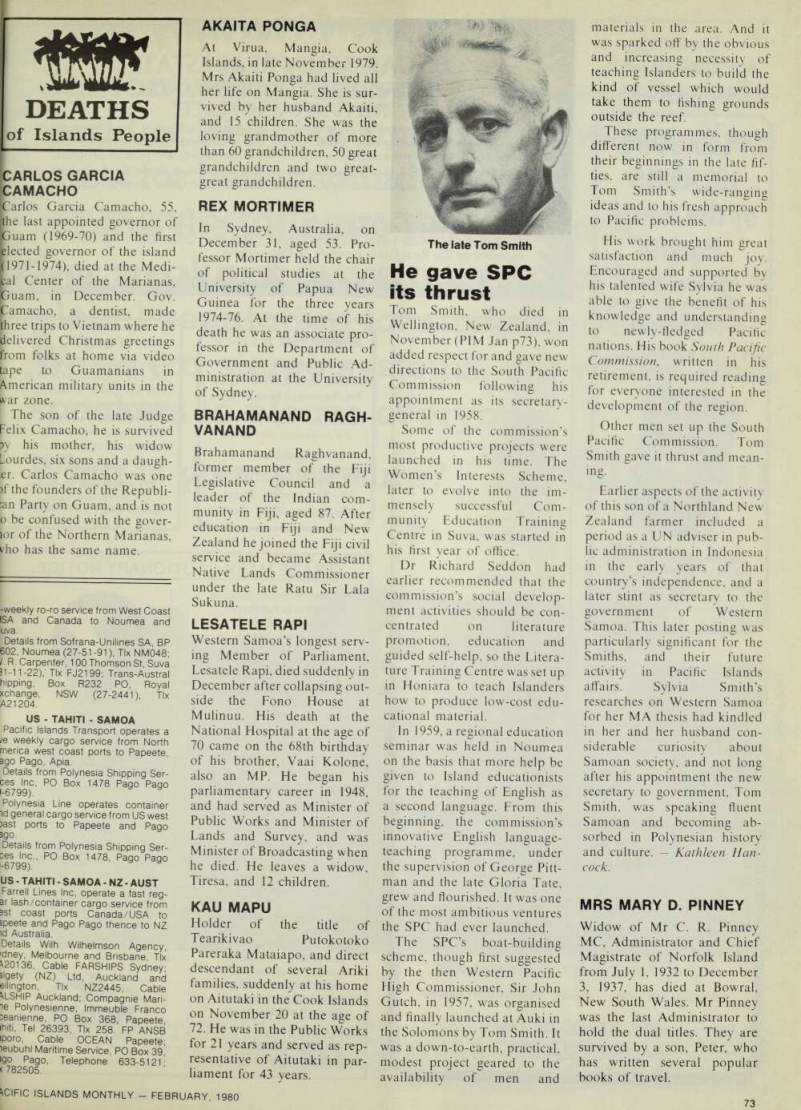
Tom Smith, who died in Wellington. New Zealand, in November (PIM Jan p 73), won added respect for and gave new directions to the South Pacific Commission following his appointment as its secretary general in 1958.
Some of the commission’s most productive projects were launched in his time. The Women’s Interests Scheme, later to evolve into the im mensely successful Com
munity Education Training
Centre in Suva, was started in his first year of office.
Dr Richard Seddon had earlier recommended that the commission’s social develop ment activities should be con centrated on literature promotion, education and guided self-help, so the Litera ture Training Centre was set up in Honiara to teach Islanders how to produce low-cost edu cational material.
In 1959, a regional education seminar was held in Noumea on the basis that more help be given to Island educationists for the teaching of English as a second language. From this beginning, the commission’s
innovative English language
teaching programme, under the supervision of George Pitt man and the late Gloria Tate, grew and flourished. It was one of the most ambitious ventures the SPC had ever launched.
The SPC’s boat-building
scheme, though first suggested
by the then Western Pacific High Commissioner, Sir John Gutch, in 1957, was organised and finally launched at Auki in the Solomons by Tom Smith. It was a down-to-earth, practical, modest project geared to the availability of men and
materials in the area. And it was sparked off by the obvious
and increasing necessity of
teaching Islanders to build the kind of vessel which would take them to fishing grounds outside the reef.
These programmes, though different now in form from their beginnings in the late fif ties, are still a memorial to Tom Smith’s wide-ranging ideas and to his fresh approach to Pacific problems.
His work brought him great satisfaction and much joy.
Encouraged and supported by
his talented wife Sylvia he was able to give the benefit of his
knowledge and understanding
to newly-fledged Pacific nations. His book South Pacific Commission, written in his retirement, is required reading for everyone interested in the
development of the region.
Other men set up the South Pacific Commission. Tom Smith gave it thrust and mean
ing.
Earlier aspects of the activity of this son of a Northland New Zealand farmer included a period as a UN adviser in pub lic administration in Indonesia in the early years of that
country’s independence, and a
later stint as secretary to the government of Western Samoa. This later posting was
particularly significant for the
Smiths, and their future activity in Pacific Islands affairs. Sylvia Smith’s researches on Western Samoa for her MA thesis had kindled in her and her husband con siderable curiosity about Samoan society, and not long after his appointment the new secretary to government, Tom Smith, was speaking fluent Samoan and becoming ab
sorbed in Polynesian history
and culture. Kathleen Han cock.
Mrs Mary D. Pinney
Widow of Mr C. R. Pinney MC, Administrator and Chief Magistrate of Norfolk Island from July 1, 1932 to December 3, 1937, has died at Bowral, New South Wales. Mr Pinney was the last Administrator to hold the dual titles. They are survived by a son, Peter, who has written several popular books of travel.
The late Tom Smith