Guadalcanal
pp. 52-55 · Read in the full issue



Tradewinds
A new ‘battle’ is raging on Guadalcanal
A PIM correspondent in Honiara reports on the ‘new battle of GuadalcanaP a fight to ensure proper safeguards against possible damage to human health and to other food crops posed by aerial crop-dusting operations carried out on the Brewer Solomons Associates rice plantations on the Guadal canal Plains.
A plane flies low over the old Koli and Carney airstrips. It circles just above the coconut palms along the notorious Red Beach and then sweeps low over the Guadalcanal Plains to
discharge its death-dealing
cargo.
This time the cargo is not a rack of 500-pound bombs aimed at Japanese troops, but instead pesticides and herbi cides aimed at the agricultural pests and weeds which have the
audacity to interfere with the intensive (and lucrative) rice growing endeavours of the multi-national Brewers in part nership with the Solomon Islands Government (Brewers Solomons Associates, or BSA) on the plains.
All this would be fine if a full, in-depth environmental, public health, and sociological survey had been done from the beginning of the pesticide-
spraying exercise. That is, if such an inquiry had established the full effects of the enterprise on the health and living con ditions of the population of the Guadalcanal Plains before the
project was begun.
However, at a meeting in Honiara on September 14, 1979, the Senior Health Minis ter Mr T. Lolemae, and the local World Health Organis ation representative (Sanita tion/Health) Mr J. Hazbun, both admitted that this had not been done, and that sub sequently a serious situation had been inherited.
The initial realisation of the possible serious social effects of the ricefield extensions on the plains was expressed in questions raised by the pre vious headmaster and staff of the Church of Melanesia School, Selwyn College, as far back as 1974.
A planned extension in the ricefields of about 1000 ha around Okea was announced.
About 30 ha of this extension would be adjacent to the build ings and gardens of the school, and the village Ngalimera.
Such factors as the toxicity of the spray, and its effects on humans (possible inducement of cancer, sterility, malfor mation of newborn children, etc), and on ground water supplies, were raised. The poss ible effects of the herbicides, which were known to destroy crops common to the village and school gardens were dis cussed, along with the noise nuisance of the cultivators, graders, tractors, low-flying aircraft, and so on. Also dis cussed was the known fact that
the paddy fields inrease the mosquito population in an area where the incidence of malaria
is already very high by world
standards. ‘Round table talks’ were begun with BSA and Selwyn College staff representatives.
But the feeling gradually de
veloped among the college
staff that the BSA consortium had in fact set itself up as de fendant, judge and jury all in one.
As a consequence, the staff put a motion before the Church of Melanesia synod of October 4 expressing the hope that the Christian concern and status of this body would assist in the establishment of a full
and intensive investigation by
the WHO, using staff expert in these matters, to safeguard the health and living standards of present and future generations of people living on the Guadal canal Plains.
However, the project foun dered due to the efforts of a very senior member of the college staff who, as a lay mem ber of the synod, contrived to have the motion amended to the extent that the BSA was left j securely in the position of ‘de- 1 fendant, judge and jury all in one’.
Late in October feelings ran high among the staff since 1 genuine efforts to put the mat- ; ter right had been aborted. The
general hush-hush, keep-it-in
the-family approach of the “ BSA, with its promises of‘more round table talks’, has given
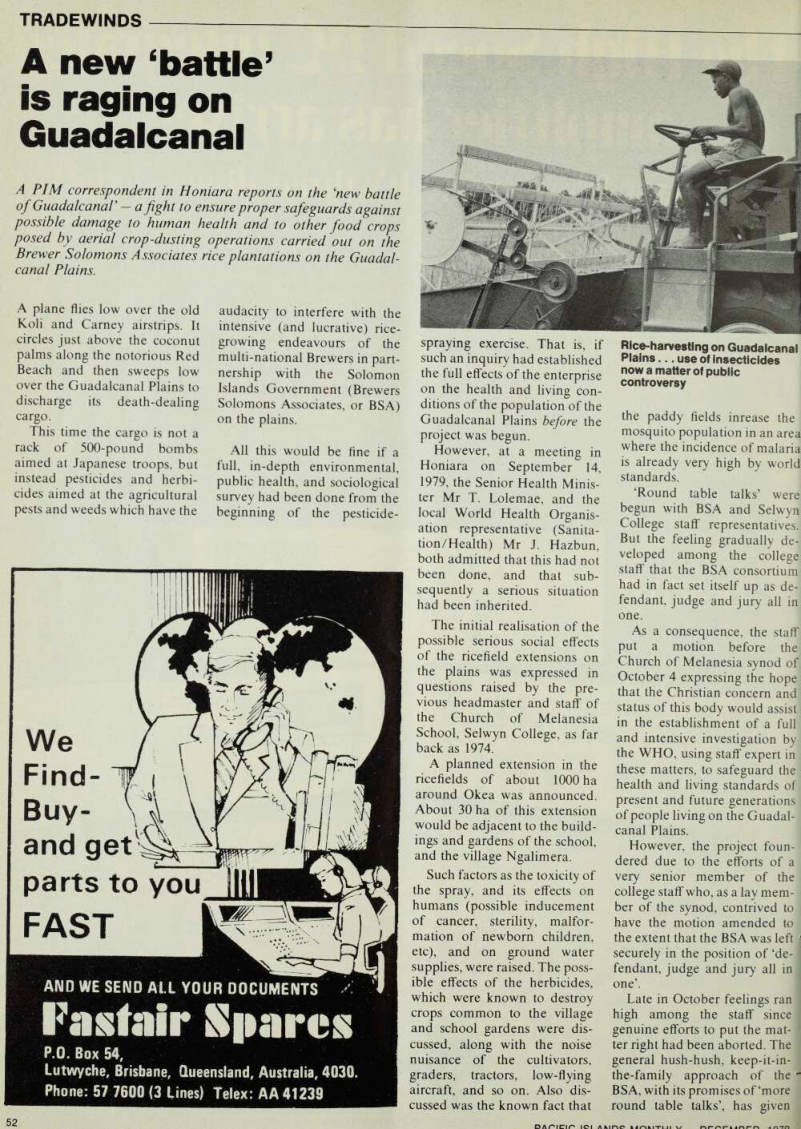
Rice-harvesting on Guadalcanal Plains... use of insecticides now a matter of public controversy
ise to a feeling of grave dis quiet about the outcome of the Tattle and the subsequent effects on the welfare of the Teople of the Guadalcanal Plains.
Fiji Gets
U.S. Advice
riji should work towards closer ;conomic ties with Asian coun ries and not just Australia and Mew Zealand, according to American economist Professor Teorge Viksnins, who made a bur-day visit to Fiji in October mder the auspices of the US Dovernment.
Professor Viksnins, who caches economics at George own University in Washington DC, thinks the Asian area ould be exploited by Fiji,
Korea, Singapore, Hong
Cong, Malaysia and Thailand
ire rapidly developing indus
rial countries ... I’m sure that hey would be interested in riji’s raw materials,’ he said.
T think that Fiji is a pretty dable country in terms of natu al resources. There’s plenty of vater and sunshine and the xmntry has a well developed nfrastructure. ‘At the moment Australia md New Zealand think excess vely of the European market, riji, despite its strong links vith Britian, should begin to hink about the “Pacific Economy”.
He said the Pacific Economy tad already outstripped the
Vtlantic Economy, and Fiji
vould be wise to capitalise on his development. To do this, it hould concentrate on the levelopment of agriculture md mineral resources. ‘lt would make a lot of sense o develop copper,’ he sug gested.
The price of copper was 'oing to rise considerably, as it
lad not yet fully participated in
he basic upward trend of
vorld prices of minerals.
What about the soaring price
)f gold and therefore Fiji’s
:hances of making money from
'old again?
The professor could not say vhat Fiji stood to make out of he gold boom, but he was ceptical about the valuable netal. ‘The price of gold is going to
come down sharply in the next year.’ he predicted. ‘I think that the price will be below SUS3OO an ounce within a year.’
Professor Viksnins acts as a consultant to investment bankers L. R. Rothschild, Unterberg and Towbin.
Visiting Fiji under the US Government’s ‘Specialist Pro
gramme,’ the professor took
part in lectures and discussions with University of the South Pacific students and govern ment officials.
French Talk
On The Sea
Some 280 delegates attended the Conference on the Sea held by the French Government re cently in Noumea. The meet
ing was organised and opened
by Paul Dijoud, Minister for Overseas Territories. Par ticipants included defence per sonnel, administrators and politicians from New Caledonia, Tahiti and Wallis and Futuna, as well as scientists and industrial representatives from France and several
foreign observers.
Now that the 200-mile econ omic zone has made France the third largest marine power,
Paul Dijoud emphasised the
mineral and energy potential of French waters in the Pacific.
Mr Dijoud also stressed the im portance of the Pacific terri tories for the spreading of French influence right to the antipodes. The French Terri tories Minister said ‘the sea offers an extraordinary domain for combat and involvement’.
Fie said the main aim of the Noumea conference was to suggest to Paris the chief areas to be explored over the next 10 or 20 years. This would entail the drawing up of various agreements between metro politan France and the Pacific territories. This raised the
problem, stressed by the
Polynesians, of the overlapping
power of France and the terri tories in control of the wealth of the sea.
The Noumea meeting fol lowed another conference earlier this year organised by Paul Dijoud in Tahiti, to dis cuss tourist strategies in the French Pacific. The Polynesian government councillor respon
sible for tourism, Alec Ata, be
ifore leaving Tahiti for
Noumea, was quoted as saying
he hoped the sea conference would do better than the tour ism meeting which had been marked by the departure of Pan Am from Tahiti (in October). In the last couple of
years, as Polynesians have
battled for internal autonomy and an independent economy, Tahiti has suffered the breaking-off of air services by Air France (to Tokyo and Peru), Qantas (to Australia) and now the US airline.
At the Noumea conference, Alec Ata was chosen to chair one of eight discussion com mittees, meeting at the Point Chaleix naval base to study de fence and maritime sur veillance. Other members of this group were General P.
Barthelemy of New Caledonia, Mr Paul Cousseran, French high commissioner from Tahiti, and Admiral Y.
Leenhardt, commander of the
nuclear base in Polynesia.
Other three-day discussion groups studied deep sea and
coastal fishing, aquaculture,
local employment, and protec tion of the environment, the mineral resources group con sidered the possibility of oil in New Caledonian waters and
some-day processable nodules
in Polynesia. A member of the Atomic Energy Centre (CEA) in Tahiti led discussions on new forms of energy from the wind, sun and thermal sea energy.
The eight discussion groups led Paul Dijoud to enumerate 17 general points which the French Government could consider in future maritime
strategies. These points in
cluded recommendations to in crease maritime surveillance forces around French Pacific territories, including Wallis and Futuna. It was also sug gested that French influence in the region could be extended by the setting up of a study centre, or ‘University of the Sea’, which could help the French and neighbouring countries. This follows de Gaulle’s idea in 1966 to establish a French university in Noumea to serve the Pacific re
gion.
Helen Rousseau.
Fiji In Big
Fish Accord
Fiji has signed a ‘technical
specification agreement’ with
Japan, covering about $2 million in aid to assist its fish
ing industry.
A six-member Japanese aid team spent three weeks in Fiji in October, and agreed to
finance seven fishing projects.
The aid package includes the purchase of two boats, a skip jack training vessel for Ika Cor poration, and a research and development vessel for the country’s Fisheries Division.
Also included are a rural fishing training scheme labora tory, and an ice-making plant, which are to be constructed at Lami, a fisheries workshop for Savusavu, and a mobile work shop for the Northern Div ision.
Solar Phone
For Tuvalu
The Tuvalu Government’s telecommunications division has received new equipment which will provide a solar
powered telephone service for
the eight outer islands in the group. Two 20-watt solar panels will be used at each station and the electricity generated will be stored in bat
teries for powering single-side
band radio telephone
equipment.
This is the first application of solar electricity in Tuvalu and a demonstration system at Funafuti telecommunications headquarters has attracted much interest from govern ment officials and interested members of the public. The communications equipment is manufactured by the Canadian Marconi Company, and the whole project costing $2O 000 is funded from Canadian aid to Tuvalu.
The first outer station to be equipped with the solar power will be on Vaitupu Island, Tuvalu’s second centre, where the agriculture division has its headquarters and Tuvalu’s sec ondary school is located. The solar system was due to be in service on Vaitupu by late
November.
Peter McQuar-
rie.