The Voyage of Taulamati
pp. 49-50 · Read in the full issue

Yesterday
The stories of successful drift voyages by Islanders are many, although the truth probably is that more such voyages end tragically than successfully. Michael Hook, one-time Superin tendent of Police for the old colony of the Gilbert and Ellice (now separately Kiribati and Tuvalu), here recalls the voyage of Taulamati, with the facts supplied at the time by Taulamati himself.
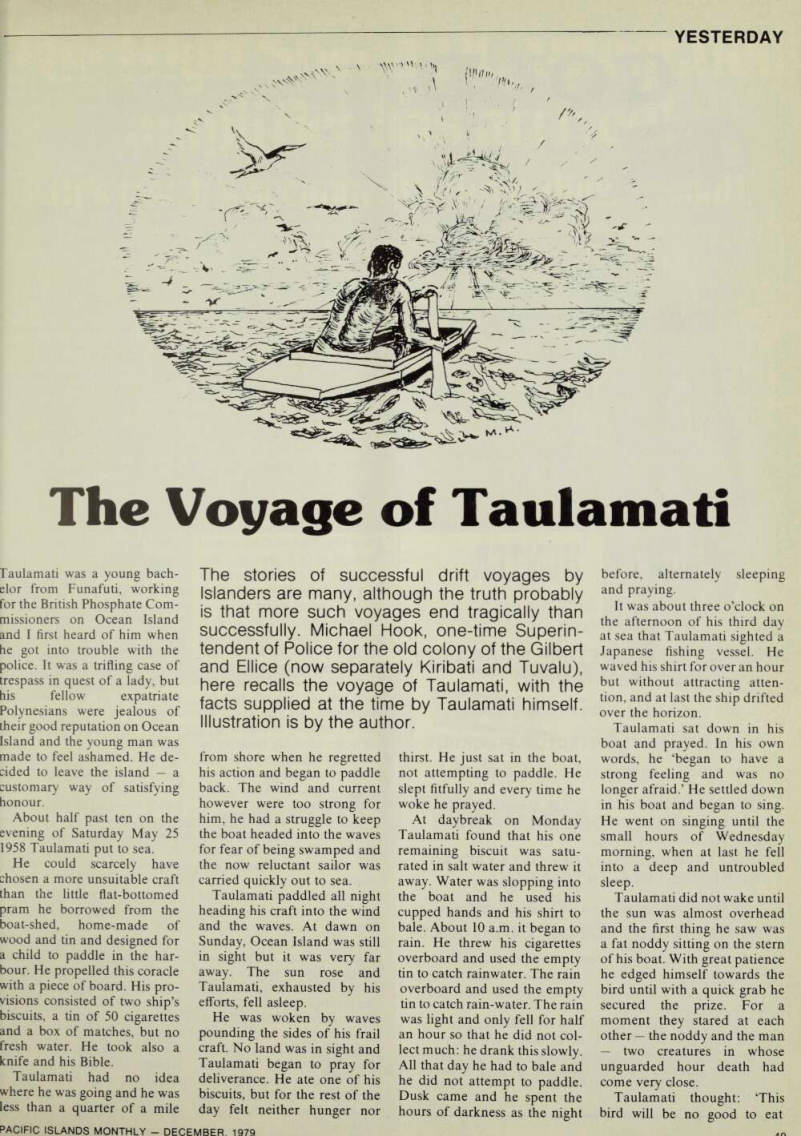
Illustration is by the author.
Taulamati was a young bach
elor from Funafuti, working
for the British Phosphate Com missioners on Ocean Island and I first heard of him when he got into trouble with the police. It was a trifling case of trespass in quest of a lady, but
his fellow expatriate
Polynesians were jealous of
their good reputation on Ocean
Island and the young man was made to feel ashamed. He de cided to leave the island a
customary way of satisfying
honour.
About half past ten on the evening of Saturday May 25 1958 Taulamati put to sea.
He could scarcely have chosen a more unsuitable craft than the little flat-bottomed pram he borrowed from the boat-shed, home-made of wood and tin and designed for a child to paddle in the har bour. He propelled this coracle with a piece of board. His pro visions consisted of two ship’s biscuits, a tin of 50 cigarettes and a box of matches, but no fresh water. He took also a knife and his Bible.
Taulamati had no idea where he was going and he was less than a quarter of a mile
from shore when he regretted his action and began to paddle back. The wind and current however were too strong for him, he had a struggle to keep the boat headed into the waves for fear of being swamped and the now reluctant sailor was carried quickly out to sea.
Taulamati paddled all night
heading his craft into the wind and the waves. At dawn on Sunday, Ocean Island was still in sight but it was very far away. The sun rose and Taulamati, exhausted by his efforts, fell asleep.
He was woken by waves pounding the sides of his frail craft. No land was in sight and Taulamati began to pray for deliverance. He ate one of his biscuits, but for the rest of the day felt neither hunger nor
thirst. He just sat in the boat, not attempting to paddle. He slept fitfully and every time he woke he prayed.
At daybreak on Monday
Taulamati found that his one remaining biscuit was satu rated in salt water and threw it away. Water was slopping into the boat and he used his cupped hands and his shirt to bale. About 10 a.m. it began to rain. He threw his cigarettes overboard and used the empty tin to catch rainwater. The rain overboard and used the empty tin to catch rain-water. The rain was light and only fell for half an hour so that he did not col lect much: he drank this slowly.
All that day he had to bale and he did not attempt to paddle.
Dusk came and he spent the hours of darkness as the night
before, alternately sleeping
and praying.
It was about three o’clock on the afternoon of his third day at sea that Taulamati sighted a
Japanese fishing vessel. He
waved his shirt for over an hour but without attracting atten tion, and at last the ship drifted over the horizon.
Taulamati sat down in his boat and prayed. In his own words, he ‘began to have a strong feeling and was no longer afraid.’ He settled down in his boat and began to sing.
He went on singing until the small hours of Wednesday morning, when at last he fell into a deep and untroubled
sleep.
Taulamati did not wake until the sun was almost overhead and the first thing he saw was a fat noddy sitting on the stern of his boat. With great patience he edged himself towards the bird until with a quick grab he secured the prize. For a moment they stared at each other the noddy and the man two creatures in whose unguarded hour death had come very close.
Taulamati thought: ‘This bird will be no good to eat
uncooked.’ He opened his hand and the noddie’s strong black wings bore it swittly away on the wind of life and freedom.
Taulamati spent that day and the night which followed in prayer and short snatches of sleep. For over four days he had had nothing to eat and drink but a biscuit and a little rain-water and on the Thurs day morning he turned his attention to fishing.
Fish were swimming round his little boat and he succeeded in stabbing a large tuna and in hauling it aboard. After return ing thanks to the Sender of the fish, Taulamati cut the fish up, ate some and spread the remaining pieces in the bottom of the boat to dry.
Later that day it rained and Taulamati drank his fill and fell asleep. He awoke at mid night, ate some more fish and sang hymns until he fell
asleep.
Taulamati now had suf ficient fish to keep him going for a few days and occasional showers of rain provided him with water. He continued to pass his waking hours baling,
praying and singing hymns.
It was after dark on Friday, six days after he had begun his voyage, that numbers of sea birds appeared flying round his boat. Taulamati realised land must be not far off and his spirits rose. He redoubled his prayers and fell asleep happy.
On the Saturday morning he saw frigate birds and, although these might have come from other islands, he knew many Nauruans kept these birds as pets. Taulamati guessed he was near Nauru and with great earnestness begged God to di rect his boat towards that island.
On Saturday afternoon and
again on Sunday morning
Taulamati saw many noddies,
flying and crying as they
swooped to catch fish. On Sun day he fought to stay awake as he was afraid he might drift past Nauru in his sleep. Despite this however he did at length succumb and awoke after dark
on Sunday night.
Far away on the horizon to the westward he saw a light. He stared at it hard and long, presently made out other lights
and knew that ahead indeed lay Nauru. The distance from Ocean Island to Nauru is about 160 miles, but both are tiny islands and it was a miracle that Taulamati had made a land fall. Breathing a prayer of thankfulness he now rigged a sail using his sulu and the piece of board he had brought as a paddle. A little later, overcome by weakness and fatigue, he
fell asleep.
Taulamati awoke just before
daybreak on Monday. Nauru
was on his right and he was being carried past the south side of the island. He hastily took down his sail. He was a good way out but he could plainly see a ship moored opposite the cantilever. As he came opposite the cantilever the set of tide and wind seemed to change and he found his boat was drifting in a more
northerly direction.
As Taulamati’s craft drifted up the western shore of Nauru
he began to paddle. By nine
o’clock in the morning he was quite close to the reef at the northern end of the west coat.
A big wave hit his frail boat and Taulamati dived over board.
Although weak from his long ordeal, he struggled ashore. He drank a coconut, thanked God for saving him, had a sleep and a little later formally reported his arrival to the astonished manager of the British Phos phate Commissioners on Nauru.
Back on Ocean Island it was decided that Taulamati had had difficulties enough and the police case against him was not
pressed. The Phosphate Com
missioners decided also to per mit him to continue his employment with them on Nauru instead of on Ocean Island. Even the borrowed boat was recovered and shipped back to its owner.
Taulamati’s voyage was something of a nine days won
der. Perhaps his extraordinary 1
good fortune in landing on Nauru gave others the idea that it was easy, for two months after Taulamati’s voyage, another Ellice Islander, finding himself in trouble, left Ocean Island in a small boat.
He was never heard of again.