Kiribati from a
pp. 31-33 · Read in the full issue
Travel
Kiribati from a bus window
Now rhor Kiribati (formerly rhe Gilbert Islands) is independent, keen attention will focus on the conflicting demands of tradition and progress. The opinion of most outside observers on the future of Kiribati will be formed after a short tour of Tarawa, the administrative centre and the most populous of the atolls making up the new republic. Dosed on a bus trip from Bonriki to Bairiki along the southern arm of Tarawa Atoll. AAAX QUANCHI comments on rhe view from rhe bus window, and on how accurately it portrays life in Kiribati.
[t has been claimed that the trip from Faleolo airport along the north coast of Upulo Island to \pia is the most interesting irive in the Pacific, if not the world.
No less interesting is the trip ilong the south arm of Tarawa Moll from Bonriki airport to :he administrative centre of Bairiki. While Tarawa may not ne able to match the lush veg
;tation, waterfalls and misty
neaks of volcanic Upulo, the
fircling, flat coral landscape
md changing colours of the la goon give Tarawa a no less
memorable setting.
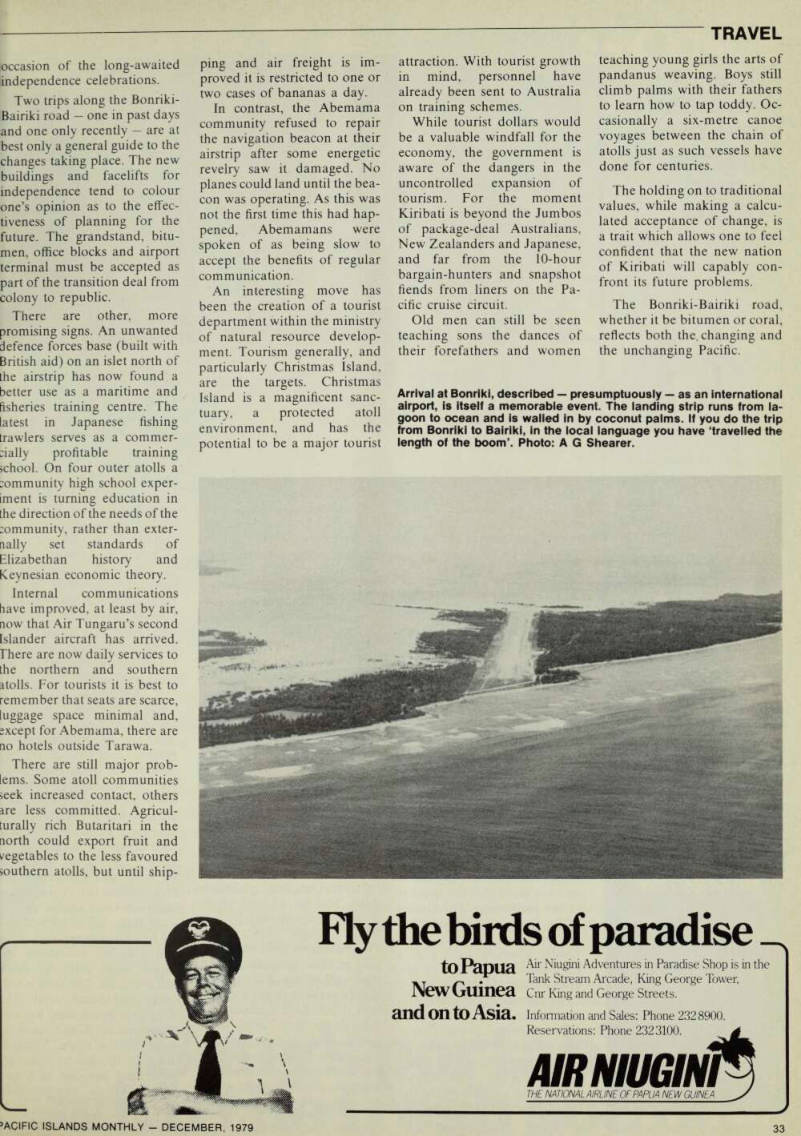
Arrival at Bonriki, described - presumptuously as an in ;emational airport, is itself a memorable event. Air Nauru make a twice-weekly stop, and Mr Pacific a bi-weekly stop, on i route that includes Tuvalu, Nauru, Christmas Island and ;he Marshalls.
The first impression is of a
dull, lifeless landscape. The
anding strip runs from lagoon
;o ocean shore and is walled in
?y stunted undergrowth and
:oconut palms. Behind the grey 3rick terminal at the lagoon md stretches an expanse of ;idal mud flats and murky la
goon shallows.
Arrivals were far more romantic just a few months igo. The terminal was then a
leaning, thatched building at
the ocean end of the runway,
squeezed in between pounding
surf and the end of the strip.
With a few trucks parked at the back and a small crowd of on lookers, to step off the plane was to step immediately into the very basic lifestyle of Kiribati. The new, rather ster
ile brick and iron terminal lacks the presence of the old ‘Bonriki International Air
port’.
There are two routes to Bairiki. The shortest is to take the new causeway which cuts across the corner of the lagoon.
The other is to take the longer road around the ocean side of the atoll. To my mind this
always provided an introduc
tion to the enigma of existence on remote Pacific atolls. As the road hugged the outside curve of the atoll, the traveller felt the enormous expanse of ocean out one window, and out the other, the severity of the scrubby, rocky, few acres which make up the land mass. It seemed that such an environment could support only the sparsest
of populations.
But this notion is quickly changed once the road
approaches the closely packed
thatch, fibro and wooden dwellings of the government settlement at Bikenibeu. The narrow strip of land seems
totally taken up by housing
with only rock-strewn coconut groves to mark off one community from the next.
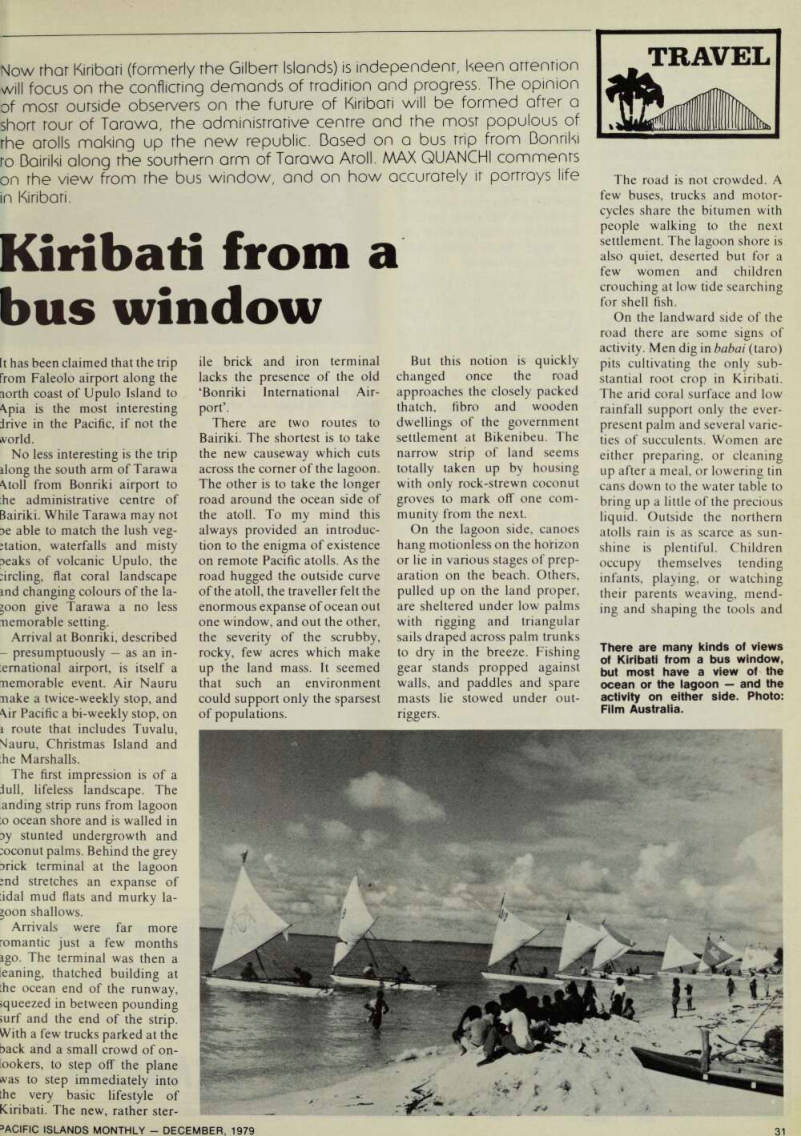
On the lagoon side, canoes hang motionless on the horizon or lie in various stages of preparation on the beach. Others, pulled up on the land proper, are sheltered under low palms
with rigging and triangular
sails draped across palm trunks to dry in the breeze. Fishing J ® gear stands propped against walls, and paddles and spare masts lie stowed under outr iaof»rc
The road is not crowded. A few buses, trucks and motor cycles share the bitumen with people walking to the next settlement. The lagoon shore is also quiet, deserted but for a few women and children crouching at low tide searching for shell fish.
On the landward side of the road there are some signs of activity. Men dig in babai (taro)
pits cultivating the only sub
stantial root crop in Kiribati.
The arid coral surface and low rainfall support only the ever present palm and several varie ties of succulents. Women are
either preparing, or cleaning
up after a meal, or lowering tin cans down to the water table to bring up a little of the precious liquid. Outside the northern atolls rain is as scarce as sun shine is plentiful. Children occupy themselves tending
infants, playing, or watching
their parents weaving, mend ing and shaping the tools and
There are many kinds of views of Kiribati from a bus window, but most have a view of the ocean or the lagoon - and the activity on either side. Photo: Film Australia.
utensils needed for everyday use.
Between each cluster of homes or settlements the road
passes through palm groves
and all the time it is possible to gaze across the extent of the land from open ocean to en
closed lagoon.
As the road approaches Bairiki, the administrative centre of Kiribati, the bus leaves the shade of the palms and lurches out along a thin causeway. Substantial timber and frame houses, leftovers of colonial days, surround the three central features of Bairiki islet. The first is the open space formed by the co-op, bank, post office and administration offices. Within this space
people wander from building
to building, stand about in twos or threes, or sit in the shade.
Push bikes are more common than trucks or buses, although the motorcycle is beginning to make its presence felt. A giant tree dominates the square and provides a shady bus stop for those waiting on the ‘Coconut
Express’.
The second focal point is the sports arena. It is shaped by the former governor’s house along the ocean shore, a huge maneaba serving as a court house (and recently as a consti tutional convention and
independence day centre), and,
along the road, by the police
station and fire brigade.
The third focal point is the wharf area. Here Bairiki’s office workers catch the hourly ferry over to Betio Islet, a mile away across the lagoon. This is the end of the bus run from Bonriki. After a short wait the bus collects workers and shop pers for the return run to settle ments out along the atoll.
Although the bus trip ends at
the Bairiki wharf, not to go on to Betio is to leave the trip in complete. Betio is a remark able few acres of coral claimed to be more densely populated
than Hong Kong or Singapore.
It does not appear so from the plane or the ferry. Hidden under the palms is a steadily
growing urban population, mi
grants from the outer atolls in search of education, work and
the bright lights missing from
their distant homes.
Betio also provides wharfage
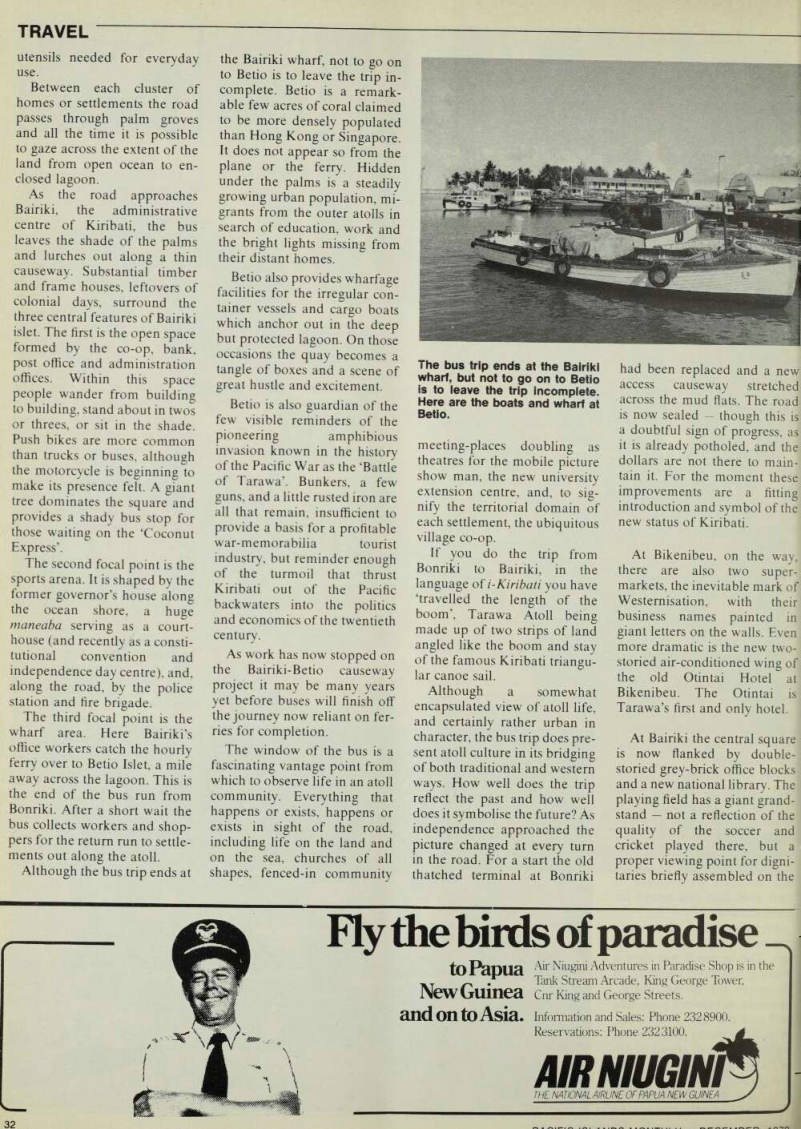
facilities for the irregular con tainer vessels and cargo boats which anchor out in the deep but protected lagoon. On those occasions the quay becomes a tangle of boxes and a scene of great hustle and excitement.
Betio is also guardian of the few visible reminders of the
pioneering amphibious
invasion known in the history of the Pacific War as the ‘Battle of Tarawa’. Bunkers, a few guns, and a little rusted iron are all that remain, insufficient to provide a basis for a profitable war-memorabilia tourist
industry, but reminder enough
of the turmoil that thrust Kiribati out of the Pacific backwaters into the politics and economics of the twentieth century.
As work has now stopped on the Bairiki-Betio causeway project it may be many years yet before buses will finish off the journey now reliant on fer ries for completion.
The window of the bus is a
fascinating vantage point from
which to observe life in an atoll
community. Everything that
happens or exists, happens or exists in sight of the road, including life on the land and on the sea, churches of all
shapes, fenced-in community
meeting-places doubling as
theatres for the mobile picture show man, the new university extension centre, and, to sig nify the territorial domain of each settlement, the übiquitous
village co-op.
If you do the trip from Bonriki to Bairiki, in the language of i-Kiribati you have ‘travelled the length of the boom’, Tarawa Atoll being made up of two strips of land angled like the boom and stay of the famous Kiribati triangu lar canoe sail.
Although a somewhat encapsulated view of atoll life, and certainly rather urban in character, the bus trip does pre sent atoll culture in its bridging of both traditional and western ways. How well does the trip reflect the past and how well does it symbolise the future? As independence approached the picture changed at every turn in the road. For a start the old thatched terminal at Bonriki
had been replaced and a new access causeway stretched across the mud flats. The road is now sealed - though this is a doubtful sign of progress, as it is already potholed, and the dollars are not there to main tain it. For the moment these
improvements are a fitting
introduction and symbol of the new status of Kiribati.
At Bikenibeu, on the way, there are also two super markets, the inevitable mark of Westernisation, with their business names painted in giant letters on the walls. Even more dramatic is the new two storied air-conditioned wing of the old Otintai Hotel at Bikenibeu. The Otintai is Tarawa’s first and only hotel.
At Bairiki the central square is now flanked by double storied grey-brick office blocks and a new national library. The
playing field has a giant grand
stand not a reflection of the quality of the soccer and cricket played there, but a
proper viewing point for digni
taries briefly assembled on the
The bus trip ends at the Bairiki wharf, but not to go on to Betio is to leave the trip incomplete.
Here are the boats and wharf at Betio.
occasion of the long-awaited
independence celebrations.
Two trips along the Bonriki- Bairiki road one in past days and one only recently are at best only a general guide to the
changes taking place. The new
buildings and facelifts for independence tend to colour one’s opinion as to the effec tiveness of planning for the future. The grandstand, bitu men, office blocks and airport terminal must be accepted as part of the transition deal from
colony to republic.
There are other, more
promising signs. An unwanted
defence forces base (built with British aid) on an islet north of the airstrip has now found a better use as a maritime and
fisheries training centre. The
latest in Japanese fishing
trawlers serves as a commer
cially profitable training
school. On four outer atolls a
community high school exper
iment is turning education in the direction of the needs of the community, rather than exter nally set standards of
Elizabethan history and
Keynesian economic theory.
Internal communications
have improved, at least by air,
now that Air Tungaru’s second [slander aircraft has arrived.
There are now daily services to the northern and southern atolls. For tourists it is best to remember that seats are scarce, luggage space minimal and, except for Abemama, there are no hotels outside Tarawa.
There are still major prob lems. Some atoll communities seek increased contact, others
are less committed. Agricul
turally rich Butaritari in the north could export fruit and vegetables to the less favoured southern atolls, but until ship
ping and air freight is im proved it is restricted to one or two cases of bananas a day.
In contrast, the Abemama
community refused to repair
the navigation beacon at their
airstrip after some energetic
revelry saw it damaged. No planes could land until the bea con was operating. As this was not the first time this had hap pened, Abemamans were spoken of as being slow to accept the benefits of regular communication.
An interesting move has been the creation of a tourist
department within the ministry
of natural resource develop ment. Tourism generally, and particularly Christmas Island, are the targets. Christmas Island is a magnificent sanc tuary, a protected atoll environment, and has the potential to be a major tourist
attraction. With tourist growth in mind, personnel have already been sent to Australia on training schemes.
While tourist dollars would be a valuable windfall for the economy, the government is aware of the dangers in the uncontrolled expansion of tourism. For the moment Kiribati is beyond the Jumbos of package-deal Australians, New Zealanders and Japanese, and far from the 10-hour
bargain-hunters and snapshot
fiends from liners on the Pa cific cruise circuit.
Old men can still be seen teaching sons the dances of their forefathers and women
teaching young girls the arts of
pandanus weaving. Boys still
climb palms with their fathers to learn how to tap toddy. Oc casionally a six-metre canoe voyages between the chain of atolls just as such vessels have done for centuries.
The holding on to traditional values, while making a calcu lated acceptance of change, is a trait which allows one to feel confident that the new nation of Kiribati will capably con front its future problems.
The Bonriki-Bairiki road, whether it be bitumen or coral, reflects both the. changing and the unchanging Pacific.
Arrival at Bonriki, described presumptuously - as an international airport, is itself a memorable event. The landing strip runs from la goon to ocean and is walled in by coconut palms. If you do the trip from Bonriki to Bairiki, in the local language you have ‘travelled the length of the boom’. Photo: A G Shearer.