People
pp. 27-29 · Read in the full issue

Vngelyn Tukuna, the girl who lad Papua New Guinea in jproar in October over a nude idvertisement, said she was striking a blow for the freedom )f women’. ‘lt’s my choice and ny choice alone how I model br an advertisement,’ she said.
How dare anyone suggest I am
?eing exploited.’ She added
bat she pitied her ‘Papua New Tuinean sisters, denied the ;ame freedoms by their old "ashioned menfolk’.
Angela, 23, a former Air hostess and Miss Papua New Guinea 1978, drew he wrath of political and civic eaders when her nude photo
graph appeared in a full-page
lewspaper advertisement. The
criticism was spearheaded by
be Premier of her home prov nce, Dr Alexis Sarei, who said: I won’t have my girls doing bings like this’.
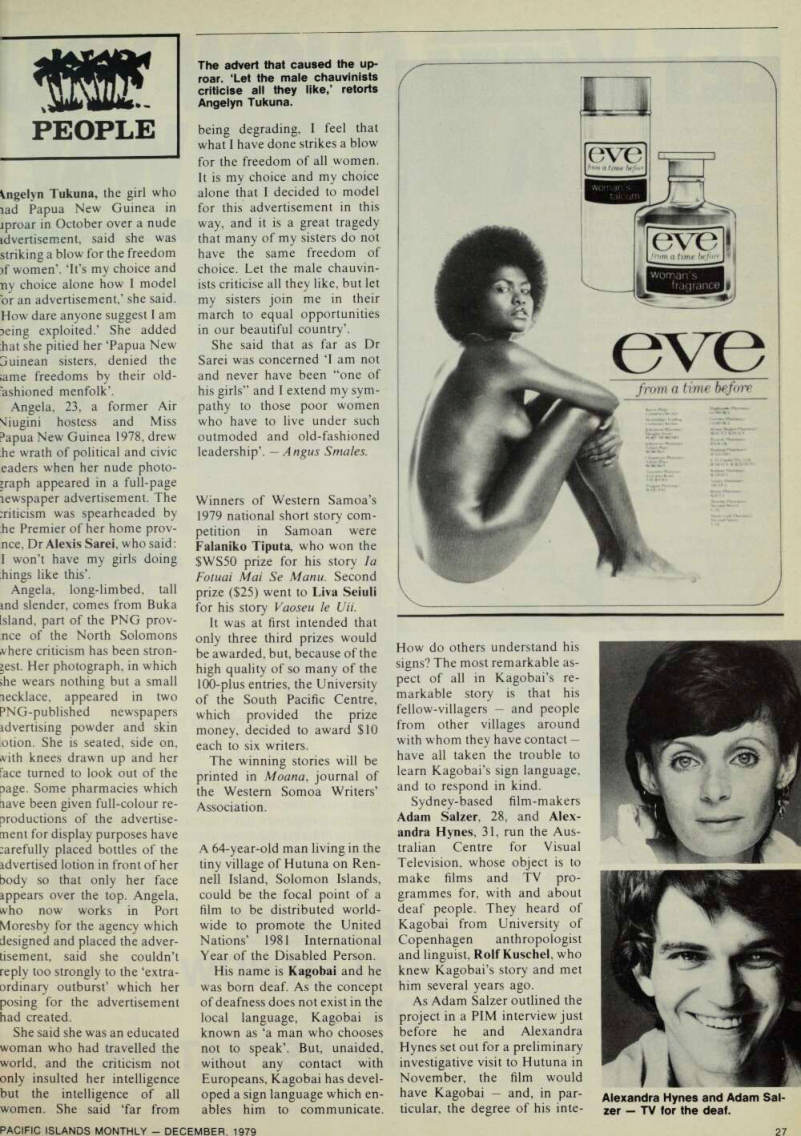
Angela, long-limbed, tall
md slender, comes from Buka [sland, part of the PNG prov nce of the North Solomons ivhere criticism has been stron gest. Her photograph, in which »he wears nothing but a small
lecklace, appeared in two
PNG-published newspapers
advertising powder and skin
otion. She is seated, side on, with knees drawn up and her face turned to look out of the
page. Some pharmacies which
have been given full-colour re productions of the advertise ment for display purposes have :arefully placed bottles of the advertised lotion in front of her body so that only her face appears over the top. Angela, who now works in Port Moresby for the agency which designed and placed the adver tisement, said she couldn’t reply too strongly to the ‘extra ordinary outburst’ which her posing for the advertisement had created.
She said she was an educated woman who had travelled the world, and the criticism not
only insulted her intelligence
but the intelligence of all women. She said ‘far from
The advert that caused the up roar. ‘Let the male chauvinists criticise all they like,’ retorts Angelyn Tukuna. being degrading, I feel that what I have done strikes a blow for the freedom of all women.
It is my choice and my choice alone that I decided to model for this advertisement in this way, and it is a great tragedy that many of my sisters do not have the same freedom of choice. Let the male chauvin ists criticise all they like, but let my sisters join me in their
march to equal opportunities
in our beautiful country’.
She said that as far as Dr Sarei was concerned T am not and never have been “one of his girls” and I extend my sym pathy to those poor women who have to live under such outmoded and old-fashioned leadership’. Angus Smales.
Winners of Western Samoa’s 1979 national short story com petition in Samoan were Falaniko Tiputa, who won the SWSSO prize for his story la Fotuai Mai Se Manu. Second prize ($25) went to Liva Seiuli for his story Vaoseu le Uii.
It was at first intended that only three third prizes would be awarded, but, because of the high quality of so many of the
100-plus entries, the University
of the South Pacific Centre,
which provided the prize
money, decided to award $lO each to six writers.
The winning stories will be
printed in Moana , journal of
the Western Somoa Writers’
Association.
A 64-year-old man living in the tiny village of Hutuna on Ren nell Island, Solomon Islands, could be the focal point of a film to be distributed world wide to promote the United Nations’ 1981 International Year of the Disabled Person.
His name is Kagobai and he was bom deaf. As the concept of deafness does not exist in the
local language, Kagobai is
known as ‘a man who chooses not to speak’. But, unaided, without any contact with
Europeans, Kagobai has devel
oped a sign language which en
ables him to communicate.
How do others understand his signs? The most remarkable as pect of all in Kagobai’s re markable story is that his
fellow-villagers and people
from other villages around with whom they have contact have all taken the trouble to
learn Kagobai’s sign language,
and to respond in kind.
Sydney-based film-makers
Adam Salzer, 28, and Alex andra Hynes, 31, run the Aus tralian Centre for Visual Television, whose object is to make films and TV pro grammes for, with and about deaf people. They heard of
Kagobai from University of
Copenhagen anthropologist
and linguist, Rolf Kuschel, who knew Kagobai’s story and met him several years ago.
As Adam Salzer outlined the project in a PIM interview just before he and Alexandra Hynes set out for a preliminary investigative visit to Hutuna in November, the film would have Kagobai and, in par ticular, the degree of his inte-
Alexandra Hynes and Adam Sal zer - TV for the deaf.
;ration into community life is its basic theme. The film vould contain segments on the ot of disabled people in one :ountry in each of the world’s :ontinents with back eferences to Kagobai’s story hreaded through them. As Vdam Salzer spoke, it was clear hat his anticipation was that he ‘comparisons’ were most mlikely to reflect badly on the fillagers of Hutuna and its leighbouring settlements in heir relationship with a handi :apped member of the com nunity.
The film-makers’ visit to Jutuna would involve a flight o Rennell’s airstrip and then a lay-long walk, and on the next lay a canoe journey and more valking, and then more canoe ng and more walking, before caching Hutuna.
After all this, and the shooi ng of trial film footage of Cagobai and his friends, the wo were to go to New York to
:ontinue negotiations with UN
)fficials on the project.
Austin Sapias was confirmed >y the Papua New Guinea jovemment in October as its tew high commissioner in Aus ralia. Mr Sapias, a former oumalist, has been acting in he post since the former high :ommissioner, Vincent Eri, re umed to PNG earlier this rear.
Yom his hospital bed in Bris )ane, Australia, former Jolomon Islands resident R. G. -lodge has sent PIM a long )pen letter he has written to the Jolomon Islands newspaper,
Sews Drum, picking several
?ones with it. In particular he
criticised the paper’s reporting
)f a court case in Solomon islands in which he was the suc
cessful plaintiff. Space, and
lome other, considerations pre /ent us from publishing his full ;ext. But we believe the open ng salvo of Mr Hodges’ on slaught on the Drum is worth quoting; ‘A few months ago, on the occasion of the arrival at Honiara of the Australian-
E>iven new patrol boat, Tulagi,
you published some very good
photos including one of part of the crew on deck as the vessel approached its berth. The cap tion was to the effect: “The
crew stands rigidly to attention as the police band plays Aus tralia’s national anthem, Waltzing Matilda.” Alas, the crew were standing correctly at ease (except that one stalwart
was busy scratching his
stomach!) for the good and suf ficient reason that Waltzing Matilda is no more Australia’s national anthem than is “Tie
me kangaroo down, sport”!’
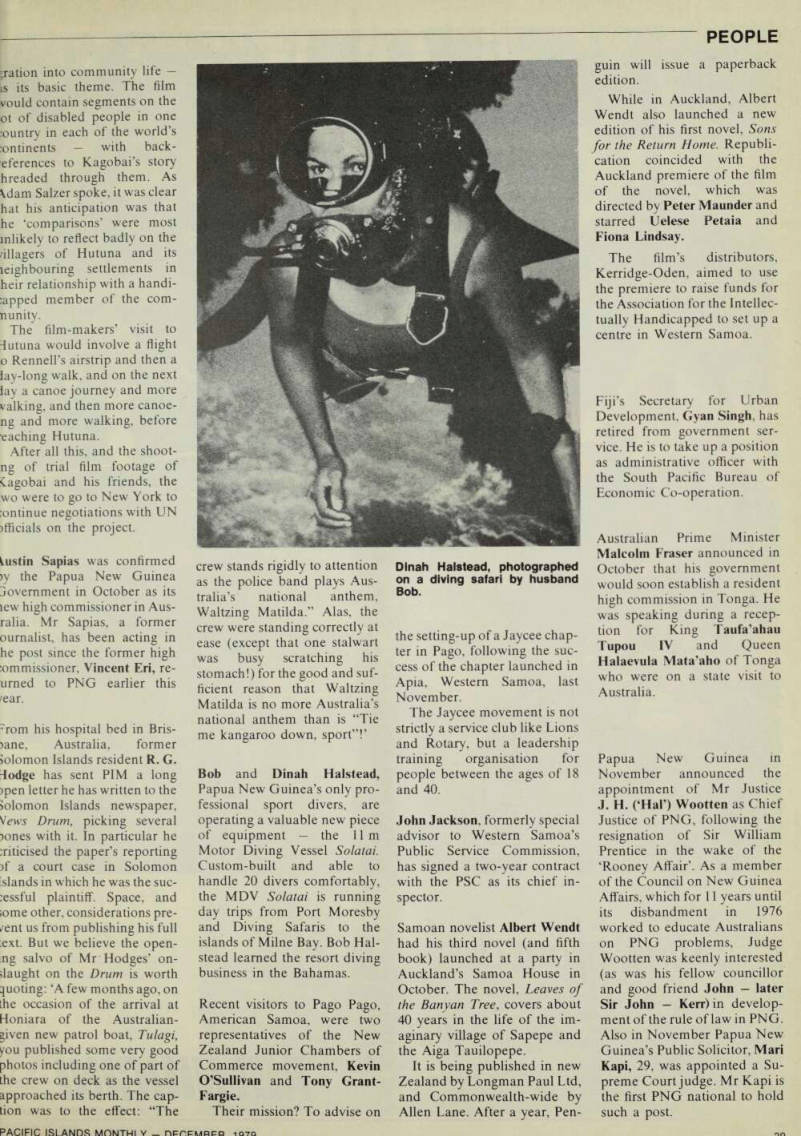
Bob and Dinah Halstead, Papua New Guinea’s only pro fessional sport divers, are operating a valuable new piece of equipment the 11 m Motor Diving Vessel Solatai.
Custom-built and able to handle 20 divers comfortably, the MDV Solatai is running
day trips from Port Moresby
and Diving Safaris to the islands of Milne Bay. Bob Hal stead learned the resort diving business in the Bahamas.
Recent visitors to Pago Pago, American Samoa, were two representatives of the New Zealand Junior Chambers of Commerce movement, Kevin O’Sullivan and Tony Grant- Fargie.
Their mission? To advise on
the setting-up of a Jaycee chap
ter in Pago, following the suc cess of the chapter launched in Apia, Western Samoa, last November.
The Jaycee movement is not strictly a service club like Lions and Rotary, but a leadership
training organisation for
people between the ages of 18 and 40.
John Jackson, formerly special
advisor to Western Samoa’s Public Service Commission, has signed a two-year contract with the PSC as its chief in spector.
Samoan novelist Albert Wendt had his third novel (and fifth book) launched at a party in Auckland’s Samoa House in October. The novel, Leaves of the Banyan Tree , covers about 40 years in the life of the im
aginary village of Sapepe and
the Aiga Tauilopepe.
It is being published in new Zealand by Longman Paul Ltd, and Commonwealth-wide by Allen Lane. After a year, Pen
guin will issue a paperback edition.
While in Auckland, Albert Wendt also launched a new edition of his first novel, Sons for the Return Home. Republi cation coincided with the Auckland premiere of the film of the novel, which was directed by Peter Maunder and starred Uelese Petaia and Fiona Lindsay.
The film’s distributors, Kerridge-Oden, aimed to use the premiere to raise funds for the Association for the Intellec tually Handicapped to set up a centre in Western Samoa.
Fiji’s Secretary for Urban Development, Cyan Singh, has retired from government ser vice. He is to take up a position as administrative officer with the South Pacific Bureau of
Economic Co-operation.
Australian Prime Minister Malcolm Fraser announced in October that his government would soon establish a resident high commission in Tonga. He was speaking during a recep tion for King Taufa’ahau Tupou IV and Queen Halaevula Mata'aho of Tonga who were on a state visit to Australia.
Papua New Guinea in November announced the appointment of Mr Justice J. H. (‘Hal’) Wootten as Chief Justice of PNG, following the resignation of Sir William Prentice in the wake of the ‘Rooney Affair’. As a member of the Council on New Guinea Affairs, which for 11 years until its disbandment in 1976 worked to educate Australians
on PNG problems, Judge
Wootten was keenly interested (as was his fellow councillor and good friend John later Sir John Kerr) in develop ment of the rule of law in PNG.
Also in November Papua New Guinea’s Public Solicitor, Mari Kapi, 29, was appointed a Su preme Court judge. Mr Kapi is the first PNG national to hold such a post.
Dinah Halstead, photographed on a diving safari by husband Bob.