Tuvalu Marine Training
pp. 83-85 · Read in the full issue

School Is In Business’
Australian High Commissioner to Tuvalu, Gordon Upton, officially opened Tuvalu’s mar ine training school on Amatuku islet, Funafuti, in September.
The school, which will train Tuvaluans as seamen for em ployment on overseas ships, is a half-million-dollar Australian aid project.
At the opening ceremony, attended by Tuvalu’s Gover nor-General, Sir Fiatau Peni tala Teo, government ministers and 100 invited guests, Mr Upton said it was fitting that an island people with a maritime culture should have such a training school. The Captain- Superintendent of the school, Ken Barnett, said it was hoped that within a year the first intake of 26 cadets would be working on overseas ships and sending remittances home to their families in Tuvalu, and also depositing money in their own personal bank accounts.
The training courses, each of a year’s duration, are broken down into three stages. Thus,
the first intake which started at the end of August will move up to stage two in December, and a new intake will enter at stage one. The course includes a one month shipboard session which will be carried out aboard the Tuvalu government’s vessel Nivanga. It is hoped that a ship may be obtained specifically to
provide sea-going training in
future.
Tuvalu seamen already have a good international reputation and as long as employment can be found for them the school should be able to turn out 60 trained people per year.
In the past, before separa tion of the Gilbert and Ellice Islands, cadets from both areas were trained at the marine school in Tarawa, Kiribati.
Peter McQuarrie.
RIM this month introduces or rather reintroduces a department specifically devoted to developments in Pacific shipping, and related activities. Return of the department, which for many years figured in the magazine, follows insistent requests from readers.
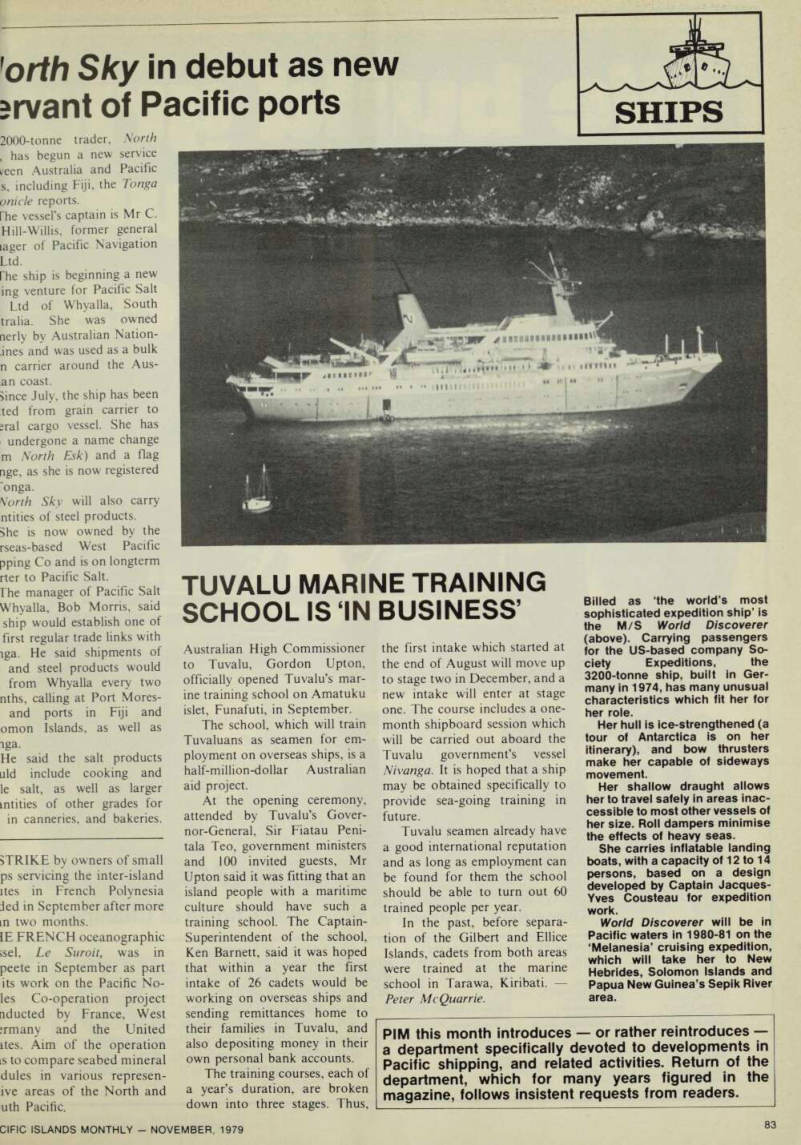
Billed as ‘the world’s most sophisticated expedition ship’ is the M/S World Discoverer
(above). Carrying passengers
for the US-based company So ciety Expeditions, the 3200-tonne ship, built in Ger many in 1974, has many unusual characteristics which fit her for her role.
Her hull is ice-strengthened (a tour of Antarctica is on her itinerary), and bow thrusters make her capable of sideways movement.
Her shallow draught allows her to travel safely in areas inac cessible to most other vessels of her size. Roll dampers minimise the effects of heavy seas.
She carries inflatable landing boats, with a capacity of 12 to 14 persons, based on a design
developed by Captain Jacques-
Yves Cousteau for expedition work.
World Discoverer will be in Pacific waters in 1980-81 on the
‘Melanesia’ cruising expedition,
which will take her to New Hebrides, Solomon Islands and Papua New Guinea’s Sepik River area.
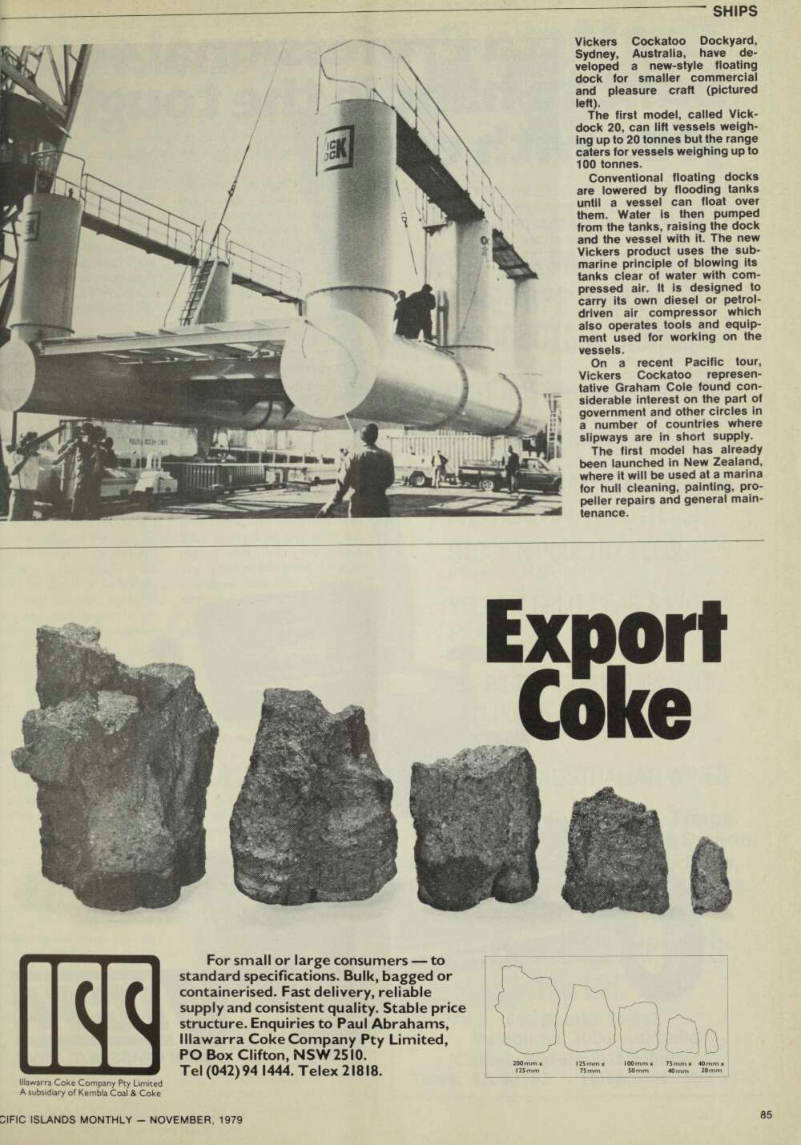
Vickers Cockatoo Dockyard, Sydney, Australia, have de veloped a new-style floating dock for smaller commercial and pleasure craft (pictured left).
The first model, called Vick dock 20, can lift vessels weigh ing up to 20 tonnes but the range caters for vessels weighing up to 100 tonnes.
Conventional floating docks are lowered by flooding tanks until a vessel can float over them. Water is then pumped from the tanks, raising the dock and the vessel with it. The new Vickers product uses the sub marine principle of blowing its tanks clear of water with com pressed air. It is designed to carry its own diesel or petrol driven air compressor which also operates tools and equip ment used for working on the vessels.
On a recent Pacific tour, Vickers Cockatoo represen tative Graham Cole found con siderable interest on the part of government and other circles in a number of countries where slipways are in short supply.
The first model has already been launched in New Zealand, where it will be used at a marina for hull cleaning, painting, pro peller repairs and general main tenance.