Australs
pp. 43-45 · Read in the full issue
With surfboard to Rurutu, in the French Australs
[y interest in making a trip to urutu, for some reason, sur ced into an obsession. Its iots lay somewhere in my adings of early European Pa
fic explorations. The flower
ew as 1 questioned my Tahi an friend, Remy, and then rocured a naval chart of the ustral group. Rurutu itself ten blossomed in my mind.
For some 10 years I had been msistently returning to rench Polynesia, extending ly explorations and friend lips.
Remy and his family warmly xepted me as one of them, aching me Tahitian history id culture. At a farewell ima’ara’a, Remy introduced ne of his friends, Jacques, a ative of Rurutu. Jacques de :ribed his island and asked hether I would see his father ho some years before had suf ;red a stroke. There were no nrealistic expectations in this jquest merely the natural mcem of a son for his ither.
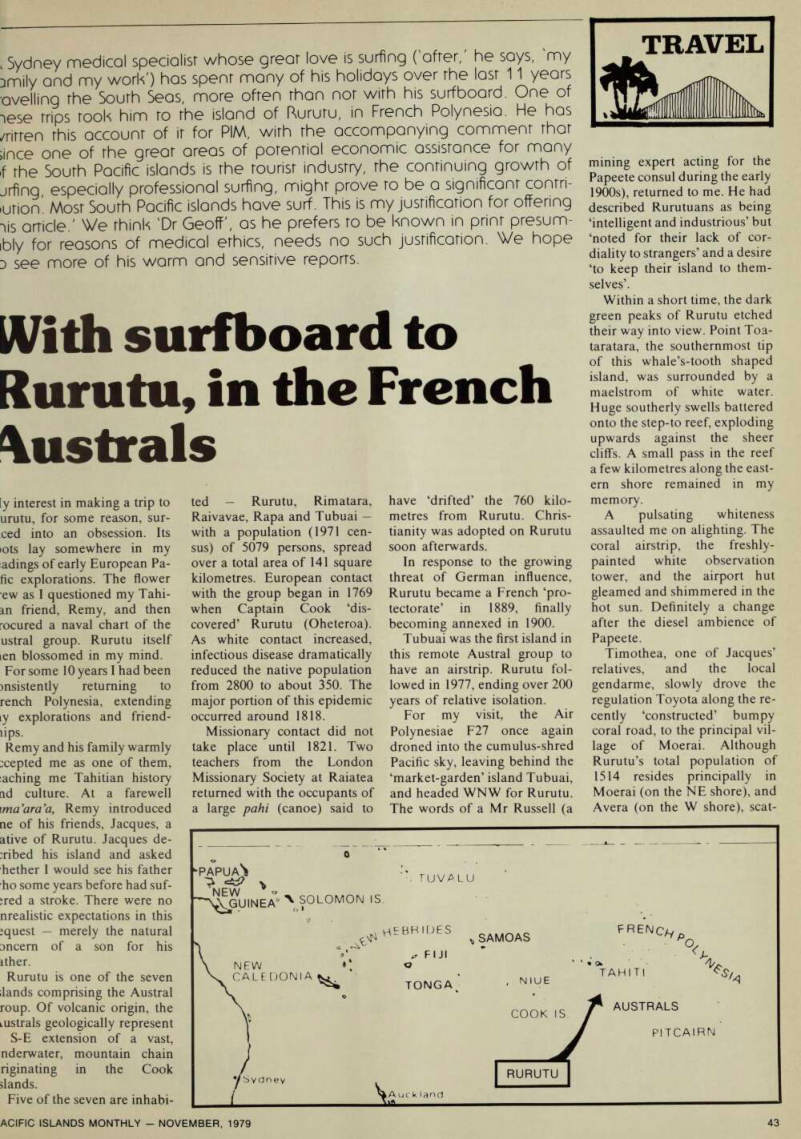
Rurutu is one of the seven ilands comprising the Austral roup. Of volcanic origin, the
Lustrals geologically represent
S-E extension of a vast, nderwater, mountain chain riginating in the Cook dands.
Five of the seven are inhabi
ted Rurutu, Rimatara, Raivavae, Rapa and Tubuai with a population (1971 cen sus) of 5079 persons, spread over a total area of 141 square kilometres. European contact with the group began in 1769 when Captain Cook ‘dis covered’ Rurutu (Oheteroa).
As white contact increased, infectious disease dramatically reduced the native population from 2800 to about 350. The
major portion of this epidemic
occurred around 1818.
Missionary contact did not take place until 1821. Two teachers from the London
Missionary Society at Raiatea
returned with the occupants of a large pahi (canoe) said to
have ‘drifted’ the 760 kilo metres from Rurutu. Chris tianity was adopted on Rurutu soon afterwards.
In response to the growing threat of German influence, Rurutu became a French ‘pro tectorate’ in 1889, finally becoming annexed in 1900.
Tubuai was the first island in this remote Austral group to have an airstrip. Rurutu fol lowed in 1977, ending over 200 years of relative isolation.
For my visit, the Air Polynesiae F 27 once again droned into the cumulus-shred Pacific sky, leaving behind the ‘market-garden’ island Tubuai, and headed WNW for Rurutu.
The words of a Mr Russell (a
mining expert acting for the Papeete consul during the early 1900 s), returned to me. He had described Rurutuans as being ‘intelligent and industrious’ but ‘noted for their lack of cor diality to strangers’ and a desire ‘to keep their island to them selves’.
Within a short time, the dark green peaks of Rurutu etched their way into view. Point Toa taratara, the southernmost tip of this whale’s-tooth shaped island, was surrounded by a maelstrom of white water.
Huge southerly swells battered onto the step-to reef, exploding upwards against the sheer cliffs. A small pass in the reef a few kilometres along the east ern shore remained in my memory.
A pulsating whiteness assaulted me on alighting. The coral airstrip, the freshly painted white observation tower, and the airport hut gleamed and shimmered in the hot sun. Definitely a change after the diesel ambience of Papeete.
Timothea, one of Jacques’ relatives, and the local gendarme, slowly drove the regulation Toyota along the re cently ‘constructed’ bumpy coral road, to the principal vil
lage of Moerai. Although
Rurutu’s total population of 1514 resides principally in Moerai (on the NE shore), and Avera (on the W shore), scat-
tered houses are nonetheless found along the island coastal strip.
As Timothea delivered the newly arrived mail, a far quicker islands communication source the coconut radio was in action. Shy children, and friendly adult faces stared at the popaa (white man) with his strange poti (my surf board).
After showing me the ad ministration building and dropping my belongings at Pa’s place (where I was to stay), Timothea took me to Caterine’s for lunch. Even though it was the only ‘eating place’ at least to my knowl edge in Moerai, there was nothing mundane about this food: it was at least equal to any I’d tasted in French Polynesia. Taro from Rurutu is renowned amongst Tahitians as ‘the best’. Today I became a disciple. Raw fish, washed down with lime-juice, com pleted the fine repast.
It felt strange giving Pa and his wife a gift of Australian rice. However, I could tell they appreciated it. Neither of them could speak French (that I could understand) so conver sation was limited to textbook Tahitian.
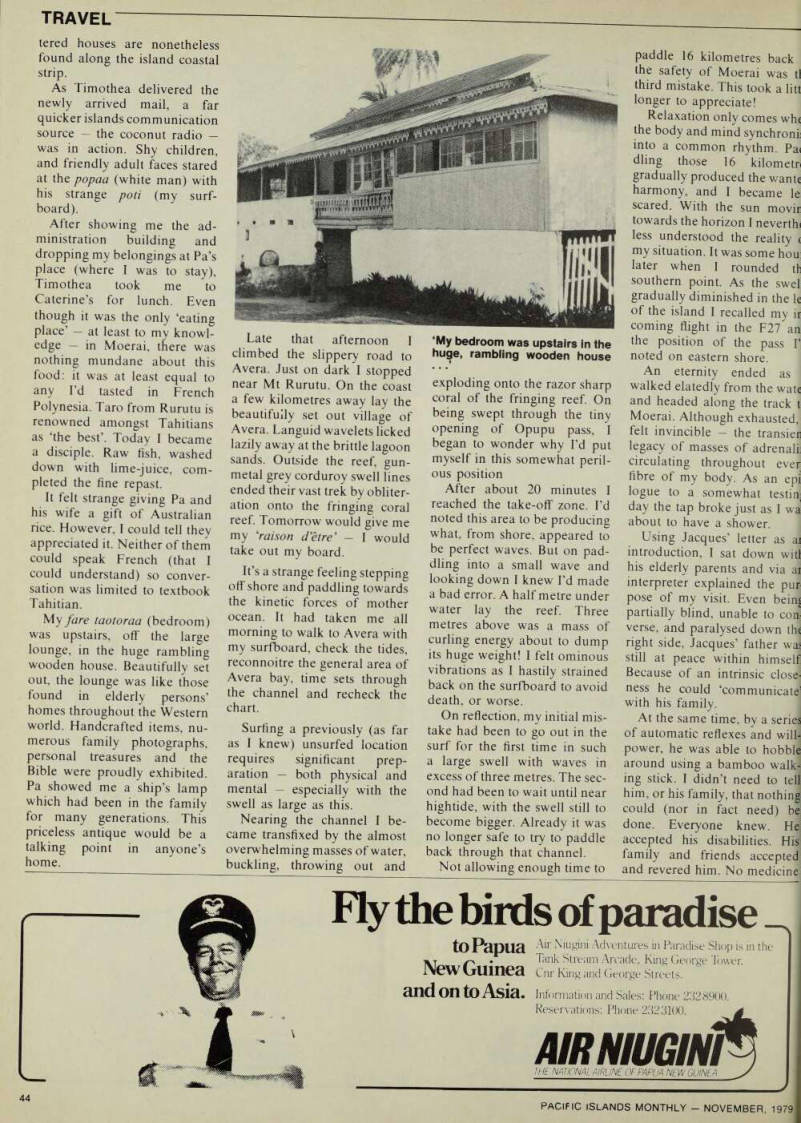
My fare taotoraa (bedroom) was upstairs, off the large lounge, in the huge rambling wooden house. Beautifully set out, the lounge was like those found in elderly persons’ homes throughout the Western world. Handcrafted items, nu
merous family photographs,
personal treasures and the Bible were proudly exhibited.
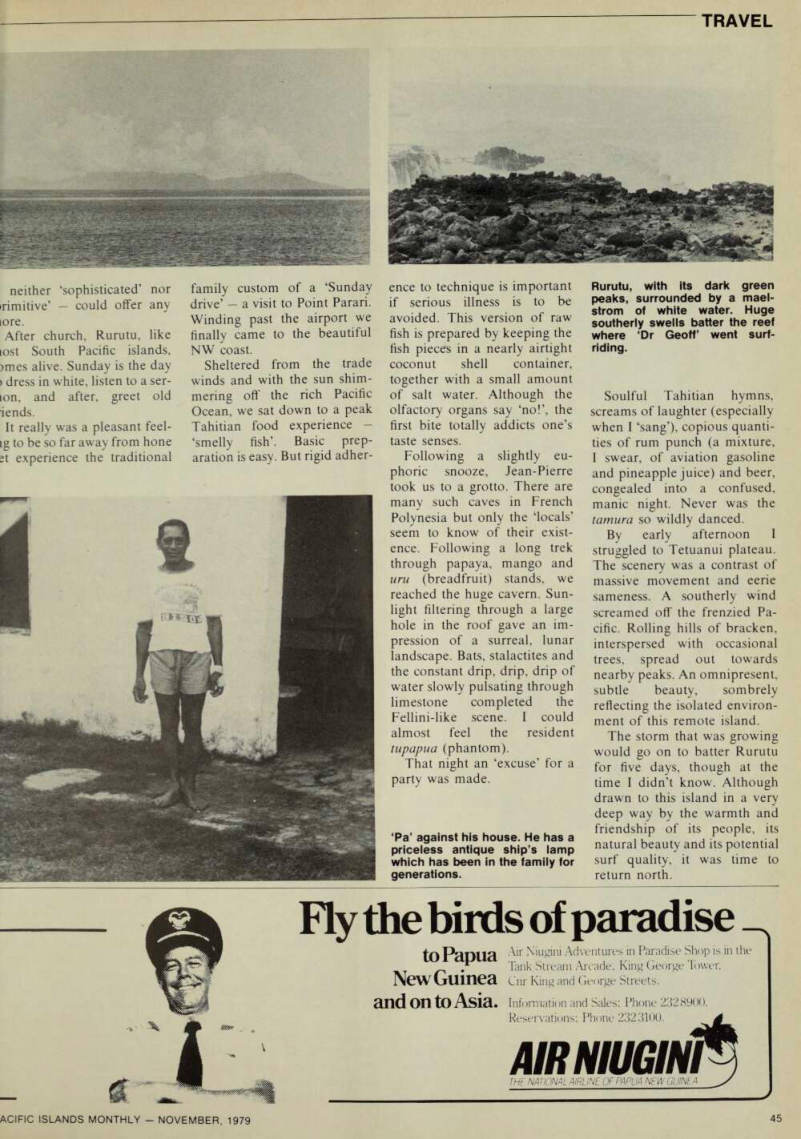
Pa showed me a ship’s lamp which had been in the family for many generations. This priceless antique would be a talking point in anyone’s home.
Late that afternoon I climbed the slippery road to Avera. Just on dark I stopped near Mt Rurutu. On the coast a few kilometres away lay the beautifully set out village of Avera. Languid wavelets licked lazily away at the brittle lagoon sands. Outside the reef, gun metal grey corduroy swell lines ended their vast trek by obliter ation onto the fringing coral reef. Tomorrow would give me my "raison d'etre ’ I would take out my board.
It’s a strange feeling stepping off shore and paddling towards the kinetic forces of mother ocean. It had taken me all morning to walk to Avera with my surfboard, check the tides, reconnoitre the general area of Avera bay, time sets through the channel and recheck the chart.
Surfing a previously (as far as I knew) unsurfed location
requires significant prep
aration both physical and mental especially with the swell as large as this.
Nearing the channel I be came transfixed by the almost overwhelming masses of water,
buckling, throwing out and
exploding onto the razor sharp coral of the fringing reef. On
being swept through the tiny
opening of Opupu pass, I began to wonder why I’d put myself in this somewhat peril
ous position
After about 20 minutes I reached the take-olf zone. I’d noted this area to be producing what, from shore, appeared to be perfect waves. But on pad dling into a small wave and looking down I knew I’d made a bad error. A half metre under water lay the reef. Three metres above was a mass of curling energy about to dump its huge weight! I felt ominous vibrations as I hastily strained back on the surfboard to avoid death, or worse.
On reflection, my initial mis take had been to go out in the surf for the first time in such a large swell with waves in excess of three metres. The sec ond had been to wait until near hightide, with the swell still to become bigger. Already it was no longer safe to try to paddle back through that channel.
Not allowing enough time to
paddle 16 kilometres back the safety of Moerai was tl third mistake. This took a litt longer to appreciate!
Relaxation only comes whc the body and mind synchronii into a common rhythm. Pa< dling those 16 kilometn gradually produced the wante harmony, and I became le: scared. With the sun movir towards the horizon I neverth( less understood the reality ( my situation. It was some hou; later when I rounded th southern point. As the swel gradually diminished in the le of the island I recalled my ir coming flight in the F 27 an the position of the pass I* noted on eastern shore.
An eternity ended as walked elatedly from the wate and headed along the track t Moerai. Although exhausted, felt invincible the transien legacy of masses of adrenalii
circulating throughout ever
fibre of my body. As an epi logue to a somewhat testing day the tap broke just as I wa about to have a shower.
Using Jacques’ letter as ai introduction, I sat down witl his elderly parents and via at interpreter explained the pur pose of my visit. Even partially blind, unable to con verse, and paralysed down the right side, Jacques’ father was still at peace within himself Because of an intrinsic close ness he could ‘communicate’ with his family.
At the same time, by a series of automatic reflexes and willJ power, he was able to hobble around using a bamboo walkJ ing stick. I didn’t need to tell him, or his family, that nothing could (nor in fact need) be done. Everyone knew. He accepted his disabilities. His family and friends accepted and revered him. No medicine
‘My bedroom was upstairs in the huge, rambling wooden house ...'
neither ‘sophisticated’ nor •rimitive’ could offer any lore.
After church, Rurutu, like lost South Pacific islands, )mes alive. Sunday is the day ) dress in white, listen to a ser lon, and after, greet old iends.
It really was a pleasant feel ig to be so far away from hone
st experience the traditional
family custom of a ‘Sunday drive’ a visit to Point Parari.
Winding past the airport we finally came to the beautiful NW coast.
Sheltered from the trade winds and with the sun shim mering oft' the rich Pacific Ocean, we sat down to a peak Tahitian food experience - ‘smelly fish’. Basic prep aration is easy. But rigid adher-
ence to technique is important if serious illness is to be avoided. This version of raw
fish is prepared by keeping the
fish pieces in a nearly airtight
coconut shell container, together with a small amount of salt water. Although the olfactory organs say ‘no!’, the first bite totally addicts one’s taste senses.
Following a slightly eu
phoric snooze, Jean-Pierre took us to a grotto. There are many such caves in French Polynesia but only the ‘locals’ seem to know of their exist ence. Following a long trek through papaya, mango and uru (breadfruit) stands, we reached the huge cavern. Sun
light filtering through a large
hole in the roof gave an im pression of a surreal, lunar landscape. Bats, stalactites and
the constant drip, drip, drip of
water slowly pulsating through
limestone completed the Fellini-like scene. I could almost feel the resident
tupapua (phantom).
That night an ‘excuse’ for a party was made.
Soulful Tahitian hymns,
screams of laughter (especially
when I ‘sang’), copious quanti
ties of rum punch (a mixture, I swear, of aviation gasoline and pineapple juice) and beer, congealed into a confused, manic night. Never was the tamura so wildly danced.
By early afternoon I
struggled to Tetuanui plateau.
The scenery was a contrast of massive movement and eerie sameness. A southerly wind screamed off the frenzied Pa cific. Rolling hills of bracken, interspersed with occasional trees, spread out towards
nearby peaks. An omnipresent,
subtle beauty, sombrely
reflecting the isolated environ ment of this remote island.
The storm that was growing would go on to batter Rurutu for five days, though at the time I didn’t know. Although drawn to this island in a very deep way by the warmth and friendship of its people, its natural beauty and its potential surf quality, it was time to return north.
Rurutu, with its dark green peaks, surrounded by a mael strom of white water. Huge southerly swells batter the reef where ‘Dr Geoff’ went surf riding.
‘Pa’ against his house. He has a priceless antique ship’s lamp which has been in the family for generations.