Softly, softly the kind
pp. 40-41 · Read in the full issue
kind of help that changes lives
To Crippled Polio Patients - Wherever They May Be - In the hope that this book will enable many of them to walk, earn their own living, and take their rightful place in society.
So reads the dedication of Professor Ronald Huckstep’s book Poliomyelitis, written as a guide for approaches to the treatment of the disease in
developing countries. The only
work of its kind, it is expressive of his warm yet intensely practical concern for disabled people in these far-flung, econ-
omically disadvantaged, parts
of the world.
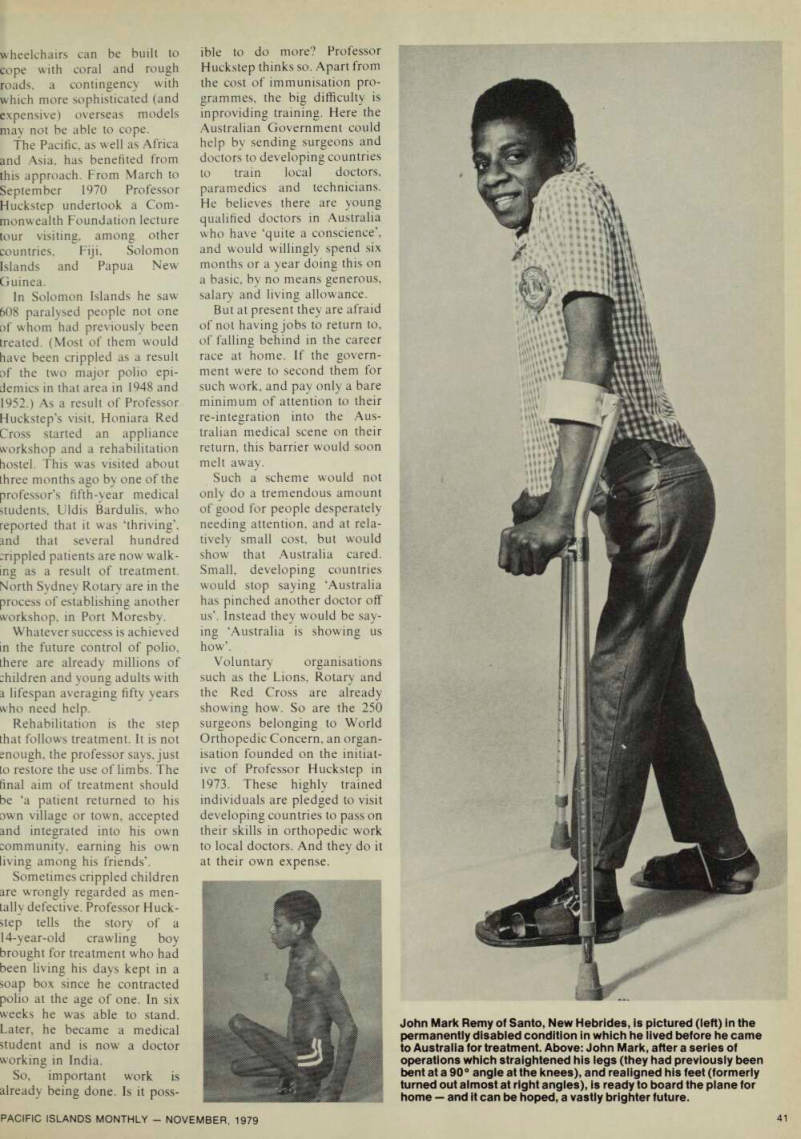
In Sydney in August, PIM talked with Professor Huckstep, who is in charge of studies in traumatic and orthopedic surgery at the University of New South Wales. On the same day, John Mark Remy, 14, from Santo, New Hebrides, had flown home from Sydney, able to walk for the first time in his life. His legs, bent at a 90° angle at the knees by a severe polio attack when he was two, had been straightened in a series of operations at the children s department of the Prince of Wales Hospital. His feet, which had been turned out almost at right angles, had also been realigned.
John Mark was flown to Australia by Randwick Lions Club, but no charge was made for medical or hospital expenses incurred during his four-month stay. Professor
Huckstep, who performed 5000
operations for polio deformities durine 12 vears as head of ues aunng iz years as bead ot the department of orthopedic
surgery in Uganda, praised the hospital for its ‘first-class’ sup port of the case. However, with approximately 40 million untreated crippled children and adults in the developing countries, there are obvious limits to the number likely to receive this kind of help
(although Joe Price, president
of Randwick Lions, already has another, similar, case in mind).
But the figures need not appear so daunting. Professor Huckstep sees home-based sol utions as both possible and
practical, except in especially
difficult cases. He has a three pronged approach preven tion, treatment and rehabilitation.
Immunisation programmes for poliomyelitis are, he feels, a neglected area, simply be cause developing countries often cannot afford them, and because once begun they must be continuous. To run one-off programmes is ‘worse than not doing it at all’, he says. In such
situations, polio epidemics are
likely to become more fre
quent, rather than less, with children in developing coun tries particularly vulnerable.
Improved community health situations have altered the polio ‘pattern’. Previously babies were prone to infection at a very early age when, pro tected by their mothers’ anti bodies, they were likely to recover unparalysed and with their own immunity. Now, after unsustained polio immu nisation campaigns, the tend ency is for a child to contract the virus after it’s two or three, and then to become paralysed, to a greater or lesser extent.
Professor Huckstep instan ced Papua New Guinea as one Pacific Island country which did not have a nation-wide immunisation programme.
Smaller Island countries have usually been able to con trol their epidemics, although they must still contend with birth abnormalities and paral ysis due to accidents.
Some developing countries are receiving help to begin im munisation programmes: the Rotary International project for 1980 and beyond is an im munisation scheme in the
Philippines.
Clearly, if money can be found, prevention makes the
best economic sense quite apart from humanitarian con siderations.
In the treatment of the dis abled, Professor Huckstep has pioneered simple yet effective solutions. The vast majority of cases can be corrected by uncomplicated surgery which does not require visits to more developed countries. Wheel chairs, calipers and other appliances to support patients can be made locally, using de signs such as are illustrated in his book.
These make use of local labour in Uganda the patients themselves became involved and everyday items: tree roots and discarded: shoes for hand supports used
by crawling or crouching
patients; galvanised iron,] leather and wooden clogs for calipers; bicycle wheels and household chairs of wheel chairs. Tt doesn’t look so glam-j orous, but it works,’ says the professor.
Moreover, the locally made appliance may be more suited 1 to local conditions. A wooden! clog for someone who doesn’t] normally wear shoes is more appropriate (and comfortable) than a boot. Home-grown
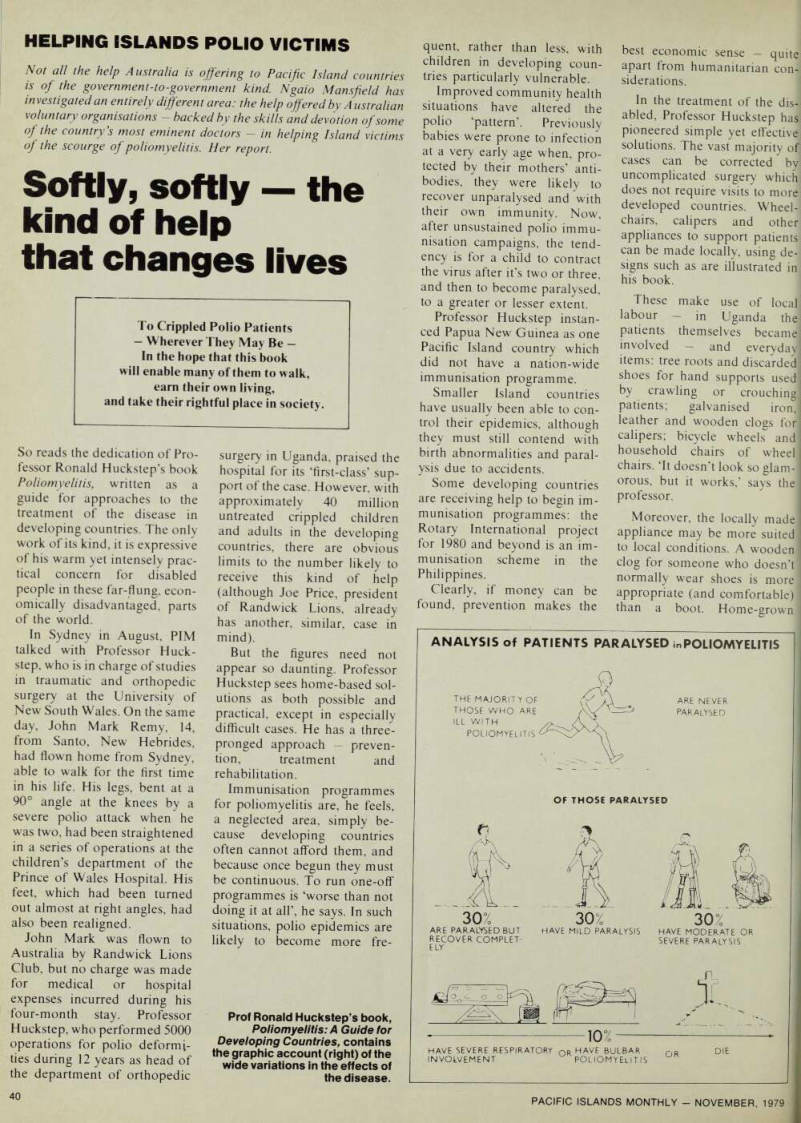
Prof Ronald Huckstep’s book, Poliomyelitis: A Guide for Developing Countries, contains the graphic account (right) of the wide variations in the effects of the disease.
wheelchairs can be built to cope with coral and rough
roads, a contingency with
which more sophisticated (and
expensive) overseas models may not be able to cope.
The Pacific, as well as Africa and Asia, has benefited from this approach. From March to September 1970 Professor Huckstep undertook a Com monwealth Foundation lecture tour visiting, among other countries, Fiji, Solomon Islands and Papua New Guinea.
In Solomon Islands he saw
508 paralysed people not one
of whom had previously been treated. (Most of them would have been crippled as a result
of the two major polio epi
demics in that area in 1948 and 1952.) As a result of Professor Huckstep’s visit, Honiara Red
Cross started an appliance
workshop and a rehabilitation hostel. This was visited about three months ago by one of the
professor’s fifth-year medical
students, Uldis Bardulis, who reported that it was ‘thriving’, and that several hundred crippled patients are now walk ing as a result of treatment.
North Sydney Rotary are in the
process of establishing another
workshop, in Port Moresby.
Whatever success is achieved in the future control of polio, there are already millions of children and young adults with
a lifespan averaging fifty years
who need help.
Rehabilitation is the step that follows treatment. It is not
enough, the professor says, just
to restore the use of limbs. The final aim of treatment should be ‘a patient returned to his
own village or town, accepted
and integrated into his own
community, earning his own
living among his friends’.
Sometimes crippled children
are wrongly regarded as men
tally defective. Professor Huck step tells the story of a
14-year-old crawling boy
brought for treatment who had been living his days kept in a soap box since he contracted polio at the age of one. In six weeks he was able to stand.
Later, he became a medical student and is now a doctor working in India.
So, important work is already being done. Is it poss
ible to do more? Professor Huckstep thinks so. Apart from the cost of immunisation pro grammes, the big difficulty is
inproviding training. Here the
Australian Government could help by sending surgeons and doctors to developing countries to train local doctors, paramedics and technicians.
He believes there are young qualified doctors in Australia who have ‘quite a conscience’, and would willingly spend six months or a year doing this on a basic, by no means generous,
salary and living allowance.
But at present they are afraid of not having jobs to return to, of falling behind in the career race at home. If the govern ment were to second them for such work, and pay only a bare minimum of attention to their re-integration into the Aus tralian medical scene on their return, this barrier would soon melt away.
Such a scheme would not only do a tremendous amount
of good for people desperately
needing attention, and at rela tively small cost, but would show that Australia cared.
Small, developing countries would stop saying ‘Australia has pinched another doctor off us’. Instead they would be say ing ‘Australia is showing us how’.
Voluntary organisations
such as the Lions, Rotary and the Red Cross are already showing how. So are the 250 surgeons belonging to World Orthopedic Concern, an organ isation founded on the initiat ive of Professor Huckstep in 1973. These highly trained individuals are pledged to visit developing countries to pass on their skills in orthopedic work to local doctors. And they do it at their own expense.
John Mark Remy of Santo, New Hebrides, is pictured (left) in the permanently disabled condition in which he lived before he came to Australia for treatment. Above: John Mark, after a series of operations which straightened his legs (they had previously been bent at a 90° angle at the knees), and realigned his feet (formerly turned out almost at right angles), is ready to board the plane for home and it can be hoped, a vastly brighter future.