A New Hebrides constitution
pp. 13-15 · Read in the full issue
Vila’s ‘political miracle’: A New Hebrides constitution
Hailed os 'a marvellous minor political miracle' by rhe British resident commissioner in the New Hebrides,, Andrew Stuart the success in September of the country's constitutional planning committee in reaching agreement on a consti tution for rhe soon-to-be independent republic is one of rhe most important developments in Pacific politics for some time In rhe article below, a PIM correspondent who was in Vila during rhe final stages of rhe committee's work, and in o position to observe this work closely, backgrounds rhe momentous events which hove cleared the way for general elections in rhe New Hebrides on November 14, and for New Hebridean independence in the first half of 1980 with May widely ripped os the most likely dote.
ls dawn was about to break on
le morning of September 19,
979 over Vila, New Hebrides, le constitutional conference fas still deadlocked over two uestions on the constitution. )ne concerned the powers to e vested in the regions or dis icts, and the other the method f adoption of the constitution, ifter a long, intense and motional debate, the con jrence resolved these ques ons, and thus cleared the path
) general elections on
lovember 14 and indepen
ence to follow as soon as the uestion of the powers to be ested in the districts of Santo nd Tanna is resolved by the
ew representative assembly,
he new assembly will have imsiderably more powers than s predecessor; and its election nd the installing of the new Duncil of ministers will clearly lark the establishment of self
ovemment, with only de
mce, currency and certain spects of internal security re
;rved to the metropolitan
owers.
The conference, at which the rench minister Paul Dijoud nd the British minister Peter laker were participants, was re culmination of several tenths of work by the consti
itional planning committee,
he boycott by the Vanuaaku
arty, generally acknowledged
) be the majority party, of the 977 elections to the assembly reduced an impasse in the
Duntry. The assembly, elec
ons to which produced no
ontest, consisted entirely of
•ancophones, variously label
ed as the moderates, or
federal party. The council of ministers came from the same group. The legitimacy of the assembly and the council was questioned from the very beginning. Meanwhile, the Vanuaaku Party carried its earlier boycott to what it con sidered the next logical step the establishment of a pro visional independent govern ment, which was facilitated by the thinness of administration on the ground and the over whelming support for VP in some parts of the country. The impasse was broken by the VP agreeing to call off its own government, and to join with
the moderates in a council of ministers as the government of national unity. Given the his tory of New Hebrides politics, the GNU was an inherently un stable body, and was unable to provide the momentum towards constitutional progress that was expected of it.
The impasse was further broken by an important initiat ive of Paul Dijoud in February 1979 when he visited Vila. He then lifted what was generally referred to as the French veto on independence. But he insisted that the country must first prepare and adopt a con stitution for independence, be-
fore the ‘unrepresentative’ assembly was dissolved, and fresh elections held, a position which was contrary to that of the VP, who considered that elections and a genuinely rep resentative assembly were pre requisites to the preparation of the constitution. Dijoud went on to make suggestions for con stitutional provisions: bi
lingualism, proportional
representation, and decentral isation or powers, all con cerned to ensure suitable
minority protection. Further,
he set a tight time table. The council of ministers, assisted by two foreign experts, were to prepare the draft constitution, to be submitted to the metro politan powers in June, and then referred to a referendum.
Under his proposals, indepen
dence could well come before the end of the year.
The Dijoud Plan met with considerable opposition, apart from that of the VP. Many complained that the time table was too tight, and, more im
portantly, the francophones
became nervous at the imminence of independence implicit in the proposals. Thus, when the constitutional advisers came there was con siderable confusion about, and some measure of opposition to, the proposals. The idea of a referendum had already been dropped at the behest of the GNU, but precisely how the constitution would be adopted was unclear. The two advisers were Professors Yash Ghai and Charles Zorgbibe, the former with considerable experience of constitutional work in the Pacific, the latter with none.
Professor Ghai’s analysis appears to have been that the fundamental problem was not the drafting of a constitution but creating the conditions for
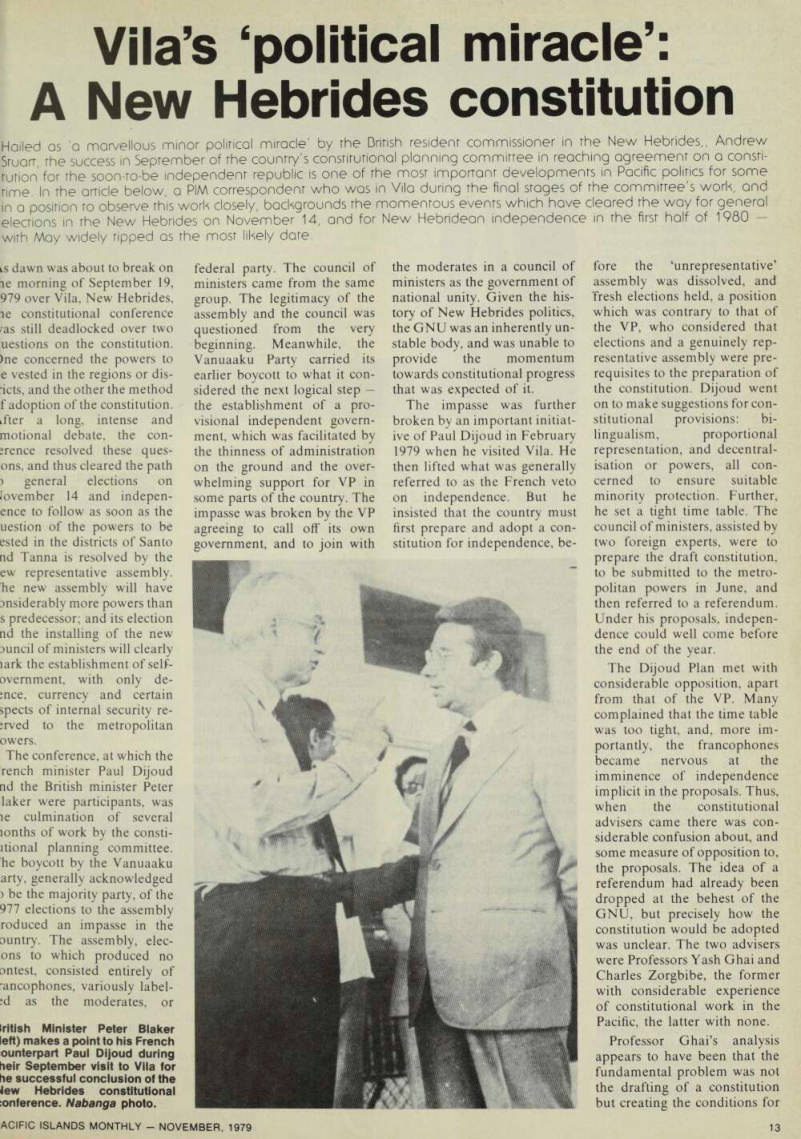
British Minister Peter Blaker (Left) makes a point to his French counterpart Paul Dijoud during heir September visit to Vila for he successful conclusion of the New Hebrides constitutional conference. Nabanga photo.
national unity. There was no doubt that the country was deeply divided, but the div isions were the result of the condominium. It was import ant that the New Hebrideans should transcend these div isions in order to find the true basis of unity in their common Melanesian heritage. In many ways this was the last oppor tunity for them to find the basis of unity, and so Professor Ghai reportedly urged the council of ministers, the different parties, churches and chiefs to expand the membership of the body charged with the basic re
sponsibility for drafting the
constitution, so that its deliber ations would begin the process of healing the national wounds, and the constitution would
enjoy greater legitimacy. The
constitutional planning com mittee was thus established in early April, on the initiative of the New Hebrideans and owing nothing to the metro
politan powers. Although its
legal status was ambiguous,it
was as representative a body as it was possible to put together in the circumstances, and the success with which it was established was an early indi cation that if the New Hebrideans were left to them selves, they were capable of resolving their differences in an amicable way.
Once the CPC took on board the task of drafting the consti tution, the vast majority of its members worked diligently and honestly. With the help of option papers prepared by the consultants, the committee held long debates on various aspects of the constitution, de bates which showed a sure grasp of the problems of the country and which were evi dence of the wish of the mem bers to find common ground and to understand the points of view of other sides. As the dis
cussions proceeded, they cut
across party lines. There was very quickly agreement on a parliamentary system, but there was considerable contro versy as to whether there should be a ‘constitutional’ or executive head of state.
Two of the most difficult issues were the system of elec tions, the moderates wanting
proportional representation,
and the VP wanting single member constituencies, and
the powers to be vested in the districts or regions (the term preferred by the moderates).
The latter issue threatened to abort the committee’s work of many months, and was not re solved until the last minutes of the conference.
There was a wide measure of agreement on the judiciary,
public services, languages and
land. It was also easy to find agreement on citizenship, de spite at one point a rather rigid and racist line taken by the Bri tish Government (withdrawn later when it was discovered that there was little in the pro posals of the CPC which need arouse the wrath of the Enoch Powells).
The conference concluded with the decision that the com mittee would travel round the islands to explain the consti tution to the people and seek their views on it. The com mittee would then reassemble in Vila when the two resident commissioners would sign the constitution on behalf of their governments, and it would then come into effect on the
eve of independence. Despite
some of the attacks which have been made on the constitution
it is generaly acknowledged
that it is very democratic; it provides for free and fair elec tions, and the government will always be responsible to the unicameral parliament. The ju
diciary is completely indepen
dent, and the Supreme Court is the final arbiter of disputes about the constitution and re sponsible to ensure that consti tutional rights and guarantees are respected. The constitution protects the fundamental human rights of all citizens, and provides for the establish ment of an ombudsman to
investigate complaints of
maladministration, discrimi nation, etc. The status of English and French as official languages is preserved, and Bislama will become the national language as well as an official language. There is to be a council of chiefs with the pri mary responsibility to safe guard and promote custom and tradition, and with important consultative functions in re spect to certain kinds of legis lation, including land.
On land, the constitution provides a basis for the return of alienated land to the
indigenous people and enables
the government to exercise greater control over land trans actions than before.
One issue the constitution does not resolve definitively is decentralisation. The com mittee was unanimous in its support of the need to decen tralise, but there was disagree ment on the extent of decentralisation and the pro cedure to determine this. An
overwhelming majority
wanted the question to be re
solved by the new Assembly' after receiving the report of a special commission; a small
minority wanted regional
powers agreed at the con-| ference and entrenched in the constitution.
The ultimate compromise was that the assembly would retain the power to make the decision on the devolution of powers to the regions and islands, but that Santo and s Tanna would elect their re gional assemblies on the same ; day as the general elections, and these would enter into I negotiations with the central government on the powers to be devolved, leaving the final ! decision on the assembly be fore independence. All in all, the constitution provides suit able guarantees for all groups, and in particular the French-1
speaking ‘minority’. It is clear 1
that each group has had to make compromises in order to reach agreement.
The constitution is therefore not only a considerable tech- I nical and political achievement j of the committee, but it is also evidence of the fact that the New Hebrideans are capable
of solving their own political <
differences, especially if the :
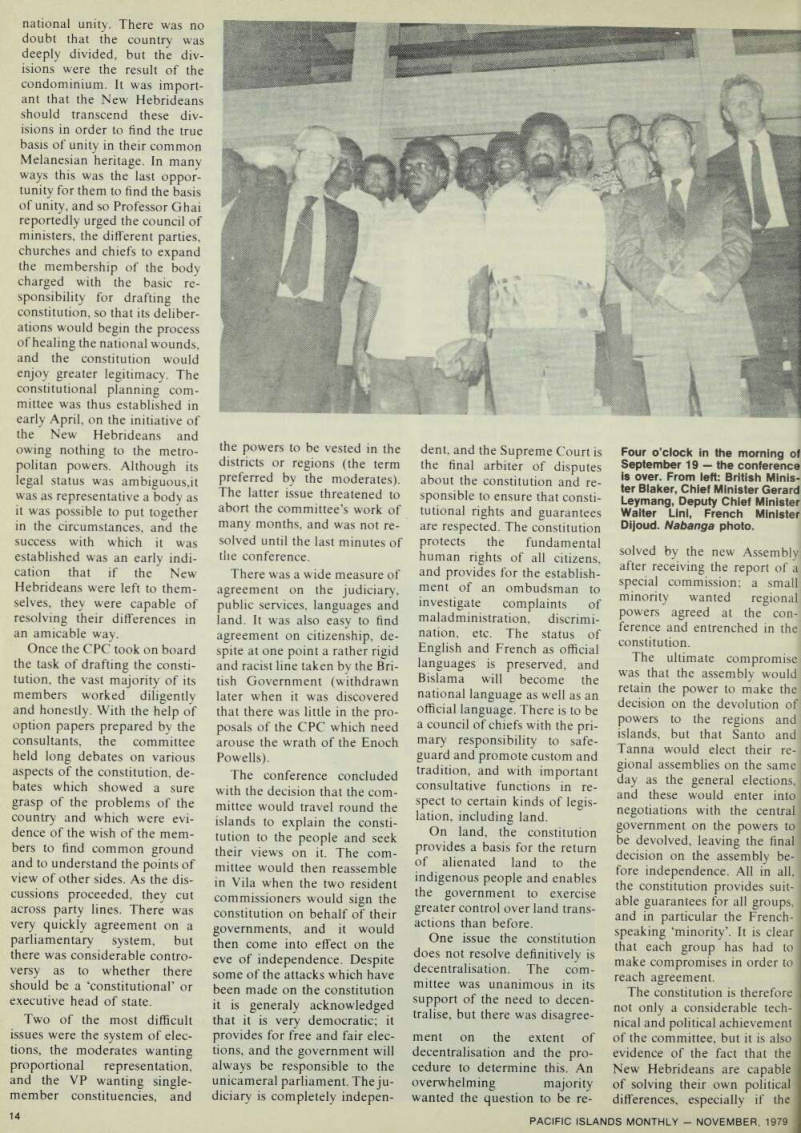
Four o’clock in the morning of September 19 the conference is over. From left: British Minis ter Blaker, Chief Minister Gerard Leymang, Deputy Chief Minister Walter Uni, French Minister Dijoud. Nabanga photo.
netropolitan powers do not nterfere unduly. There was a trong suspicion among the nembers of the committee that >n issues on which it was dif icult to get an agreement, one
>r the other metropolitan
lower was inciting a small ninority to be recalcitrant. De pite such interference, which
he ‘cognoscenti’ freely ack
lowledged, the committee suc eeded in its mission.
The ultimate success of the ommittee can only be judged •ver time, but it can be stated hat its work has truly laid the
»asis of national unity, fragile
hough the basis may be. It was he view of many observers hat the work and the spirit of he committee may have
irought about a qualitative
hange in the politics of the Jew Hebrides. Under the
iatient and gentle chairman
hip of Father Leymang, the ommittee worked on the basis f consensus, which meant in ractice that even one member f the Committee could hold p agreement on any point, 'here was therefore a strong icentive to concede points, to
ompromise and to persuade
ather than to threaten. The de ates helped to clear the air,
nd better understanding of
ae points of view of the dif jrent groups by others was stablished. It was clear that le political groups could no mger be facilely divided into nglophones and fran-
Dphones. Many prominent
ancophones co-operated with te VP, while among the mod rates there were at least two
nglophones. A very positive
)le was played by the
Tabwamesaana-Nakamal al liance. Many observers were impressed by the sense of re
sponsibility and maturity
shown by the VP, not least by those members of it who have been constantly attacked for being ‘communists’ and ‘Marx ists’.
A factor which ultimately facilitated co-operation among the New Hebrideans was their realisation that if the matter was left to the metropolitan powers, the interests of the New Hebrides would be poorly served. They realised that the NH was a small pawn in the game of international re lations, including the EEC, that Britain and France conduct with each other, and that this pawn would be lightly sacrificed. Those who saw the supine performance of the Bri tish minister would have been more than confirmed in their suspicions. Few expect that the two metropolitan powers will now desist from their intrigues.
Yet others may decide to try to divide the leadership of the VP in their mistaken and simplistic belief that a few communists exist who should be isolated.
Unless these outsiders want to see an area of instability in the Pacific, they would be well advised to let the New Hebrideans get on with the already difficult task of
national integration and unity
without external sabotage.
If the urge to carry on the Battle of Waterloo is too strong, they should be told to carry it on elsewhere, as Pro fessor Ghai stated in his fare well message to the committee.
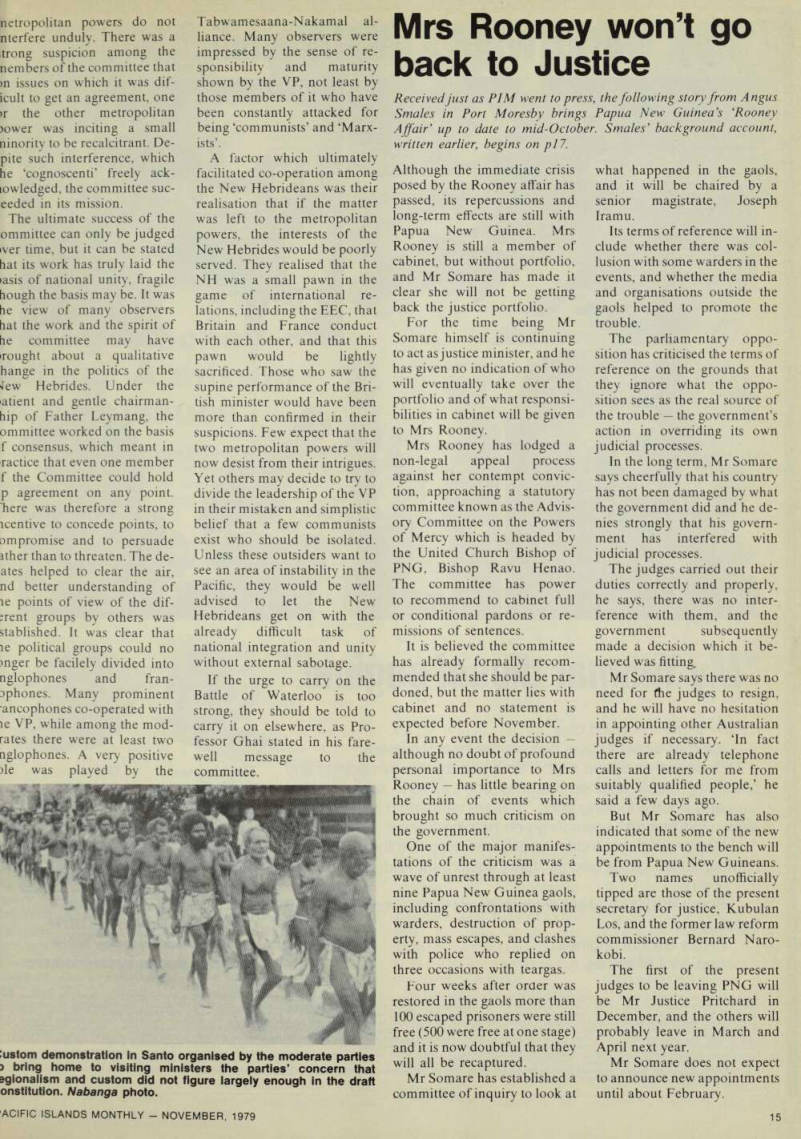
Custom demonstration In Santo organised by the moderate parties [?] bring home to visiting ministers the parties’ concern that regionalism and custom did not figure largely enough in the draft constitution Nabanga photo.