Letters
pp. 5-9 · Read in the full issue
Acre on the
eluctant missionary
entirely agree with Nigel
Lrauth (PIM, Aug, p 6) that le Institute of Papua New juinea Studies should be con eming itself with the present s well as the past, though per aps in the field of factual laterial rather than that of fic on.
I doubt whether the institute ;, in the long run, doing a good im to Papua New Guinean
reative writing by providing a
idtered workshop for PNG’s ovelists and a subsidised üblishing channel for their ovels. This kindly process de rives them of the kind of
ough editing’ which Nigel
rauth admits John Kolia’s ork stands in need of.
Some sort of a case could, no oubt, be made for giving this ind of aid to beginners in the
rt of novel writing, though it
lould be noted that our pion ;r PNG novelist, Vincent Eri, lanaged very well without it tid finished up in the Penguin st.
But John Kolia, currently the :ting director of the institute, not a beginner. My reluctant fissionary is his fourth novel, ad it is surely time for this riter to be thrown in at the eep end and left to sink or vim.
Nigel Krauth suggests that jmmercial publishers have •st interest in PNG. If so, I link that their interest would s quickly revived if a new avel of the calibre of Vincent ri’s The Crocodile appeared in
ieir in-trays.
Nigel Krauth accuses me of lack of sympathy with ‘dis aught humanity’. Not so. I >uld have very much sym athy with John Kolia’s Judy ; a reluctant Christian. But a Juctant missionary is a con adiction in terms. One does it, or at least one should not, y to convert others to a faith le is not sure about oneself.
Nigel Krauth refers to the
‘policy’ of the institute. I find this hard to gauge; but I notice that out of 10 publications listed back of the title page of My Reluctant Missionary, no fewer than seven are by John Kolia. Of the remaining three, only one is by an indigenous Papua New Guinean.
John Kolia is, of course, quite entitled to write what he likes, and to get it published if he can. But I am one of a num ber of PNG taxpayers who would like to be reassured that public funding of the institute is not being used to subsidise the publication of such highly tendentious fictional material.
Percy Chatterton
Port Moresby
Png
‘Reflections by
a Coral Reef’
I wrote the attached poem very late one Saturday night when I was teaching on Guam back in 1974-1976. It summed up a few of the changes a Statesider like me had to get used to, from phones not working, to drivers passing you at 90 mph on the street shoulder, to no buses or
public transport, to learning
that one had to live with all of these ‘O.O.G.’s’ (only on Guam’s).
Now that I am living the quiet life of a graduate student at the University of Colorado at Boulder, it seems a shame that there is no one I can share my little poem with any more who could enjoy the meaning of life on an island in Micronesia, If possible, I would appreciate it if you could print my poem in your magazine. It seems a shame to let it sit in a drawer in Boulder, when there are so many Islanders who could appreciate the little differences that make
island living so unique.
Marilyn Kaminski
Boulder Colorado
Usa
‘Reflections By A Coral
Reef’
To the tune of ‘Home on the Range’
By Marilyn Kaminski
Sunday, Nov 23,1975,2.45 am. 1 Oh, give me a land, Where the snowstorm is banned, And tropical breezes blow sweet.
Where never is heard, “Yon comes an iceberg!”
And you never wear shoes on your feet.
CHORUS: Guam, Guam in the sea, Oh, you look awfully good to me, Though you go far and wide, You will just find your stride.
Takes you back to the island of Guam. 2. You eat Australian beef.
And get high on a reef, And the mountains inspire you to heights.
Though it always is hot, It’s a pretty nice spot.
From the dawn to the tropical nights.
Chorus.
3. How could anyone lurk, Where the telephones work, And they take the mail right to your door?
Where the houses are brick, Without louvres to click, It’s so easy it must be a bore.
Chorus.
4. And how could you take, No coral to make.
Your car wheels skid from lane to lane.
Few mosquitos or boonie cats, And there are no fruit bats, Or many earthquakes or typhoons with rain.
Chorus.
5. Oh, how could you live, Where a bus ride would give.
You a look at too many pale faces?
Where subways go fast, And the radios blast.
Twenty stations from the world of rat races.
PIM regrets that space
problems preclude us from
publishing the final four verses
of reader Kaminski's pome, A nd trusts she is now settling down in her far-off Colorado home.
That ‘Pacific
Quebec’ again
In the past, local politicians in Tahiti and New Caledonia
have occasionally protested
against the hypocritical stand
of their ‘home’ government in Paris which is all for the independence of French Quebec but refuses to grant more freedom to its own ‘terri tories’ in the Pacific.
A former French journalist.
Daniel Tardieu, who lived for some time in Tahiti in the early 19705, has now added, in a let ter published in PIM. June, a new twist to the Quebec Saga
by twisting the facts.
In his view, the only problem is the ‘incorrect’ attitude of the
English-speaking peoples of
the Pacific, the editor of PIM and us, the under-signed cor
respondents of the magazine,
towards ‘the French-speaking
islands, with their population of some 320 000 people’ who are all perfectly happy with the present system of govern ment.
The simple truth, of course, as everybody knows, is that in the whole of French Polynesia, New Caledonia and the Wallis group there is not a single island where the French
language is the commonly
spoken mother tongue of the majority of the inhabitants, who are either Polynesians or Melanesians. And how does Mr Tardieu arrive at a popu lation figure of 320 000? Even if we leave out the New Hebrides, as he has obviously done, because of the embar rassing fact that they will soon achieve independence, the total is definitely wrong. As for Mr Tardieu’s contention that the majority of peoples in the French possessions are not in favour of independence, it is flatly contradicted by the re cent territorial elections in New Caledonia, the only ones so far where independence was the main issue. Not less than 82.5% of the Melanesians voted for
independence. What the figure
would be in French Polynesia, if a similar choice were given to the Islanders, is anybody’s guess.
Certainly, there can be found in some of the large islands a varying number of French officials, troops, nu clear test technicians,
gendarmes, businessmen,
planters, missionaries, and so on. But to equate the situation of these minority groups with that of the compact majority of French Canadians living in Quebec, as Mr Tardieu does, constitutes a deliberate attempt to create confusion in the minds of PIM readers, to say the least. Incidentally, if any valid comparison between Canada and the South Pacific can be made at all, these
‘French-speaking Islanders’
are rather matched by the
cordially detested ‘English
overlords’ in Quebec.
Having fabricated a totally
fictitious ‘Pacific Quebec’ con sisting of 320 000 French citi zens, Mr Tardieu makes a strong plea for a more tolerant attitude, meaning a hands-off policy and no criticism of the
ld-fashioned colonial lethods, from the govern lents and mass media in the
3-called English-speaking
art of the ocean. It must there ire have been a rather chilling xperience for him to read in le June issue of PIM, immedi tely after his own letter, what le most conservative and well isposed statesman in this inglish’ half of the Pacific has > say on this subject: ‘New ealand’s Prime Minister obert Muldoon has spoken of
le “growing difficulties”
iced by France in the South acific as “the major French domes. New Caledonia and rench Polynesia, become lore and more restive in as iring to independence”. He iid New Zealand’s position as that it wished “to see in
je time a wholly independent
Duth Pacific” .. .’
As for ourselves, we shall mtinue to report as correctly id completely as possible, in rite of all the pressures, reals and abuse to which we e subjected, all major events French Polynesia.
Marie-Therese And Bengt
Danielsson
pehue niti
/hat are the Games
II about?
ne can expect that the South acific Games will eventually ivelop towards the point here it will be too expensive •r any of, the Pacific Islands
mntries realistically to stage
em.
What are the South Pacific ames all about anyway? arely they at best can be tiled a third-rate gathering of »orting l urants who will iver make the grade in the Big ne. The Big One is the Olym cs not the ex-British mpire’s second-class Olym cs called the Commonwealth ames. Our local Pacific-style ini-games should be called a
iendly get-together.
Many participants are not e nationals of the country ey represent. Surely this must op! What is the point of send g a New Zealand golfer, or ustralian tennis player, to present Papua New Guinea Suva? Does this mean that VG has no national golfer or nnis player of sufficient stan
dard to represent this country?
If this is the case, then surely no one should represent Papua New Guinea in that sport!
The size of any contingent
can easily be limited by setting
minimum standards, and limit ing participants to nationals of each country and none of this ‘four years residence rule’ nonsense, either.
Participant numbers can also be limited by looking hard at the type of sports covered. In particular, sailing stands out to me. Ten years ago the boat selected was a Fireball; a good
boat, capable of being built by
the sailor for much less than KlOOO then. The committee then selected the Laser Kl2OO or so, professionally built only. Now they have moved into the big class Hobie Cat 16s more than
K2Loo (Sus3Ooo) In Png.
This is an expensive class. Has the committee ever considered what chance any national has (certainly in PNG, but prob ably every other place too) of ever owning or sailing a Hobie 16? PNG can’t even boast one national boat owner who races
regularly so perhaps the
selection committee could have a second thought about boats.
Why not eliminate sailing
unless it is done in a lakatoi?
I’m serious. Port Moresby sails up to 80 of these each weekend.
But if that type is not wide spread in the Pacific it would be unfair to select lakatois.
It seems to me the Games have run their predictable course and should be stopped, on account of the cost/benefit analysis. The cost is great and just what benefit does anyone but a select group of (often ex patriate) second-rate sports as pirants get from such expensive hoo-ha?
John Gardner
Boroko
Png
Goodbye Tim!
PIM has always had an unsur
passed reputation for predict
ing forthcoming events as well as its ability for exercising an
impeccable sense of timing.
There is no better illustration of this than the message that appears on pp 34-35 of August
Pim.
Dr Tim Kuberski, who has
been the epidemiologist with the South Pacific Commission for the past two years, is about to leave that post to return to the United States. During his time with the commission, Dr Kuberski has contributed con siderably to the SPC’s health programme. Dr Kuberski has
been held in high regard by
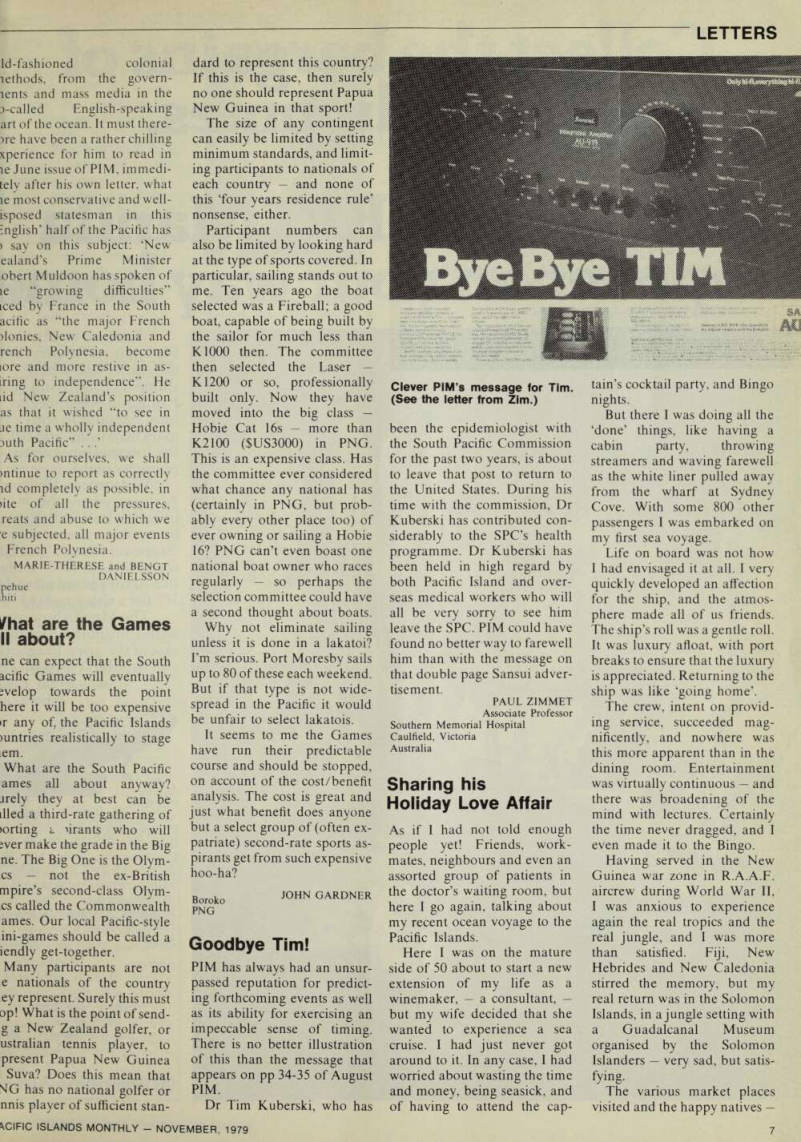
both Pacific Island and over seas medical workers who will all be very sorry to see him leave the SPC. PIM could have found no better way to farewell him than with the message on that double page Sansui adver tisement.
Paul Zimmet
Associate Professor Southern Memorial Hospital Caulfield, Victoria Australia
Sharing his
Holiday Love Affair
As if I had not told enough
people yet! Friends, work
mates, neighbours and even an assorted group of patients in the doctor’s waiting room, but here I go again, talking about my recent ocean voyage to the Pacific Islands.
Here I was on the mature side of 50 about to start a new extension of my life as a winemaker, a consultant, but my wife decided that she wanted to experience a sea cruise. I had just never got around to it. In any case, I had worried about wasting the time and money, being seasick, and of having to attend the cap
tain’s cocktail party, and Bingo
nights.
But there I was doing all the ‘done’ things, like having a cabin party, throwing streamers and waving farewell as the white liner pulled away from the wharf at Sydney Cove. With some 800 other passengers I was embarked on my first sea voyage.
Life on board was not how I had envisaged it at all. I very
quickly developed an affection
for the ship, and the atmos phere made all of us friends.
The ship’s roll was a gentle roll.
It was luxury afloat, with port breaks to ensure that the luxury is appreciated. Returning to the ship was like ‘going home’.
The crew, intent on provid ing service, succeeded mag nificently, and nowhere was this more apparent than in the dining room. Entertainment was virtually continuous and there was broadening of the mind with lectures. Certainly the time never dragged, and I even made it to the Bingo.
Having served in the New Guinea war zone in R.A.A.F. aircrew during World War 11, I was anxious to experience again the real tropics and the real jungle, and I was more than satisfied. Fiji, New Hebrides and New Caledonia stirred the memory, but my real return was in the Solomon Islands, in a jungle setting with a Guadalcanal Museum
organised by the Solomon
Islanders very sad, but satis
fying.
The various market places visited and the happy natives
Clever PIM’s message for Tim. (See the letter from Zim.)
do not know why one always lys “happy”, but it seems anonymous with the Island
rs met my anticipations,
lowever some islands are
lowing signs of “commer
alism”. This is a great pity id should be curbed by the Jthorities. The sight of native
lildren begging was fortu
ately not common, but it did :cur.
I found life on board par
cularly pleasing because, at
iproximately half the Aus alian price, I battled on with daily bottle of 1973 vintage
loet and Chandon chap
iagne another pleasant side
jnefit of the trip.
It is neither right or proper i presume that my friends will ijoy the same vacation, but I
we been boldly recommend
g a life on the ocean waves all and sundry. After all, a 1-day cruise ‘away from it all’ the South Pacific without a emish must create some loy ty in me.
R. W. ‘Scotty’ Ireland
>at Harbour 5W istralia
luestions for
Ir Malandain
ind it surprising that Bernard alandain of the French mbassy in Fiji has been Jremely quiet of late on
rench nuclear testing. Why
is he, who has so often Tended these tests on the ounds of their harmlessness, id nothing to say on the July » explosion at Moruroa? With e South Pacific Games now ell under way, Mr Malandain ould be seeking maximum iblicity for the humanitarian mefits of French nuclear sts.
Could it be that the South
icific Games participants,
irticularly those from French
might just react
angerously’ if a debate on the jestion were going on now in
e Fiji papers?
One thing is clear: history )es not teach the French
ilers anything. French nu
ear experimentation is like
iose developments which in
H 6 culminated in ‘Operation
rossroads’, an operation hich, according to the US ilitary governor of the
Marshalls at the time, involved
experiments designed ‘for the
good of mankind and to end all wars’. And yet three decades later the innocent inhabitants of Bikini and Enewetak are still
plagued by these ‘humani
tarian’ American exper iments!
Marie-Therese Danielsson (PIM, Aug, P 5) raises six ques tions about nuclear testing. I am also anxious for Mr Malan dain’s answers. And, in the interest of truth, I would also ask the following of Mr Malan dain: (1) An explanation and justi fication, on humanitarian
grounds, of the underground
explosion of July 25.
(2) An explanation of the ac cidents which occurred on Moruroa on July 6, which incidentally killed two and
injured four.
(3) To deny the claim of French biologist Jean Rostand that ‘every increase in the radioactive dose, however slight it may be, enhances the possibility of a mutation’.
If France has a conscience then its leaders must immedi ately put an end to its testing programme. The peoples of the Pacific can no longer tolerate the ‘official lie’ (Monod, Nobel Prize-winner). In the words of Albert Schweitzer, ‘those who claim that these tests are harm less are liars!’
For Pacific peoples, it is imperative that the French Government is confronted so that it will take hefd of Nelson
Anjain’s words (PIM, Aug,
p 14). A magistrate who, unlike Malandain and his colonial co horts, has acquired wisdom
from history! And though
Anjain speaks specifically of
US deception, his words are just as applicable to French betrayal of the true peoples of French Polynesia and the Pacific. ‘For me and the people of Rongelap, it is life which mat ters most. For you it is facts and figures. We want our life and our health. In all these years ... you’ve never once treated us as people ... you’ve never sat down among us, and really helped us honestly with our
problems ...’
J. J. Herman
Suva Fiji Once more on
that word ‘Fijian’
I belatedly came across PI M’s July issue and I am prompted to express to you my disap pointment with Laz Vusoniwailala’s article (pi 3) advising other races to become ‘Fijian’ in order to solve the
national identity problem.
Your readers certainly de served more enlightening •analysis and solutions than vague statements such as ‘walk ing the same road (to) evolve a set of shared values and per ceptions of the meaning of life’.
I wonder whether there is any validity in the belief that we
indigenous Fijians have ident
ical ‘values’ and ‘life con cern’?
On the one hand, Laz Vusoniwailala wants a plural society, but then enjoins other races to make sacrifices ‘to be
come Fijian’. People can’t
choose the culture they are born into, hence a person of Indian stock cannot miracu lously transform himself into a native Fijian any more than Mr Vusoniwailala can choose to become an American Indian in
Washington! The suggestion is
not only impracticable but also
culturally arrogant.
Instead of asking their races to do the impossible, why shouldn’t native Fijians make the sacrifice, and allow every citizen to adopt that name?
After all, it is not an indigenous word because it was what our former colonial masters chose to call us. If the natives are sin
cerely an ‘accommodating
people’ then why shouldn’t
such a gesture in the interest of national unity be made?
Mr Vusoniwailala put the cart before the horse when he said that the lack of a common name in Fiji is a result of a lack of national consciousness. On the contrary, there is as strong a sense of national identity in Fiji as in any other country but what is lacking is the political will on the part of the present leadership to come to terms with the question of a common name. It had been raised many times before and was always fobbed off with lame excuses such as Fijian opposition or the lack of a nice-sounding, widely acceptable alternative name.
So far, no attempt has been made to find out by survey, poll, or referendum what the
general populace actually
thinks. It seems that the Fijian leaders prefer to leave the mat ter in benign neglect because they can’t afford to bury old
political myths about Indian
designs to grab Fijian land etc,
as they still have their political
use nowadays for arousing
ignorant suspicions and false
fears for the purpose of main
taining political support.
If the natives’ possessiveness about the name ‘Fijian’ cannot
be ignored or dispelled by
rational argument, then why not circumvent the issue by having the country adopt a new
name altogether?
The different groups can retain their present racial identification and strengthen the sense of belonging together by a new national name. There are numerous countries in the world that discarded their old colonial names without any difficulty and the best
examples are Fiji’s neighbour
ing countries such as Kiribati and Tuvalu.
With the races in Fiji now more than ever divided as a consequence of disputes over entry to the University of the South Pacific, and within the
major political parties, the time
may be right for the leaders to do at least something positive that will not cost much finan
cially and is in everyone’s long
term interest.
J. D. Varani
Wellington New Zealand
French biologist Jean Rostand ... ‘every Increase In the radioactive dose, however small, increases the possibility of a mutation’