Softly, softly
pp. 70-73 · Read in the full issue


Tropicalities
A new island
for Tonga
Captain R. Jones, a New Zea lander who is a pilot with Ton ga’s domestic airline Tonga Air, can claim to have witnes sed the birth of a new island which has added itself to the approximately 170 islands already in the group.
He watched its gradual birth over a period of three days late in June. ‘It was tremendously spectacular each time I flew back over. A fantastic experi ence I will never forget,’ he told the New Zealand Herald.
The first signs of activity were large volumes of smoke rising from the sea midway be tween the volcanoes of Kao and Late, in the centre of the
Tongan group.
Captain Jones said that at first there was no sign of land anywhere around, although near the centre of the smoke he saw the green outline of a sub terranean peak in the midst of the blue ocean. ‘The green area was about two miles in diameter on
Thursday, and by the next day
it was about five miles. On Saturday it had grown to about seven miles in diameter,’ he said.
By Friday, the island had appeared. Captain Jones de scribed it as a huge boiling mass of volcanic activity throw ing up rocks as high as 500 feet.
There appeared to be no crater, and emissions occurred spas modically from different parts of the island.
The island was named per
sonally by King Taufa’ahau
Tupou IV as Lateiki, a name indicating its proximity to the Tongan island of Late. Similar islands appear and disappear in Tongan waters from time to time, the best known being Falcon Island first sighted as early as 1781.
At the same time as Captain Jones was witnessing the viol ent birth of the island, the New
Zealand research ship Tui was
experiencing an alarming
cruise over several active underwater volcanoes near the Tonga group. In particular, the crew was shaken by a series of powerful thumps as the ship passed over the Orion cone south of Tonga.
A New Zealand Navy spokesman said that a whole series of old and new volcanoes had been rumbling away on the Louisville Ridge which runs several thousand miles from New Zealand’s East Cape up
past Tonga.
Pacific People
wows Auckland
Pacific People, a nightly radio programme aimed at the 100 000 Maoris and Pacific Islanders who live in Greater
Auckland, has given Polynes
ians a new trust in the media, according to the programme’s host James Waerea. The pro gramme is now their media voice in Auckland, he claims. ‘When it all started, most phone-in callers were ob
viously non-Polynesians,’ he
says. ‘As the weeks have passed the number of Polynesian callers has climbed. Now
there s a sense of trust. They can talk to us in English or their own language without fear of
being misrepresented. They are
speaking for themselves.’
Monday night on Pacific People is Maori night (co hosted by brilliant scholar and
linguist PatHohepah); Tuesday
is for Tongans (co-host Semisi
Finaulagi); Wednesday is
Samoa night, and is shared among co-hosts Sue McCarthy, Alfred Hunkin and Pepe
Aiolupotea; on Thursdays
Cook Islanders take charge, with co-hosts Paul Tangata, Dorice Reid and Norman George; Friday is Niue’s night, with John Osikai and Marion McQuoid.
In a report on the pro gramme, the monthly journal Radio Pacific records that one caller to ‘Pacific People’ ran two blocks to a public tele phone box and hung on for 40
minutes until his turn came on air, keeping at bay three people who also wanted to use the
phone. Radio Pacific said:]
The caller claimed he wasn’t prepared to “leave his post” until he had got through to the show.’
Softly, softly
on TV in Fiji
The Fiji Government is tread ing softly in its approach to the mounting pressures upon it to approve the introduction of television into the country.
According to Los Angeles
Times reporter Barry Siegel
who was recently in Suva, the
pressures are coming mainly
from Suva’s business and tour ist interests one government source mentioned specifically to Siegel the Junior Chamber of Commerce. There are also! less formal influences at work!
Historic scene as the Tongan flag was raised on the country’s
171st - and newest - island,
Lateiki, on July 8, 1979. The flag was raised by Police Inspector George Blake while 29 of the landing parly sang the national anthem. Fifth from right is His Majesty’s youngest son, Prince ’Ahoeltu, who represented King Taufa’ahau Tupou IV at the cer emony. The island emerged from the sea as a result of volcanic activity, and geologists think it is most likely to have a short life.
Tonga Chronicle photos.
- from native Fijians and ex >atriates from Britain, New Zealand and Australia some f whom already buy pro rammes on cassettes to play
n their videotape players
ooked into television sets.
But the government is wary.
Writes Siegel: ‘They look to imerican Samoa and to Tahiti, lew Caledonia and parts of licronesia, the only Pacific ;land areas that now have TV . . They are tracking the ap roach of television across the acific as they might plot the ath of a tornado.’
One of the documents on the
roblem most frequently con
ilted by Fijian leaders was repared by a team of Can-
Jian anthropologists from the
niversity of Winnipeg on the fects of the arrival of tele sion on the northern Mani
la Cree Indian community
' the settlement of Norway ouse in late 1973. The scien >ts were not content just to udy the immediate effects, Jt continued their work as the fects of the new medium sank to the community. In May is year they published a
)3-page ‘preliminary report’
' their findings.
Fijian officials especially
e Minister for Information
atu William Toganivalu
e paying extremely close
tention to the undoubted uses, and the equally idoubted minuses, revealed the Canadian report.
Bowing to the pressures, the ji Government earlier this ar commissioned a feasibility ady into the implications of e advent of television to Fiji, le cost of the study at least 00,000, and perhaps twice at is to be sought as aid Dm the Commonwealth
and for Technical Co-oper
ion. Said Ratu Toganivalu:
ft could do without tele don for the time being, but ievision is bound to come be use people will demand it. )liticians can’t ignore this. So it is to come, we want it to
: the proper type.’
In contrast to Fijian officials’ >ubts and fears is the charac
ristically non-conformist
sw of Pacific television taken ' Samoan novelist Albert endt, who admits to prefer
ig ‘junk’ to ‘highbrow’ shows.
Warning against over-romant icising the idea of cultural pres ervation, he says: ‘lt’s the
people actually living in the
culture who want a better, more modern life, and I under stand that. It’s the outsiders who already have televisions and big cars and nice homes who want to preserve the native cultures. I don’t blame people for wanting to move from the plantations to the cit ies. The fact is, hacking away on a plantation is hard work.’
What’s that,
Sir Roden?
Lord Howe Island, 675 km off the east Australian coast, remembered in August the 50th anniversary of the start of its first radio link with the out side world. And the man who tapped out that first message on the Morse key it was an
expression of loyalty addressed
to NSW Governor Sir Dudley de Chair was happily still on hand to press the key that auto
matically despatched a similar
message to NSW Governor Sir Roden Cutler.
Back in 1929 Sir Dudley, following a visit to the island, had been instrumental in get ting a wireless station erected there. Before that, their only connection with Australia was by ship. World War I was three weeks old before Lord Howe Islanders heard about its out break.
Local resident Stan Fenton, an experienced ship’s radio of ficer, got the job of Postmaster and Wireless Officer for Lord Howe and remained in charge of the radio until his retirement in 1968.
The Morse operation which Stan started on August 19, 1929, gave way to telex only on August 8, 1975 - it being the last public communication Morse circuit to be made redundant by the Australian post office.
At the packed public dinner to mark the occasion (superb local fish and calorie-laden island desserts) Stan was so moved as to be almost speech less. The nostalgia was underlined by a display in the hall of much of the early man ual wireless equipment so long
used by Stan Fenton, now, thanks to the foresight of island resident Jim Dorman, owned
by the recently established
Island Museum.
The Island Member for the Lord Howe Island Board,
Bruce McFadyen, publicly
read out the message that Stan that day had sent off to Sir Roden Cutler, in which the islanders ‘hoped that Lord Howe will continue to benefit from further radical changes in communication without des troying the peace and tranquil lity of this relatively isolated
community’.
What the governor’s reply
was, the dinner guests never heard, for as Bruce McFadyen explained, the governor’s care
fully composed return message
had got caught up somewhere in the computer technology of a half-century later, and the technicians at the Sydney end were still trying to extricate it!
Problem drums
of Lord Howe
Rusting away in various sites beneath the coconut and kentia palms of otherwise beautiful Lord Howe Island are dumps
totalling 9000 empty 44-gallon
oil drums with more being added every few weeks. Once
only an economic problem,
they are now becoming an environmental one Lord Howe, off Australia’s east coast, has no bulk fuel in stallations and no overseas wharf, so fuel supplies come by ship in 44-gallon drums for
easy handling. The trouble is that the high cost of freight to the island makes it uneconomic to return the empty drums to Sydney $23 freight per drum is more than a new drum is worth.
The last big consignment of empty drums left the island in 1977, for Noumea. Compara tively few have left since, by
special back-loading arrange
ments.
Island Committee member Clive Wilson says there will be a clean-up soon when badly deteriorated drums are dumped at sea. In the longer term there are tentative plans for erection of diesel fuel storage tanks (put under ground so as not to ruin the environment) connected by a pipeline to the jetty. Mean while, he agrees ruefully, the island will have to make a con certed attack on the problem of repatriating its unwanted drum population before the drums take over the island.
Suicide misfits’
way out in TT
The Saipan newspaper Marianas Variety News & Views has carried a two-part series on the growing problems of suicide in Micronesia (PIM
May).
The writer, Teresa Sullivan, notes: Tn the Trust Territory, the overall rate for suicides per 100 000 population in 1977 was
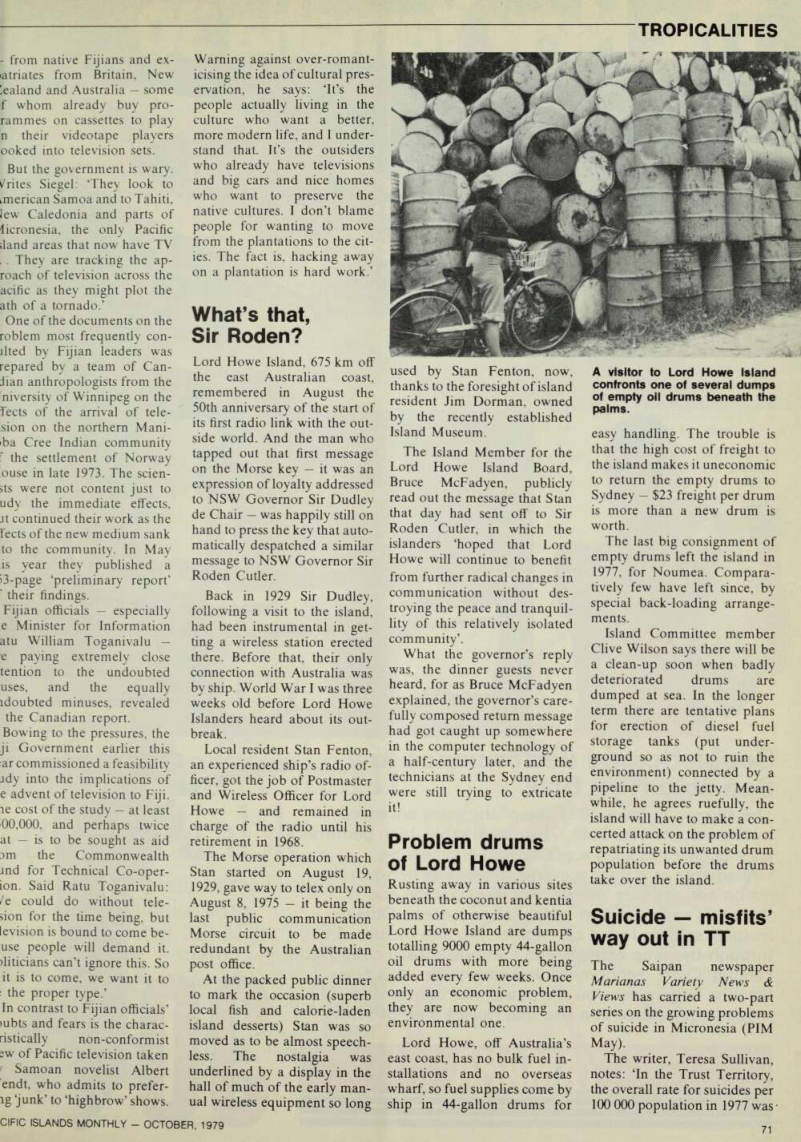
A visitor to Lord Howe Island confronts one of several dumps of empty oil drums beneath the palms.
-3.6, only slightly higher than
he 12.6 US rate. However, /hen these suicides are con idered on an age and sex pecific rate, the figure soars to 11 suicides per 100 000 popu ition.’
She cites a study of suicides i the Marshall Islands which evealed: all suicides were male; all were between the ges of 16 and 25; all were
itoxicated usually with beer
-just before their suicide; all
having adjustment prob
;ms and were relatively unsuc essful in their Marshallese ommunity; all were unem
loyed school dropouts depen
ent on parents with no articular place in the com
munity; all experienced dis
ord with their families and ften the suicide occurred soon fter the parents refused the oy money with which to buy eer; most suicides occurred in me district centre (where the ash economy’ is at its stron est and the traditional ways
lost disrupted); most suicides
ere people whose education ad not gone very far and who
had never been outside the Islands.
Dr Paul Dale, chief of the mental health division in the
Trust Territory, disputes a
widely held view that the absence of job openings for
qualified youth returning
home from overseas training was a cause of the prevalence of suicide. He maintains the re verse, pointing out that the suicide candidates are over
whelmingly people who had
had limited educational suc cess. He adds: ‘The notion that having no job is such an over whelming defeat that death is preferred is strictly “an American work ethic” notion.
For Micronesians, work con tinues to be an intermittent phenomenon and not some thing they’re apt to kill them selves over.’
Dr Dale says: ‘The problem in self-destructive acts has its basis in difficulties within the family or clan.’
One senior public health
authority, after spending three
years in Truk, sees two types of suicide as occurring in that dis
trict. He explained that suicide was traditionally an honourable act, a ‘socially stabilising factor’, in Truk in years past, when there was nowhere else to go, it was the only alternative for those who were unable to con form to the norms of the clan.
He related the story of a young couple on the island of Tol in Truk who bound themselves together and jumped from a cliff to their deaths. It seemed that the two had become lovers, but being of the same clan they found themselves ostracised as a result. Suicide thus became their only way out.
According to Father Francis Hezel, director of Xavier High School in Truk, these ‘classic suicides are not what’s happen ing these days, at least in most cases’. To help curb the in crease in suicides, he rec ommends a ‘slowing up of social change’ in concrete terms, a reduction in the cash inflow into Micronesia.
Hezel also sees the need for a programme to educate
parents in more consistent forms of child-raising. Ado lescent males ‘are in a pigeon hole where they are not lis tened to’, he says. Responsi bility is not asked of them, but at the same time they are trying to find a place in society.
Hezel sees a third area of action in the efforts to meet the
problem ‘restoring the
integrity of the community’. He says: ‘lt’s difficult to see young
people growing up healthy in
a community that isn’t
healthy.’
‘My feeling,’ says Hezel, ‘is that a lot of communities are sitting down and playing dead,
abdicating responsibility to the
government.’ With the pro liferation of social services,
people are no longer challeng
ing their government, since so much is done for them.
While advocating an in
depth study for the problem
over the 10-year period
1968-78, Hezel is not wildly optimistic. ‘All we can do is present the problem and probe,’ he says.