lesson ro be learned
p. 66 · Read in the full issue
AFTERTHOUGHTS with Percy Chatterton in Port Moresby.
Low and order A big lesson ro be learned in PNG and learned fast
No one can complain that life in Papua New Guinea is dull.
In recent weeks we have witnessed the declaration of a stale of emergency in the Highlands provinces, and the summoning of the minister for justice to answer a charge of contempt of court! The second of these two events is still sub judice and my comments on it must be postponed. The state of emergency has been ratified by parliament.
The law and order situation in the Highlands has been stead ily deteriorating for some time. It has now reached a state in which inter-group fighting has become endemic and normal living has been totally disrupted. Schools and aid posts have been closed, casualties in the fighting, a number fatal, have been increasing in numbers, and damage to and destruction of property houses, stores, livestock, coffee trees has reached massive proportions. Banditry on the Highlands High way has reached a point at which trucking companies and their drivers have threatened to suspend business altogether a step which, if taken, would bring the Highlands economy grinding to a halt.
The provisions in PNG’s constitution for the declaration of a state of emergency have been well devised. Parliament must not only give its approval, but must also renew that approval, if necessary, at intervals of 60 days. The exercise of the special powers given to the authorities, and in particular to the police, is watched over by a committee made up of rank-and-file members of parliament drawn from both government and op position benches, and this committee is also charged with the responsibility of advising parliament at the end of each 60-day period whether the state of emergency should be extended or not. The committee of nine currently appointed includes vet eran Sir John Guise, and a former secretary for law and now opposition MP. Mr Joseph Aoae.
On paper it’s all excellent. In practice its success depends, of course, on how those responsible, and particularly the police, carry out its day-to-day administration. There have already been some complaints of inconveniences suffered, of the disruption of lifestyle and livelihood, and of police excesses in the uses to which they have put their extended powers.
One of the most spectacular of the immediate results has been the putting off the road of large numbers of unroad worthy vehicles and unlicensed drivers, a step which one would have thought could have been taken without the declaration of a state of emergency. Whatever inconvenience it may have caused, surely no one in their right senses could complain that this blitz was harsh or oppressive.
On the whole, public reaction to the declaration of the state of emergency has been favourable, especially among the women, some of whom recently organised a meeting at which no men were allowed to speak so much for the myth that PNG’s women are downtrodden drudges!
There are differences of opinion as to the reasons for the current lawlessness in the Highlands, and as a dweller on the coast I will not stick my neck out by trying to analyse them.
But whatever the causes, the time for a showdown has clearly arrived.
There has also been a massive upsurge of lawlessness in the
urban areas, particularly in Port Moresby. The reasons are no doubt quite different from those which have operated in the Highlands, but the end result is the same, and clearly here too the time for a showdown has come.
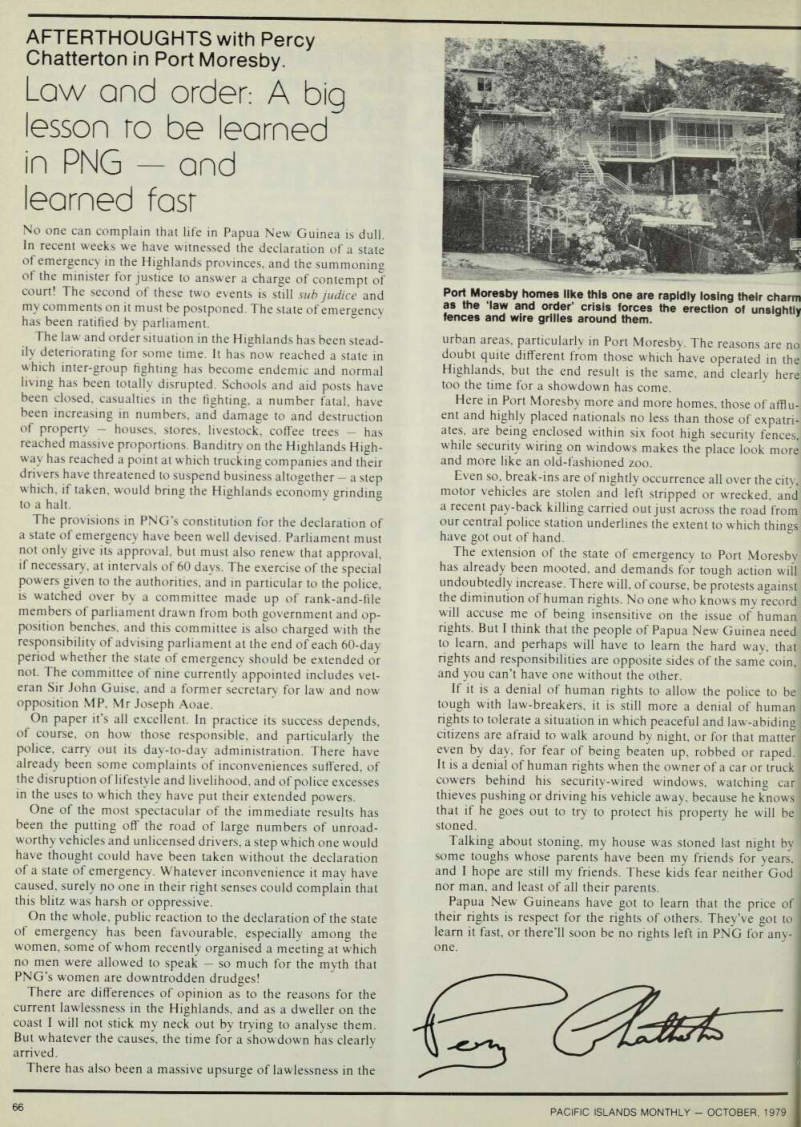
Here in Port Moresby more and more homes, those of afflu ent and highly placed nationals no less than those of expatri ates. are being enclosed within six foot high security fences, while security wiring on windows makes the place look more and more like an old-fashioned zoo.
Even so, break-ins are of nightly occurrence all over the city, motor vehicles are stolen and left stripped or wrecked, and a recent pay-back killing carried out just across the road from our central police station underlines the extent to which things have got out of hand.
The extension of the state of emergency to Port Moresby has already been mooted, and demands for tough action will undoubtedly increase. There will, of course, be protests against the diminution of human rights. No one who knows my record will accuse me of being insensitive on the issue of human rights. But I think that the people of Papua New Guinea need to learn, and perhaps will have to learn the hard way, that rights and responsibilities are opposite sides of the same coin, and you can’t have one without the other.
If it is a denial of human rights to allow the police to be tough with law-breakers, it is still more a denial of human rights to tolerate a situation in which peaceful and law-abiding : citizens are afraid to walk around by night, or for that matter ; even by day, for fear of being beaten up, robbed or raped. I It is a denial of human rights when the owner of a car or truck cowers behind his security-wired windows, watching carl thieves pushing or driving his vehicle away, because he knows that if he goes out to try to protect his property he will be stoned.
Talking about stoning, my house was stoned last night by some toughs whose parents have been my friends for years, i and I hope are still my friends. These kids fear neither God , nor man, and least of all their parents.
Papua New Guineans have got to learn that the price of their rights is respect for the rights of others. They’ve got to learn it fast, or there’ll soon be no rights left in PNG for any- j one.
Port Moresby homes like this one are rapidly losing their charm as the ‘law and order’ crisis forces the erection of unsightly fences and wire grilles around them.