of string figure
p. 63 · Read in the full issue
Books
Solomons: cradle of string figure In Oceania?
Solomon Islands String Fig
ures, by Honor Maude, pub
lished by the Homa Press.
Distributed by ANU Press,
Canberra, ACT. SA6. 3ne of the curious side effects )f the introduction of tea to Europe in the seventeenth cen ury was that Europeans icquired a pastime that had ong been known in China, the tome of tea, and other coun ries in the Far East. This was
he art of making figures with
i length of string, which be
ame known in England as :at’s cradles’.
It must still have been fairly
lew to England when Captain
rook left on his first voyage to he Pacific in 1768, for the arliest description of cat’s radles in the Oxford English )ictionary was written in that ame year.
To make a cat’s cradle, the 768 account says, ‘one ties the vo ends of a packthread 3gether and then winds it bout his fingers, another with oth hands takes it off, perhaps i the shape of a gridiron, the rst takes it from him again in nother form, and so on, alter
atively changing the
ackthread into a multitude of
gures ...’
It was probably because the rt of the cat’s cradle was still ttle known in England in 768, or because it was looked
n as only a simple amusement
)r children, that Cook and his
Dmpanions recorded nothing
bout the making of string fig
res during their extensive
oyages.
It is hard to imagine that ley never saw any of the landers playing at cat’s
•adles, for anthropologists
ow know that the islanders re among the world’s most
extrous practitioners of the
rt.
Indeed, cat’s cradles have pparently been made in the acific Islands for so long that ley constitute valuable clues
» the Islanders’ prehistoric
past. This is because all cat’s cradles fall into several well defined categories which are determined by the type of
opening and the following
move. As the patterns tend to be passed down from gener ation to generation and from island to island, it is thus poss
ible to plot migration trails by
means of them.
Since the noted anthropol ogist A. C. Haddon interested himself in the string figures of the Torres Strait islanders at the turn of the present century, the ingenuity of the Pacific Islands’ artists in string has been reasonably well recorded.
Undoubtedly the most en thusiastic recorder of Pacific Islands string figures in recent years has been Honor Maude, wife of Professor Harry Maude of Canberra, a former Pacific administrator. Mrs Maude be came interested in the subject when she accompanied her husband to his first adminis trative post in the Gilbert Islands half a century ago.
She has since collaborated in the publication of more than half a dozen monographs on
string figures.
Her latest work is based on collections made in the Solomon Islands by the noted
anthropologist Sir Raymond
Firth, in 1928-29, and by Christa de Coppett in 1963-65.
The book, which is offset
from typescript, describes 112
distinct figures plus three
tricks, and gives details on how they are made with the help of line illustrations. ‘lt now seems clear,’ she says, ‘that the Oceanic region, from New Guinea eastwards to Eas ter Island and the Carolines southwards to New Zealand, represents a separate and rela
tively homogeneous technique
unit, which includes the Torres Strait islands and most, if not all, of Australia. Whether Indonesia has affinities to Oceania, as one would suspect on other grounds, must await the publication of detailed local studies; but now that we have adequate data from Japan it is clear that Japanese figures are not, taken as a whole, Oceanic in type. ‘With this Oceanic region the Solomon Islands appear to constitute a convergent area where one finds 45 figures pre viously recorded in one or more localities in New Guinea, the Torres Strait and Australia, 41 on one or more islands of Polynesia, 32 parts of Micronesia and 25 on other Melanesian islands (including Fiji) ... about 10% of the fig ures recorded in the Solomon Islands are basic Oceanic pat terns known throughout the re
gion: these were presumably
part of the ancestral culture of the Oceanic peoples at a time prior to the eastward dispersal of the present Polynesians.’
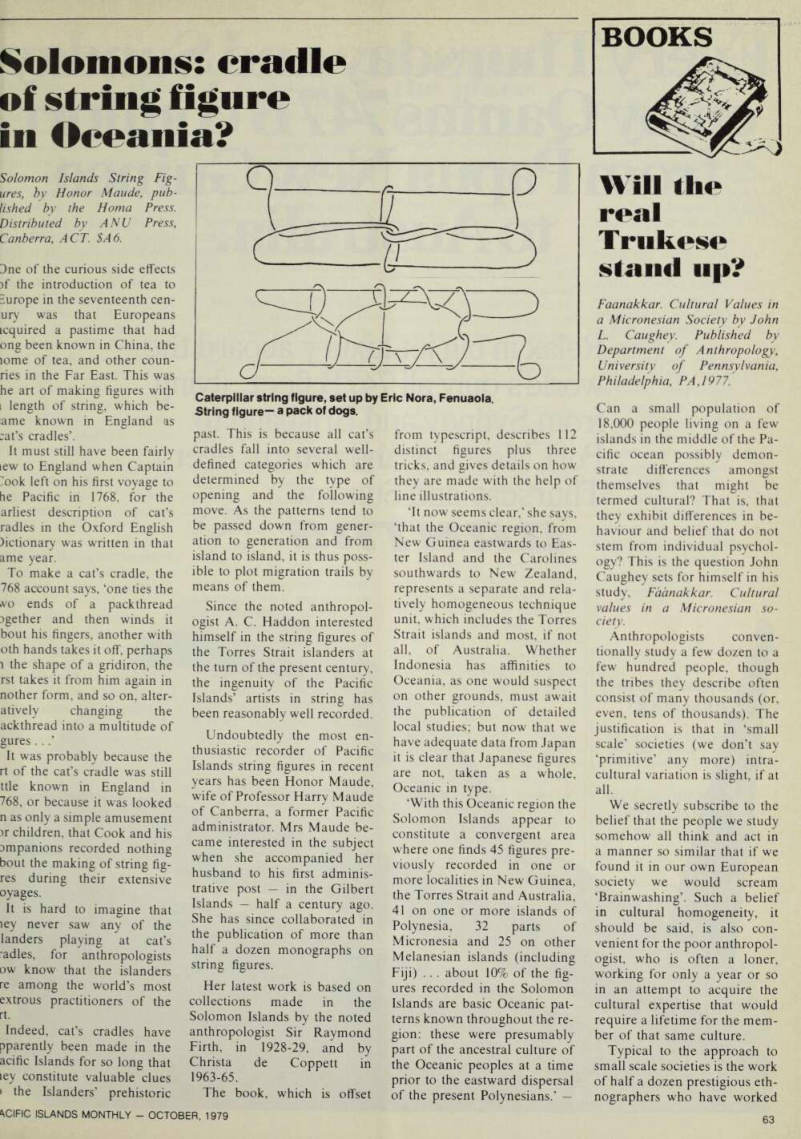
Caterpillar string figure, set up by Eric Nora, Fenuaola.
String figure— a pack of dogs.