and do’
p. 53 · Read in the full issue
Tonga
‘A readiness to muck in and do’
The Australian presence in
Tonga is limited numerically
but effective in impact,
writes Penny Hodgkinson in
Nukualofa. There are five sub sidised civil servants, and a handful each of; aid advisors and services instructors, Aus tralian Volunteers Abroad, teachers and tradesmen, per sonnel active in the private sec tor and church administration.
They are popular mainly be
muse of their readiness to muck-in-and-do rather than stand-back-and-order, their ;asy friendliness, and a genu ine interest in the place and aeople. Australians are also embraced in a strong Com
nonwealth loyalty which has
aeen boosted by the projected
itate visit to Australia by fonga’s King and Queen in October, and Australian remit ance dollars from relatives on vork permits which are often :rucial to local families.
Two ‘unofficial Australian imbassadors’ who have been
videly praised are orthopedic
urgeon lan Stratton for his
miracle’ operations on club
boted children, and construc
ion supervisor Leo Foley of
he Vavau hospital project,
vho has made many friends md taught new standards to
fongan workmen.
Here is a brief description of najor aspects of the relation hip between the two coun ties; Trade: Australian com >anies are said to outperform, mtprice and outpack New
Zealand companies. But the
alter score with more frequent
hips and goodwill arising from
more generous reverse mar et access. The figures in the ccompanying table tell the tory.
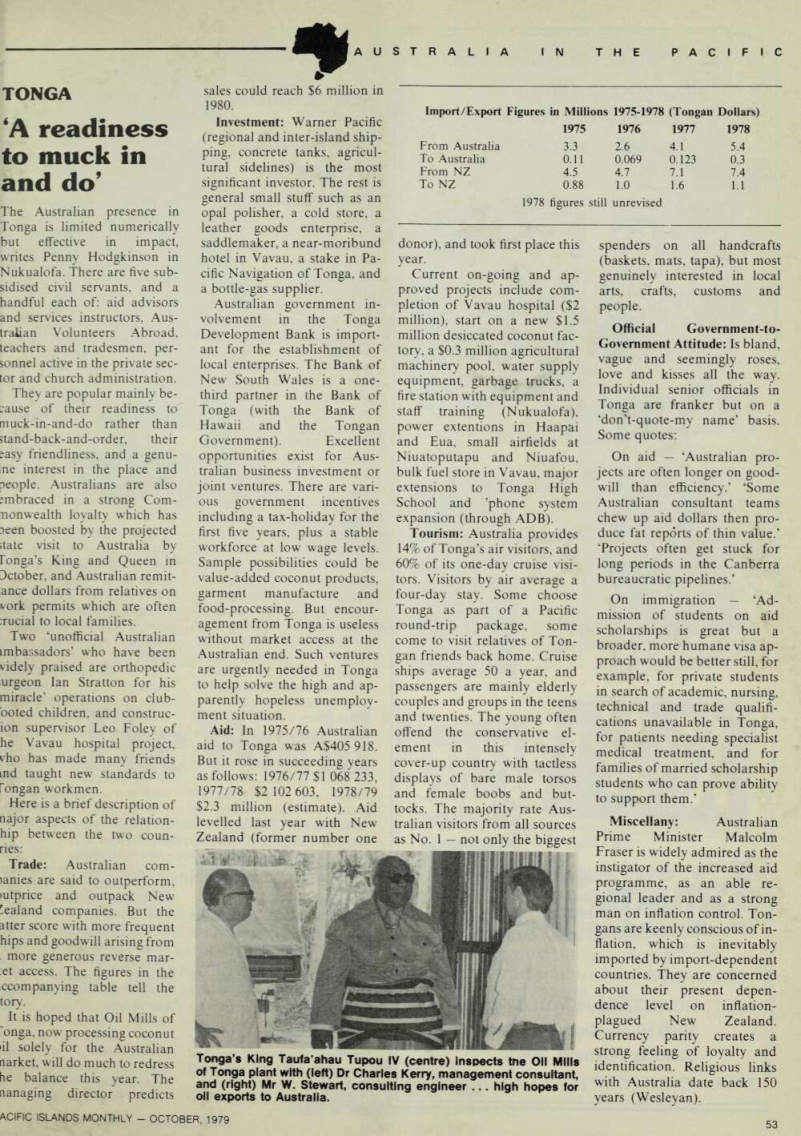
It is hoped that Oil Mills of onga, now processing coconut •il solely for the Australian aarket, will do much to redress he balance this year. The managing director predicts
sales could reach $6 million in 1980.
Investment: Warner Pacific
(regional and inter-island ship
ping, concrete tanks, agricul
tural sidelines) is the most significant investor. The rest is general small stuff such as an opal polisher, a cold store, a
leather goods enterprise, a
saddlemaker, a near-moribund hotel in Vavau, a stake in Pa cific Navigation of Tonga, and
a bottle-gas supplier.
Australian government in volvement in the Tonga
Development Bank is import
ant for the establishment of local enterprises. The Bank of New South Wales is a one third partner in the Bank of Tonga (with the Bank of Hawaii and the Tongan Government). Excellent opportunities exist for Aus tralian business investment or joint ventures. There are vari ous government incentives including a tax-holiday for the first five years, plus a stable workforce at low wage levels.
Sample possibilities could be
value-added coconut products, garment manufacture and food-processing. But encour agement from Tonga is useless without market access at the Australian end. Such ventures are urgently needed in Tonga to help solve the high and ap
parently hopeless unemploy
ment situation.
Aid: In 1975/76 Australian aid to Tonga was As4os 918.
But it rose in succeeding years as follows: 1976/77 $1 068 233, 1977/78 $2 102 603, 1978/79 $2.3 million (estimate). Aid levelled last year with New Zealand (former number one
Import/Export Figures in Millions 1975-1978 (Tongan Dollars)
donor), and took first place this year.
Current on-going and ap proved projects include com pletion of Vavau hospital ($2 million), start on a new $1.5 million desiccated coconut fac tory, a $0.3 million agricultural
machinery pool, water supply
equipment, garbage trucks, a fire station with equipment and staff training (Nukualofa), power extentions in Haapai and Eua, small airfields at Niuatoputapu and Niuafou, bulk fuel store in Vavau, major
extensions to Tonga High
School and ’phone system expansion (through ADB).
Tourism: Australia provides 14% of Tonga’s air visitors, and 60% of its one-day cruise visi tors. Visitors by air average a four-day stay. Some choose Tonga as part of a Pacific
round-trip package, some
come to visit relatives of Ton gan friends back home. Cruise ships average 50 a year, and
passengers are mainly elderly
couples and groups in the teens and twenties. The young often offend the conservative el ement in this intensely cover-up country with tactless displays of bare male torsos and female boobs and but tocks. The majority rate Aus tralian visitors from all sources as No. 1 not only the biggest
spenders on all handcrafts (baskets, mats, tapa), but most genuinely interested in local arts, crafts, customs and people.
Official Government-to- Govemment Attitude: Is bland, vague and seemingly roses, love and kisses all the way.
Individual senior officials in Tonga are franker but on a ‘don’t-quote-my name’ basis.
Some quotes: On aid ‘Australian pro jects are often longer on good will than efficiency.’ ‘Some Australian consultant teams chew up aid dollars then pro duce fat reports of thin value.’ ‘Projects often get stuck for long periods in the Canberra
bureaucratic pipelines.’
On immigration ‘Ad mission of students on aid scholarships is great but a broader, more humane visa ap proach would be better still, for
example, for private students
in search of academic, nursing, technical and trade qualifi cations unavailable in Tonga,
for patients needing specialist
medical treatment, and for families of married scholarship students who can prove ability to support them.’
Miscellany: Australian Prime Minister Malcolm Fraser is widely admired as the instigator of the increased aid programme, as an able re gional leader and as a strong man on inflation control. Ton gans are keenly conscious of in flation, which is inevitably
imported by import-dependent
countries. They are concerned about their present depen dence level on inflation plagued New Zealand.
Currency parity creates a strong feeling of loyalty and identification. Religious links with Australia date back 150
years (Wesleyan).
Tonga’s King Taufa’ahau Tupou IV (centre) Inspects the Oil Mills of Tonga plant with (left) Dr Charles Kerry, management consultant, and (right) Mr W. Stewart, consulting engineer ... high hopes for oil exports to Australia.
1975 1976 1977 1978 From Australia 3.3 2.6 4.1 5.4 To Australia 0.11 0.069 0.123 0.3 From NZ 4.5 4.7 7.1 7.4
To Nz
0.88 1.0 1.6 1.1 1978 figures still unrevised