but they’re
p. 45 · Read in the full issue
Fiji
Resentments linger, but they’re losing their sting
Australian businessmen have had a profound impact on the story of Fiji for more than a century, writes Robert Keith-Reid in Suva.
Their sugar-mill, mining, general trading and plantation companies were the biggest single influence in putting the Fiji economy where it is today.
Now Australian airlines and Australian tourists are making different contributions, though in a fashion that is making the country more self-reliant rather than less so.
The importance of the Aus tralian presence in Fiji can be gauged most easily from fig
ures. Fiji’s imports are running
at SF3OO million a year, and a third of them are of Australian arigin. It was a market worth 589 583 000 to Australia in 1978, and the Australian trade :ommission in Suva aims to make it one worth more than 5100 million by the end of next Of 200 000 tourists a year ibout 40% are Australians ibout 70 000 in 1978 - and that
proportion is a rapidly
iccelerating one.
Australia’s W. R. Carpenter md Burns Philp trading groups lave been the ‘big two’ in Fiji or 50 years and they still ire.
Emperor Mines of Mel bourne is also still a vital part )f the although its
15-year-old gold mine at
/atukoula is struggling to stay >pen.
Two relative newcomers, erth’s Westralian Timbers md Queensland’s Robb and irown group, are investing in me of the country’s most iromising industries pro luction of veneer from tropical imbers.
There’s considerable Australian-backed mineral
irospecting underway, and
Australia’s Conzinc Rio Tinto recently bought a 25% stake in a consortium that is likely to launch a $6OO million copper mining venture in the early 1980 s.
Scores of other Australian
companies are active through
out the whole Fiji spectrum, with growing emphasis on land and tourist-related projects.
Hookers is a household name in Fiji and Qantas, apart from its jumbo jet terminator ser vices to Nadi, has large financial interests in Fiji hotel and cruiseboat companies.
Australian tourist traffic is snowballing at a rate which is attracting yet more Australian investment.
Unfortunately for Australia, its economic interests in Fiji have been so large that local resentment and political criti cism have been aroused. The criticism has some hoary ori gins but is still significant in affecting local attitudes. Per haps the chief cause of it disap peared in 1973 when Colonial Sugar Refineries Ltd sold its sugar mills to the Fiji Govern ment and withdrew from the country after having controlled the sugar industry for 60 years.
The remaining ‘big two’, Car penters and Burns Philp, have made massive efforts to attune themselves to the changing pol itical conditions since Fiji got independence from Britain in 1970. They’ve localised branch management and aligned local investment and business poli cies closely to criteria laid down by the new govern ment.
Much local resentment of ‘Australian domination’ is fad ing. But, there’s still a fair
amount of discomfort about the trade gap between the two countries.
In return for selling $9O million worth of every product imaginable to Fiji last year, the
Australians took Fiji products
worth only $9 985 000, of which $4 952 000 was gold bullion from the Emperor mine.
Next on the list was coconut oil worth $1724 000, timber worth about $6OO 000 and fruit
and vegetable juice worth
about $350 000.
While the huge trade gap in Australia’s favour is useful pol itical ammunition for those who want to use it, a more
pragmatic attitude is gaining
ground in Fiji. This holds that the reason for the flood of Aus tralian goods is that Australia is simply the cheapest and best source of them, as far as Fiji is concerned, while the reason for the small flow of return trade is simply that Fiji, at this stage, hasn’t much to offer.
Unhappiness about the trade position is further mollified by the earnings derived from free spending Australian tourists and by an Australian pro gramme of economic aid which is now probably the biggest coming Fiji’s way from any single country. This pro gramme was worth about $9 million between 1973 and 1976. It has leapt to $2l million for the 1976-1979 period, and is expected to jump substan
tially again in the next one.
Trade and aid relations with Fiji are of a scale that have built up the Australian High Commission in Suva into one of the country’s largest over seas posts.
Political relations are no less
significant. While Fiji main
tains a reciprocal mission in Canberra and a consular office in Sydney, the two countries still think it desirable to hold an annual meeting of senior officials one year in Can berra and the next in Suva to iron out any difficulties that crop up in dealings between the two governments.
Exposure to Australian goods, bosses, teachers, tour ists, sportsmen, and to the ideas presented to them in Aus tralian films and books, news papers and magazines on sale at local bookshops makes a sig nificant impact on most Fiji Islanders.
The vision of wealth, excite ment and variety conveyed to them makes Australia a Mecca for many of them.
Migration runs at a high rate, and the trend of it is an unfor tunate one for Fiji. Attracted by the prospect of big pay packets, and able to get a mi grant’s visa more easily than an
unskilled applicant, most Fiji
migrants are skilled, locally
trained tradesmen and tech nicians who represent a form of export that Fiji simply can’t afford.
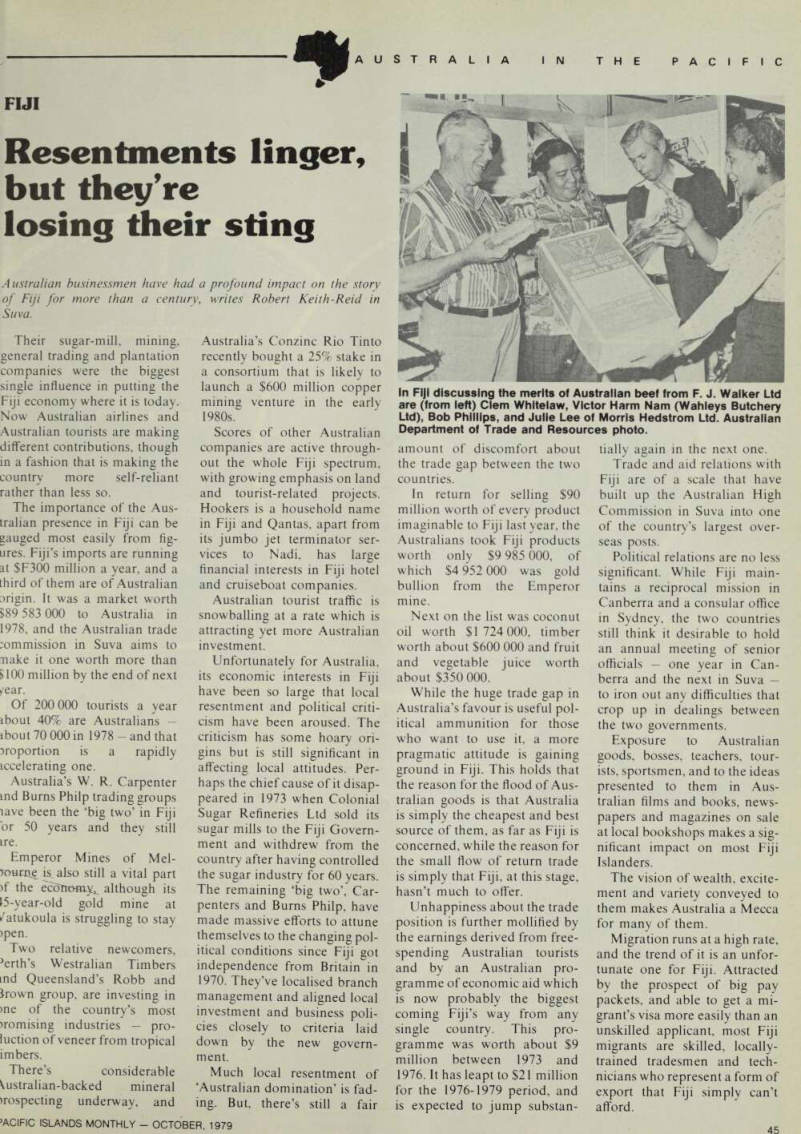
In FIJI discussing the merits of Australian beef from F. J. Walker Ltd are (from left) Clem Whitelaw, Victor Harm Nam (Wahleys Butchery Ltd), Bob Phillips, and Julie Lee of Morris Hedstrom Ltd. Australian Department of Trade and Resources photo.