Last Of The Super Games
pp. 9-17 · Read in the full issue
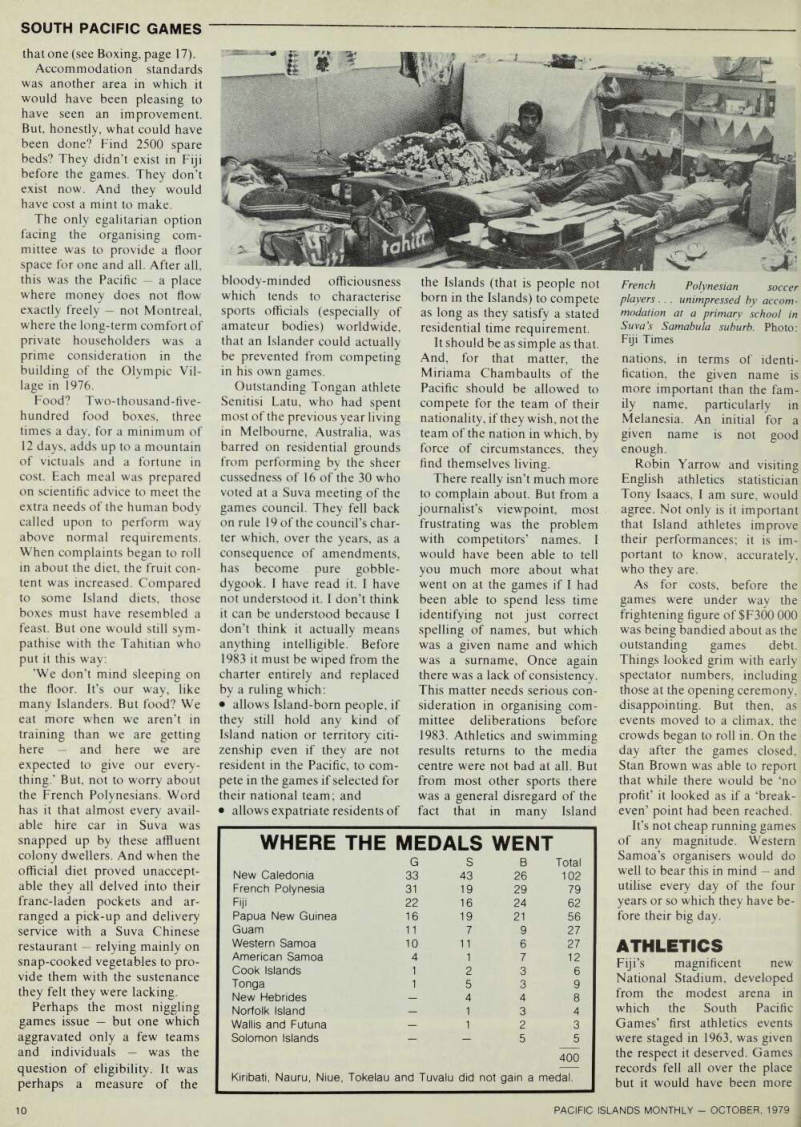

Two-and-a-half-thousand play ers and officials in Suva for the Sixth South Pacific Games were too many by far even though Stan Brown and his army of organisers coped mag nificently with this five loaves and two small fishes predica ment, writes Bob Hawkins. The lesson has been learned but perhaps not well enough in time for the 1983 seventh shames in Western Samoa. With a competitor/official target of 1500 in mind, it seems a total 3f this magnitude could loom larger to tiny Apia than did 2500 to Suva. But first, back to his year’s sporting extrava ganza.
Naturally, in 12 days of shames, from the August 28
Dpening to September 8 closing
:eremonies, there were vhinges and groans, moments ?f bitterness and defiance, and he odd flash of pure
chauvinism. But, most import
ant, when the lonely late revel er had sung his last hurrah, not i word of serious justified dis ient was to be heard. Even the ~rench Polynesians whose
miforms were clearly labelled
fahiti had stopped corn gaining about the food and iccommodation.
Perhaps the supreme accol ide came from a Parisien who bllowed the games with a :ealously critical eye. What did
he think after it was all over? ‘Zee Games? Not bad, eh?’ he conceded. That, in the context of an ex-British colony’s efforts under French scrutiny, was not
faint praise.
We mustn’t overdo the con gratulations. There was the odd negative in overall perform ance - to which organisers
would freely admit. Perhaps
most obvious was the impetus (or lack of it) of track and field events in the magnificently upgraded National Stadium at Buckhurst Park. Without going into the hows of it, serious thought should be given over the next four years about concertina-ing stadium events to keep spectators involved. It
might even mean integrating
rugby and soccer with track events. The benefits would be
twofold happier, occupied
spectators; possibly a shorter,
more dynamic, cheaper
games.
The desirability of a tighter schedule came up time and
again with competitors and
officials. Obviously it needs a great deal of thought. And there are major problems to consider - like how often a boxer can front up to have his brain jolted around in a time span shorter than the Suva games’ duration. Stan Brown, who also is retiring president of the Fiji Amateur Boxing As sociation, has a few ideas on
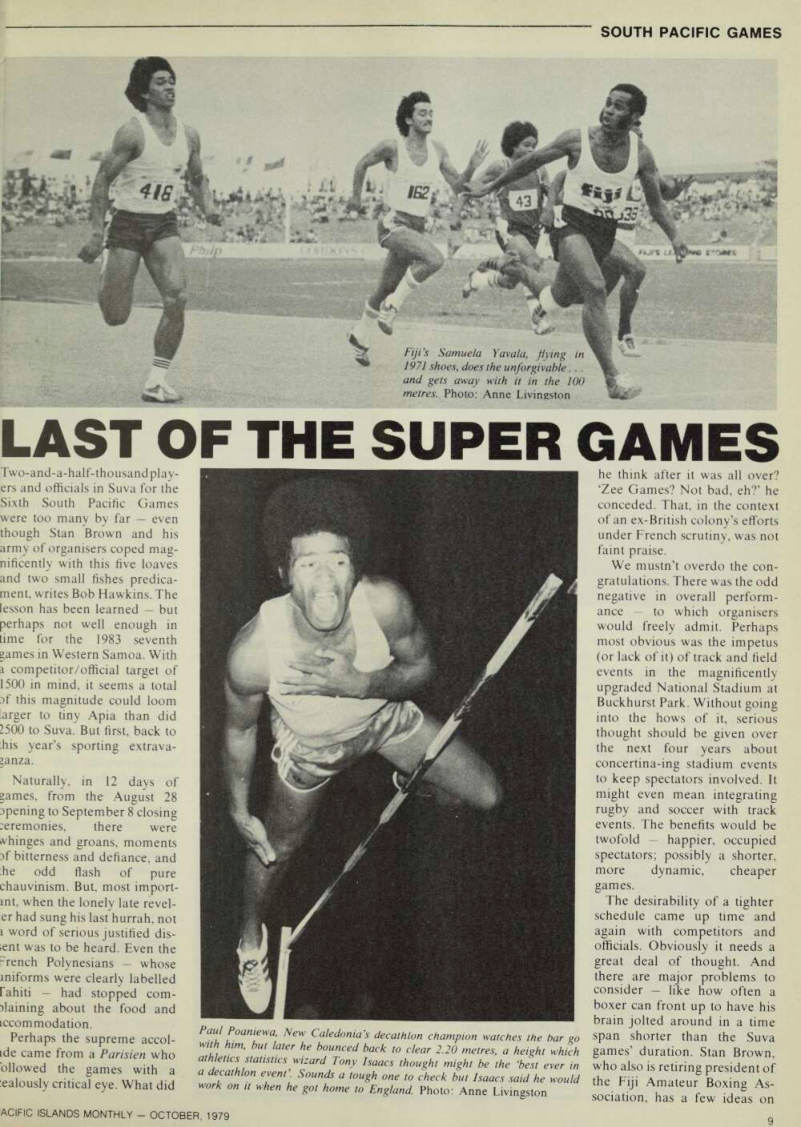
Fiji’s Samuela Yavala, flying in 1971 shoes, does the unforgivable ... and gets away with it in the 100 metres. Photo: Anne Livingston
Paul Poaniewa, Mew Caledonia’s decathlon champion watches the bar go with him, but later he bounced back to clear 2.20 metres, a height which athletics statistics wizard Tony Isaacs thought might be the ‘best ever in a decathlon evenl’. Sounds a tough one to check but Isaacs said he would work on it when he got home to England. Photo: Anne Livingston
that one (see Boxing, page 17).
Accommodation standards was another area in which it would have been pleasing to have seen an improvement.
But, honestly, what could have been done? Find 2500 spare beds? They didn’t exist in Fiji before the games. They don’t exist now. And they would have cost a mint to make.
The only egalitarian option
facing the organising com
mittee was to provide a floor space for one and all. After all, this was the Pacific - a place where money does not flow
exactly freely not Montreal,
where the long-term comfort of private householders was a prime consideration in the building of the Olympic Vil lage in 1976.
Food? Two-thousand-five hundred food boxes, three times a day, for a minimum of 12 days, adds up to a mountain of victuals and a fortune in cost. Each meal was prepared on scientific advice to meet the extra needs of the human body called upon to perform way above normal requirements.
When complaints began to roll in about the diet, the fruit con tent was increased. Compared to some Island diets, those boxes must have resembled a feast. But one would still sym pathise with the Tahitian who put it this way: ’We don’t mind sleeping on the floor. It’s our way, like many Islanders. But food? We eat more when we aren’t in training than we are getting here and here we are expected to give our every thing.’ But, not to worry about the French Polynesians. Word has it that almost every avail able hire car in Suva was snapped up by these affluent colony dwellers. And when the official diet proved unaccept able they all delved into their franc-laden pockets and ar
ranged a pick-up and delivery
service with a Suva Chinese
restaurant relying mainly on
snap-cooked vegetables to pro
vide them with the sustenance
they felt they were lacking.
Perhaps the most niggling
games issue but one which aggravated only a few teams and individuals was the question of eligibility. It was perhaps a measure of the
bloody-minded officiousness
which tends to characterise sports officials (especially of amateur bodies) worldwide, that an Islander could actually be prevented from competing in his own games.
Outstanding Tongan athlete
Senitisi Latu, who had spent most of the previous year living in Melbourne, Australia, was barred on residential grounds from performing by the sheer cussedness of 16 of the 30 who voted at a Suva meeting of the games council. They fell back on rule 19 of the council’s char ter which, over the years, as a consequence of amendments, has become pure gobble dygook. I have read it. I have not understood it. I don’t think it can be understood because I don’t think it actually means
anything intelligible. Before
1983 it must be wiped from the
charter entirely and replaced
by a ruling which:
• allows Island-bom people, if they still hold any kind of Island nation or territory citi zenship even if they are not resident in the Pacific, to com pete in the games if selected for their national team; and • allows expatriate residents of
the Islands (that is people not born in the Islands) to compete as long as they satisfy a stated residential time requirement.
It should be as simple as that.
And, for that matter, the Miriama Chambaults of the Pacific should be allowed to compete for the team of their nationality, if they wish, not the team of the nation in which, by force of circumstances, they find themselves living.
There really isn’t much more to complain about. But from a
journalist’s viewpoint, most
frustrating was the problem
with competitors’ names. I would have been able to tell you much more about what went on at the games if I had been able to spend less time
identifying not just correct
spelling of names, but which was a given name and which was a surname. Once again there was a lack of consistency.
This matter needs serious con sideration in organising com mittee deliberations before 1983. Athletics and swimming results returns to the media centre were not bad at all. But from most other sports there was a general disregard of the fact that in many Island
French Polynesian soccer
players. . . unimpressed by accom
modation at a primary school in Suva’s Samabula suburb. Photo; Fiji Times nations, in terms of identi fication, the given name is more important than the fam
ily name, particularly in
Melanesia. An initial for a given name is not good
enough.
Robin Yarrow and visiting English athletics statistician Tony Isaacs, I am sure, would agree. Not only is it important that Island athletes improve their performances; it is im portant to know, accurately, who they are.
As for costs, before the games were under way the frightening figure of SF3OO 000 was being bandied about as the outstanding games debt.
Things looked grim with early spectator numbers, including those at the opening ceremony, disappointing. But then, as events moved to a climax, the crowds began to roll in. On the day after the games closed, Stan Brown was able to report that while there would be ‘no profit’ it looked as if a ‘break even’ point had been reached.
It’s not cheap running games of any magnitude. Western Samoa’s organisers would do well to bear this in mind and utilise every day of the four years or so which they have be
fore their big day.
Athletics
Fiji’s magnificent new
National Stadium, developed from the modest arena in which the South Pacific Games’ first athletics events were staged in 1963, was given the respect it deserved. Games records fell all over the place but it would have been more
atisfying if there had been a ;reater spread of gold. How ever, the French domination of rack a id field, in the long run, an do nothing but good for sland competition. Even in his games, the challenge from
he super-fit, luxuriously
rained athletes of the French srritories spurred competitors rom elsewhere to give their verything to prove that, like 'lack, poor but independent is •eautiful.
When time for reminiscing omes along, which will be the ames that will come to mind mong those who gave their all t the 25 000 capacity stadium
i September 1979?
You really couldn’t go past dain Lazare - not just the larathon Man who romped ome in record time, seven linutes ahead of his nearest
rival, but the man from New Caledonia who cleaned up four other gold medals from 1500 to 10 000 metres including the 3000 metres steeplechase and a silver in the 800 metres. A re markable performance in any class. • Or his team mate Brigitte Hardel who seemed to be in everything golds for the 100, 200 and 400 metres and silvers in the 100 metre hurdles, long jump and the 4 x 400 metres
relay.
• And then there was Jean- Claude Duhaze of French
Polynesia who triple-golded
with the shot put, discus and hammer. • And New Caledonia’s Yan nick Talon for his long and triple jump firsts; and Paul
Poaniewa who jumped high
enough for the gold and did everything right for the pen tathlon number one placing; and Miriama Chambault, the Fijian who hated winning her two golds 100 metres and
long jump for the territory in
which she now lives, New Caledonia; and Marie-Chris tine Sealeu of New Caledonia
shot put and discus; and the indomitable, irrepressible Dan niele Guyonnet of French
Polynesia who romped home
in the decathlon and soared up and away from everyone in the
high jump.
These are just a few of the names we will remember from track and field 1979. Then
there’s Guam’s Betty Boppart
who set a games record in the 3000 metres but got the head lines for her pre-sam run over the marathon course which she completed inside the time to qualify for the Boston mara thon in the US next April. They wouldn’t let her run against the men. Veteran 1971 400-metres winner Samuela Yavala of Fiji
donned his Papeete golden
running shoes and raced to the 100 metres gold this time. If
Five-gold-Alain Lazare from 1500 netres to marathon congratulates [?]ew Caledonia team mate Christele Barthelemy after her shock but [?]rilliantly-deserved 1500 metre vie [?]ry over Fiji favourite Rucila Radinibega. Photo Ann Living ston
They called her the ‘flying house girl'... New Caledonia's multi-medallist, Brigitte Hardel.
Photo: Anne Livingston
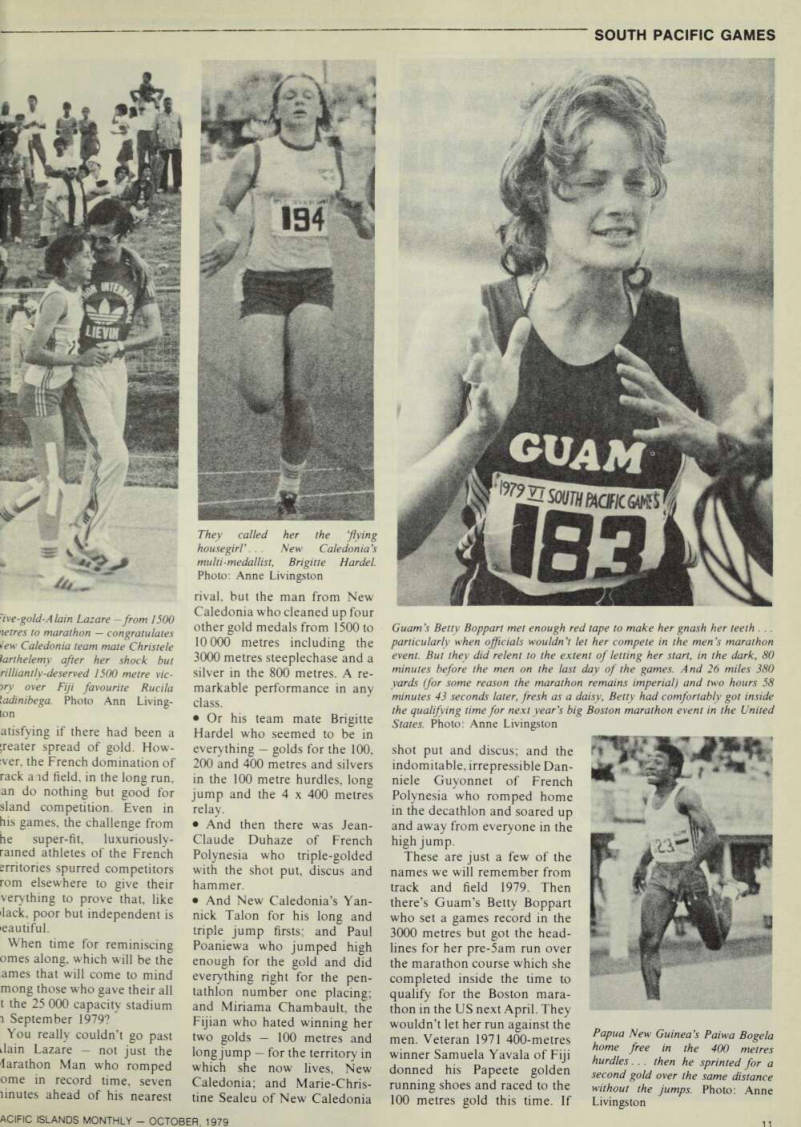
Guam’s Betty Boppart met enough red tape to make her gnash her teeth ... particularly when officials wouldn't let her compete in the men's marathon event. But they did relent to the extent of letting her start, in the dark, 80 minutes before the men on the last day of the games. And 26 miles 380 yards (for some reason the marathon remains imperial) and two hours 58 minutes 43 seconds later, fresh as a daisy, Betty had comfortably got inside the qualifying time for next year's big Boston marathon event in the United States. Photo: Anne Livingston
Papua New Guinea's Paiwa Bogela home free in the 400 metres hurdles... then he sprinted for a second gold over the same distance without the jumps. Photo: Anne Livingston
ed spent less time looking »ver his shoulder at New
Caledonia’s Joseph Wejieme
le probably would have won in aster time than his 10.86 econds.
Papua New Guinea’s Paiwa logela nearly didn’t make the ;ames team and then be ame the only athlete from the
louth Pacific’s biggest nation
d strike gold (twice) in track or ield, taking out the 400 metres nd hurdles over the same dis ance.
From a team viewpoint, ath
stics statistics make depressing
eading for non-French com •etitors. Of the 22 men’s adividual and team events, 15 olds went to French-terri 3ries competitors, 10 to New
Caledonia alone, the balance to French Polynesia. In the 15 women’s events, nine golds went to New Caledonia and two to French Polynesia. Of all others only Fiji (3) and Guam enjoyed gold success in the women’s events.
It doesn’t matter which way you look at it, there seems to be little chance that French domination of track and field will continue for some years to come, even if multiple medal lists like Lazare, Hardel and Duhaze call it a day.
Where does the difference lie? Probably not in dedication to training in the immediate run-up to the games. More likely a wide conbination of factors: diet (how those French
Polynesians complained about
the scientifically-selected food boxes handed out to all com
petitors); much longer prep
aration; quality training
facilities; coaching techniques;
and the almost fanatic Paris de sire to convince Pacific neigh bours that French is best.
Games successes can be bragged about just like the French territories’ living stan dards statistics which we hear so much about. More power to France. France’s stars can do nothing but good for sport in the Pacific. As pacemakers to
improved performance,
French colony performers are
maintaining an impetus in
Pacific athletics which could so easily be lost without them.
Squash
It might have been a tighter competition if two of Fiji’s top squash stars had been eligible to compete but residential qualifications prevented them.
The result? A procession by PNG players to both team and individual golds with Phil Gertzel coming out on top of the pile. PNG’s Peter Ealding, early favourite for the individual gold, was never at his best and ended up present
ing only token opposition in
the bronze play-off to Fiji’s Winston Thomson.
Squash is not a cheap game and facilities Pacific-wide apart from PNG where strong Australian influence has helped establish the game as a major sport for all races in sev eral centres do not suggest much of a change in the present state of play. This was the first time squash has been a games sport. Players from PNG, Fiji, New Caledonia, French Polynesia, Guam, Norfolk Island and Western Samoa took part.
Weightlifting
Western Samoa continued their domination taking six of 10 golds, with one each going to French Polynesia, PNG, New Caledonia and Fiji. Per formances in the lighter
weights showed some improve
ment on the 1975 Guam figures but in the heavier divisions lifts were down.
Judo
Only in the under 86 kg, over 95 kg and Open events was the French grip on Judo golds broken. Between them, New Caledonia and French Poly nesia took out six of the nine events (eight individual and one team), the Polynesians
[?] on go’s Sanitesi Latu ... ruled out [?]y a law which many say argues [?]gainst itself if, in fact, it makes any [?]ense at all. Rule 19 on eligibility
[?]eeds wiping completely and replac
ing with something simpler, specific
[?]nd sympathetic. For Sanitesi and
spectators, officialdom ’s decision
[?]as a disaster. Photo: Anne Living ton
Daniele Guyonnet of Tahiti didn ’t let this pentathlon slip worry her. She went on to repeat her 1975 gold medal performance. Photo: Anne
Livingston
The action and agony of Fiji’s Miriama Chambault, performing on behalf of New Caledonia, her new home since the 1975 games. The damage wasn’t permanent. Miriama went on to add the 100 metres, in record time, to her record-breaking long jump. Photos; Anne Livingston
playing second fiddle to New Caledonia which landed five gold, seven silver and three bronze.
French Polynesia’s tally was one gold, one silver and eight bronze. Guam’s Ricardo Bias in the over 95 kg and Open and Fiji’s Viliame Takayawa in the under 86 kg events broke the monotony.
Swimming
Better than ever before was the verdict of technical head John Gledding. What else could he say? In every event the games record was broken. More im portant, said Gledding, was that when news got out about what was going on down at Suva’s Olympic pool, swim ming became a spectator sport too.
Men’s team honours went French Polynesia’s way with seven out of 11 golds. Henri Noble, three individual golds, got the nod as the best men’s performer, but Guam’s Hollis
Kimbrough, also three golds,
can .ook back with immense pleasure on the day he slashed eight whole seconds off the 400 metres freestyle record.
In the women’s (?) events it was a much different story.
Without a superb all-round performance by New Cale
donia’s Patricia Legras (three
firsts) the French wouldn’t have had a look-in on the individual gold market. But the question mark is provoked by
water-babies Judy Macaskill of
Fiji and Trudy Chang of PNG.
Both 12, they took out two golds a piece. With Henri Noble, an ‘old man’ of 18, the swimming might as well be re labelled ‘boys’ and ‘girls’ with the ‘men’ and ‘women’ compet ing at their peril.
Volleyball
With a blend of strict disci
pline, power play and
individual brilliance, American Samoa methodically wrested control of men’s vol leyball, a sport which has been dominated in every games since 1963 by French teams. In 1963 and 1966 French Poly nesia were volleyball kings; in 1969, 1971 and 1975 honours went to New Caledonia.
Only in their first game, co
incidentally against the team
they were to thrash in the final, New Caledonia, did the Samoans drop a set. After that it was 3-0 right through to the gold medal. But the fighting spirit which, as usual, marked French territories’ per formances in all sports was there to the end in the men’s final. Trailing 15-6, 15-4, New Caledonia fought every inch of the way to a 15-11 third set de feat. French Polynesia had little trouble disposing of Guam 3-0 for the bronze.
In women’s volleyball, French Polynesia returned to the throne, having been edged out in the 1975 games by New Caledonia after taking the gold in 1966, 1969 and 1971. (Women’s volleyball was not played in the 1963 games.) New Caledonia were victims 3-1.
In an unbeaten run, French
Polynesia’s women dropped
only two sets.
American Samoa met much sterner opposition from Fiji in the play-off for the bronze be fore getting up 3-2.
Visiting volleyball official from New Zealand, Joseph Ang, described the men’s stan dard as ‘quite pleasing’ and, in comparison with the women’s showings, of a higher standard.
He felt that the pool system often criticised for forcing a likely silver winner into a bronze situation had not worked against the teams on this occasion in either men’s or
women’s competition.
American Samoa, New Caledonia and French
Polynesia stood out clearly
from the rest in the men’s com petition, he said, while in the women’s competition New Caledonia and French Polynesia were clearly the tops
with American Samoa some distance back in third place.
Ang paid special tribute, in the women’s competition, to Guam’s ‘small girls who played so well’ and Tuvalu’s girls for their courage in facing up to teams of much higher stan dards. He gave full marks for organisation.
Hockey
When Fiji romped home 4-1 against Papua New Guinea in the play-off for semi-final places it seemed the final would be a formality. The only question unanswered was who would miss out on a medal in this four-cornered contest Western Samoa or Solomon Islands such was the chasm between the standards of the top and bottom two.
As it turned out, Western Samoa proved too good against Solomons for the bronze and Fiji horrified their supporters before scrambling to a 2-1 golden victory over PNG after trailing 1-0 at half time.
It’s up to hockey to establish itself Pacific-wide or miss out on future Island and South Pa cific Games. Pacific hockey as sociations would be better to look to staging their own per iodic competitions. It seems they intend to.
Netball
Netball is to women’s basket ball what rugby union is to
rugby league. Statements like
that are likely to invite a punch in the face but it is a fact that league and women’s basketball have benefited enormously over the years by recruiting from union and netball re spectively. In the Islands, union
is barely affected by league
apart from those players who have been enticed away by Bri tain and Australia but net ball will always see a drain to women’s basketball. But the
stars keep coming and Fiji,
after behind-the-scenes drama, looked to schoolgirl Lusiana Delana for the big effort in overcoming Cook Islands in the match which decided the
gold.
The decider was much more clear-cut than the thriller be tween the two teams almost a week earlier which led to a Cooks protest. At full time in that match Fiji were leading
41-39 but Cooks claimed that the end had come 90 seconds early and won their point with competition officials.
They needn’t have bothered.
The re-match saw Fiji rub in their superiority with a comfortable 45-35 margin to take the gold. Papua New Guinea took the bronze.
A visiting umpire said she had seen some ‘very good net ball but it doesn’t last’. Fiji and Cooks were clearly the best teams followed some way be hind by PNG but there were ‘no others’.
This was the first compe tition since 1966 in Noumea when Cooks topped the com petition. In 1969 in Port Moresby PNG fielded a side and, there being no compe tition, was awarded the gold.
Basketball
Pacific Island basketball is
grouped along with New
Zealand and Australia in the Oceania zone for Olympic
competition but, according to
visiting technical officials, it will be some years before any Island national team can expect to give either Aus tralasian side a run for its money in the competition for an Olympic place. But Aus tralasia is doing its bit to push standards across the Pacific. As well as getting coaches into the region it is also working on ways to get foreign teams particularly from the United States which undertake tours in Australia and New Zealand to drop in for games with top Island basketballers.
A technical official from
Water babies Justine Macaskill of Fiji and Trudy Chang of Papua New Guinea... two golds apiece. Photo: Fiji Times
This time the good little ’uns beat the
good big ’ uns... Fiji's Mea
Waqairawai tries to put the lid on PNG star Martha Tahija but it was PNG who struck gold. Photo; Fiji Times
New Zealand, Pat Neville, who assisted in coaching the Solomon Islands women’s team, gave this assessment of the state of basketball play in the Pacific: a top-rank of five teams (Guam, Tahiti, American Samoa, PNG and, with reservations, Fiji), with New Caledonia having ‘dropped back a bit’ in relation to the top teams, and then a long gap to Solomon Islands, Nauru, Northern Marianas and Western Samoa.
There could be no com plaints by either men or women in the final distribution of medals. Guam confirmed their ranking as top Island group but were kept on their toes by a talented French Polynesian combination before taking out the final 113-106 while American Samoa edged out Papua New Guinea for the bronze.
The women, as usual, played a purer if less dynamic basket ball than the men. There was no doubting the rights of PNG and Fiji to battle out the final.
However this proved some thing of a disappointment after a stirring earlier encounter be tween these teams which went into extra time before PNG made a winning break.
The final saw the shorter
PNG players cleverly outwit
the comparative Amazons of Fiji. When Tina Hazelman was conned into fouling herself off five minutes from time Fiji might as well have thrown in the towel. Piling on the press ure and penalty points, PNG were well clear at the end, 78-65.
But watch out for Fiji’s girls in 1983. There’s a wealth of teenage talent in the side, with Hazelman, if she can resist the urge to mix it with the oppo sition, and Julie Apted, the pick of the bunch. PNG’s was a fine team effort with Cecilia Mondumi, Kaia Kapa and Martha Tahija the spear heads.
Lawn Bowls
The ‘British’ game, played for the first time, attracted five starters Papua New Guinea, Fiji, Western Samoa, Cook Islands and Norfolk Island but there are hopes that Solomon Islands will become
interested. There’s even talk of a French connection in the not too-distant future.
This year honours were well
spread, all competitors taking
home at least three medals, Fiji with four golds in their tally of six and PNG with two golds in a total of seven. Men’s singles top honours went to PNG’s Tom Menton, but general ac
claim judged Fiji’s Maraia
Lum On as the overall star with
an impressive singles victory
and a pairs gold shared with
Willow Fong.
Cricket
Tonga probably are still won
dering how they came to topple
mighty Papua New Guinea in a game which had an amazing 10 LBW decisions. Set only 91 to win PNG crumbled before Vakavelo Kolotau’s medium pacers to a 17-run defeat.
And Tonga are still wonder ing how they came to be demolished in the semi-final by New Hebrides after an un beaten run. But that’s limited over cricket. One wonders if it is necessary for cricket to be on the South Pacific Games agenda. It is a spectacle in itself and would attract much bigger crowds if staged outside of the games.
Fortunately for PNG the Tonga match was the first of the competition and it had time to rally itself to a semi-final
placing against Fiji, the only
serious opposition. In the semi PNG’s players had to hold their breath as Fiji battled gamely to within 20 runs of the target 198.
The final, against New Hebrides, was a formality with
PNG overhauling the under dogs’ total of 53 with the loss of only one wicket.
The play-off for the bronze
found Fiji struggling again, this
time against Tonga who had hit up a formidable 183 for the loss of six wickets. At one stage Fiji were seven down for 160 but tail-enders saved the day, the host side earning the bronze with eight wickets down.
Western Samoa, Tuvalu and New Caledonia have a long way to go before they will be able to dent the medallists’ armour. Perhaps, by 1983, if cricket sneaks onto the Apia games list which it shouldn’t New Caledonia’s cricketing girls will have taught their men a googly or two.
Table Tennis
French domination in the men’s events continued with New Caledonia playing second fiddle to French Polynesia, everyone else being also-rans.
However, Fiji’s all-round depth in the women’s matches enabled them to retain superi ority in the teams event, an honour it has enjoyed since 1971. There was also gold for
veteran Fiji campaigners Akisi
Renner (a competitor since 1963) and Laisa Naivalulevu in
the women’s doubles, an event they won at Guam in 1975.
Tahiti’s Victor Lau was in
everything, systematically
disposing of New Caledonia’s Roger Lao Yan in the singles, and teaming with Felix Lieou Kui in the doubles and
women’s singles champion
Luana Trafton in the mixed doubles to take out those
golds.
Tennis
A double tum-up highlighted the French-dominated tennis competitions at Suva’s mag nificent five new all-weather Victoria Park hardcourts.
When New Caledonia’s 1975
singles gold medallist Gerard
Winter went down to French
Polynesia’s Philippe Rauzy in a
three-hour thriller in the final of the teams event, their singles re-encounter was awaited with intense interest. And, for a mo ment, it seemed Winter was to regain his crown when he romped to a 6-2 first set win.
But Rauzy then cleaned him up in the next two sets. Tennis is still markedly a French pre serve but its capital has moved from Noumea to Papeete.
Of the tennis golds only one did not go back to Papeete the men’s doubles title which, predictably, went to Noumea.
Yachting
Yachting golds in the previous
games always went to the host country - PNG in 1969, French Polynesia in 1971, Guam in 1975. But this year hosts Fiji were not in the hunt. ‘World class’ was one experi enced sailor’s description of the performance of French Polynesia’s crewmen in the seven Hobie Cat 16 races.
Gold winners, French Polynesia I (J. and N. Salmon), won four of the seven races and placed second in the other three. Silver w nners, French Polynesia 111 (D. Arnould and G. Sachet) won two races, placed second twice, third once and fifth twice. New Caledonia I (A. Mazoyer and N. Cale) took the bronze for consist ency, placing second twice, third three times and fourth twice. Papua New Guinea, overall fourth, came on strong toward the end of the racing, winning Race 7 and placing third in Race 1, which was
It’s bowls not ballet. But style like
this, by Laufili Faraimo of Western
Samoa who played in the winning triples combination, makes a mock ery of those who say bowls is for the oldies. Photo: Fiji Min For
Fiji’s women took most of the honours in table tennis but not top gold. . . singles winner Luana Traf ton of French Polynesia gives the ball a bit of stick in an early round.
Photo: Fiji Times
re-run as the final event after being abandoned earlier be cause no crew completed the course within the allowed
elapsed time.
Soccer
French criticism of the pool draws for soccer before the games started seemed, by the time the semi-finals were reached, to have some justifi cation. In a first semi-final thriller French Polynesia and New Caledonia matched each other move for move. The Tahitians, rather fortunately, won 3-2 and it looked as if New Caledonia had been unjustly relegated to bronze status. The
performances of Fiji and
Solomon Islands in the second semi-final did nothing to change this thinking. In an exciting but scrappy game Fiji got up 2-0 in extra time. Goals count but one got the feeling Solomon Islands would have provided better final oppo sition for French Polynesia.
As it turned out. New Caledonia did nothing in their play-off with Solomons to
suggest their superb perform
ance against French Polynesia was anything more than a flash in the pan. Apart from a precise execution of the offside trap which for some reason the Solomons’ forwards never countered - New Caledonia forfeited all claims to any kind of medal, submitting meekly to a 3-1 pounding.
In the final which followed, before a crowd estimated at around 20 000, there was little doubt as to which team was su perior, even though Fiji held the Tahitians to a draw until 10 minutes into the second half. It was a case of French discipline
and method against a hopeful,
physical, driving team of Fiji
individuals. That 55-minute E>oal which set French Polynesia on the path to de
served victory was the first Fiji
aad conceded in the whole ournament, an indication of low much was owed to a dour, irickwall defence for the host country’s place in the final. 50LF *or a while it looked like a
Jean Papua New Guinea
weep of the team events but
i bright start by PNG’s women
vas not maintained and
individual gold medallist Kim
Young spearheaded American
Samoa’s gold-winning team effort. PNG’s men never looked back and were still going away from the field in the final round.
In the men’s individual event it was a case of the master out mastered when teenager Kundi Umba tied with the man he used to caddy for, Phil Frame, and then went on to beat him at the fourth hole in a play-off.
Boxing
The finals line-up had Western
Samoans jumping eight in
with a golden chance. But, in the words of boxing director Hector Hatch, the ‘Western Samoans fought their hearts out in the semis while the others reserved themselves’. Of those eight Western Samoans only three struck out success fully for gold.
Stan Brown, chairman of the games organising committee and retiring president of the
Fiji Amateur Boxing Associ
ation, summed it up this way; ‘Like all finals, the boxers per formed less well in the finals ... At the end of 10 days of
competition they are tired, they
hurt, they’re bruised. You always get inferior boxing in the finals ...’
Boxing at this games, accord ing to Hatch, was much more rugged, a little less scientific.
Observing that even in the Olympics it is the aggressive boxer who usually comes out on top, Hatch said he thought some coaches, with little time to bring their men along, had concentrated on making the most of their natural abilities as
fighters.
Flatch’s pick of the bunch were Western Samoa’s Tanalai Folasi (welterweight) for his combination of technical skill and aggression, and Fiji’s Joe
Nitiva (light welterweight) who
‘picked his punches beautifully
and is a devastating hitter’.
Nitiva needed only one punch in each of his first two fights, and then bided his time in the final against Western Samoa’s Tuasiui Poto, not wasting a blow.
Hatch reckons the best boxer of the whole bunch, Anthony Naidu of Fiji, did himself out of the gold against American Samoa’s Douglas Westbrook by forgetting his skills and
fighting too aggressive a
bout.
While a track man might thrive on daily competition, a boxer needs time to recuperate and this factor vindicates a growing feeling that the games are too long, both from financial and spectator interest viewpoints. Stan Brown be lieves the way around this would be for the number of boxers allowed to compete in, say, an eight-day games, to be limited, resulting in fewer bouts in the run to the final.
The final gold count in the boxing showed a fairly even distribution of medals over the 11 divisions - Western Samoa three, Fiji. PNG and New Caledonia two each and American Samoa and French Polynesia one each.
The writing was on Fiji's Josef a Nivita and on the wall for Tuasiui Poto of Western Samoa in the final of the light-welterweight event.
Photo: Fiji Times
Rugby
Fiji’s players will want to forget
the 1979 final. But it will be much harder for them than the 20 000-plus crowd who politely sat through a thoroughly for gettable game. Bravely, next day, the Fiji press talked of
how much possession Fiji
enjoyed, particularly in the sec ond half, and how it should have won handsomely if stat istics were a guide. No one mentioned that it was a turgid, messy final, completely out of character with the brand of football the world has come to expect from Fiji and Tonga.
The result was right 6-3 to Tonga (converted try against a penalty goal, both in the sec ond half). The only redeeming feature? Tonga’s dedicated de fensive work, made easier by
Fiji’s ineffective penetrative
tactics.
Much more interesting was New Caledonia’s performance in the play-off for the bronze.
Word was before the comp that New Caledonians had come only to leam the game. Sud denly they were in the semis and, after a thrashing from Tonga, it was a game with Western Samoa for third. At full time they found themselves 9-8 in front of a Samoan side which had, three days earlier, missed out on a final place when Fiji scored a try after nor mal time had elapsed but the ball had been kept alive. New Caledonia’s bronze should prove a great boost for the game back in Noumea.
Tonga's Fakahau Valupresses home the leather to seal his country's only gold. Photo Fiji Times