Letters
pp. 4-5 · Read in the full issue
Questions for
Air Niugini
After reading with interest your, to me rather uncritical, survey of aviation in the Pacific
region (PIM July), perhaps you
will permit me to point to the other side of the coin - at least as far as one of the carriers is concerned - and tell your readers about Air Niugini, the airline that is never on time.
Being one of its constant vic tims, I am not out to slight this airline, its management or its staff. I would also resent suggestions that I pick on one particular airline in the region, being fully aware that here in PNG with our ‘Melanesian ways’, efficiency in the com
plex operations business of
modem air travel is not easily achieved.
But in the case of Air Niugini the old adage of ‘Enough is
Enough’ must surely apply.
Only by spreading criticism
and making a wider public aware of this inefficiency can one hope for any improve ment. Smooth and glossy pulicity alone does not make an airline efficient, nor do profits. As air travel has be come every man’s mode of travel, it is essential that time tables are kept, or that at least every effort is made to keep them. In Air Niugini’s case it appears as if nobody cares, at least not the airline itself. Most times lateness of services are not even announced I guess because it means loss of face leaving the waiting travellers to sweat it out.
Naturally, every airline has inevitable emergencies and breakdowns (sometimes it’s the weather) which are beyond control and best intentions. But here in PNG we have a national airline which prides itself to be primus inter pares with the international airline fraternity, which runs sched ules where being on time is the exception, not the other way round. And this is no exagger-
ation, as any air traveller in this country will vouch for.
Unfortunately, most of us have learned to treat it as a bad joke and a fact of life here.
Business people have become cynical and resigned to it, although it upsets one’s rou tines and stomachs, given the lack of facilities at nearly all of our airports. That’s another saga as well. In Port Moresby at least one is lucky. The aptly
named good old Gateway
Hotel is close enough to amble across to for sustenance or a spot or two to drown one’s sor rows. If only Air Niugini would be smart or interested enough to put a TV monitor or a PA system there!
But it is the general flying and paying public that suffers, women and children in par ticular. And it is about time that a concerned criticism was levelled at Air Niugini in this respect, as it is not fulfilling its duties and obligations as a transport operator.
One asks oneself whether it is really necessary for this air line to run before it can walk.
Why must it try to play in the
big league, with tremendous
and rushed growth, and remaining ‘thin on the ground’? The problem with the airline is that it has too small a fleet to service the nation efficiently. Not to mention its efforts on the international scene. In its hungry effort to dominate aviation in this country, the management and
its policy are driving other car riers out of the air, but cannot fill the vacuum. Apart from other reasons, many times the whole day’s schedule is late be cause of problems with one air craft. Or a pilot has reached his legal flying hours limit because of delays and there is no re placement. Is that good for business or image, even for a
monopoly? And getting away
with it unscathed only because of an uncritical public?
Monopoly, high fares and
profits alone are not enough.
Nor is a good safety record.
So, through your publication
I should like to ask Air Niugini, its management and political masters, to have a good look at itself and at where it is going.
Would it not be better to admit to teething problems, and oper ational ones as well? Run less services, but provide the basic requirement of any transport operator be on time. PNG can’t afford and doesn’t need an airline that appears large and flies lots of fancy aircraft with glossy liveries, etc. It needs an airline that provides an efficient and reliable ser vice. Then we can be proud of it, no matter what its size.
PO Box 636
Lae Papua New Guinea
F. G. Iseke
Students: A word
from Julius Nyerere
Editor Bob Hawkins’ comment on ‘Students?’ PIM, July, was wise and timely, not only for Papua New Guinea, but also for other countries.
Students everywhere would do well to read the following message from the President of Tanzania, Julius Nyerere, which is displayed at the University of Dar es Salaam: ‘Those who receive this privi lege (of education) therefore have a duty to repay the sacri fice which others have made.
They are like the man who has been given all the food avail able in a starving village in order that he might have
strength to bring back supplies
from a distant place. If he takes his food and does not bring help to his brothers, he is a traitor. Similarly, if any of the young men and women who are given an education by the republic adopt attitudes of su periority or fail to use their
knowledge to help the develop
ment of this country, then they are betraying our Union.’
(Rev) Sydney Jacka
Region President (Australia, NZ, PNG), Reorganised Church of Jesus Christ of Latter Day Saints Protest from an
Aussie Fijian
As a Bilong befor in Salamaua/Wau/Bulolo 1934/ 37, you will know I have been a PIM reader for a long time.
I continued readership later in Fiji 1938/1961, and knew Mr Robson and met Judy Tudor in the old days in the Solomons and elsewhere, so I have an instinctive feeling about the
credibility of PIM reporting.
However I, as an Ocker, must confess to feelings of nausea (bel bilong me hot tomus) at such blatant blah emanating from your Mr Keith-Reid’s
pro-Kiwi, anti-Aussie garbage
in June issue entitled ‘Fiji Just like Home’.
I served in the Fiji Army 1939-53 and was close to Fijians and part-Europeans all 23 years I lived in and loved
Fiji, playing rugby, cricket,
boxing, fishing and being one
of them, so although it might be pardonable for you not to notice the de ni bulumakau in
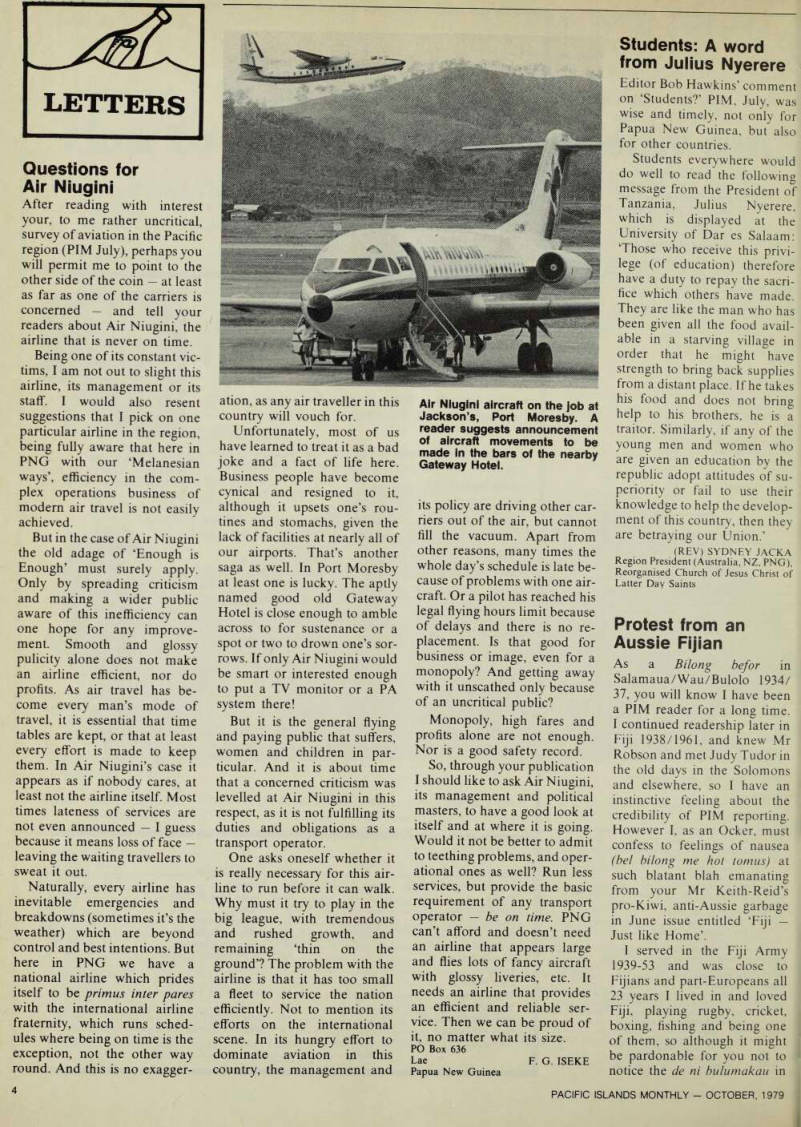
Air Niugini aircraft on the Job at Jackson’s, Port Moresby. A reader suggests announcement of aircraft movements to be made in the bars of the nearby
Gateway Hotel.
Keith-Reid’s article, it sticks out a mile to me, and any other
Aussie-Fijian.
As far as Fijians or part-
Fijians going to NZ and feeling
‘just like going home’ is con cerned, it was practically im possible for them to obtain an entry permit to ‘Godzone’, and the locals, far from considering Kiwiland as ‘an extension of
home territory’, quite defi
nitely resented the ‘barrier atti tude’ emanating from NZ Immigration officialdom. Past records going back 30 years will prove that barrier was very real and very effective in frus trating any Fijian ideas of im migration, and this is still the
case today.
I wonder if Mr Keith-Reid has ever heard the Fijian word macawa. It was a commonly used nickname for Kiwis par ticularly in Suva, where most Kiwis lived. It was both deris ive and quite derogatory as the rough translation means ‘no
account’, so the reported
brotherly love, etc, in his article is a little far-fetched, as Fijian
people are conservatively
minded, and I cannot credit they could have changed all that much. I, for one, read Mr
Keith-Reid’s ‘Song of Praise’
3f NZ efforts with a wry but unbelieving smile unless Mr K.eith-Reid is a Kiwi (is he?).
If he is, everything falls into.
Diace.
E. Mayo-Gaskell
~nd 9 'Jew Zealand Robert Keith-Reid is English born. Now in his late thirties, he has lived in Fiji since boyhood.
- Ed, Pim.
3e more specific,
slease!
am a Pacific Islander and I am 'ery concerned about what ;ome New Zealand news papers publish on Pacific slanders working in New Zealand. Most of the time hese articles give a very bad mage of the Pacific Islands as i whole.
Often you read in New Zealand newspapers that Pa ific Islanders took part in a ight or did this and that. This
s really degrading. Why can’t
he papers be more specific?
Vhich Islanders did all that?
Vhich country did they come rom?
I am not a racist but I would like to point out that only Tonga, Samoa, Niue, Tokelau, Cook Islands and Fiji have many of their people working in New Zealand. Other coun tries like Solomon Islands, Papua New Guinea, New Hebrides, Tuvalu, Kiribati and others hardly have any of their
people working in New
Zealand. Why is it that they have to suffer under the name Pacific Islander when it is someone from another country who causes trouble in Auckland?
New Zealand newspapers and their reporters to other papers must be more specific when dealing with Pacific Islanders in New Zealand.
Please don’t just class all Islanders as troublemakers be cause that isjust not true. There are only a few Pacific Island countries who have citizens in New Zealand, not all Pacific Island countries.
Clarence Marae
University of PNG Port Moresby
In quest of
Goss china
Some of your readers may have vases, cups and saucers, models and other ornaments on their shelves with the mark of W. H.
Goss on the base, and have
possibly wondered where they
originally came from.
They were made by the Staf fordshire firm of William Henry Goss in Stoke-on-Trent, England, between 1870 and 1930. These little parian ware white glazed ornaments were all adorned with a coat-of arms, according to where they were intended to be sold. They were exported all over the world but so far as I can trace,
only two consignments were
delivered to the Pacific Islands.
One was in 1918 when an order was delivered to Morris Hed stroms of Nukualofa, Tonga, which contained cups and
saucers bearing the Tongan
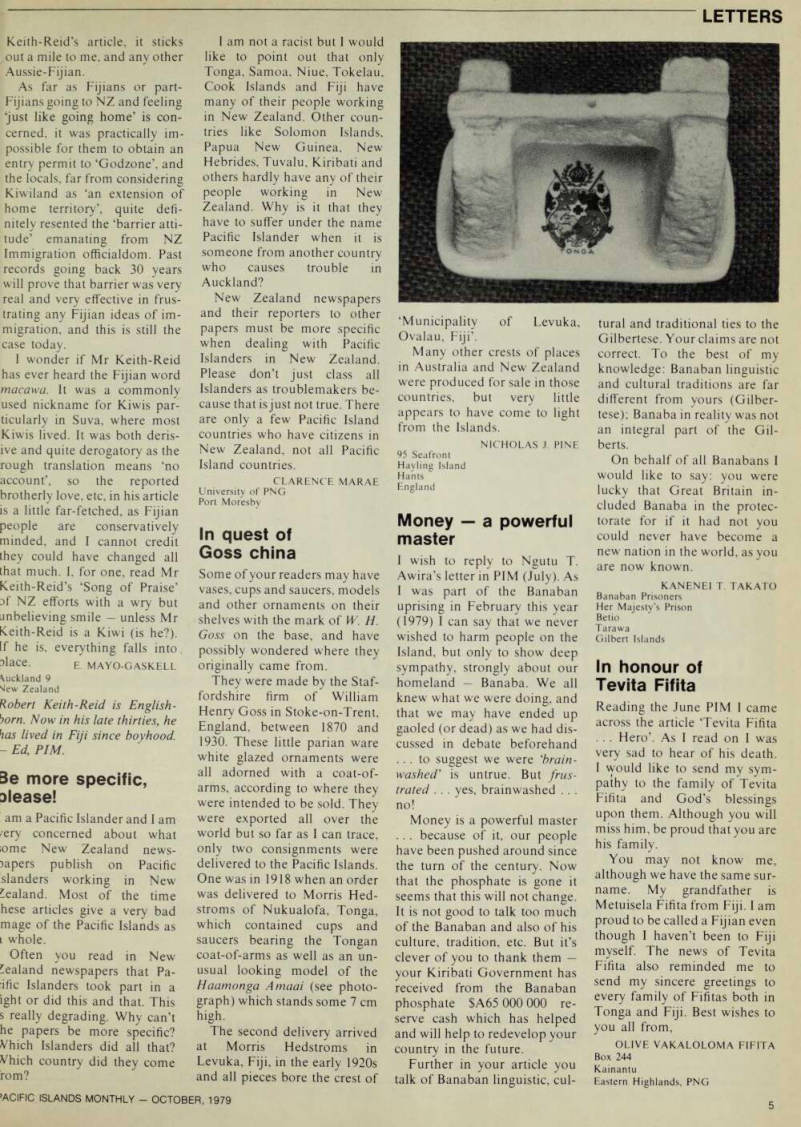
coat-of-arms as well as an un usual looking model of the Haamonga Amaai (see photo graph) which stands some 7 cm
high.
The second delivery arrived at Morris Hedstroms in Levuka, Fiji, in the early 1920 s and all pieces bore the crest of
‘Municipality of Levuka,
Ovalau, Fiji’.
Many other crests of places in Australia and New Zealand were produced for sale in those countries, but very little appears to have come to light from the Islands.
Nicholas J. Pine
95 Seafront Hayling Island Hants England
Money a powerful
master I wish to reply to Ngutu T.
Awira’s letter in PIM (July). As I was part of the Banaban uprising in February this year (1979) I can say that we never wished to harm people on the Island, but only to show deep
sympathy, strongly about our
homeland Banaba. We all knew what we were doing, and that we may have ended up gaoled (or dead) as we had dis cussed in debate beforehand ... to suggest we were ‘ brain washed ’ is untrue. But frus trated ... yes, brainwashed .. . no!
Money is a powerful master ... because of it, our people have been pushed around since the turn of the century. Now that the phosphate is gone it seems that this will not change.
It is not good to talk too much of the Banaban and also of his culture, tradition, etc. But it’s clever of you to thank them your Kiribati Government has received from the Banaban phosphate SA6S 000 000 re serve cash which has helped and will help to redevelop your country in the future.
Further in your article you talk of Banaban linguistic, cul
tural and traditional ties to the Gilbertese. Your claims are not correct. To the best of my
knowledge: Banaban linguistic
and cultural traditions are far different from yours (Gilber tese); Banaba in reality was not an integral part of the Gil berts.
On behalf of all Banabans I would like to say: you were lucky that Great Britain in cluded Banaba in the protec torate for if it had not you could never have become a new nation in the world, as you are now known.
Kanenei T. Takato
Banaban Prisoners Her Majesty’s Prison Betio Tarawa Gilbert Islands In honour of
Tevita Fifita
Reading the June PIM I came across the article ‘Tevita Fifita . . . Hero’. As I read on I was very sad to hear of his death.
I would like to send my sym pathy to the family of Tevita Fifita and God’s blessings upon them. Although you will miss him, be proud that you are
his family.
You may not know me, although we have the same sur
name. My grandfather is
Metuisela Fifita from Fiji. I am proud to be called a Fijian even though I haven’t been to Fiji myself. The news of Tevita Fifita also reminded me to send my sincere greetings to every family of Fifitas both in Tonga and Fiji. Best wishes to you all from,
Olive Vakaloloma Fifita
Box 244 Kainantu Eastern Highlands, PNG