Before The
pp. 75-76 · Read in the full issue
Travel
See Saipan
Casino Boom
PIM Publisher Stuart Inder recently visited Saipan, capital of the Northern Marianas. He found it a major drawcard for Japanese tourists but doesn’t see why others shouldn’t try the pleasures of this mixed bag of attractions.
The newspapers on Saipan, main island in the Common wealth of the Northern Marianas, from time to time re port with morbid detail, usually illustrated with photo graphs of neatly stacked piles of human skulls, the results of the latest Japanese ‘bone mission’ in the islands.
We are told the number of Japanese volunteers who took part in the search, how many skulls and bones of Japanese soldiers and civilians were col lected from the cliffs, caves and jungle trails of Saipan and how many people attended the cremation ceremony before the consecrated ashes were re turned to Japan.
One gets the impression that
these frequent missions are
part of a tourist marketing exercise as indeed they are in a small way. Japanese tour Dperators encourage them be :ause they add to the numbers 3f Japanese visitors to Saipan and help keep alive Japan’s ong-term association with the Northern Marianas.
During 1978, about 15 major lapanese travel wholesalers
organised package tours which
Drought 62 000 Japanese visi ors into the Marianas, mostly o Saipan, thus accounting for he majority of the 91 000 tour sts from all destinations who irrived last year. Of this total, he next biggest group,
Americans, accounted for only
16 000, and there were less than
(000 visitors originating from
fiber countries.
This year both the total num )er of visitors and the pro )ortion of Japanese visitors in he total has continued to limb, and projections indicate here will be no slackening of he trend. It’s more likely, if ome influential local poli icians get their way, there will
be a dramatic increase in Japanese visitors, for there are serious moves to turn Saipan into a Las Vegas type gambling haven with licensed casinos.
Japanese money is behind these proposals which have split the population into vocal
gambling and anti-gambling
lobbies.
If casinos are permitted, un doubtedly the character of tourism on the island will change, but at present Japanese history, wartime memories, sun and white sand beaches and
Saipan’s proximity to Japan,
are the attractions which make Saipan a Japanese tourist desti nation.
There is no reason why the Japanese should retain their virtual monopoly. While there are regular direct air services to Saipan’s modern international air terminal from Japan, only three hours off, there also are direct services from Honolulu and the US mainland (via Con tinental). And with frequent
daily flights from Guam only
about 30 minutes away any body can connect with Saipan
from anywhere.
Australian and New Zealand travellers can come in via
Manila or by Air Nauru jets to Guam either from Melbourne, which is the way I travelled, or from Auckland. Visas can be stamped in your passport at point of entry if you have a return ticket and want to stay no more than 30 days. US citi zens don’t even need a passport if they have other proof of
citizenship.
For my money, Saipan’s sun and beaches are enough in themselves to attract holidaymakers. Most of Saipan’s comfortable, half dozen hotels, including the magnificent Continental where
I stayed, are widely spaced
along many miles of flat beaches of fine white sand looking out over a tropical South Seas lagoon.
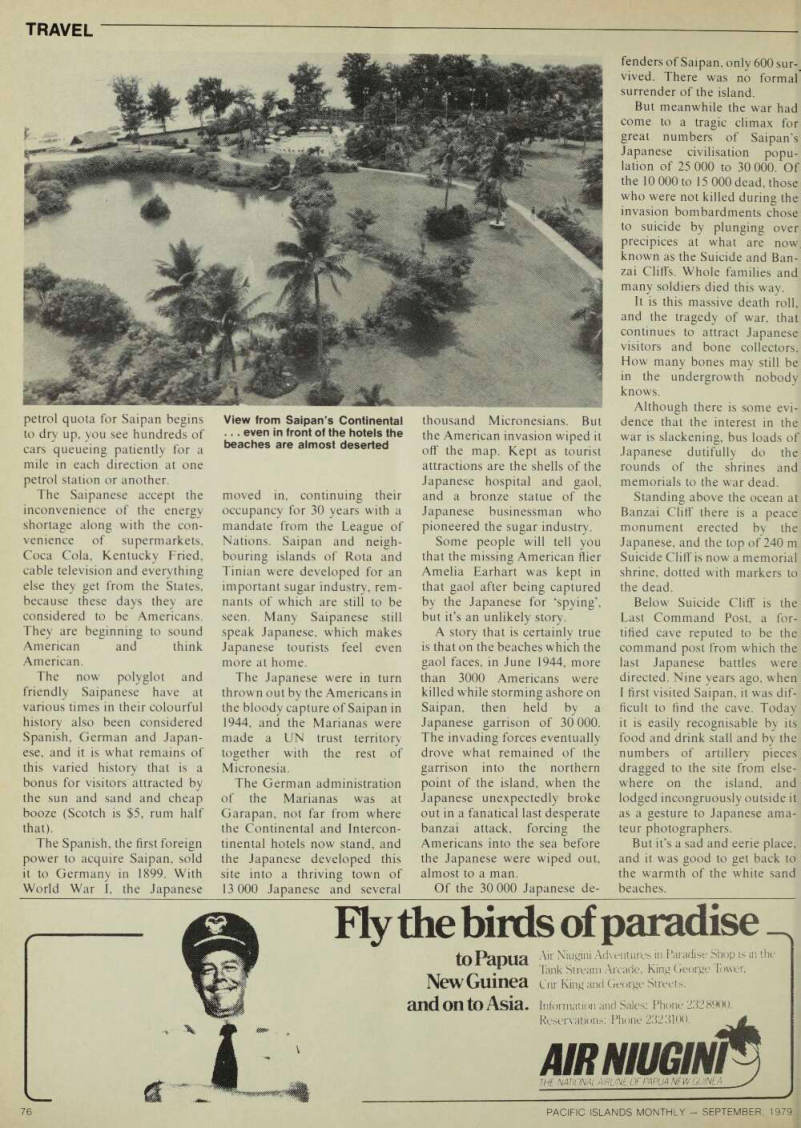
Those beautiful beaches are
virtually unoccupied even in
front of the hotels. Most of the
Japanese tourists on package
tours limited to three or four days spend their time else where on organised expedi tions to war sites or cheap shopping. But if Saipan’s entire annual tourist influx were to sun themselves one afternoon on that stretch of sand, there would be room to spare. As an Australian brought up in Syd ney beachside suburbs I know what a beach should look like, and Saipan’s beaches (as dis tinct from surf beaches there aren’t any) deserve to be better known.
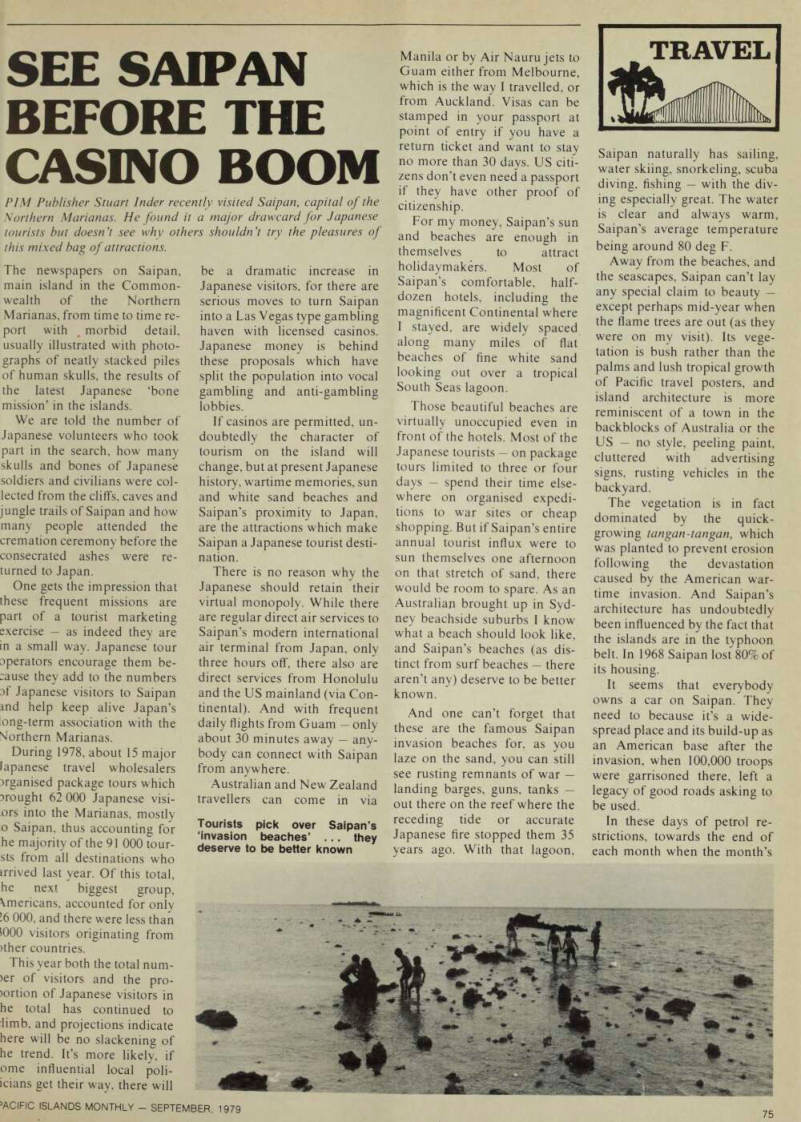
And one can’t forget that these are the famous Saipan invasion beaches for, as you laze on the sand, you can still see rusting remnants of war
landing barges, guns, tanks
out there on the reef where the receding tide or accurate Japanese fire stopped them 35 years ago. With that lagoon,
Saipan naturally has sailing, water skiing, snorkeling, scuba diving, fishing with the div ing especially great. The water is clear and always warm, Saipan’s average temperature being around 80 deg F.
Away from the beaches, and the seascapes, Saipan can’t lay any special claim to beauty except perhaps mid-year when the flame trees are out (as they were on my visit). Its vege tation is bush rather than the palms and lush tropical growth of Pacific travel posters, and island architecture is more reminiscent of a town in the backblocks of Australia or the US no style, peeling paint, cluttered with advertising signs, rusting vehicles in the
backyard.
The vegetation is in fact dominated by the quick growing tangan-tangan, which was planted to prevent erosion following the devastation caused by the American war time invasion. And Saipan’s architecture has undoubtedly been influenced by the fact that the islands are in the typhoon belt. In 1968 Saipan lost 80% of
its housing.
It seems that everybody owns a car on Saipan. They need to because it’s a wide spread place and its build-up as an American base after the invasion, when 100,000 troops were garrisoned there, left a legacy of good roads asking to be used.
In these days of petrol re strictions, towards the end of each month when the month’s
Tourists pick over Saipan’s ‘invasion beaches’ ... they deserve to be better known
petrol quota for Saipan begins
to dry up, you see hundreds of cars queueing patiently for a mile in each direction at one petrol station or another.
The Saipanese accept the inconvenience of the energy shortage along with the con venience of supermarkets, Coca Cola, Kentucky Fried, cable television and everything else they get from the States, because these days they are considered to be Americans.
They are beginning to sound American and think American.
The now polyglot and
friendly Saipanese have at
various times in their colourful history also been considered
Spanish, German and Japan
ese, and it is what remains of this varied history that is a bonus for visitors attracted by the sun and sand and cheap booze (Scotch is $5, rum half that).
The Spanish, the first foreign power to acquire Saipan, sold it to Germany in 1899. With World War I, the Japanese
moved in, continuing their occupancy for 30 years with a mandate from the League of
Nations. Saipan and neigh
bouring islands of Rota and Tinian were developed for an
important sugar industry, rem
nants of which are still to be
seen. Many Saipanese still
speak Japanese, which makes Japanese tourists feel even more at home.
The Japanese were in turn thrown out by the Americans in the bloody capture of Saipan in 1944. and the Marianas were made a UN trust territory together with the rest of Micronesia.
The German administration of the Marianas was at Garapan, not far from where the Continental and Intercon tinental hotels now stand, and the Japanese developed this site into a thriving town of 13 000 Japanese and several
thousand Micronesians. But the American invasion wiped it off the map. Kept as tourist attractions are the shells of the
Japanese hospital and gaol,
and a bronze statue of the Japanese businessman who
pioneered the sugar industry.
Some people will tell you that the missing American flier Amelia Earhart was kept in
that gaol after being captured
by the Japanese for ‘spying’,
but it’s an unlikely story.
A story that is certainly true is that on the beaches which the gaol faces, in June 1944, more than 3000 Americans were killed while storming ashore on Saipan, then held by a Japanese garrison of 30 000.
The invading forces eventually
drove what remained of the garrison into the northern point of the island, when the
Japanese unexpectedly broke
out in a fanatical last desperate banzai attack, forcing the Americans into the sea before the Japanese were wiped out, almost to a man.
Of the 30 000 Japanese de
fenders of Saipan, only 600 sur vived. There was no formal surrender of the island.
But meanwhile the war had come to a tragic climax for great numbers of Saipan’s Japanese civilisation popu lation of 25 000 to 30 000. Of the 10 000 to 15 000 dead, those who were not killed during the invasion bombardments chose to suicide by plunging over precipices at what are now known as the Suicide and Ban zai Cliffs. Whole families and many soldiers died this way.
It is this massive death roll, and the tragedy of war, that continues to attract Japanese visitors and bone collectors.
How many bones may still be
in the undergrowth nobody
knows.
Although there is some evi dence that the interest in the war is slackening, bus loads of Japanese dutifully do the rounds of the shrines and memorials to the war dead.
Standing above the ocean at Banzai Cliff there is a peace monument erected by the Japanese, and the top of 240 m Suicide Cliff is now a memorial shrine, dotted with markers to the dead.
Below Suicide Cliff is the Last Command Post, a for tified cave reputed to be the command post from which the last Japanese battles were directed. Nine years ago, when I first visited Saipan, it was dif ficult to find the cave. Today
it is easily recognisable by its
food and drink stall and by the
numbers of artillery pieces
dragged to the site from else where on the island, and
lodged incongruously outside it
as a gesture to Japanese ama
teur photographers.
But it’s a sad and eerie place, and it was good to get back to the warmth of the white sand beaches.
View from Saipan’s Continental ... even in front of the hotels the beaches are almost deserted