but nothing
p. 72 · Read in the full issue
Cook Islands
All the signs but nothing in the flesh
‘Without Japan the Cook Islands would be in one hell of a mess financially,’ claimed an importer who runs a thriving duty free business in what is colloquially known as ‘down town Avarua’, writes Karen Garner-Williams in Raro tonga. He bases his claim on figures which show the role of tourism in the Cook Islands’ economy, and says that duty
free shopping plays a major
part in attracting visitors. Cer
tainly, without Japanese trade
his store would be in dire straits.
In 1977, 10% of Cook Islands’ total imports came from Japan, second only to New Zealand (which supplied a massive 67% of imported goods that year).
A Kyowa line ship now calls at Rarotonga every two months
bringing consumer goods, ve
hicles and tinned fish. The Cook Islands spent $236 350 on imported tinned fish in 1977, 78% of which was of Japanese origin a Pacific coals to New castle situation.
The only lines that the Japanese haven’t cornered, says Bill Johnson of Johnson’s Duty Free, are sunglasses, per fumes, toys and jewellery. Duty free store manager Brian Baudinet says that 80% of the goods in his Avarua store come from Japan.
Statistics Office figures for 1977 show that 92% of phono
graphic and sound equipment
imported to Rarotonga came
from Japan, along with 80% of cameras, 79% of clocks, 73% of watches and 71% of all cars, buses, and lorries.
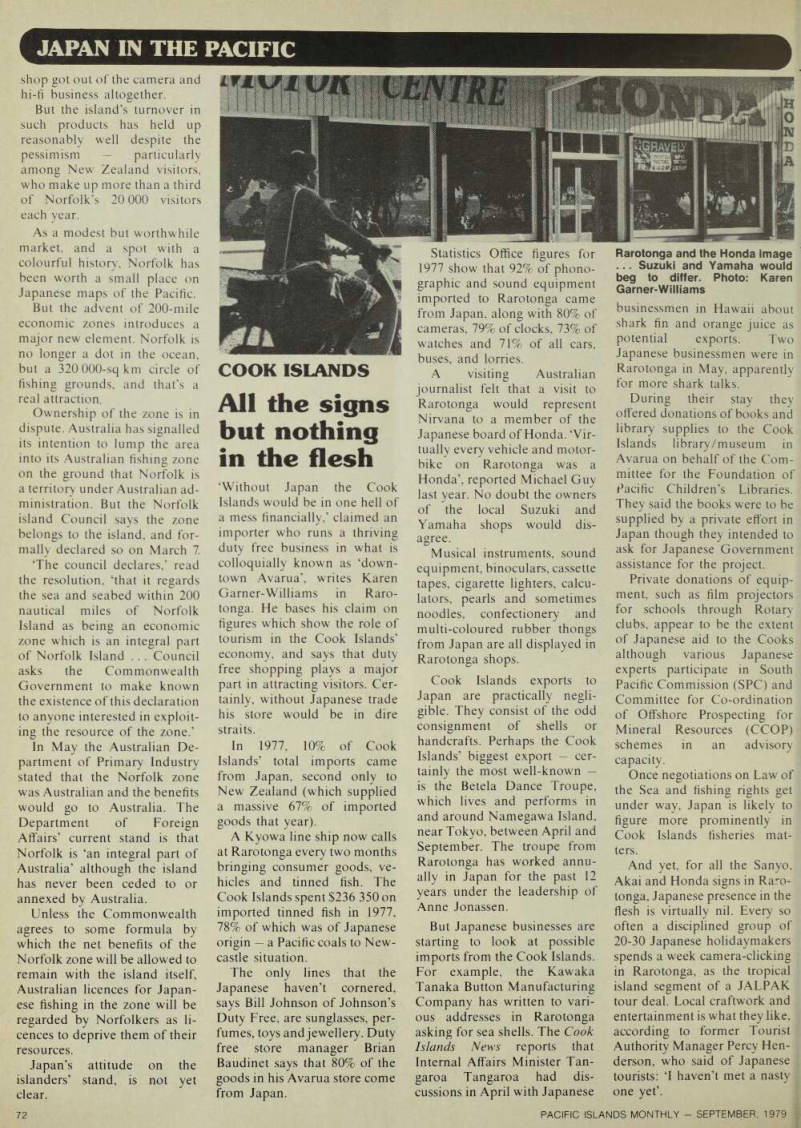
A visiting Australian journalist felt that a visit to Rarotonga would represent Nirvana to a member of the Japanese board of Honda. ‘Vir tually every vehicle and motor bike on Rarotonga was a
Honda’, reported Michael Guy
last year. No doubt the owners of the local Suzuki and Yamaha shops would dis agree.
Musical instruments, sound equipment, binoculars, cassette
tapes, cigarette lighters, calcu
lators, pearls and sometimes noodles, confectionery and multi-coloured rubber thongs from Japan are all displayed in
Rarotonga shops.
Cook Islands exports to
Japan are practically negli
gible. They consist of the odd consignment of shells or handcrafts. Perhaps the Cook Islands’ biggest export cer tainly the most well-known is the Betela Dance Troupe, which lives and performs in and around Namegawa Island, near Tokyo, between April and September. The troupe from Rarotonga has worked annu ally in Japan for the past 12 years under the leadership of Anne Jonassen.
But Japanese businesses are starting to look at possible imports from the Cook Islands.
For example, the Kawaka Tanaka Button Manufacturing Company has written to vari ous addresses in Rarotonga asking for sea shells. The Cook Islands News reports that Internal Affairs Minister Tan garoa Tangaroa had dis cussions in April with Japanese
businessmen in Hawaii about shark fin and orange juice as potential exports. Two Japanese businessmen were in Rarotonga in May, apparently for more shark talks.
During their stay they
offered donations of books and library supplies to the Cook Islands library/museum in Avarua on behalf of the Com mittee for the Foundation of Pacific Children’s Libraries.
They said the books were to be
supplied by a private effort in
Japan though they intended to ask for Japanese Government assistance for the project.
Private donations of equip ment, such as film projectors for schools through Rotary clubs, appear to be the extent of Japanese aid to the Cooks although various Japanese experts participate in South Pacific Commission (SPC) and Committee for Co-ordination of Offshore Prospecting for Mineral Resources (CCOP) schemes in an advisory
capacity.
Once negotiations on Law of the Sea and fishing rights get under way, Japan is likely to
figure more prominently in
Cook Islands fisheries mat ters.
And yet, for all the Sanyo, Akai and Honda signs in Raro tonga, Japanese presence in the flesh is virtually nil. Every so often a disciplined group of 20-30 Japanese holidaymakers
spends a week camera-clicking
in Rarotonga, as the tropical island segment of a JALPAK tour deal. Local craftwork and entertainment is what they like, according to former Tourist Authority Manager Percy Hen derson, who said of Japanese tourists: T haven’t met a nasty
one yet’.
Rarotonga and the Honda image ... Suzuki and Yamaha would beg to differ. Photo: Karen Garner-Williams