To Britain
p. 23 · Read in the full issue
Decolonisation
Kiribati: Free
But Red Taped
To Britain
No one complained or got drunk. And no one, not even a Banaban, was arrested. The Republic of Kiribati - the Gilbert Islands of colonial days moved smoothly into independence on July 12, writes John Carter.
Princess Anne, Queen
Elizabeth IPs only daughter,
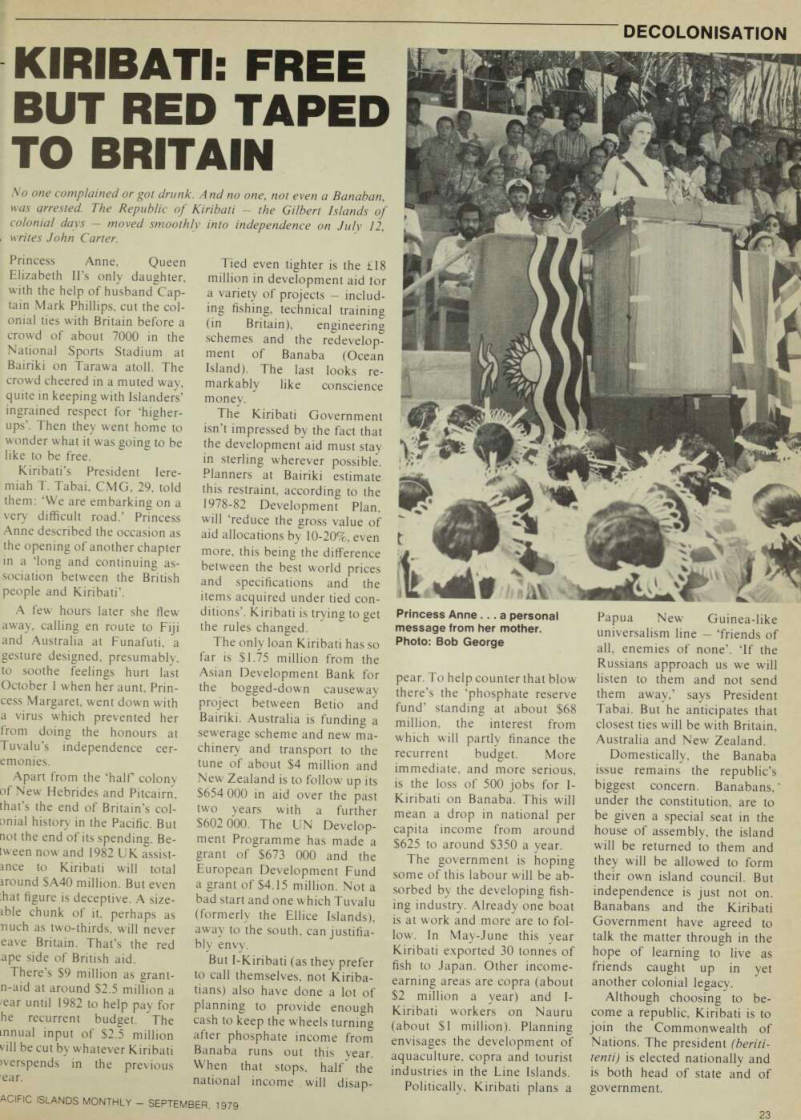
with the help of husband Cap tain Mark Phillips, cut the col onial ties with Britain before a crowd of about 7000 in the National Sports Stadium at Bairiki on Tarawa atoll. The crowd cheered in a muted way, quite in keeping with Islanders’
ingrained respect for ‘higher
ups’. Then they went home to wonder what it was going to be like to be free.
Kiribati’s President Jere miah T. Tabai, CMG, 29, told them: ‘We are embarking on a very difficult road.’ Princess Anne described the occasion as the opening of another chapter in a ‘long and continuing as sociation between the British people and Kiribati’.
A few hours later she flew away, calling en route to Fiji and Australia at Funafuti, a
gesture designed, presumably,
to soothe feelings hurt last October 1 when her aunt. Prin cess Margaret, went down with a virus which prevented her from doing the honours at
Tuvalu’s independence cer
emonies.
Apart from the ‘half colony of New Hebrides and Pitcairn, that’s the end of Britain’s col onial history in the Pacific. But not the end of its spending. Be tween now and 1982 UK assist ance to Kiribati will total around SA4O million. But even
fiat figure is deceptive. A size
able chunk of it, perhaps as nuch as two-thirds, will never cave Britain. That’s the red ape side of British aid.
There’s $9 million as grant n-aid at around $2.5 million a 'ear until 1982 to help pay for he recurrent budget. The innual input of $2.5 million vill be cut by whatever Kiribati werspends in the previous ear.
Tied even tighter is the £lB million in development aid tor a variety of projects - includ
ing fishing, technical training
(in Britain), engineering schemes and the redevelop ment of Banaba (Ocean Island). The last looks re markably like conscience money.
The Kiribati Government isn’t impressed by the fact that the development aid must stay in sterling wherever possible.
Planners at Bairiki estimate this restraint, according to the 1978-82 Development Plan, will ‘reduce the gross value of aid allocations by 10-20%, even more, this being the difference between the best world prices and specifications and the items acquired under tied con ditions’. Kiribati is trying to get the rules changed.
The only loan Kiribati has so far is $1.75 million from the Asian Development Bank for the bogged-down causeway project between Betio and Bairiki. Australia is funding a sewerage scheme and new ma chinery and transport to the tune of about $4 million and New Zealand is to follow up its $654 000 in aid over the past two years with a further $602 000. The UN Develop ment Programme has made a grant of $673 000 and the
European Development Fund
a grant of $4.15 million. Not a bad start and one which Tuvalu (formerly the Ellice Islands), away to the south, can justifia
bly envy.
But I-Kiribati (as they prefer to call themselves, not Kiriba tians) also have done a lot of
planning to provide enough
cash to keep the wheels turning after phosphate income from Banaba runs out this year.
When that stops, half the national income will disap-
pear. To help counter that blow there’s the ‘phosphate reserve fund’ standing at about $6B million, the interest from which will partly finance the recurrent budget. More immediate, and more serious, is the loss of 500 jobs for I- Kiribati on Banaba. This will mean a drop in national per capita income from around $625 to around $350 a year.
The government is hoping some of this labour will be ab sorbed by the developing fish
ing industry. Already one boat
is at work and more are to fol low. In May-June this year Kiribati exported 30 tonnes of fish to Japan. Other income earning areas are copra (about $2 million a year) and I- Kiribati workers on Nauru (about $1 million). Planning envisages the development of aquaculture, copra and tourist industries in the Line Islands.
Politically, Kiribati plans a
Papua New Guinea-like universalism line - ‘friends of all, enemies of none’. ‘lf the Russians approach us we will listen to them and not send them away,’ says President Tabai. But he anticipates that closest ties will be with Britain, Australia and New Zealand.
Domestically, the Banaba issue remains the republic’s biggest concern. Banabans, * under the constitution, are to be given a special seat in the house of assembly, the island will be returned to them and they will be allowed to form their own island council. But independence is just not on.
Banabans and the Kiribati Government have agreed to talk the matter through in the hope of learning to live as friends caught up in yet another colonial legacy.
Although choosing to be
come a republic, Kiribati is to join the Commonwealth of Nations. The president (beriti tenti) is elected nationally and is both head of state and of government.
Princess Anne ... a personal message from her mother.
Photo: Bob George