Two territories,
pp. 17-22 · Read in the full issue
Political
Currents
President Giscard: Two territories, two messages
For the first time in 13 years, a French president has paid an official visit to France’s Pacific territories. But the most casual
. comparison of President
Charles de Gaulle’s September 1966 tour with the July 1979 visit by President Valery Gis
card d’Estaing highlights many
of the changes that have taken place in the region in the inter
vening years.
President Giscard, for example, drew a highly dif ferentiated picture of France’s relations with the two main ter ritories of New Caledonia and
French Polynesia something
President de Gaulle probably felt himself under no great compulsion to do in 1966.
Furthermore, President Gis card knew he was operating against the delicate back ground of keen challenge within the highly influential South Pacific Forum to the whole principle of France’s presence in the Pacific. (The Forum had completed its de liberations in Honiara only a few days before he arrived in the Pacific - PIM page 10).
President de Gaulle had no such problem with the (as yet unborn) Forum in 1966.
Finally, President Giscard received in Noumea the two
top Francophone and
Anglophone representatives of
the soon -to-be-independent
New Hebrides. He spoke
French to one, and English to fie other (Political Currents).
Le grand Charles' in 1966 had 'ound himself under no such
axing obligation.
Perhaps the most dramatic political aspect of President discard’s Pacific tour was the renchant manner in which he listinguished between the
-rench relationship with
J olynesia on the one hand and <ew Caledonia on the other. (In New Caledonia there are ibout 55 000 Melanesians and 0 000 Europeans. In elections •n July 1, the vote was 65% in avour of continued association fith France, and 35% for tidependence - PIM, Political
Currents. In French Polynesia the population is about 80% Polynesian, and there is a much broader consensus for main taining the status of autonomy within the French com
munity.)
On July 19 in Papeete, Presi dent Giscard voiced his belief in ‘Polynesia’s French future’.
Earlier, he had referred to France’s relations with French Polynesia as ‘lasting’, since the population, he said, had strongly expressed its desire to remain with France.
In Noumea, on the first leg of his tour, he had used quite
different language. According
to a correspondent of the semi official French newsagency Agence France-Presse travel ling with the president: in New Caledonia, President Gis card d’Estaing had a double barrelled message for the French and Melanesian com munities ... He warned the settlers that there would be no unconditional support from France for any colonial-style behaviour in the post-colonial
period. “France’s image must
no longer be tarnished by the sequels of the colonial era,” he said. ‘President Giscard d’Estaing told the Europeans to settle the problem of their relations with
the indigenous community
known as “Kanaks”. ‘But he fired off the other round at the Kanaks. French presence could not be main tained unless it was desired by a majority of the population of New Caledonia. “New Caledonians are masters of their destiny,” he said. The Kanaks could have indepen dence if they could win it at the ballot box. But it would be at their own risk and peril.’
In his speech to the terri torial assembly. President Gis card returned to the attack on entrenched conservative el ements in the Caledonian com
munity, saying: ‘Nothing
important or lasting will be created in this territory if you do not restore to the
Melanesians the place which is rightfully theirs in the New Caledonia of tomorrow.’ He said that the best way to do this would be to give back to the Melanesian community the land which was wrested from them during the colonial period.
The president stressed French efforts for the econ omic development of New Caledonia, but warned citizens that sooner or later they would
have to participate financially
in these projects.
He raised the problem of di rect taxation, which does not exist in New Caledonia, but which the French Government wishes to establish, he said, ‘in the interests of justice and
equity’.
The AFP correspondent
reported that the welcome to the president was ‘far warmer in Po ynesia lhan in New Caledonia'. Among sour notes accompanying the Caledonian visit the correspondent men tioned; a dem F onstratlon b 300.400 supporters of indepen dence in the streets of NoU m ea 0 n July 18: a boycott of the president’s speech to the 36member territorial assembly by the 14 pro-independence mem bers' who had sent him a letter protesting at their exclusion rom positions or com mittees in the territorial government; the felling of trees
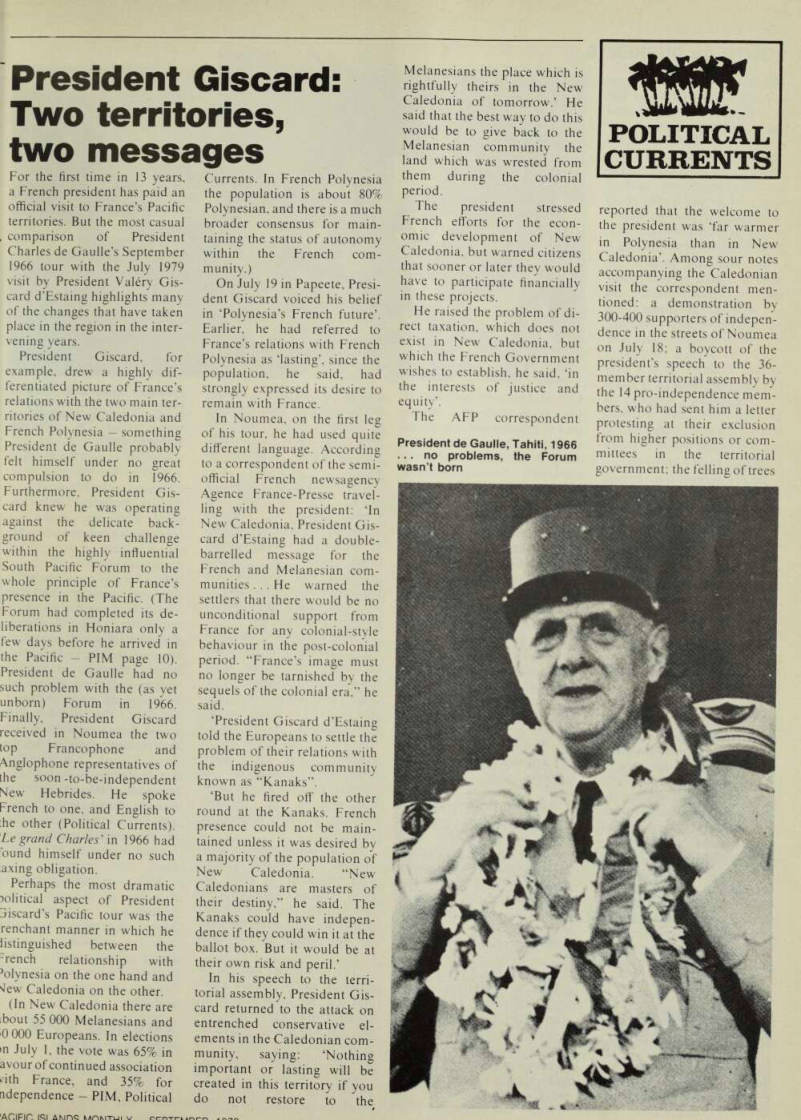
President de Gaulle, Tahiti, 1966 ... no problems, the Forum wasn’t born
on the island of Touho in an attempt to stop a large turn-out to welcome the president; and the presence of pro independence banners on the island of Lifou, Loyalty Islands. (President Giscard be came the first French head of state ever to visit Kanak tribal areas, and the Loyalty Islands, where pro-independence sen timent is traditionally strong.) But, according to news re ports available to PIM at the time of going to press, the visit to French Polynesia was marred by no such incidents; President Giscard was wel
comed by French Polynesia’s
Deputy Premier Francis San ford, accompanied by a group of Polynesian dancers in national costume. Nothing seems to have happened during the visit to mar the lei- laden at
mosphere of its beginning.
In his speeches in French
Polynesia, the president vowed
that France would not be sparing in support and soli
darity for the Polynesians,
since, he claimed, they had freely chosen to remain within the French community.
Measures he announced in cluded steps to reduce the dif ference in living standards between Tahiti and the terri
tory’s other archipelagoes, and
plans to deal with social prob
lems and reducing unemploy
ment.
The president made two other sorties on his Pacific tour: he paid a three-hour visit to the French territory of Wallis and Futuna, where he met the three ruling kings and took part in a traditional drink ing ceremony; then, as his final stop, he chose the Moruroa nu clear testing range. The AFP correspondent had the follow ing comment: ‘For all the dis cretion surrounding that visit, the stopover marked the re lationship between France’s position as a ranking nuclear power and the French presence in the Pacific.’
Nh Leaders
See Giscard
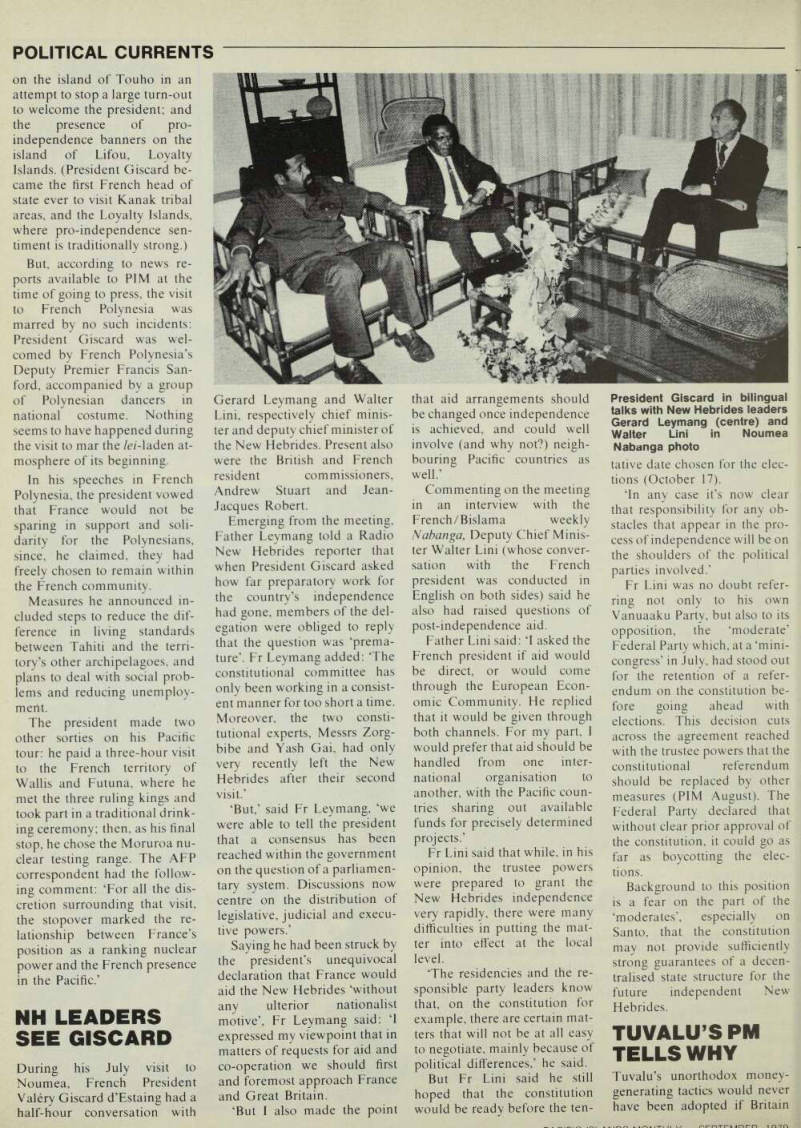
During his July visit to Noumea, French President Valery Giscard d’Estaing had a half-hour conversation with
Gerard Leymang and Walter Lini, respectively chief minis ter and deputy chief minister of the New Hebrides. Present also were the British and French resident commissioners, Andrew Stuart and Jean-
Jacques Robert.
Emerging from the meeting.
Father Leymang told a Radio New Hebrides reporter that when President Giscard asked how far preparatory work for
the country’s independence
had gone, members of the del
egation were obliged to reply
that the question was ‘prema ture’. Fr Leymang added; ‘The constitutional committee has only been working in a consist ent manner for too short a time.
Moreover, the two consti tutional experts, Messrs Zorg bibe and Yash Gai, had only very recently left the New Hebrides after their second visit.’ ‘But,’ said Fr Leymang, ‘we were able to tell the president that a consensus has been reached within the government on the question of a parliamen tary system. Discussions now centre on the distribution of
legislative, judicial and execu
tive powers.’
Saying he had been struck by
the president’s unequivocal
declaration that France would aid the New Hebrides ‘without any ulterior nationalist motive’, Fr Leymang said: T expressed my viewpoint that in matters of requests for aid and co-operation we should first and foremost approach France and Great Britain. ‘But I also made the point
that aid arrangements should
be changed once independence
is achieved, and could well involve (and why not?) neigh bouring Pacific countries as well.’
Commenting on the meeting
in an interview with the
French/Bislama weekly
Nabanga, Deputy Chief Minis
ter Walter Lini (whose conver sation with the French president was conducted in English on both sides) said he also had raised questions of
post-independence aid.
Father Lini said: i asked the French president if aid would be direct, or would come through the European Econ
omic Community. He replied
that it would be given through both channels. For my part. 1 would prefer that aid should be handled from one inter national organisation to another, with the Pacific coun tries sharing out available funds for precisely determined
projects.’
Fr Lini said that while, in his opinion, the trustee powers were prepared to grant the New Hebrides independence very rapidly, there were many difficulties in putting the mat ter into effect at the local level. ‘The residencies and the re sponsible party leaders know that, on the constitution for example, there are certain mat ters that will not be at all easy to negotiate, mainly because of political differences,’ he said.
But Fr Lini said he still hoped that the constitution would be ready before the ten
tative date chosen for the elec tions (October 17). ‘ln any case it’s now clear that responsibility for any ob stacles that appear in the pro cess of independence will be on the shoulders of the political
parties involved.’
Fr Lini was no doubt refer ring not only to his own Vanuaaku Party, but also to its opposition, the ‘moderate’
Federal Party which, at a ‘mini congress’ in July, had stood out for the retention of a refer endum on the constitution be fore going ahead with elections. This decision cuts across the agreement reached with the trustee powers that the constitutional referendum should be replaced by other measures (PIM August). The Federal Party declared that without clear prior approval of the constitution, it could go as far as boycotting the elec tions.
Background to this position
is a fear on the part of the ‘moderates’, especially on Santo, that the constitution
may not provide sufficiently
strong guarantees of a decen tralised state structure for the future independent New Hebrides.
Tuvalu’S Pm
Tells Why
Tuvalu’s unorthodox money generating tactics would never have been adopted if Britain
President Giscard in bilingual talks with New Hebrides leaders Gerard Leymang (centre) and Walter Uni in Noumea Nabanga photo
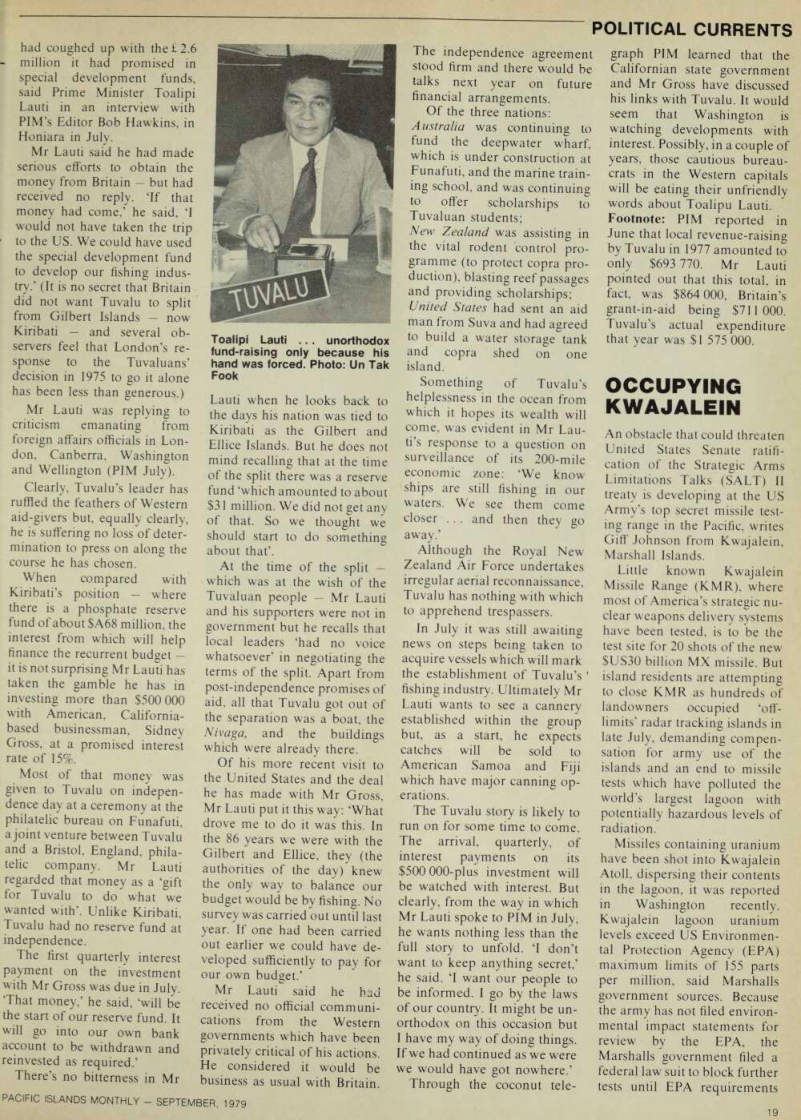
had coughed up with the £2.6 - million it had promised in special development funds, said Prime Minister Toalipi Lauti in an interview with PlM’s Editor Bob Hawkins, in Honiara in July.
Mr Lauti said he had made serious efforts to obtain the money from Britain but had received no reply. ‘lf that money had come,’ he said, ‘I would not have taken the trip to the US. We could have used
the special development fund
to develop our fishing indus try.’ (It is no secret that Britain did not want Tuvalu to split from Gilbert Islands now Kiribati and several ob servers feel that London’s re sponse to the Tuvaluans’ decision in 1975 to go it alone has been less than generous.) Mr Lauti was replying to criticism emanating from foreign affairs officials in Lon don, Canberra, Washington
and Wellington (PIM July).
Clearly, Tuvalu’s leader has ruffled the feathers of Western
aid-givers but, equally clearly,
he is suffering no loss of deter mination to press on along the course he has chosen.
When compared with Kiribati’s position where there is a phosphate reserve fund of about SA6B million, the interest from which will help finance the recurrent budget it is not surprising Mr Lauti has taken the gamble he has in investing more than $5OO 000 with American, California based businessman, Sidney Gross, at a promised interest rate of 15%.
Most of that money was given to Tuvalu on indepen dence day at a ceremony at the philatelic bureau on Funafuti, a joint venture between Tuvalu and a Bristol, England, phila telic company. Mr Lauti regarded that money as a ‘gift for Tuvalu to do what we wanted with’. Unlike Kiribati, Tuvalu had no reserve fund at
independence.
The first quarterly interest payment on the investment with Mr Gross was due in July. ‘That money,’ he said, ‘will be the start of our reserve fund. It will go into our own bank account to be withdrawn and reinvested as required.’
There’s no bitterness in Mr
Lauti when he looks back to the days his nation was tied to Kiribati as the Gilbert and Ellice Islands. But he does not mind recalling that at the time of the split there was a reserve fund ‘which amounted to about $3l million. We did not get any of that. So we thought we should start to do something about that’.
At the time of the split which was at the wish of the Tuvaluan people - Mr Lauti and his supporters were not in government but he recalls that local leaders ‘had no voice whatsoever’ in negotiating the terms of the split. Apart from post-independence promises of aid, all that Tuvalu got out of the separation was a boat, the
Nivaga, and the buildings
which were already there.
Of his more recent visit to the United States and the deal he has made with Mr Gross, Mr Lauti put it this way: ‘What drove me to do it was this. In the 86 years we were with the Gilbert and Ellice, they (the authorities of the day) knew the only way to balance our
budget would be by fishing. No
survey was carried out until last year. If one had been carried out earlier we could have de veloped sufficiently to pay for our own budget.’
Mr Lauti said he had received no official communi cations from the Western governments which have been privately critical of his actions.
He considered it would be business as usual with Britain.
The independence agreement stood firm and there would be talks next year on future financial arrangements.
Of the three nations: Australia was continuing to fund the deepwater wharf, which is under construction at Funafuti, and the marine train ing school, and was continuing to offer scholarships to Tuvaluan students; New Zealand was assisting in the vital rodent control pro gramme (to protect copra pro duction), blasting reef passages
and providing scholarships;
United States had sent an aid man from Suva and had agreed to build a water storage tank and copra shed on one island.
Something of Tuvalu’s helplessness in the ocean from which it hopes its wealth will come, was evident in Mr Lau d’s response to a question on surveillance of its 200-mile economic zone: ‘We know ships are still fishing in our waters. We see them come closer .. . and then they go
away.’
Although the Royal New
Zealand Air Force undertakes irregular aerial reconnaissance, Tuvalu has nothing with which to apprehend trespassers.
In July it was still awaiting news on steps being taken to acquire vessels which will mark the establishment of Tuvalu’s ’
fishing industry. Ultimately Mr
Lauti wants to see a cannery established within the group but, as a start, he expects catches will be sold to American Samoa and Fiji which have major canning op erations.
The Tuvalu story is likely to run on for some time to come.
The arrival, quarterly, of interest payments on its $5OO 000-plus investment will be watched with interest. But clearly, from the way in which Mr Lauti spoke to PIM in July, he wants nothing less than the full story to unfold. ‘I don’t want to keep anything secret,’ he said. ‘I want our people to be informed. I go by the laws of our country. It might be un orthodox on this occasion but I have my way of doing things.
If we had continued as we were we would have got nowhere.’
Through the coconut tele
graph PIM learned that the Californian state government and Mr Gross have discussed his links with Tuvalu. It would seem that Washington is watching developments with interest. Possibly, in a couple of years, those cautious bureau crats in the Western capitals will be eating their unfriendly words about Toalipu Lauti.
Footnote: PIM reported in June that local revenue-raising by Tuvalu in 1977 amounted to only $693 770. Mr Lauti pointed out that this total, in fact, was $864 000, Britain’s grant-in-aid being $7llOOO.
Tuvalu’s actual expenditure that year was $1 575 000.
Occupying
Kwajalein
An obstacle that could threaten United States Senate ratifi cation of the Strategic Arms Limitations Talks (SALT) II treaty is developing at the US Army’s top secret missile test ing range in the Pacific, writes Gilf Johnson from Kwajalein, Marshall Islands.
Little known Kwajalein Missile Range (KMR), where most of America’s strategic nu clear weapons delivery systems have been tested, is to be the test site for 20 shots of the new SUS3O billion MX missile. But island residents are attempting to close KMR as hundreds of landowners occupied ‘off limits’ radar tracking islands in
late July, demanding compen
sation for army use of the islands and an end to missile tests which have polluted the world’s largest lagoon with potentially hazardous levels of radiation.
Missiles containing uranium have been shot into Kwajalein Atoll, dispersing their contents in the lagoon, it was reported in Washington recently.
Kwajalein lagoon uranium levels exceed US Environmen tal Protection Agency (EPA) maximum limits of 155 parts per million, said Marshalls government sources. Because the army has not filed environ mental impact statements for review by the EPA, the Marshalls government filed a federal law suit to block further tests until EPA requirements
Toalipi Lauti ... unorthodox fund-raising only because his hand was forced. Photo: Un Tak Fook
for tests are met. ‘We have closed it (the base) before and we will close it again,’ Marshallese leading the
Kwajalein occupation said.
Although US State Depart ment spokesmen have down
played the importance of
KMR, army representatives say there is ‘no comparable range anywhere else for testing the MX, and a great deal of time and money would be necessary to relocate the
Kwajalein base’. Any appreci
able delay in MX missile development could hurt pass age of the SALT treaty in the US Senate, said a State Depart
ment spokesman recently.
Imada Kabua, a local legis lature member, was clubbed with a nightstick by the American security manager as he led 25 unarmed men, women and children onto the beach at Roi Namur, a tiny island on the north tip of Kwajalein dotted with missile
tracking equipment.
‘Maybe he thought he would scare us off the island by doing that,’ said Kabua, who sus tained a five-inch bruise on his ribs. But, he added: ‘We are here to stay.’ Kabua immedi ately filed an assault and bat tery law suit against the security manager and the army seeking $5 million in damages.
Within a day there were close to 100 landowners occupying Roi Namur.
At the same time, hundreds of Marshallese landowners set up camp on Kwajalein Island, headquarters of KMR. There were no incidents. Spokes people for the landowners said
they are demanding renegotia
tion of a lease signed in 1964 in which the US paid $750 000 for 99 years use of Kwajalein - about $lO an acre per year and agreed to ‘improve the economic and social conditions of the Marshallese people, par
ticularly at Ebeye ...’
In 1964, hundreds of Marshallese were moved to Ebeye from over a dozen islands in Kwajalein to make way for the army’s missile test ing.
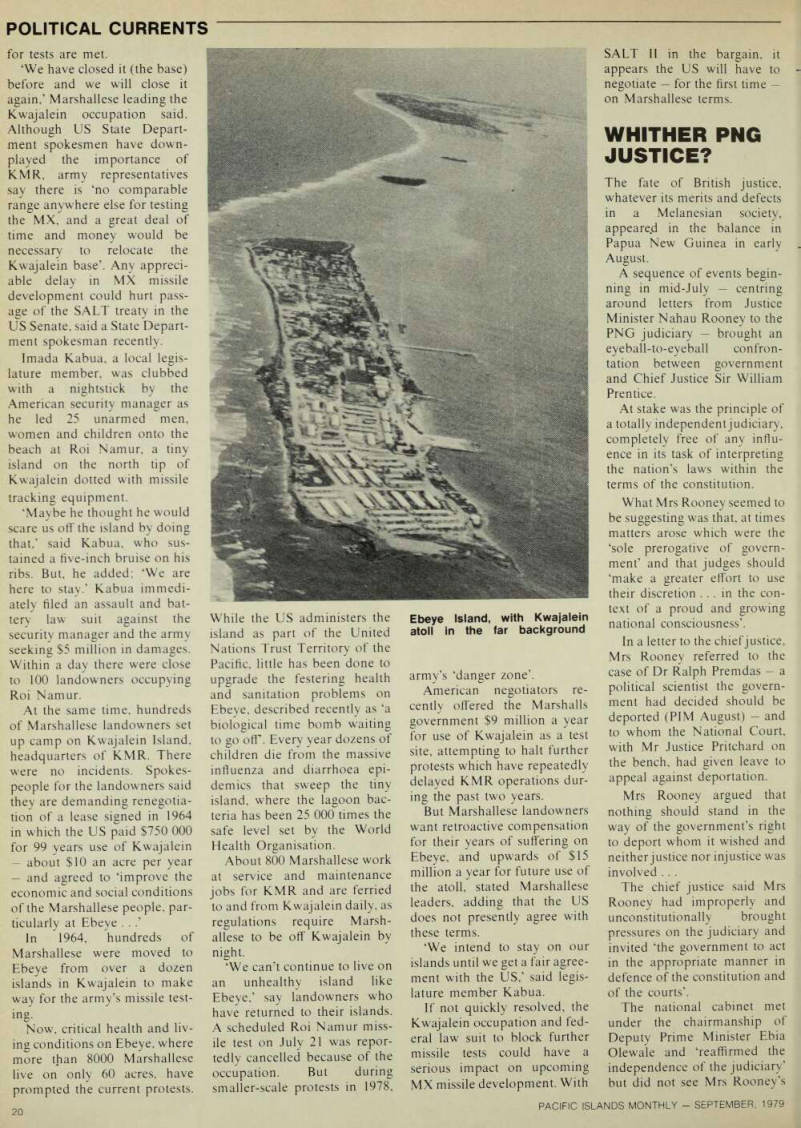
Now, critical health and liv ing conditions on Ebeye, where more than 8000 Marshallese live on only 60 acres, have prompted the current protests.
While the US administers the island as part of the United Nations Trust Territory of the Pacific, little has been done to
upgrade the festering health
and sanitation problems on Ebeye, described recently as ‘a
biological time bomb waiting
to go off. Every year dozens of children die from the massive influenza and diarrhoea epi demics that sweep the tiny island, where the lagoon bac teria has been 25 000 times the safe level set by the World
Health Organisation.
About 800 Marshallese work at service and maintenance jobs for KMR and are ferried to and from Kwajalein daily, as
regulations require Marsh
allese to be off Kwajalein by
night.
‘We can ? t continue to live on an unhealthy island like Ebeye,’ say landowners who have returned to their islands.
A scheduled Roi Namur miss ile test on July 21 was repor tedly cancelled because of the occupation. But during smaller-scale protests in 1978,
army’s ‘danger zone’.
American negotiators re cently offered the Marshalls government $9 million a year for use of Kwajalein as a test site, attempting to halt further protests which have repeatedly
delayed KMR operations dur
ing the past two years.
But Marshallese landowners want retroactive compensation for their years of suffering on Ebeye, and upwards of $l5 million a year for future use of the atoll, stated Marshallese leaders, adding that the US does not presently agree with these terms. ‘We intend to stay on our islands until we get a fair agree ment with the US,’ said legis lature member Kabua.
If not quickly resolved, the
Kwajalein occupation and fed
eral law suit to block further missile tests could have a
serious impact on upcoming
MX missile development. With
SALT II in the bargain, it appears the US will have to negotiate for the first time on Marshallese terms.
Whither Png
Justice?
The fate of British justice, whatever its merits and defects in a Melanesian society, appeare.d in the balance in Papua New Guinea in early August.
A sequence of events begin
ning in mid-July centring
around letters from Justice Minister Nahau Rooney to the
PNG judiciary brought an
eyeball-to-eyeball confron
tation between government and Chief Justice Sir William Prentice.
At stake was the principle of
a totally independent judiciary,
completely free of any influ ence in its task of interpreting the nation’s laws within the terms of the constitution.
What Mrs Rooney seemed to be suggesting was that, at times matters arose which were the ‘sole prerogative of govern ment’ and that judges should ‘make a greater effort to use their discretion ... in the con text of a proud and growing national consciousness’.
In a letter to the chief justice, Mrs Rooney referred to the case of Dr Ralph Premdas a political scientist the govern ment had decided should be deported (PIM August) and to whom the National Court, with Mr Justice Pritchard on the bench, had given leave to
appeal against deportation.
Mrs Rooney argued that nothing should stand in the way of the government’s right to deport whom it wished and neither justice nor injustice was involved .. .
The chief justice said Mrs Rooney had improperly and
unconstitutionally brought
pressures on the judiciary and invited ‘the government to act in the appropriate manner in defence of the constitution and of the courts’.
The national cabinet met under the chairmanship of Deputy Prime Minister Ebia Olewale and ‘reaffirmed the
independence of the judiciary’
but did not see Mrs Rooney’s
Ebeye Island, with Kwajalein atoll in the far background
letter as ‘showing interference with the independence of the
judiciary’.
Prime Minister Michael Somare who had just re turned from sick leave and was preoccupied with arrange ments for declaration of PNG’s state of emergency to combat
Highlands tribal fighting did
not attend the cabinet session.
However, Mr Somare’s suggestion later that the situ ation which had developed was ‘not unusual and could help to establish precedent when it is resolved’ did nothing to assuage the judiciary but it did suggest some design in the chain of events.
Another letter came to light about the same time, from Mrs Rooney to Public Prosecutor Kevin Egan, in relation to the appearance before the National Court of Minister for National Planning John Kapu tin on a charge of having failed to respond to a court order relating to returns for a company in which he was involved.
Mr Justice Pritchard tabled Mrs Rooney’s letter, which suggested that there was no reason for prosecuting Mr Kaputin and that ‘I trust you will use your discretion effec
tively’.
Judge Pritchard said Mrs Rooney’s earlier letter had in ferred that he had discharged his duties without honour and he could not permit such an ac cusation. He then disqualified himself from hearing the charge against Mr Kaputin and announced his intention to re
sign from the judiciary.
On the same day Mrs Rooney did nothing to ease the tension by announcing that she was working towards a judicial system ‘more appropriate to Papua New Guinea’ in which locally-skilled people would sit with judges as assessors on all matters. (None of PNG’s eight judges at the time was Papua New Guinean).
It was all ideal ammunition for the opposition led by lam bakey Okuk, never one to miss an opportunity to give the government a bad time. On August 1, on behalf of himself and ‘the people of Papua New Guinea’ he applied to the Su
preme Court to gaol Mrs Rooney or remove her from office. The writ sought to have Mrs Rooney examined by the court about the letters she wrote and to have examined those who ‘connived, sup ported, aided, abetted and encouraged’ her in writing the letters.
The writ claimed that Mrs Rooney and others broke the
constitution by giving direc
tions on judicial matters. Mr Olewale on the same day indi cated that cabinet had no intention of backing down by
saying the situation provided
‘an opportunity for all mem bers of the community to be come better acquainted with the system of government and justice’, and saying that the constitution ‘belongs to the people of Papua New Guinea and arguments about its in terpretation should not be left to lawyers alone’.
Mr Okuk’s writ was later disallowed by the court. For his part, the public prosecutor an nounced his intention of laying
contempt charges against Mrs
Rooney. They were to be heard on August 27.
In the meantime Dr Prem das’ appeal was heard and he was granted an extension of the
injunction preventing the
government from deporting him. He appealed on the grounds that he had been de nied constitutional rights in which the government had dealt with him. The Supreme Court reserved its decision.
Nl: Pomp
But No Joy
Norfolk Island’s new form of government, with a locally
elected legislative assembly,
was ushered into being in August with a ceremonial
complement of dignitaries
trom Australia on hand, writes a Norfolk correspondent.
The electors had voted the
following into the assembly;
president-elect and deputy president-elect: David Buffett, Bill Blucher; members: former councillors Brian Munn, Dun can Mclntyre, Bruce Macken zie; new members Kevin Williams, John Ryves, Gilbert Jackson, Ed Howard.
Governor-General Sir Zel
man Cowen, Minister for Home Affairs Bob Ellicott, Speaker of the House Sir Billy Snedden and Canberra-based high commissioners from England and New Zealand were among those who helped commemorate what Australia hopes will be seen as a big step out of colonialism and a start on the road to local self government for Norfolk.
Most Norfolk Islanders were astonished and dismayed at the assembly results, after using for the first time the new pro portional representation sys tem. Norfolk voters have always elected their members on a first-past-the-post system and could not quickly under stand a system in which a voter’s number one vote was the important one and his other votes were regarded as mere
preferences that might or
might not be regarded.
As a result, two sitting Islanders, Lisle Snell and Greg Quintal, were passed over, although Quintal has been a councillor for 26 years. Ken Nobbs, president of the society of Pitcairn Descendants, also missed election. On the other hand, out of nine assembly members there are three public servants, including the new
president of the assembly,
David Buffett, who got in with a massive 254 first preference votes, compared with 87 for his nearest rival, Bill Blucher.
There is strong feeling on the island that the proportional system should not have been introduced just before an im portant election and certainly not without a massive public education programme to ex
plain it.
Australian Minister for Home Affairs, Mr Ellicott, de cided on the new system only five weeks before the election.
The council insisted on a refer endum to seek public approval or otherwise for the pro portional system, but this won’t be held until September.
Meanwhile, the minister insisted the assembly election go ahead under the new scheme. Some assembly mem bers are asking what will hap pen should the referendum reject the scheme, which is thought likely. Would there be a call for new elections to be
held under the old system?
There is a wide feeling that Mr Ellicott insisted on pro portional representation in the hope that it would break up the voting patterns which seem to have ensured a ‘Norfolk Islander bloc’ has held power, and this bloc has made life dif ficult for the Commonwealth because of its anti-colonial,
anti-integration-with-Australia,
stance. If so the scheme has succeeded beyond the Minis ter’s dreams. But it could well rebound on him.
As the president of the as sembly, David Buffett has an executive position and must re sign from the administration.
As an executive officer of the assembly he will have ministerial-type duties in the new Norfolk Council, being re sponsible for finance, supply, commerce, immigration and tourism, among other things.
The only other executive pos ition is held by Bill Blucher, deputy president. His responsi bilities will include works and industries.
Whether they are a valid rep resentative body or not, the as sembly members were to face
President Buffett ... as an executive of the assembly he must resign his administration job
a small mountain of legislative and policy decisions as they took up office.
Under the recently passed
Norfolk Island Act which crea ted the assembly, they will be subject to Australian vetoes or disallowance for as long as six
months after they’ve approved
any Norfolk act. At the same time, they have been given at least the formal right of initiat ing laws on any Norfolk subject except raising armed forces,
taking property unjustly, or
coining money.
Among issues that will come before them in the early months of their existence are a new social welfare scheme, amended immigration restric tions, new public service laws, quite possibly new taxes, and the island’s first official zoning and conservation codes. Some of these bills may be drafted in Australia and introduced into the assembly in the name of the
governor-general. Whether
that is the case, or whether a bill originates on the island, the key questions on Norfolk will be how the assembly amends or passes them and whether the Australian Government then lets local wisdom prevail or exercises its superior powers to dictate the final laws.
The word ‘independence’ was heard publicly in July for
the first time in any modern Norfolk election, with can didate Ken Nobbs, president of the Society of Descendants of the Pitcairn Settlers, saying he thought Norfolk should be come free-standing and associated with Australia only on terms acceptable to the island. Most other candidates were cautious about commit ting themselves on the subject, and seemed to hope that Aus tralia would treat the as
sembly’s proposals with some
deference. If that proves to be the case, ‘independence’ talk can be expected to subside.
The island is still smarting from Mr Ellicott’s now notorious comment to the old council in negotiations last March: ‘You are under the complete bondage of the Aus tralian Parliament. You are not free.’ If Australia presses that view, arguments in favour of
independence will inevitably
increase.
After The
Nc Poll
If the members of the French Government were seeking a clearer picture of the political scene in New Caledonia they should now be happy, writes Andr'e Chaville from Noumea.
The July 1 elections were held under new rules which re stricted the number of compet ing parties. As a result, three main federations fought a battle which, for the first time, was broadcast and televised.
Official reason for the elec tion was renewal of territorial assembly. But the dominant issue in the election immedi ately became apparent: it was independence. For the first time the word was officially used, and those in favour of it were able to speak openly.
Thus, a state-owned television station carried interviews with candidates who were openly
and sometimes quite violently
critical of French domination.
For electors opposed to independence, there was some confusion. The Rightwing RPCR (Rally for Caledonia and the Republic) and the lib eral FNSC (Federation for a New Society in Caledonia) both claimed to be ‘national’
parties, and both boasted the full support either of the presi dent, the prime minister, or of Madame Veil, official leader of the National list for the European elections held three weeks before. Perhaps the great difference between the two was the amount of money they had available to spend on propaganda the financial
backing enjoyed by the RPCR
was probably influential in the final results: it got 20 253 votes, and won 15 seats.
For those who were a little
more discerning, the picture
was pretty clear. The RPCR was obviously related to the RPR, the unenthusiastic part ner in the present governing coalition in Paris. The FNSC was supporting the plan of Overseas Territories Minister Paul Dijoud of reform, which includes a redistribution of land. With two representatives of large landholders on the RPCR list, there could be little doubt about their real feelings about at least this aspect of the
Dijoud plan.
It is interesting that the FNSC received the support it did 8927 votes and seven seats in view of the fact that it stood candidates in only two of the four electoral districts.
An important aspect of the election was the geographical breakdown of results: the par
ties favouring independence
obtained 62% of the votes on the East Coast and 64% in the Loyalty Islands. The two par ties in favour of French auth ority both obtained their best results in Noumea: 81%, or even 90% if votes for the other small anti-independence par ties are included in the count.
Comparing the results with the demographic situation in the territory shows that the unofficial issue, /or or against independence, has divided the
population once again black
versus white, or even Noumea versus the bush. Electors were scared of a ‘Pacific Rhodesia’ on the one hand, or ‘Black Power’ on the other when in fact neither of these outcomes was likely or even possible.
Composed as it is of 22
assemblymen opposed to
independence and 14 favour
ing independence (pro
independence candidates
secured 16 883 votes), and the vital issue of ‘independence or not’ settled for the immediate future, doubtless the old feuds will soon reappear.
The FNSC will naturally expect to obtain seats in the future government council, while the opposition parties will rarely be united on all issues.
Png Extends
Emergency
Emergency regulations,
introduced on July 23 by the government to deal with con
tinuing tribal fighting in Papua
New Guinea’s Highlands prov inces, were approved and extended by the National Par liament on August 10.
Approval came despite op
position charges that the
government had acted in a dic tatorial and oppressive man
ner, unnecessarily curbing
freedoms and undermining trade and commerce in the
Highlands.
The August meeting of par liament was a constitutional re quirement to approve or reject the government’s decision to introduce the emergency regu lations.
The August 10 vote in parlia ment allows the government to extend the emergency by 60
days.
In the week the question was debated an opposition official claimed that reports were coming in from Simbu Prov ince, which lies between the Eastern and Western High lands Provinces, of assault, theft and rape by Royal Papua New Guinea Constabulary
policemen exceeding authority
extended to them under the
emergency regulations.
The government’s July dec
laration came after many months of tribal clashes, mainly in the Enga Province to the west of the Western High lands.
One European resident in Enga Province, who emphasised that he did not feel personally threatened by the fighting, said press reports had come ‘nowhere near’ describ ing the seriousness of the situ ation. More than 50 deaths have occurred so far this year and damage to stock, crops and houses is incalculable.
Greg Quintal ... an Islander passed over by the new-fangled voting system