Bikini Enewetak
pp. 11-17 · Read in the full issue

Micronesia
On August 6, 1945, the B-29 Enola Gay dropped the first of two atomic bombs that would kill over 200 000 people in Hiroshima and Nagasaki.
Within months the United States began searching for sites far from American population centres for further develop ment and testing of nuclear weapons. The Defense Depart ment looked to Micronesia in the western Pacific, whose 2000 remote islands have only one half the land area of the state of Rhode Island.
Easternmost in Micronesia lie the Marshall Islands, about 3500 km southwest of Hawaii.
Up to the 1940 s the Marshall [slanders, like most other Micronesians, were self sufficient, living off the ocean
md land. Though covering a
>reat expanse of ocean, the Marshalls’ 28 multi-islet atolls md five single islands com
3rise only about 180
square km. The atolls are rings }f 15 to as many as 97 islets xmnected by a coral reef that mcircles a clear blue lagoon.
Dut of necessity, the
Marshallese are traditionally
expert fishermen, deriving
nost of their protein from the ich lagoons, while the land )rovides coconuts, breadfruit, )andanus and taro.
The most isolated and least vestemised of the Marshallese ived on the northern atolls of
Bikini and Enewetak. Having
ittle contact with foreigners not even with the Japanese
luring their 25-year occu
>ation), they relied on the out ide world for almost nothing, ronically, this very isolation hrust the Bikini and Enewetak )eople into the nuclear age.
In January 1946, Navy
)fficials in Washington, DC,
mnounced that Bikini Atoll
itted all requirements for Op
ration Crossroads , designed to
est the destructive power of mclear weapons on naval vessels. When the US military governor of the Marshalls went o Bikini in February, he told he people that American
■dentists were experimenting
vith nuclear weapons ‘for the
In July 1947 the United States of America gave its word to the United Nations, when it signed the UN Trusteeship Agree ment for the US Trust Territories of the Pacific Islands (Micronesia) to *. . .protect the inhabitants against the loss of their land and resources’. The Micronesians of Bikini and Enewetak Atolls have good reason to doubt the United States’ sincerity as they survey the devastation of their homelands for the good of mankind and to end all world wars’. Gifford Johnson, a freelance writer, traces the tragic sequence of events since 1947 in this article which first appeared in the Bulletin of the Atomic Scientests. PIM reprints it in the hope of widening public discussion on a problem which shows no sign of going away. It is not a question of digging up an old story. The future for the Bikinians and the Enewetakese is as bleak now as it was, without their knowing, in the middle
forties.
good of mankind and to end all world wars’. He promised that their atoll would be returned after the tests were finished, and asked that they consent to being moved to another island.
With more than 42 000 mili tary, scientific and technical personnel, 250 naval ships and more than 150 observation air craft poised to enter Bikini Atoll for Operation Crossroads, the 166 Bikinians had little choice but to leave their island.
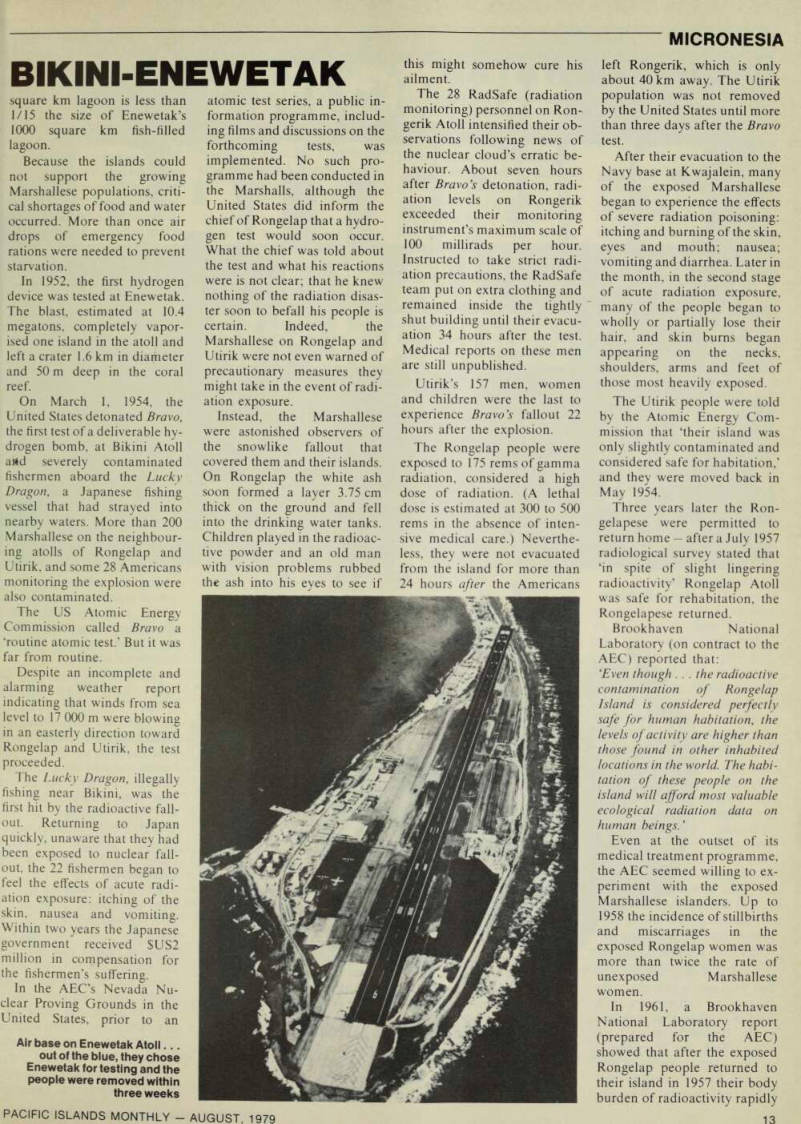
Less than two years later, in December 1947, the Navy de cided to use another atoll, Enewetak, for a second series of atomic tests. The Enewe takese, like the Bikinians, were relocated by the United States quickly and with little planning to small, uninhabited atolls.
Even while the United States
was removing the Marshallese from their islands, in July 1947 it was signing the United Nations Trusteeship Agree ment for the US Trust Terri tory of the Pacific Islands (Micronesia). This agreement stated: 7« discharging its obligations, the administering authority (US) shall: promote the econ omic advancement and self sufficiency of the inhabitants, and to this end shall ... en courage the development of
fisheries, agriculture and indus
tries; and protect the inhabitants against the loss of their land and resources. ’
In addition, this agreement bound the United States to ‘promote the social advance
ment of the inhabitants, and to this end .. . protect the rights and fundamental freedoms of all elements of the population without discrimination; and protect the health of the inhabitants. . .
After the relocation of the Marshallese, however, what happened during the next 12 years was that about 70 atomic and hydrogen bomb blasts dev astated the islands and irrever sibly changed the lives of the
people.
The Bikinians first moved about 160 km east to Rongerik, an uninhabited atoll consisting of barely 1.25 square km of land. Within two months, they
expressed anxiety over the
atoll’s meagre resources and made the first of many requests to return home. Within a year, the people faced starvation; a visiting American medical offi cer reported that the Bikinians
were ‘visibly suffering from
malnutrition’. In 1948 the Bikinians were evacuated to a temporary tent city at the Navy base on Kwajalein.
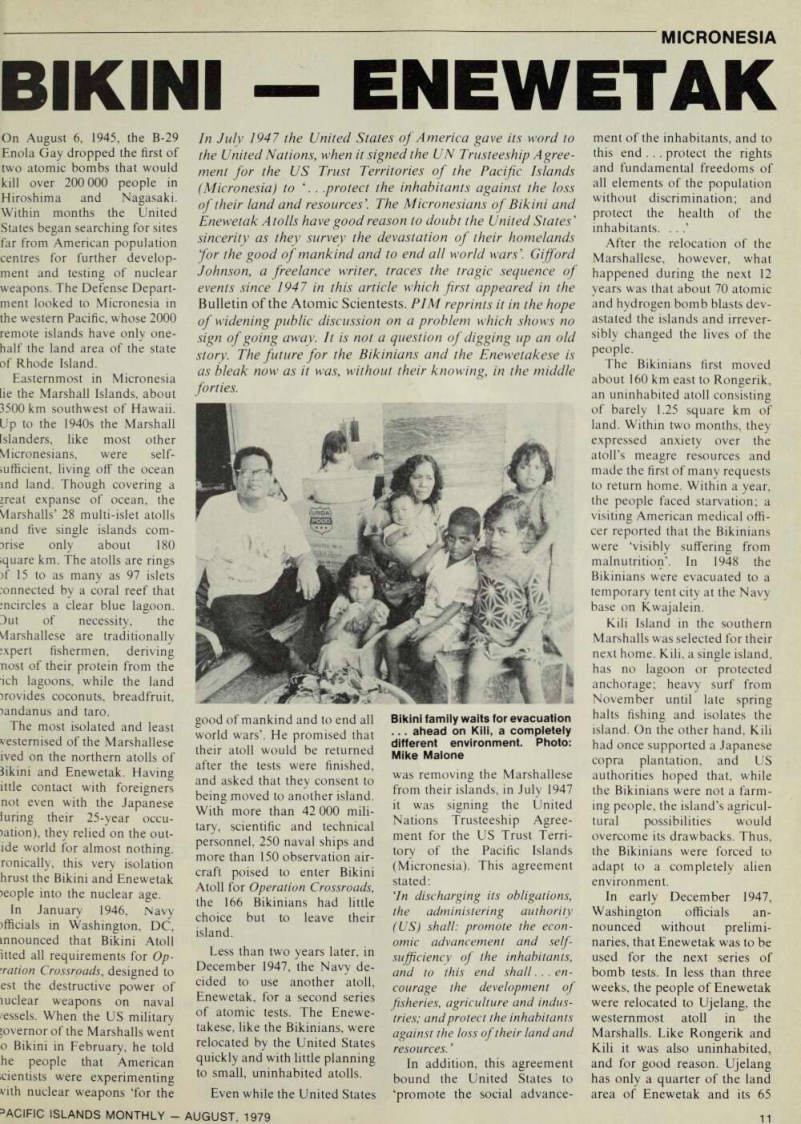
Kili Island in the southern Marshalls was selected for their next home. Kili, a single island, has no lagoon or protected
anchorage; heavy surf from
November until late spring halts fishing and isolates the island. On the other hand, Kili had once supported a Japanese copra plantation, and US authorities hoped that, while the Bikinians were not a farm
ing people, the island’s agricul
tural possibilities would overcome its drawbacks. Thus, the Bikinians were forced to adapt to a completely alien environment.
In early December 1947, Washington officials an nounced without prelimi naries, that Enewetak was to be used for the next series of bomb tests. In less than three weeks, the people of Enewetak were relocated to Ujelang, the westernmost atoll in the Marshalls. Like Rongerik and Kili it was also uninhabited, and for good reason. Ujelang has only a quarter of the land area of Enewetak and its 65
Bikini family waits for evacuation ... ahead on Kili, a completely different environment. Photo: Mike Malone
square km lagoon is less than 1/15 the size of Enewetak’s 1000 square km fish-filled
lagoon.
Because the islands could not support the growing Marshallese populations, criti cal shortages of food and water occurred. More than once air drops of emergency food rations were needed to prevent starvation.
In 1952, the first hydrogen device was tested at Enewetak.
The blast, estimated at 10.4 megatons, completely vapor ised one island in the atoll and left a crater 1.6 km in diameter and 50 m deep in the coral reef.
On March 1, 1954, the United States detonated Bravo, the first test of a deliverable hy drogen bomb, at Bikini Atoll attd severely contaminated fishermen aboard the Lucky
Dragon, a Japanese fishing
vessel that had strayed into nearby waters. More than 200 Marshallese on the neighbour ing atolls of Rongelap and Utirik, and some 28 Americans
monitoring the explosion were
also contaminated.
The US Atomic Energy Commission called Bravo a ‘routine atomic test.’ But it was far from routine.
Despite an incomplete and
alarming weather report indicating that winds from sea level to 17 000 m were blowing in an easterly direction toward Rongelap and Utirik, the test proceeded.
The Lucky Dragon, illegally
fishing near Bikini, was the first hit by the radioactive fall
out. Returning to Japan
quickly, unaware that they had been exposed to nuclear fall out, the 22 fishermen began to feel the effects of acute radi ation exposure: itching of the skin, nausea and vomiting.
Within two years the Japanese government received SUS 2 million in compensation for the fishermen’s suffering.
In the AEC’s Nevada Nu clear Proving Grounds in the United States, prior to an
atomic test series, a public in formation programme, includ ing films and discussions on the forthcoming tests, was implemented. No such pro gramme had been conducted in the Marshalls, although the United States did inform the chief of Rongelap that a hydro gen test would soon occur.
What the chief was told about the test and what his reactions were is not clear; that he knew nothing of the radiation disas ter soon to befall his people is certain. Indeed, the Marshallese on Rongelap and Utirik were not even warned of
precautionary measures they
might take in the event of radi ation exposure.
Instead, the Marshallese were astonished observers of the snowlike fallout that covered them and their islands.
On Rongelap the white ash soon formed a layer 3.75 cm thick on the ground and fell into the drinking water tanks.
Children played in the radioac tive powder and an old man with vision problems rubbed the ash into his eyes to see if
this might somehow cure his ailment.
The 28 Rad Safe (radiation monitoring) personnel on Ron gerik Atoll intensified their ob servations following news of the nuclear cloud’s erratic be haviour. About seven hours after Bravo’s detonation, radi ation levels on Rongerik exceeded their monitoring instrument’s maximum scale of 100 millirads per hour.
Instructed to take strict radi ation precautions, the Rad Safe team put on extra clothing and remained inside the tightly shut building until their evacu ation 34 hours after the test.
Medical reports on these men are still unpublished.
Utirik’s 157 men, women and children were the last to experience Bravo’s fallout 22 hours after the explosion.
The Rongelap people were
exposed to 175 rems of gamma radiation, considered a high dose of radiation. (A lethal dose is estimated at 300 to 500 rems in the absence of inten sive medical care.) Neverthe less, they were not evacuated from the island for more than 24 hours after the Americans
left Rongerik, which is only about 40 km away. The Utirik population was not removed by the United States until more than three days after the Bravo test.
After their evacuation to the Navy base at Kwajalein, many of the exposed Marshallese began to experience the effects of severe radiation poisoning: itching and burning of the skin, eyes and mouth; nausea; vomiting and diarrhea. Later in the month, in the second stage of acute radiation exposure, many of the people began to wholly or partially lose their hair, and skin burns began appearing on the necks, shoulders, arms and feet of
those most heavily exposed.
The Utirik people were told by the Atomic Energy Com mission that ‘their island was
only slightly contaminated and
considered safe for habitation,’ and they were moved back in
May 1954.
Three years later the Ron
gelapese were permitted to
return home after a July 1957 radiological survey stated that
‘in spite of slight lingering
radioactivity’ Rongelap Atoll
was safe for rehabitation, the
Rongelapese returned.
Brookhaven National Laboratory (on contract to the AEC) reported that: ‘ Even though . . . the radioactive
contamination of Rongelap
Island is considered perfectly safe for human habitation, the levels of activity are higher than those found in other inhabited locations in the world. The habi tation of these people on the island will afford most valuable ecological radiation data on
human beings.’
Even at the outset of its medical treatment programme, the AEC seemed willing to ex
periment with the exposed
Marshallese islanders. Up to 1958 the incidence of stillbirths and miscarriages in the exposed Rongelap women was more than twice the rate of
unexposed Marshallese
women.
In 1961, a Brookhaven National Laboratory report (prepared for the AEC) showed that after the exposed
Rongelap people returned to
their island in 1957 their body
burden of radioactivity rapidly
Air base on Enewetak Atoll... out of the blue, they chose Enewetak for testing and the people were removed within three weeks
increased. In 1961 their body levels of radioactive cesium had risen 60-fold, zinc rose 8-fold and strontium-90 rose 6-fold.
In 1964, the first thyroid tu mours and cancers appeared.
Since that time, more than 90% of the Rongelap children who were under 12 years old in 1954
have developed thyroid tu
mours. Forty percent of all the exposed Marshallese have de
veloped thyroid problems, as
compared to an average of 3-4% among Americans.
Some people who returned to Rongelap in 1957 had been away from the island when the bomb exploded and therefore had not been exposed to radi ation.
Brookhaven’s 1960 medical survey showed little difference in radioactivity levels among
exposed and unexposed people
living on Rongelap. However,
as late as 1969, the body radioactivity levels of pre
viously unexposed Rongelap
people was 10 times that of Marshallese living on a non contaminated island.
In 1971, Marshall Islands leaders invited a Japanese medical team to perform an independent survey of the
Rongelap and Utirik people.
Barred by the United States from actually going to Ron gelap and Utirik, the team
examined exposed people in
the district centre of Majuro.
The Japanese report stated:
‘The people of Rongelap who
were not exposed to fallout, received a considerable amount of radioactive nuclides from the environment. Consequently, the
“unexposed” group actually be
came an “ exposed” group ... it was a great mistake to permit
the people of Rongelap to return
to their island in July 1957 with out sufficient work having been done to remove radioactive pol lution from the island . ’
In 1972, Lekoj Anjain, who had been only a year old at the time of his exposure in 1954, died of myelogenous leukemia at the National Cancer Insti tute in Bethesda, Maryland.
The Atomic Energy Com mission has consistently obs cured information about the
irradiation of the people and their high incidence of thyroid disease and cancer. In 1975
Nelson Anjain, Rongelap’s
magistrate, wrote to Dr Robert Conard of Brookhaven: ‘For me and the people on Rongelap, it is life which mat ters most. For you it is facts and figures. We want our life and our health. In all the years you’ve come to our island you’ve never once treated us as people. You’ve never sat down among us and really helped us
honestly with our problems.
You have told the people that the “worst is over,” then Lekoj
and this was quite unpredicted and we had some of the best experts in the United States, said Dr Conard, who has headed the Atomic Energy Commission and now ERDA (Energy Research and
Development Administration)
medical programme in the Marshalls since 1954. ‘The theory was put forth that Utirik received low radi ation so a detailed follow-up was not necessary,’ said Dr Konrad Kotrady, a former Brookhaven resident physician in the Marshalls. ‘Now the facts of the thyroid cancer of Utirik have strongly shown that the
theory was wrong,’ Kotrady
Anjain died. I am very worried that we will suffer again and
again.’
The Utirik people were suf fering as well. Because their exposure was considered small, tests on genetic and second generation effects were not conducted on them. The Atomic Energy Commission had always told the Utirik people that the 14 rads of radi ation they had experienced was too insignificant to be harmful.
Nevertheless, in 23 years the Atomic Energy Commission treated 11 reported cases of thyroid tumours, three of them malignant, out of a population of only 157.
But suddenly in 1977 the cancer and thyroid disease rate among the Utirikese rose so sharply that it equalled that of the much more heavily
exposed Rongelap population.
This unexpected increase has forced government scientists to revise theories on which radi ation dose rate will lead to adverse human effects. ‘Thyroid nodules have been increasing in the Utirik people
wrote in a stinging critique of the ERDA medical pro gramme. ‘The people ask if this
thyroid problem has suddenly
occurred is it not possible that the experts have been wrong for so many years and more problems will occur in the future?
Despite the inability of the AEC’s ‘experts’ to predict the thyroid cancers among the Utirik population, they have adamantly barred outside medical teams from the islands. Not until the Ron gelapese and others refused to undergo the 1972 AEC medical examinations unless indepen dent doctors participated were two doctors added to the AEC team for that examination.
Every year since 1954, the AEC and later ERDA medical teams have examined the Marshallese people, and every year they reassure them of their good health. When the people
eventually began asking ‘lf
nothing is wrong with us, why
do you keep coming back every year to examine us? ERDA re plied that it was a precaution ary measure.
A study by a special com mittee of the Congress of Micronesia stated: ‘Time and again the committee found that the people did not understand anything about their exposure, the possible effects on them selves and to their children and on their environment.”
Protesting at what they con sidered inadequate medical care and, to underline the monumental cultural clash be tween the US medical person nel and the islanders, the Utirikese refused a quarterly ERDA medical checkup on December 1976, and the ERDA physician was recalled. ‘The people of Utirik are very distressed and angry as a result of the radiation,’ the chiefs of the atoll wrote in a letter to the
Energy Research and Develop
ment Association in 1977. ‘The people feel that the ERDA pro gramme is in need of vast
changes.’
While the Utirik and Ron gelap populations were experi encing the effects of direct fallout exposure, the peoples of Bikini and Enewetak were attempting to survive in their US-imposed exile on tiny, in
hospitable islands.
Because living conditions on both Kili and Ujelang deteriorated further during the late 1950 s and early 19605, the United States instituted small trust funds in an effort to al leviate some of the problems.
For the Enewetak people the trust fund was $150,000 and for the Bikinians it was $300,000, both yielding semi annual interest payments (about $l5 per capita for the Bikinians).
By the mid-1960s the people were demanding a return to their home islands. Because the Bikinians and Enewetakese began to receive extensive in ternational publicity for their plight, the pressure increased on the United States to return them to Bikini and Enewetak.
In addition, the Atomic Energy Commission, which had been increasingly criticised for advocating that there were per missible levels of radiation
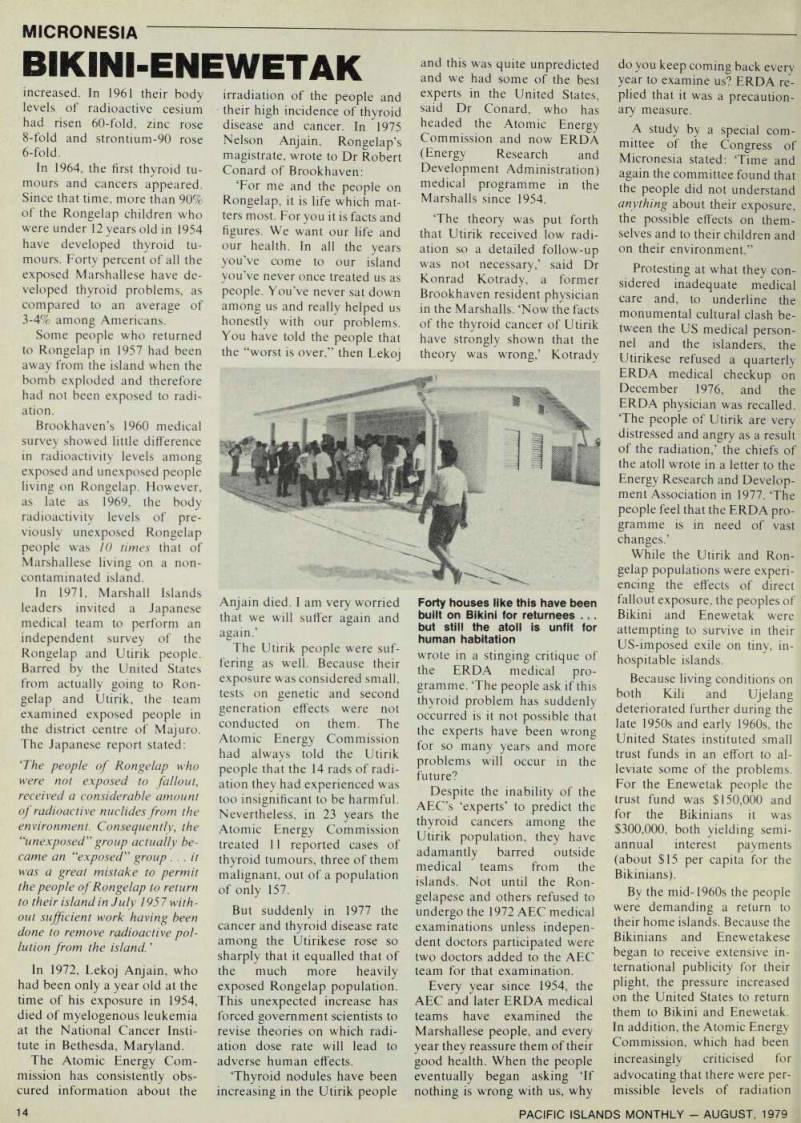
Forty houses like this have been built on Bikini for returnees ... but still the atoll is unfit for human habitation
exposure, was eager to demon strate that low levels of radi ation were not harmful to
people.
In 1968, 10 years after the Marshalls’ nuclear test pro gramme had ended, President
Lyndon Johnson promised the
540 Bikini people a permanent return to their home; the radi ation had dropped below the danger level, according to the Atomic Energy Commission.
In 1969, an AEC radiological survey stated: ‘There’s virtually no radiation left and we can find no discernible effect on plant or animal life (on Bikini).’
In the early 1970 s the
Bikinians began slowly return
ing to their atoll to help in the massive rehabilitation pro gramme, which included the replanting of more then 50,000 coconut trees and many other local crops, as well as construc tion of a new village.
About 100 Bikinians were on the atoll when the Lawrence Livermore Laboratory con ducted a radiation assessment in June 1975. The study, Dose Assessment at Bikini Atoll, not released until mid-1977, stated
clearly: ‘All living patterns
involving Bikini Island exceed federal (radiation) guidelines
for 30-year population doses.’
A preliminary report issued by the Engergy Research and Development Association in August 1975 pointed to the need to restrict completely the use of pandanus, breadfruit and conconut crabs ( a dietary mainstay in the Marshalls).
Despite these and other
warnings. Energy Research
and Development Associ ation’s Dr Conard stated a short time earlier; ‘Our medi cal team has evaluated the radiation exposure in the people who have been working on Bikini the past two years.
There is some low level radi ation remaining on the island of Bikini and measures have been taken to reduce these levels . . . The internal absorp tion of radioactive materials will be . . . only slight from ter restrial food plant sources.
Therefore, we do not expect to see any ill effects in the Bikini people or in their offspring
from the small amounts of radiation to which they will be exposed.’
Caught in the middle of these conflicting statements, in late 1975 the Bikinians filed a federal law suit against the US government demanding a com plete scientific survey of Bikini to determine if the island was
indeed safe for habitation.
In late 1977, ERDA monitor ing of the Bikinians who had returned earlier showed a marked increase in the amount of radioactive nuclides in the people’s bodies. These tests show that the Bikinians were
ingesting higher than accept
able concentrations of cancer causing radiation from the water and from food grown in the island’s contaminated soil.
The US government then
began importing all food
(except local fish, which was declared safe) and drink to Bikini. This food programme has compounded the Bikini di lemma; while the Bikinians have been told that the island is radioactive and potentially dangerous, the prospect of free
food and housing and a chance to move from Kili called the
‘prison’ by resident has
encouraged people to return.
In early 1978, the Energy Re search and Development As sociation considered moving the people to another island in Bikini Atoll Eneu and was
growing fruits and vegetables
in an experimental gardens to test radioactivity levels there.
Results from these exper iments, however, weren’t expected for about a year.
According to a careful report in the Los Angeles Times, by February 1978 it was official government policy: Bikini was unfit for people to live on.
Nevertheless, In April, Trust
Territory officials, testifying at
a congressional hearing on
funding for re-establishing the
Bikinians on Eneu Island, insisted that the people could remain on Bikini without harm until the experiments on Eneu
were completed in January
1979 provided that they
didn’t eat any coconuts, and that the coming medical tests showed, as was expected, no large increases in internal radi ation levels.
In the April 1978 medical examinations, however, the Bikinians’ internal radiation levels ranged up to 0.980, or nearly twice the US maximum safety standard of 0.5 rems. At the same time, the preliminary results from the experimental garden at Eneu Island showed that radioactivity levels were 5-6 times higher than
expected.
Throughout the rehabilita tion of Bikini, the Energy Re search and Development Association and the Depart ment of Energy (DOE) had conducted countless radiologi cal surveys of the island many of which suggest the
Left: Exodus from Bikini; above: Andrew Jakeo (69) ... he refused to leave his homeland
Bikinians were unwitting sub jects for scientific radiation tests. A recent study for the Department of Energy concluded that ‘Bikini Atoll may be the only global source of data on humans where intake via ingestion is thought to contribute the major fraction
of plutonium body burden’.
A 1976 Lawrence Livermore Laboratory scientist stated that Bikini ‘is possibly the best available source of data for evaluating the transfer of plu tonium across the gut wall after
being incorporated into bio
logical systems.’
Government scientists ve
hemently deny they have used
the Marshallese for experimen tation. A DOE official
explained: ‘lt was done by technical types anxious to know about the transfer of radioactive elements.’
Interior Department officials announced in May 1978 that the atoll would be evacuated within 90 days, and the people returned to Kill Island. In late August, Interior represen tatives went to Bikini to super vise the evacuation, in many ways reminiscent of the 1946 removal. ‘There are some things we didn’t feel good about,’ said Taro Lokebal, who serves as liaison between the Bikini Council and the United States. ‘The high commissioner made the people rush ... Some things were left behind pigs, chickens, lumber. We had to
have our ceremony on the ship.
It was supposed to be on the shore but we had no time.’
Though the Bikinians, like the Enewetakese, suffered the
devastating physical and
psychological effects of relo cation and, at times, even near starvation, they had never suf fered radiation exposure until they returned to their radioac tive island after 25 years. Now the Bikinians are an exposed population, too. And who knows what the future holds for the Enewetak people many of whom have now re turned to their home atoll to work with thousands of US army soldiers in the massive nuclear debris cleanup.
Until the scientific com
munity and independent or
ganisations begin critically to
monitor US government agen cies’ treatment of the Marshallese, their situation is not apt to change.
From the nuclear bomb tests at Bikini and Enewetak to the medical treatment of the irradiated islanders, the 30 years of American trusteeship has brought the Marshallese anything but the conditions promised in the UN trust agreement.
Reprinted by permission of the Bull etin of the Atomic Scientists, a magazine of science and public affairs. Copyright 1979 by the Edu cational Foundation for Nuclear Science, Chicago, Illinois.