Pacific friendship
pp. 59-62 · Read in the full issue


Fokker pursues a Pacific friendship
‘A policeman - not a soldier'is the line European aircraft manufac turer Fokker-VFW is pushing in a big Pacific sales drive for its surveillance aircraft, the F 27 Maritime, writes Angus Smales from Port Moresby.
The Maritime is the well-tried F 27 Friendship feeder airline stuffed to the gills with an im pressive array of electronics.
With Australia already flying about 50 Friendships and with as many more distributed among its nearer South Pacific Island neighbours, the Fokker salesmen are already at first base: crewing, maintenance and operational factors of the Friendship are well estab lished.
But the real thrust in the
sales campaign lies in the new resources legislation adopted by almost every country in the Pacific under which marine re source boundaries are pushed out to 200 nautical miles. Now they are all wondering how they will protect their newly claimed interests.
Australia, Papua New Guinea and Solomons Islands are three countries in particular which have long been troubled by unlicensed fishing of prawns, tuna and clam meat.
and the new sea limits will in crease the problem. Taiwan’s
wide-ranging clam fishing has
caused reef damage on isolated atolls and islands, and evidence suggests the problem is now being experienced on the Aus tralian Great Barrier Reef.
Australia, with a long empty coastline providing many secret havens, has the added
problem of drug smuggling.
The Fokker-VFW organis ation, based in Holland but also using the aerospace indus tries of the United Kingdom and West Germany, hopes to impress South Pacific govern ments with the ‘value for money’ potential of the Maritime.
The first demonstration Maritime to enter the region was flown into Papua New Guinea recently and put through an exhaustive evalu ation flight and a series of dem onstrations for government observers. Sea-drops, naviga tional exercises and spotter type operations were part of the demonstrations.
The Maritime then flew on to Darwin for a brief showing, but the full-scale Australian demonstrations will not be undertaken until later in the year.
One reason for the frag mented demonstrations is that the Maritime showed to PNG Netherlands registration PH-FTC has been sold to the Spanish Government search and rescue service and the de livery date could not be stretched.
The ‘policeman not a soldier’ concept of the Mari time was explained to PNG officials by the general man ager of Fokker’s South Pacific Division in Melbourne, R. W.
Walesby. He described the Maritime as a civil-role air craft, not designed to attack any target. Its basic work, he said, was to patrol a beat, over national seas or possibly over land for specialised functions making observations and
gathering evidence through
sophisticated electronic sys tems.
The Maritime could look for
poaching fishermen, drug run
ners, smugglers, illegal
immigrants, pollution from oil rigs or shipping, marine ecol ogy disturbances and general
shipping movements.
It was also fitted for active search and rescue duties, including the accurate flying of programmed search patterns, the detection of survivors and distressed surface craft and the
dropping of survival equip
ment.
Its third role was as a flying
co-ordination centre on patrol or search, using extensive radio communication facilities to keep in touch with ships, other aircraft, ground installations and distant headquarters. The price tag on the Maritime is in the SAS million bracket.
Although the roles of the two types are not fully comparable, this is small money compared with what Australia pays for its big Orions which are used for defence surveillance duties.
But at $5 million, that’s big money for Island nations.
However, Papua New Guinea is known to be evaluating a proposal in which it would use two or three Maritimes to guard the fishing waters of its island neighbours as well as its own.
An internal government pro posal suggests that by selling a watchdog service to other countries the government could find the money and jus tify its expenditure.
The frequency of coastal
shipping incidents in the reef and island-studded waters of the South Pacific would be another motivating factor, the report suggests.
The areas under study for the proposal include the Caroline Islands, 2000 km north of Port Moresby, the Marshall Islands east of the Carolines, and Kiribati (Gil bert Islands), northeast of Port Moresby. PNG’s immediate neighbour to the east, Solomon Islands, is also .being investi gated as a patrol customer.
The Port Moresby demon strations of the Maritime cre ated wide interest from defence, civil defence and fisheries officials, and the South Pacific Forum Fisheries Agency, based in Honiara, sent observers.
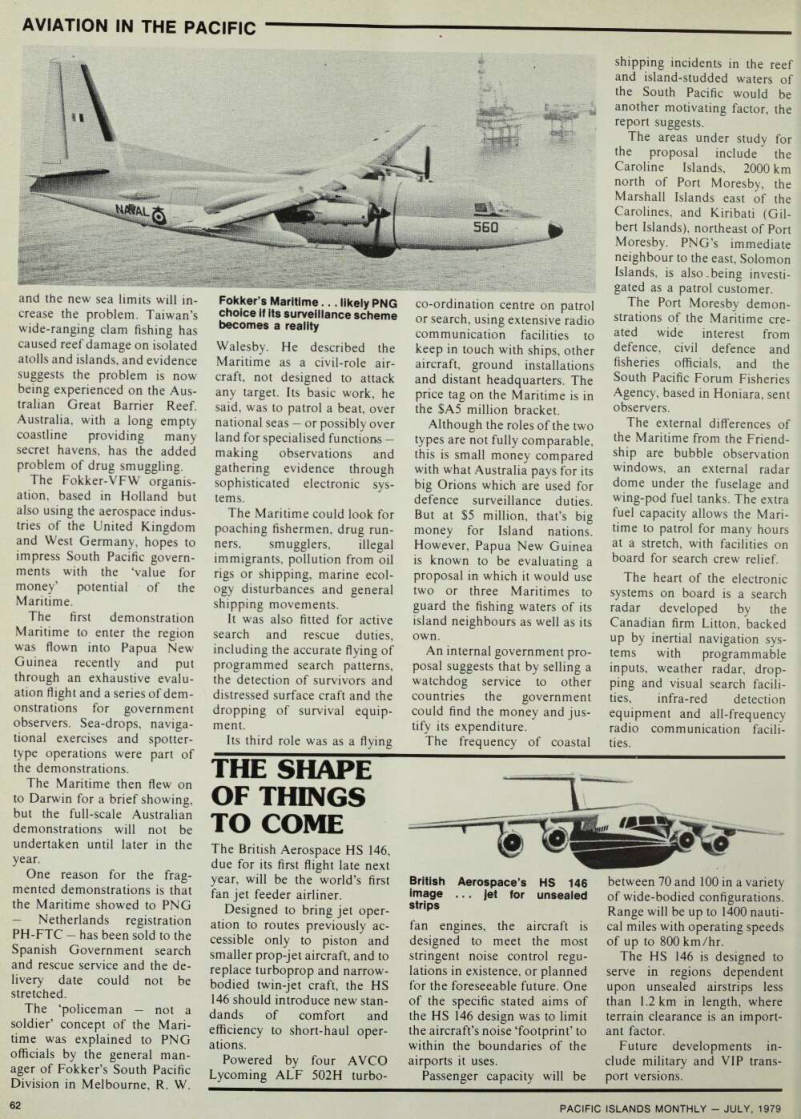
The external differences of the Maritime from the Friend ship are bubble observation windows, an external radar dome under the fuselage and wing-pod fuel tanks. The extra fuel capacity allows the Mari time to patrol for many hours at a stretch, with facilities on board for search crew relief.
The heart of the electronic systems on board is a search radar developed by the Canadian firm Litton, backed up by inertial navigation sys tems with programmable
inputs, weather radar, drop
ping and visual search facili ties, infra-red detection equipment and all-frequency radio communication facili ties.
Fokker’s Maritime...likely PNG choice if its surveillance scheme becomes a reality