Commuter
pp. 57-59 · Read in the full issue
David And
Goliath In
Battle
The giant of world aircraft pro duction is locked in battle with a small and upstart newcomer for a share of the 20-passenger commuter aircraft market.
In competition are the US
built Fairchild-Swearingen
Metro II and the Brazilian built Bandeirante EMB-110PS.
The Brazilian aircraft industry is only 10 years old. But the Bandeirante is still giving the ‘Metroliner’, product of the homeland of the Wright Brothers, a run for its money.
Both planes have already made an impact on the Aus tralian and Pacific market. The Metro is in service with Bush Pilot Airways in Queensland, the Melbourne-based Bizjets and Kendall Airlines in Wagga, NSW. The Ban deirante is flying for other Aus-
tralian third-level operators such as Masling Airlines and Advance Airlines. It recently broke through into Papua New Guinea with the purchase of one of the aircraft by Talair.
Distributors of both planes are moving actively into Pacific
Islands markets with their pro ducts.
British pilot/aviation writer Alan Bramson gave a concise account of the relative merits of the aricraft in an article in the London magazine Pilot (August 1978). Bramson, who had just flight-tested the Ban deirante, wrote; ‘The Bandeirante is a docile, stable light transport aircraft
with the most gentle of man ners, and one immediately feels at home behind the con trols. ‘From the passenger point of view the big cabin with its large windows, excellent seats and relatively low noise level can not fail to impress. ‘Of course, figures can be made to prove anything, so when I read a manufacturer’s
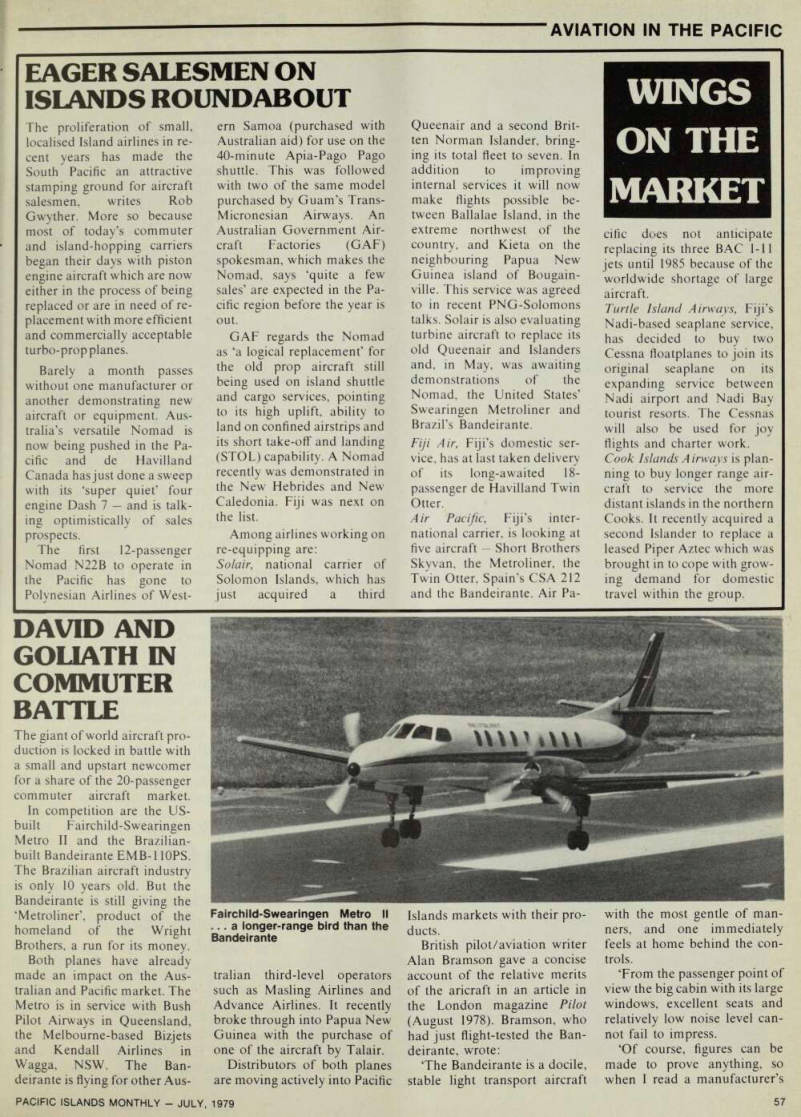
Fairchild-Swearingen Metro II ... a longer-range bird than the Bandeirante
essay comparing the Ban deirante with the opposition I automatically asked myself: “Are they telling the whole truth and nothing but the truth?” In this particular case there are few aircraft in even approximately the same class as the Bandeirante, now that the 15-passenger Beech 99 has gone out of production.
Another aircraft used by manufacturer Embraer in their
comparison of performance
and operating costs is the Twin Otter. It carries a similar pass enger load to the Bandeirante, and flies rather lower on less power, but as a STOL aircraft it should not be compared with the Brazilian. Each aircraft has special talents and is capable of doing what the other cannot. ‘The other type mentioned by the manufacturers is the Swearingen Metro 11, an air craft offering similar
passenger-carrying capacity to
the Bandeirante, but which,
being pressurised, is naturally
somewhat more expensive to buy. In any case the Metro is a longer-range bird than the Bandeirante, at its best while cruising at 15 000-20 000 feet.
But not all routes lend them selves to climbing above the weather. Take, for example, a 25-minute trip, around 65 nautical miles allowing for take-off, climb, joining the traffic and landing. There
would be little point in using a pressurised aircraft on that... ‘The point I am trying to make is that while Embraer’s figures are no doubt factual
and certainly interesting, I
would have thought them to be of limited value. If you have to operate out of small airfield ... you must go for the Twin Otter or the Skyvan, while those third-level airlines need
ing a turboprop capable of fly
ing distances of 1500 nautical miles, preferably over the weather, would perhaps be attracted to the pressurised Metro lIA. ‘But if you want a simple 18-21 passenger aircraft offer ing outstanding economics over relatively short distances, you buy a Bandeirante.’
Bramson concluded; ‘I shall be very surprised if we do not see a lot of these fine aircraft
operating throughout the
world.’
Both planes have rapid con vertibility from all-passenger
to all-cargo. Approximate
prices for the aircraft are SAI.3 million for the Metro and $975 000 for the Bandeirante.
Some physical characteristics of the two aircraft are listed in the accompanying table.
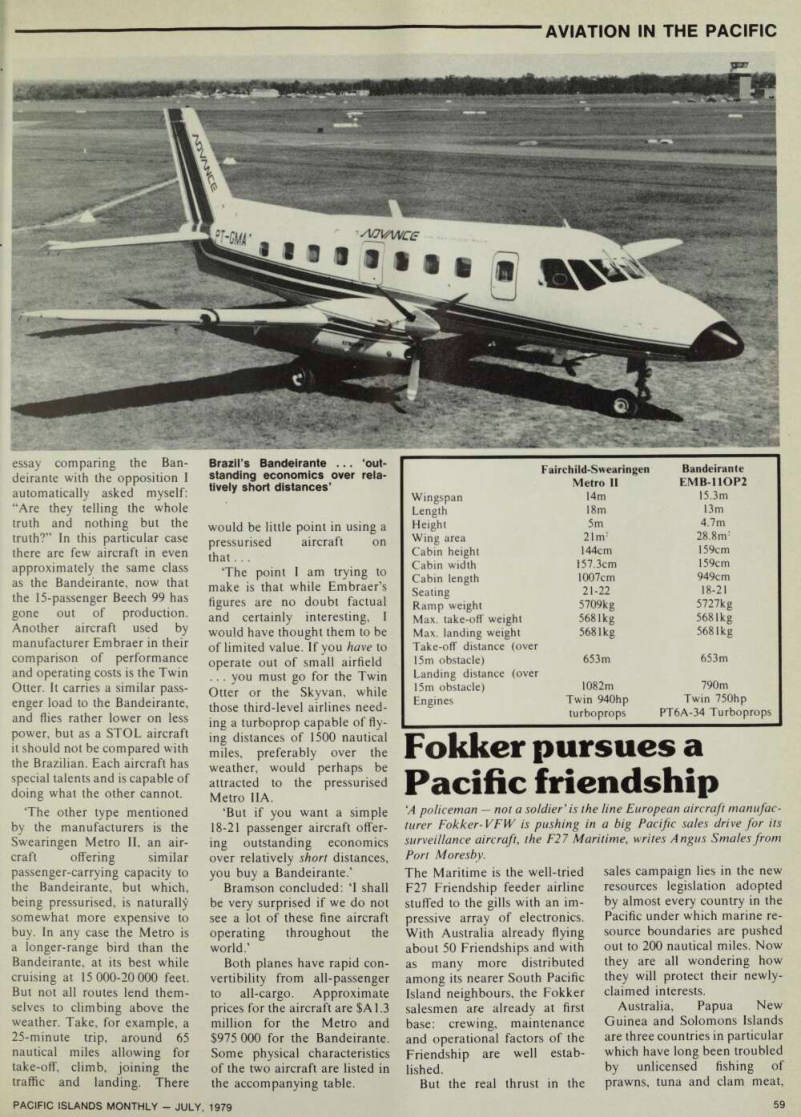
Brazil’s Bandeirante ... ‘out standing economics over rela tively short distances’
F airchild-Swearingen Bandeirante Metro II
Emb-Hop2
Wingspan 14m 15.3m Length 18m 13m Height 5m 4.7m Wing area 21nv 28.8m : Cabin height 144cm 159cm Cabin width 157.3cm 159cm Cabin length 1007cm 949cm Seating 21-22 18-21 Ramp weight 5709kg 5727kg Max. take-off weight 5681kg 5681kg Max. landing weight 5681kg 5681kg Take-off distance (over 15m obstacle) 653m 653m Landing distance (over 15m obstacle) 1082m 790m Engines Twin 940hp Twin 750hp turboprops PT6A-34 Turboprops