Not where
p. 52 · Read in the full issue
New Zealand
Not where it would like to be
Air New Zealand’s involve ment with several South Pacific air services resembles a parent child situation. And that’s not
being patronising. It’s simply a
question of age, growth and re lationships, writes William Gasson.
The growth of commercial avi ation in the Islands has not been even and this seems, to some extent, to have been affected
by the changing ties of individual operators with the likes of Air New Zealand and Qantas.
Fiji, for example, which has had long ties with Qantas, Air New Zealand and British Air ways, has grown to assertive
independence, not frightened
to argue a point on behalf of its Air Pacific. Polynesian Air lines is on its way, not without problems, toward indepen dence of operation. But Cook Island Airways remains very much a dependant of New Zealand.
Air New Zealand’s assist ance to the Islands has been varied. In Fiji its efforts have contributed considerably to the development of the tourist industry; in Western Samoa it has helped sustain and develop
Polynesian Airways; and in
Cook Islands it has taken upon itself to operate internal and international services and accepted substantial losses on them.
Air New Zealand, as well as encouraging New Zealanders to holiday in Fiji, also sells Fiji in Britain, Europe and North America by incorporating it in South Pacific package tours. In 1977-78 on its southbound ser vices to Fiji, Air New Zealand carried 4748 visitors who had bought their tickets in North America. Air New Zealand market research is available free of charge to Fijian interests.
Air New Zealand has helped
Polynesian Airlines by provid
ing managerial staff who have played major roles in arranging the purchase of aircraft, nego
tiating air rights agreements,
staff training and aircraft maintenance. The secondment of Air New Zealand staff began in 1971. At the same time Samoan staff were taken for training in New Zealand.
Air New Zealand was in on Cook Islands air services from
the beginning, investing
SNZI.2 million in land, build
ings and establishing Cook
Island Airways. On top of this Air New Zealand met the full cost of establishing and operat ing seven international services a week to the Cooks. In fact, it has, if anything, overplayed its hand. The handling facilities on Rarotonga today are under utilised, one reason Air New Zealand’s services operate at a substantial loss. Another is the low fare structure available to residents of New Zealand and the Cook Islands.
In some ways Air New Zealand finds itself in a cleft stick. In one direction there is pressure for assistance, in the other it is meeting growing competition. Apart from the gains Air Pacific has negoti ated, Air Nauru is also pushing for access. Add to that the cut fare challenges from other in ternational trans-Pacific car riers, New Zealand’s limited population, and its remote lo cation, and it is easy to sym pathise with the idea that Air New Zealand might be better off, geographically, somewhere else.
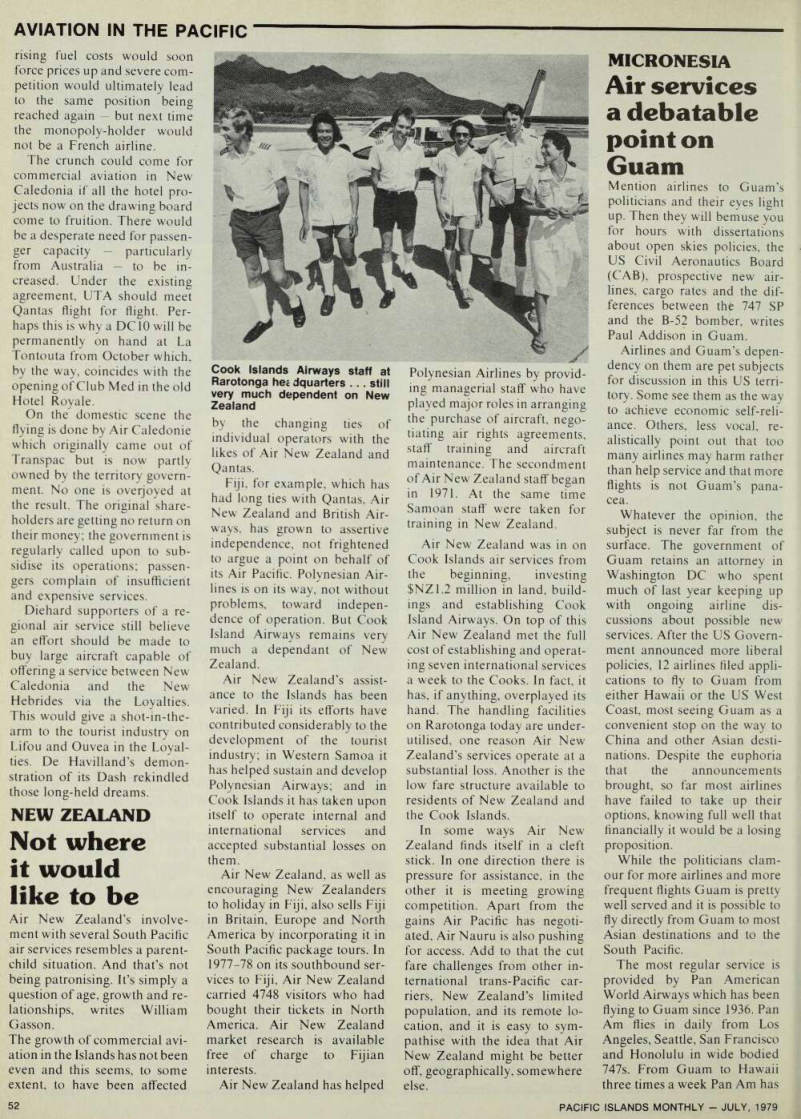
Cook Islands Airways staff at Rarotonga hes dquarters ... still very much dependent on New Zealand