what might
pp. 51-52 · Read in the full issue
New Caledonia
Dreams of what might have been
When de Havilland Canada demonstrated its latest aircraft in New Caledonia recently memories stirred of what might have been, writes Andre Chaville. It caused Gaston
Morlet, for example, perhaps
the most outspoken councillor on the New Caledonia Terri torial Assembly, to recall past dreams, to suggest again im possible plans, but, above all, to draw public attention to the state of air services in New Caledonia.
Back in the late fifties a group of businessmen in New Caledonia created Transpac a name which was almost a passionate declaration. In those days there were no direct flights to Europe and the weekly Qantas flying boat had just been replaced by a DC4.
If first moves were to be restric ted to local flights, the company’s dream was to link New Caledonia with Australia, the New Hebrides and Fiji.
Economic and political ob stacles prevented Trans-Pacific Airways from getting off the ground. As things turned out, the French carrier, UTA, was given a virtual monopoly on in ternational flights which it still guards jealously. Qantas has a weekly service, now using a Boeing 747, but this is subject to a pool agreement with UTA.
Qantas has never succeeded in incorporating a Noumea stopover into one of its cross- Pacific routes or even into its shorter Sydney-Nadi service.
Air New Zealand has a weekly DC 10 service Auckland-Noumea, also sub ject to pool agreement with
UTA. the French airline offer
ing a rather out-of-the-way
route Auckland-Noumea-
Papeete-Los Angeles.
Pan Am attempted then abandoned two years ago a trans-pacific service through Noumea.
The only other foreign air line to offer regular and fre quent services is Air Pacific.
However, Air Pacific’s service between Noumea and Bris bane does not conflict with UTA’s interests and its Noumea-Nadi hop, flown by a BAC 1-11, is more than matched by UTA’s DC 10 ser vice.
The recent announcement that UTA intends to drop its Nadi service in October has led to much speculation about Air Pacific’s future services through New Caledonia. Ironi cally, New Caledonia residents cannot use Air Pacific’s 45minute Noumea-Vila flight be cause the airline has no traffic rights on this section. Instead, they must travel on the recon ditioned Fairchild Friendships, bought secondhand by UTA in the United States, which take twice the time.
Air Nauru is seen at La Ton touta Airport which 53 km from Noumea, is New Caledonia’s gateway to inter national travellers but only when it drops in to refuel. It cannot accept passengers for Vila or Melbourne.
In theory, UTA enjoys pro tection because it offers a ser vice between Noumea and Paris which, without the necessary favours, would be uneconomical. UTA enjoys re cord profits from its Paris-
Noumea run. Figuring largely
on its loadings are French pub
lic servants including military
personnel. Government em ployees’ contracts include a paid trip to France every three years.
Not only has UTA decided to drop its Noumea-Nadi ser vice, it is also reducing its num ber of flights between New Caledonia and Australia be cause this service, which goes on to Paris, is attracting few customers as a result of the new low fares to Europe offered by other companies. UTA is not willing to match them.
In practice, residents in New Caledonia can take advantage of the new cheap fares pro vided that their travel agent is willing to pay the nominal fine levied for what is considered commercially as ‘unfair com petition’. Thai-International is particularly active in this field.
About 100 000 passengers use La Tontouta each year and
incoming freight is around
4500 tonnes. Many in the
industry believe these figures
could be considerably in creased if services are im proved. Maurice Lenormand, the recently-dismissed vice president of the Government Council, suggested that the agreement between the terri tory government and UTA should be reconsidered, taking into consideration cheaper fares available elsewhere.
Any company enjoying such favourable circumstances be comes subject to criticism.
UTA is no exception but it also has its supporters, among them those who claim that if com petitors were allowed to fly
through Noumea, picking up
and setting down passengers and cargo and offering lower fares, UTA would soon be forced to withdraw. While such
developments might have
short-term benefits for New Caledonia, they argue that
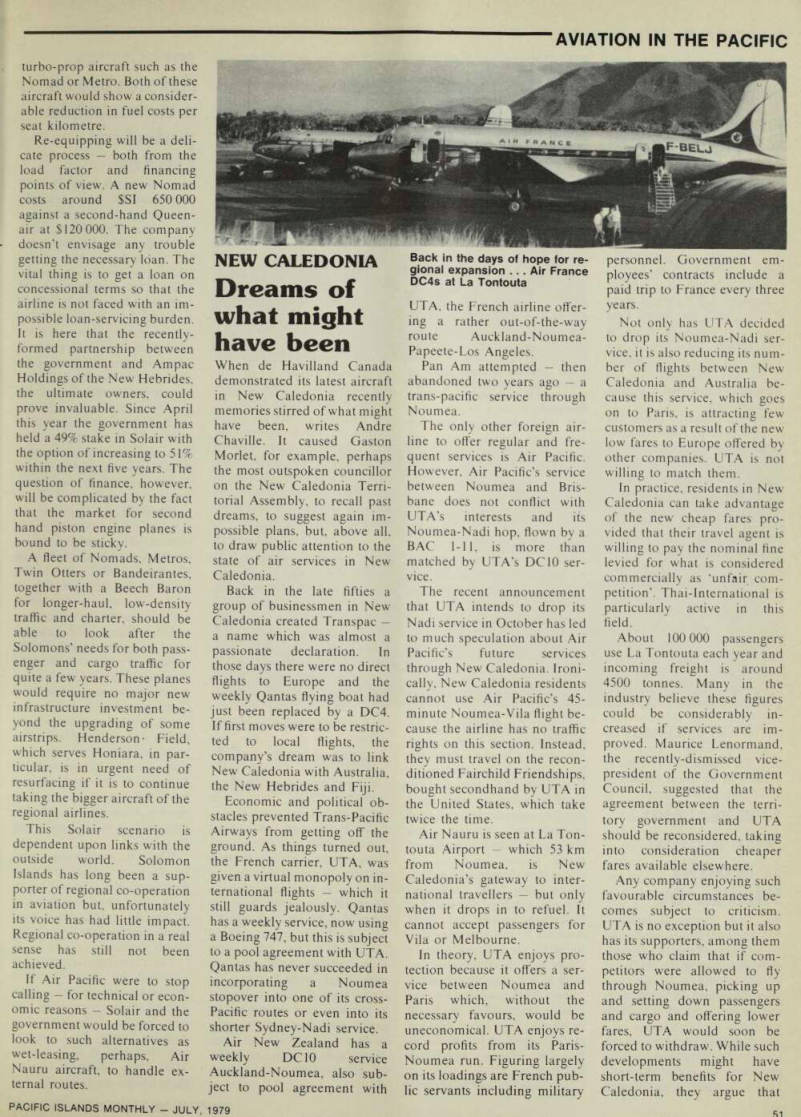
Back in the days of hope for re gional expansion ... Air France DC4s at La Tontouta
rising fuel costs would soon force prices up and severe com petition would ultimately lead to the same position being reached again but next time the monopoly-holder would not be a French airline.
The crunch could come for commercial aviation in New Caledonia if all the hotel pro jects now on the drawing board come to fruition. There would be a desperate need for passen
ger capacity particularly
from Australia to be in creased. Under the existing agreement, UTA should meet Qantas flight for flight. Per haps this is why a DC 10 will be permanently on hand at La Tontouta from October which, by the way, coincides with the opening of Club Med in the old
Hotel Royale.
On the domestic scene the flying is done by Air Caledonie which originally came out of Transpac but is now partly owned by the territory govern ment. No one is overjoyed at the result. The original share holders are getting no return on their money; the government is regularly called upon to sub sidise its operations; passen gers complain of insufficient and expensive services.
Diehard supporters of a re gional air service still believe an effort should be made to
buy large aircraft capable of
offering a service between New Caledonia and the New Hebrides via the Loyalties.
This would give a shot-in-the arm to the tourist industry on Lifou and Ouvea in the Loyal ties. De Havilland’s demon stration of its Dash rekindled those long-held dreams.