Political problems
pp. 41-44 · Read in the full issue
Papua New Guinea
Political problems but it’s still a success story
Papua New Guinea, with a mainland land mass of 400 million square kilometres, no railways and few trunk roads, has always been an air-minded country, writes Angus Smales in Port Moresby. Neighbour ing Australians, whose own country helped pioneer air transport, brought their initiat ives to PNG early in the piece.
By the mid-thirties more air cargo was being carried in PNG than the total air cargo carried in the rest of the world.
This situation which lasted about two years was largely due to the opening of the Wau- Bulolo goldfields which were inaccessible then by road.
Today’s politically-inde pendent PNG has more than 230 aircraft most of them revenue-earners on its regis ter, 13 transport department major airports, about 150 government-maintained air fields and more than 80 private airfields.
It also has a national airline, Air Niugini, operating domes tically and internationally, which in less than five years has become the biggest Pacific flag carrier outside the developed countries.
The terrain and isolation at home which spurred the avi ation industry have simul taneously created huge engineering and navigation problems. At Omkalai in the Highlands, for instance, the landing gradient is so steep that a touch-down is followed by power-on or else you are likely to run backwards over the edge. And from Omkalai, too, it would take you all of a day to reach a nearby mission airstrip across a deep gorge if you tried to walk. But a light aircraft will get you there in eight minutes.
The aeroplane remains the mainstay of trunk travel and isolated supply runs in PNG, and there are 29 third-level op erators. Two of these operators
alone use more than 80 aircraft between them.
But today’s biggest problems in the industry are as much pol itical as technical. Australian type procedures inherited at independence are being main tained, but to keep the services going requires capital and expertise which remains short among PNG nationals. As a re sult the industry still depends heavily on outside involve ment.
The major political issue be comes striking a balance be tween the interests of the industry and the assimilation of local expertise and equity.
Air Niugini this year has allocated the equivalent of $A1.25 m purely for the train ing and mechanics of phasing its own countrymen into the airline workforce. The airline employs 1696 people of whom 441 mainly flight crew and senior office-holders are not PNG nationals.
Talair, the country’s biggest third-level operator, has come under frequent political attack.
It has been criticised for not doing enough to train Papua New Guineans as maintenance engineers, but its ability to train and even to operate was jeopardised by a clamp on the number of outside skilled per sonnel it could employ.
Ownership of air services has been another prickly area and has led to a mushrooming of small operators with some or a majority Papua New Guinean equity. The government has encouraged this, but some of the smaller operators claim they have then been strangled by the government’s own re strictions on employment and operations.
The once Australian dominated industry is getting the message, but the problems go deeper than a mere dilution of capital. One of the biggest recent developments was the allocation of a5l per cent local equity in Pacific Helicopters
Pty Ltd, a major helicopter op erator in the Highlands.
Another political issue although often presented as purely technical is striking a balance between the routes of the national airline and the third-level operators. Aus tralians in the industry, and more recently some Papua New Guinean shareholders, frequently criticise the govern ment for setting out to encourage third-level work but then stifling it with national airline exclusive routes.
The third-level industry itself sees its overall problem today as a state of flux in government attitudes and plan ning, an attitude which Trans port Minister Paias Wingti
strongly denies.
But whatever the issues and despite the basic soundness of third-level operations in PNG, existing operators make no secret of the fact that they are working in a sensitive, finan cially mercurial, and some
times unpredictable industry.
Air Niugini has been one of the most successful ventures undertaken by the new Papua New Guinea. In 1978 the air line’s performance was 213.4 million domestic passenger kilometres and 239.1 million international passenger kilometres. The cargo figures for the same period were 2.8
million tonne-kilometres dom estic and 5.3 million inter national. The airline has returned a continuous profit since its inception, mainly from international operations. Its profit last year was equivalent to $A1.55 million.
A restrained but adequate
policy of fleet re-equipment
and expansion has been another factor in the airline’s success. Rather than rush into
heavy new-equipment borrow
ing, which might also have caused delivery delays, the air line negotiated favourable deals to take over its Boeing 707 from Qantas and two of its F2B Fokker Fellowships from Air Nauru.
On the international scene Air Niugini has fitted into a re gional operation with no major negotiating problems, and flies now to Australia, the Philip
pines, Japan, Hong Kong,
Solomon Islands and to the Indonesian provincial capital
of Jayapura in neighbouring
Irian Jaya.
Governments have shown a readiness to enter into recipro cal rights sometimes with at least an early balance in PNG’s favour. The geographic lo cation of the routes has un doubtedly been a factor in
these negotiations, bridging a
new regional area. Under re
ciprocal rights, Air Niugini’s
links to Hong Kong, the Philip
pines and Australia are shared
respectively with Cathay Pa
cific, Philippine Airlines and
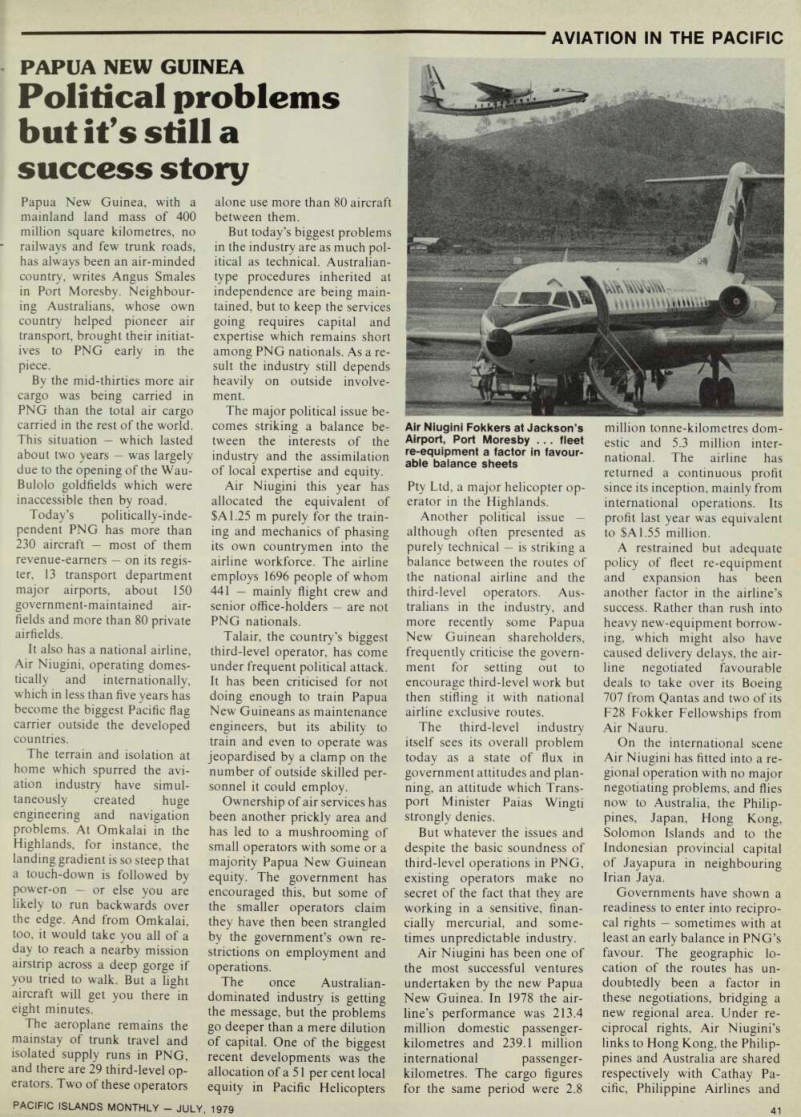
Air Niugini Fokkers at Jackson’s Airport, Port Moresby ... fleet re-equipment a factor in favour able balance sheets
Qantas. Air Niugini’s link to Japan is subject to eventual
negotiation by Japan for re
ciprocal rights.
Air Niugini itself flies the re ciprocal services on its links to Jayapura in Indonesia and Honiara in Solomon Islands.
This is done under an arrange ment with the respective oper ators which hold the rights, Merpati Nusantara in Indo nesia and the Fiji airline Air Pacific.
USA and Indonesia have yet
to negotiate the reciprocal ar rangements which will become open when Air Niugini extends its services to Hawaii and Jakarta later this year, The international cheap fares controversy has left Air
Niugini largely untouched.
This, too, is a by-product of the airline’s regional bridging role.
Opposition spokesman for transport in PNG, Silas Atopare, has predicted a bleak future for PNG tourism be
cause of the country’s failure to enter the wheeling and dealing.
But the government and the airline have denied this, and gross relative costs still favour short-term tourism in PNG for Australians and some other Pa cific sources.
From the airline’s point of view tourism is a minor factor in the heavy-volume link with Australia which rests on com mercial, business, government and community links between the two countries.