Pacific
pp. 37-39 · Read in the full issue

Pim Pacific Islands Monthly
AVIATION in the
Time For Island
Operators To
Toughen Up
Nineteen-seventy-nine, with six months of it still to go, has been a soul-searching year for airlines operating in the Pacific whether they be worldwide, regional or domestic carriers. Aviation writer Rob Gwyther considers developments to date and the shape of things to come.
Airline boardrooms across the Pacific this year have been more preoccupied with the
problems of re-equipment and
route expansion or rationalis ation than ever before. Add to that turn-of-the-year and on going tremors in the inter national airline environment
(which, by and large, have
benefited the air traveller), and it should be generally accepted that directors are earning their fees, if only for the time they’re spending in the boardroom.
The decisions some of which have already been made are critical, possibly with im
plications right through the
eighties. Decisions which have been made by some regional carriers suggest that they pos sess the necessary determi nation and entrepreneurial skills to handle the challenges ahead.
Air Pacific and Air Nifigini stand out from the pack. Their firm handling of negotiations
with those bigger than them selves is indicative of the cur rent, new mood prevailing in the Islands.
The transitory stage in which most operators now find them selves will enter a new round when Australia and the United States once again lock horns over renewed American attempts to introduce deregulation of fares and ca pacity across the Pacific. (Qan tas, celebrating 25 years of cross-Pacific operations this year, has reluctantly greeted its new competitor. Continental Airlines, which could even outdo it in the marketing ag
gression stakes.)
At the regional level, several airlines are holding fire on orders for new aircraft until they see the effects of the big ger carriers’ new fare policies.
On a combined front, the formation this year of the As sociation of South Pacific Air lines (ASPA) gives some hope that the 12 member airlines will at last embark on some form of co-operation.
The Fiji-New Zealand nego tiations represented an interesting confrontation. Both Air Pacific and Air Niugini had watched Air New Zealand and, more recently, UTA, make concessions in the face of Aus tralia’s new aviation policy.
This possibly spurred Fiji’s
negotiators to a tougher-than usual stance in their talks with New Zealand’s aviation rep resentatives.
The central issue of the argu ment was the right for Air Pa cific to get a 50-50 share of traffic between Fiji and NZ. It won this point with effect from next April. Fiji also has the choice of a second port in New Zealand - either Christchurch or Wellington but it must give 12 months’ notice before starting a service to either of these.
Fiji’s lever was Air New Zealand’s wish to fly into Suva’s Nausori airport. Air New Zealand can now fly to Nausori from April next year.
Another bone of contention was Air Pacific’s desire to fly large charter aircraft into New Zealand. The compromise was permission to Air Pacific to fly genuine charters between the two countries provided they contain only nationals of the two countries and do not travel on to a third country.
These conditions, appar ently, were to ensure that Air Pacific was not to be used as a ‘back door’ into New Zealand for other airlines without
rights. Flights between Fiji and
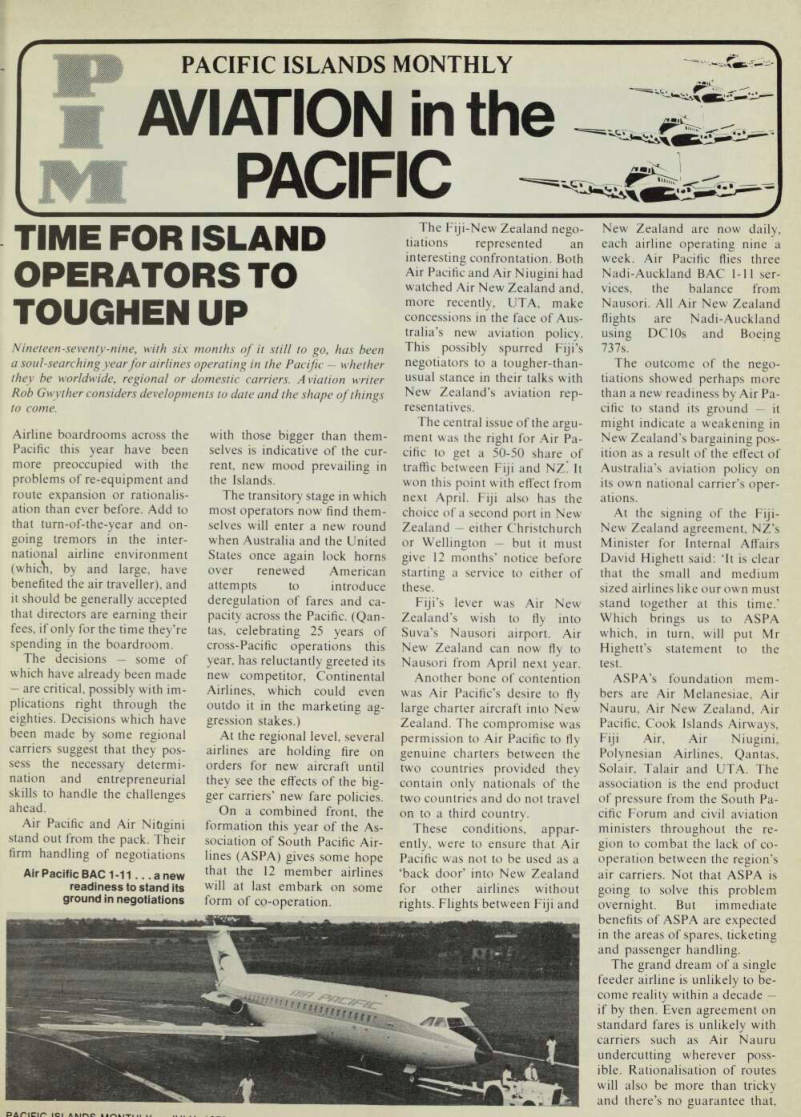
New Zealand are now daily, each airline operating nine a week. Air Pacific flies three Nadi-Auckland BAC 1-11 ser vices, the balance from Nausori. All Air New Zealand flights are Nadi-Auckland using DC 10s and Boeing 7375.
The outcome of the nego tiations showed perhaps more than a new readiness by Air Pa cific to stand its ground it might indicate a weakening in New Zealand’s bargaining pos ition as a result of the effect of Australia’s aviation policy on its own national carrier’s oper ations.
At the signing of the Fiji- New Zealand agreement, NZ’s Minister for Internal Affairs David Highett said; ‘lt is clear that the small and medium sized airlines like our own must stand together at this time.’
Which brings us to ASPA which, in turn, will put Mr Highett’s statement to the test.
ASPA's foundation mem bers are Air Melanesiae, Air Nauru, Air New Zealand, Air Pacific, Cook Islands Airways, Fiji Air, Air Niugini, Polynesian Airlines, Qantas, Solair, Talair and UTA. The association is the end product of pressure from the South Pa cific Forum and civil aviation ministers throughout the re gion to combat the lack of co operation between the region’s air carriers. Not that ASPA is going to solve this problem overnight. But immediate benefits of ASPA are expected in the areas of spares, ticketing and passenger handling.
The grand dream of a single feeder airline is unlikely to be come reality within a decade if by then. Even agreement on standard fares is unlikely with carriers such as Air Nauru undercutting wherever poss ible. Rationalisation of routes will also be more than tricky and there’s no guarantee that,
Air Pacific BAC 1 -11 ... a new readiness to stand its ground in negotiations
when asked, the larger carriers will make confidential infor mation available to ASPA.
Membership of ASPA was open to airlines with head offices in ‘the South Pacific’ (including Micronesia) but Air New Zealand, Qantas and UTA, because of the important
roles they play in the region,
were invited to take mem
bership.
It is somewhat ironical that ASPA should come into being at a time when relations be tween the big and small car riers are at their lowest ebb.
The smaller airlines know that they are going to get nothing in the way of concessions without
asking and forcefully too.
Fiji, for example, in May went
to do battle with Australia to
negotiate new Australia-Fiji
fares and to win rights to a Fiji-
Sydney-Melbourne deal.
Air Pacific was confident of a fair share of the route but not without paying a price.
The quid pro quo was expected to be Fiji going along with Aus tralia’s advance purchase excursion fares as the basis of a new fare structure some thing with which Fiji does not agree.
Air Niugini is also finding the going hard with Australia in its campaign for traffic rights between Port Moresby and Townsville in northern Queensland and for a third ser vice each week out of Brisbane.
It believes the extra Australian
services are justified by
‘embarrassingly high’ load fac
tors out of Queensland but Qantas has been opposing any expansion of Air Niugini’s op erations.
Up to May, Air Niugini from
Port Moresby was providing
four Fokker F2B jet flights a week to Cairns in northern Queensland, and four Boeing 707 flights to Sydney, two of which call at Brisbane.
Air Niugini’s second Boeing
707 arrived in Sydney in late
May, marking the beginning of
another upgrading programme for its international services. A third 707, on order, will replace the 707 which has been flying
Air Niugini’s Hongkong,
Kagoshima, Manila, Brisbane and Sydney services for more than two years.
Big airline pressures from both sides of the Pacific are beginning to show in the Islands. UTA French Airlines was the first carrier to make adjustments, announcing can cellation of its Noumea-Nadi service as a direct result of Aus tralia’s new point-to-point fares and operating structure.
UTA said it had experienced several years of falling revenue from Fiji and now had been ‘hard hit’ by Australia’s new
‘detrimental’ policies.
Polynesian Airlines, which deferred a decision on acquir ing its own pure jet, is now more hopeful that Continen tal’s entry on the US- Australasia run will not, with
Samoa, replacing it with an extra trans-Pacific 747 ser vice.
Projections on passenger traffic in the South Pacific are hazy at the moment. Overfly ing by larger carriers has hurt but in some areas of the tourist industry there is optimism that traffic will be back to former high levels within two or three years. However one leading statistician has warned that the Islands can expect a drop in the meantime from the present fig ure of about 13.5 million visi tors. He said that with the trend toward point-to-point fares, visitors would be likely to stay longer but their numbers over all would drop.
tourist industry hopes. Gordon
Oliver of the Fiji Coral Coast Hotel charged that the block had cost Fiji an extra 11 000 tourists and that it was pressure from CP Air which had caused the Canadian Government to reverse its earlier decision to allow Wardair to run a weekly 747 flight six months of the year. Mr Oliver’s charges were levelled at last month’s Fiji Tourism Convention at which CP Air’s Fiji manager, George Heinmiller, was reported as saying that his airline would commence a DC 10 service to Fiji from Vancouver in December.
Computer technology is
another field Islands operators
its Pago Pago call, pose a serious threat to the markets the Apia-based carrier has
been developing.
This depends very much on whether Continental ever suc
ceeds in operating standby
fares between Pago Pago and Auckland at a level far below what Polynesian can afford.
Already Contiental has dropped its decision to operate fares out of Australia and New Zealand different to other car riers. Continental is eager to re assure regional carriers that it will operate in close co operation with them. But it has foreshadowed a move later this year to get permission for daily flights on South Pacific routes.
Air New Zealand is also con sidering the impact of recent developments on its Auckland- Pago Pago run. Its load factors, without new pressure, have not been all that high.
Pan Am, arguing that Pago
Pago would be adequately
served from the US by Con
tinental, has dropped one of its two weekly flights to American Fuel prices are another worrying factor. Already sur charges have been imposed to combat higher fuel prices and third level operators using older equipment know they are in for tougher times until they can get through their re
equipment programmes.
Despite these gloomy projections it seems certain that more airlines will come into the Islands. Hawaiian Airlines and AeroAmerica have been granted rights. Hawaiian has two years in which to start a
Honolulu-Pago Pago-Nadi-
Papeete-Honolulu round trip service. So far it has filed for five flights a week to Pago Pago.
The Fiji Government has has a proposal from Canadian charter airline Wardair to op erate 747 flights to Fiji from November, these being tied to
tour packages.
However the news from Canada that the government would not allow Wardair the right to fly came as a blow to
are likely to move into in the near future. Already Air Pa *s on ** ne Qantas’
Q antam system. Air Pacific chairman Don Aidney antici- P ates computerised reserva tlons alone will mean a 12% annua l increase in business.
Suddenly, flying in the
Islands has taken on a new
complexion altogether. Cur
rents are at wor j c which are not
only new t 0 Islands operators
but are only a year or so old in t h e muc h busier airlanes of Europe and North America, Whereas, in the past, Pacific operators have had years in which to plan to cope with
slowly emerging changes, this
year’s frenzied activity has hit b ke an undetected air pocket.
All round, it seems, every air iine must emerge a tougher op erat while a f the e beari . mjnd , h Mr Pass . • , , • r . „ enger is looking for a better de f,_ The skjes B ahead are not cloudless but the challenges
may be a good thing, especially
for ASPA. They may prove the
making of Islands co-operation
aloft.
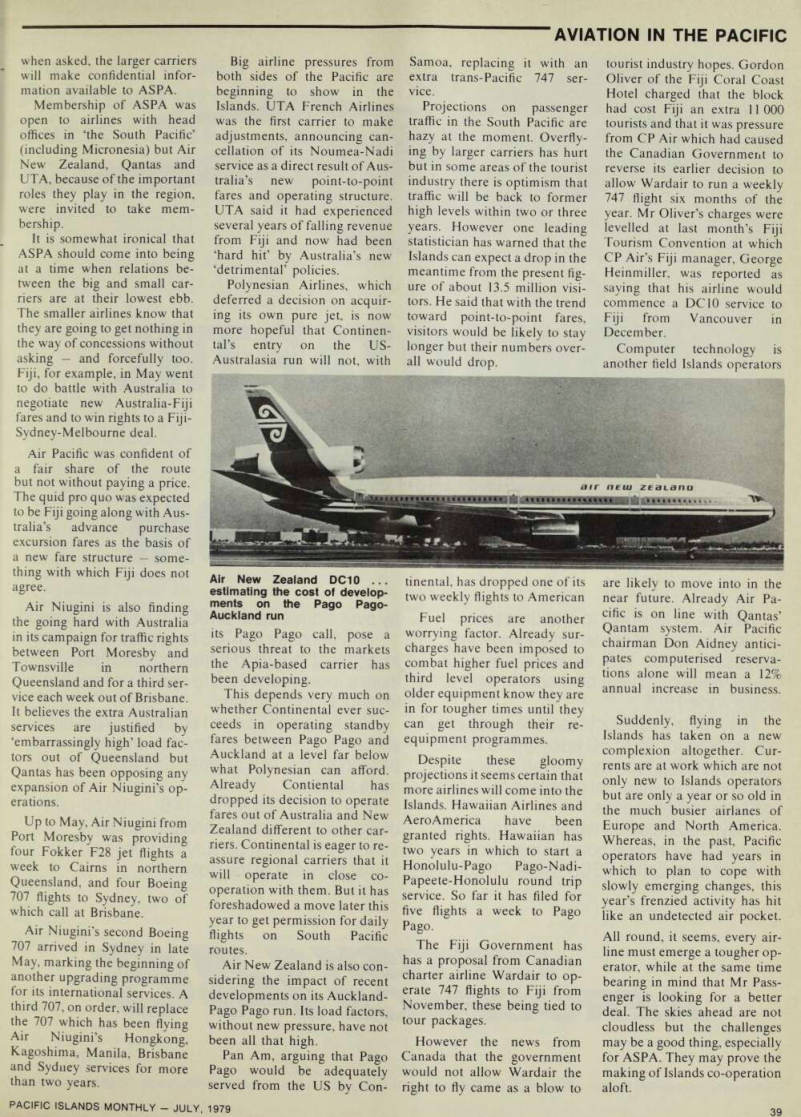
Air New Zealand DCIO ... estimating the cost of develop ments on the Pago Pago- Auckland run