What A Dish!
pp. 32-33 · Read in the full issue
A Tongan love story
It’s nearly a year since Tonga’s satellite communications dish came into operation. And the item we publish here was written about the same time. But, for the record, and as an insight to the thinking of an American Peace Corps volunteer, now back at home in Arizona, we let Jan Worth tell you of her love affair with The Dish.
I am absurdly, hopelessly, irrationally in love with Tonga’s new Cable and Wireless Satellite Receiving Station. I suppose that’s a sign I’ve been here too long. Nonetheless, I love riding my bicycle by the gleaming new building, white and solid and with real doors and (most amazing) real door-knobs and solid glass (not louvres) and a driveway with curbs and a landscaped yard around it. All these things are remarkable in Tonga, except at the Mormon school, Liahona, which some of us call ‘Little California’.
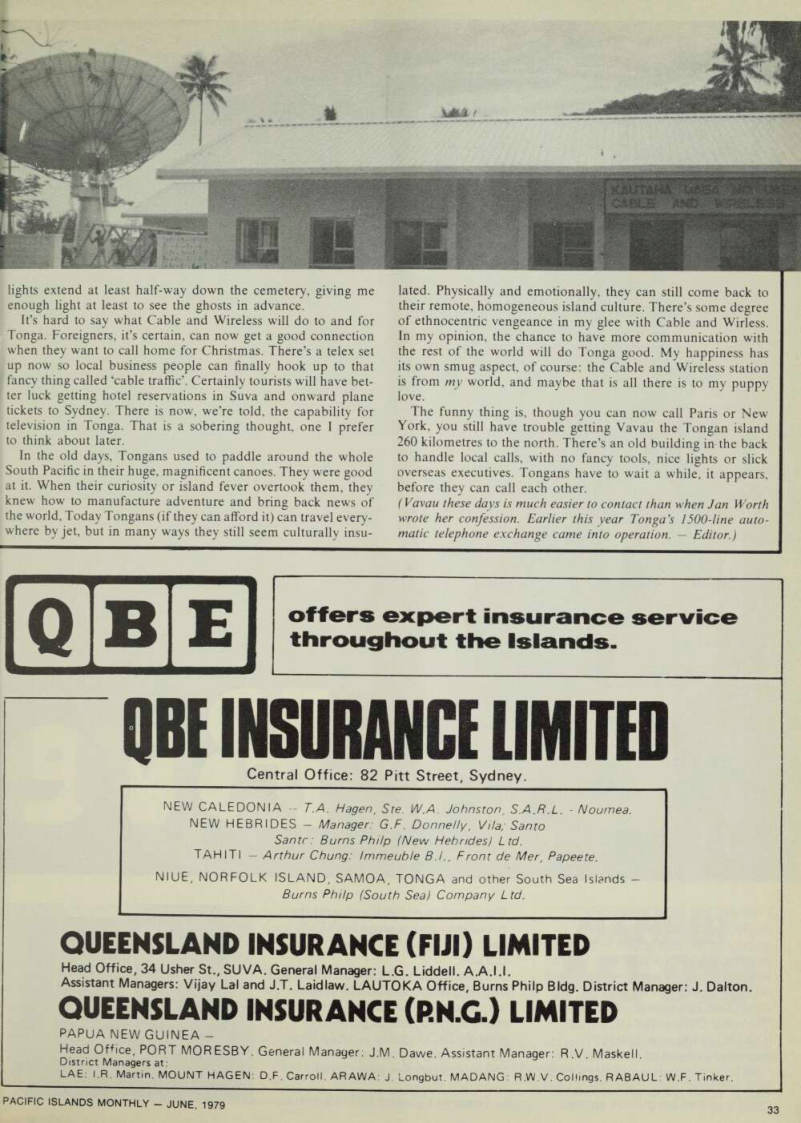
I even love the big sign on the front that says Cable and Wire less Ltd in blue-on-white, professional-looking letters, and above that, Kautaha Uaea mo Uaealesi, a name I can’t help mak ing fun of. In Tongan it means ‘Wire and Wireless Company’.
If they had to use a corruption of the English, why didn’t they say Kepolo mo Uaealesi which is what everybody calls it anyway?
But that’s all right ... I can love imperfections and if I didn’t
have something to be sarcastic about I’d feel even more silly about my helpless reaction to the place.
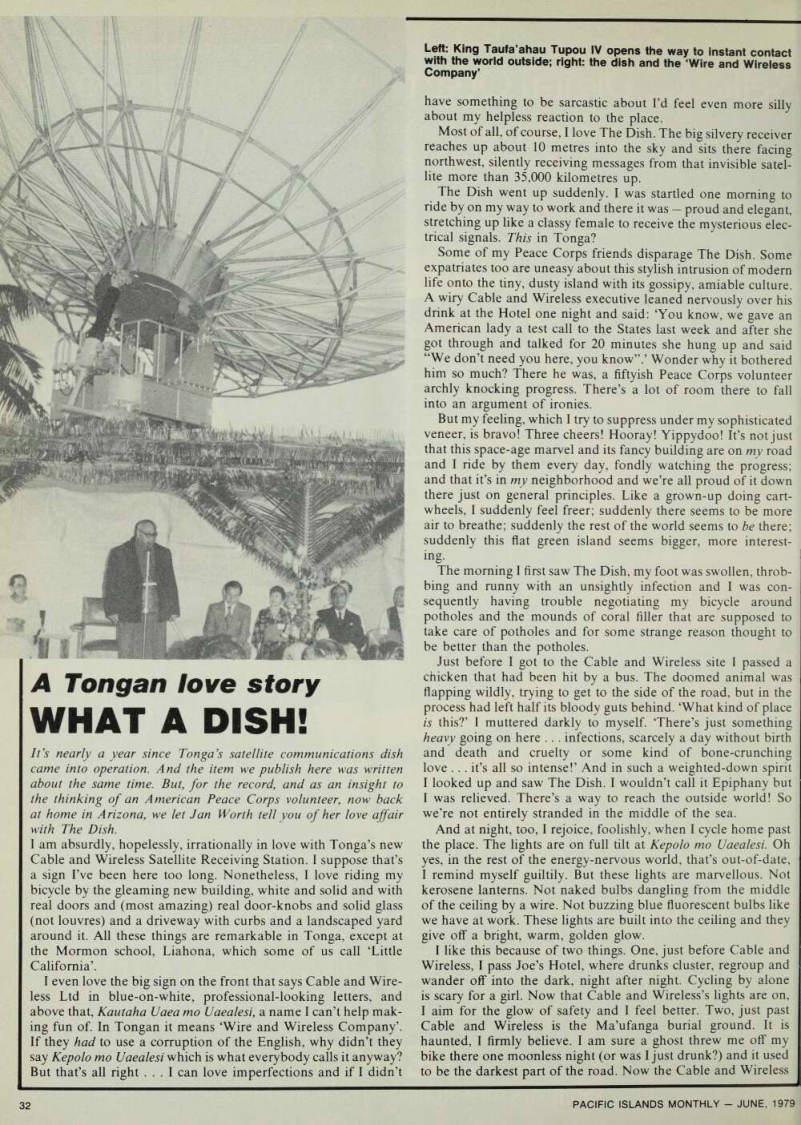
Most of all, of course, I love The Dish. The big silvery receiver reaches up about 10 metres into the sky and sits there facing northwest, silently receiving messages from that invisible satel lite more than 35,000 kilometres up.
The Dish went up suddenly. I was startled one morning to ride by on my way to work and there it was proud and elegant, stretching up like a classy female to receive the mysterious elec trical signals. This in Tonga?
Some of my Peace Corps friends disparage The Dish. Some expatriates too are uneasy about this stylish intrusion of modern life onto the tiny, dusty island with its gossipy, amiable culture.
A wiry Cable and Wireless executive leaned nervously over his drink at the Hotel one night and said: ‘You know, we gave an American lady a test call to the States last week and after she got through and talked for 20 minutes she hung up and said “We don’t need you here, you know”.’ Wonder why it bothered him so much? There he was, a fiftyish Peace Corps volunteer archly knocking progress. There’s a lot of room there to fall into an argument of ironies.
But my feeling, which I try to suppress under my sophisticated veneer, is bravo! Three cheers! Hooray! Yippydoo! It’s not just that this space-age marvel and its fancy building are on my road and I ride by them every day, fondly watching the progress; and that it’s in my neighborhood and we’re all proud of it down there just on general principles. Like a grown-up doing cart wheels, I suddenly feel freer; suddenly there seems to be more air to breathe; suddenly the rest of the world seems to be there; suddenly this flat green island seems bigger, more interest
ing.
The morning I first saw The Dish, my foot was swollen, throb bing and runny with an unsightly infection and I was con sequently having trouble negotiating my bicycle around potholes and the mounds of coral filler that are supposed to take care of potholes and for some strange reason thought to be better than the potholes.
Just before I got to the Cable and Wireless site I passed a chicken that had been hit by a bus. The doomed animal was flapping wildly, trying to get to the side of the road, but in the process had left half its bloody guts behind. ‘What kind of place is this?’ I muttered darkly to myself. ‘There’s just something heavy going on here ... infections, scarcely a day without birth and death and cruelty or some kind of bone-crunching love ... it’s all so intense!’ And in such a weighted-down spirit I looked up and saw The Dish. I wouldn’t call it Epiphany but I was relieved. There’s a way to reach the outside world! So we’re not entirely stranded in the middle of the sea.
And at night, too, I rejoice, foolishly, when I cycle home past the place. The lights are on full tilt at Kepolo mo Uaealesi. Oh yes, in the rest of the energy-nervous world, that’s out-of-date, I remind myself guiltily. But these lights are marvellous. Not kerosene lanterns. Not naked bulbs dangling from the middle of the ceiling by a wire. Not buzzing blue fluorescent bulbs like we have at work. These lights are built into the ceiling and they give off a bright, warm, golden glow.
I like this because of two things. One, just before Cable and Wireless, I pass Joe’s Hotel, where drunks cluster, regroup and wander off into the dark, night after night. Cycling by alone is scary for a girl. Now that Cable and Wireless’s lights are on, I aim for the glow of safety and I feel better. Two, just past Cable and Wireless is the Ma’ufanga burial ground. It is haunted, I firmly believe. I am sure a ghost threw me off my bike there one moonless night (or was I just drunk?) and it used to be the darkest part of the road. Now the Cable and Wireless
Left: King Taufa 'ahau Tupou IV opens the way to instant contact with the world outside; right: the dish and the ‘Wire and Wireless
Company’
lights extend at least half-way down the cemetery, giving me enough light at least to see the ghosts in advance.
It’s hard to say what Cable and Wireless will do to and for Tonga. Foreigners, it’s certain, can now get a good connection when they want to call home for Christmas. There’s a telex set up now so local business people can finally hook up to that fancy thing called ‘cable traffic’. Certainly tourists will have bet ter luck getting hotel reservations in Suva and onward plane tickets to Sydney. There is now, we’re told, the capability for television in Tonga. That is a sobering thought, one I prefer to think about later.
In the old days, Tongans used to paddle around the whole South Pacific in their huge, magnificent canoes. They were good at it. When their curiosity or island fever overtook them, they knew how to manufacture adventure and bring back news of the world, Today Tongans (if they can afford it) can travel every where by jet, but in many ways they still seem culturally insu
lated. Physically and emotionally, they can still come back to their remote, homogeneous island culture. There’s some degree of ethnocentric vengeance in my glee with Cable and Wirless.
In my opinion, the chance to have more communication with the rest of the world will do Tonga good. My happiness has its own smug aspect, of course: the Cable and Wireless station is from my world, and maybe that is all there is to my puppy love.
The funny thing is, though you can now call Paris or New York, you still have trouble getting Vavau the Tongan island 260 kilometres to the north. There’s an old building in the back to handle local calls, with no fancy tools, nice lights or slick overseas executives. Tongans have to wait a while, it appears, before they can call each other. (Vavau these days is much easier to contact than when Jan Worth wrote her confession. Earlier this year Tonga's 1500-line auto matic telephone exchange came into operation. Editor.)