Norfolk gets
p. 45 · Read in the full issue
Australia In The Pacific
Norfolk gets more but less than it asks
Norfolk Island, the Australian island territory 1063 km east of Sydney, got a blueprint for a new style of government in April not the government most islanders want, but at least something they consider is
capable of being developed for
their needs, writes Stuart Inder.
The blueprint, in the form of the Norfolk Island Bill 1978, was passed by the Australian House of Representatives after
a long and partly-successful
fight by the eight-man Norfolk
Island Council to get the Australian Government to acknowledge that the latter day home of the descendants of the Bounty mutineers is a special place, a distinct and separate settlement that has never been ceded to or annexed by Australia.
The new bill, still in early April to go to the Senate for final approval, which will vir tually be automatic, establishes a Westminster model of government, with a nine-man
Legislative Assembly, elected
for three-year terms, and an executive council holding ministerial type portfolios (one member to be designated chief minister or equivalent). The bill gives legislative and execu tive authority to the assembly, including the right to raise local revenue and legislate on most functions, but reserves impor tant powers of veto by the Commonwealth of Australia and retains the title of‘admin istrator’, although the post has
less authority.
The entire council visited Sydney and Canberra for talks leading up to the passage of the bill. They failed in their efforts to gain virtually full immediate self-government on the island, but they extracted vital promises from the government as to Australia’s future inten tions on Norfolk, and also got recognition that Norfolk Island is ‘different’.
More importantly, they had
these intentions written into
the preamble of the bill, which now states that the ‘residents of Norfolk Island include de scendants of the settlers from Pitcairn Island . . . and the par liament recognises the special relationship of the said de scendants with Norfolk Island and their desire to preserve their traditions and culture . . . and parliament considers it de sirable that Norfolk Island achieve, over a period of time, it being the wishes of the
people of Norfolk Island, internal self-government as a territory under the authority of the Commonwealth .. . and the parliament intends that within a period of five years of the coming into operation of this act consideration will be
given to extending the
powers. ..’
These, and other promises now incorporated, had been understood between coun cillors and the Australian minister responsible for Nor folk affairs. Bob Ellicott, dur
ing long negotiations, but the
council’s victory was in getting the government to enshrine them in the wording of the bill, and thus make it difficult for a future government to reverse
the spirit of the bill and integrate Norfolk Island entirely into the Australian federal system.
The unanimous council view is that Australia is merely re storing self-government which, the council says, was illegally taken away from Norfolk in 1896.
Complete integration, with federal income tax, voting rights and social service pay ments, had been recommended following the Nimmo Report of 1977. These recommenda tions met sharp opposition on the island (population 1800), culminating in negotiations resulting in the new Norfolk Island Bill.
Although the councillors have not yet got all that most islanders want, they returned from their Australian sortie with the satisfaction of know ing that they could have achieved no more than they did and that what they did achieve was vital. They would like to have seen a guarantee in the Bill that Norfolk has control of the resources of its surrounding seas and that it has the right to determine its own political future.
Mr Ellicott stressed through out all the talks that he be lieved the bill gave the island
enough self-government to en
able it to gain the adminis trative experience it needed before further steps could be taken.
The councillors said, finally, that they would do all they could to make the bill work, but it contained ‘in-built in justices which we fear will cause continuing difficulties and discontent’, and islanders would go on ‘trying to earn understanding and support for our cause wherever we can find it’.
As if to underline this, the Australian newspapers the day after the bill went through pub lished a New York interview with Ken Nobbs, president of the Society of Descendants of the Pitcairn Settlers on Nor folk, who said during a New York visit, ‘1 have been advised at the UN to find a champion of the island to put the case be fore the Committee of 24, and I’ll suggest this to the council when I return.’
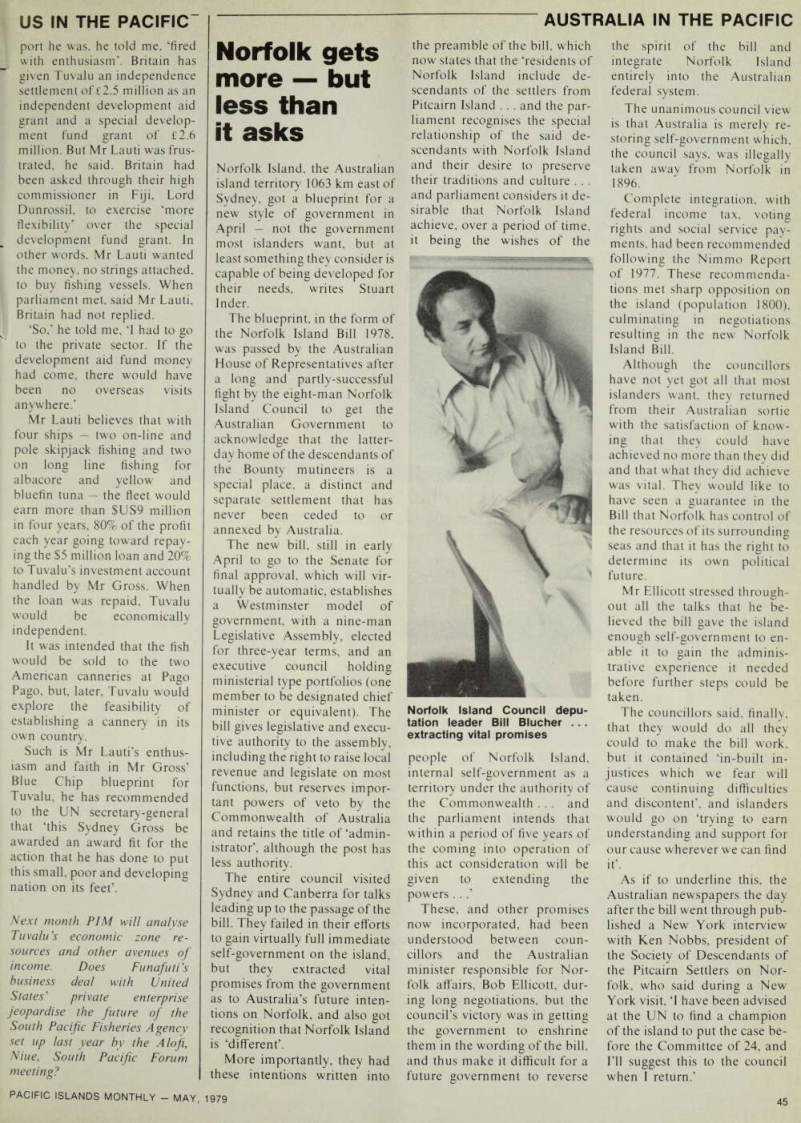
Norfolk Island Council depu tation leader Bill Blucher ... extracting vital promises