Tuvalu Puts All
pp. 42-45 · Read in the full issue


Us In The Pacific
Its Eggs In One
Basket
What do you do when you fall out of love? Tiny Tuvalu was faced with this dilemma when its going-away present last year , from Britain after more than three-quarters of a century under its ‘pro tection ’ was something less than generous. Tuvalu's Prime Minister Toalipi Lauti is a man of faith, a man with a deep trust in human nature. He doesn't have the cash resources of Nauru or the natural resources of Papua New Guinea. But he did have half a million dollars. And there was an American who told him how it could be spent to Tuvalu's advantage. PI M's John Carter flew to Funafuti in April to find out where the money went and what Tuvalu expects to get in return for it. This is his story.
Armed with a cheque for SASSO 380 the whole of his
little country’s ready money
and a colossal faith in man’s humanity to man, Tuvalu’s Prime Minister Toalipi Lauti flew to the United States in February and handed the money to a total stranger.
Then, he flew back to his capital of Funafuti and told the parliament of 12 worried men at the turn of April that he had ‘achieved’ his goal that the stranger would raise a $5 million loan for Tuvalu to create a fishing industry and
satisfy the prime minister’s
‘burning desire’ to make his
7000-population nation
economically independent.
Mr Lauti in his office at Funafuti told me about his ‘trip of trips’. His plan to make
Tuvalu ‘economically indepen-
dent’ is a most amazing act by a South Pacific Island leader. It seems fraught with so many risks as to raise grave doubts
about its success. But Mr Lauti has no doubts whatever that his action has started his little nation along the road to true
independence. His colleagues
are not so sure. In fact they, and government officials, are worried. But, such is the hold Mr Lauti has on his people. that no one actively opposes his course or openly criticises him for committing Tuvalu to the plan with little or no prior discussion, Mr Lauti has been frank and open from the start. When the parliament began its session a few days before I arrived on the island, he gave a full report of his travels, his talks with American businessmen in California and details of the plan for a fishing fleet. He was equally open with me, not surprisingly, because Mr Lauti,
a gentle giant, obviously honest
and without guile, invites com plete trust. Equally, he wants to trust others to help him. Which
is, perhaps, why his main con tact in the United States. Sid ney Gross of Blue Chip Realty Investment, Encino, Cali fornia, promised, over the seal of a notary public on February 16, to invest the $554 380 at an interest rate of 15%.
And, as was recorded in another document, to ‘act very diligently to aid you in
establishing the fishing in
dustry trade that is so desired and needed at this time ... I will be attempting to arrange for financing and/or leasing of the fishing fleet that you want to establish ...
Mr Gross signed this docu ment as ‘Tuvalu Ambassador and Representative in the United States of America’. (This appointment, as Mr Lauti said, was subject to Washington’s approval becuse, as US Ambassador John Con don told me in Suva, American subjects are not allowed to act
as diplomats for any foreign nation.) The whole operation started when Bula Tokatasi. born in Fiji of a Fijian father and a part-Tuvaluan mother, visited Tuvalu from his home in the Marshall Islands as repre sentative of an investment company. Mr Tokatasi sold land in Green Valley, Texas, to the people of Tuvalu's Nanumanga Island. The Nanumangans. persuaded by Mr Tokatasi of the excellence of the investment, paid out $75 000. $6OOO for each five acres.
Mr Tokatasi also saw Prime Minister Lauti who told him of his desire to start a fishing industry. So Mr Tokatasi gave Mr Lauti a list of contacts in the United States, a list which, Mr Lauti told me. was subse
quently vetted by Ambassador
condon with whom he dis cussed his plans while on a visit to Suva.
PlM’s initial inquiries failed to unearth more details of Mr Gross and his company, or about real estate salesman Tokatasi except that the latter is also known as Bula O’Brien.
He is described as being associated with ‘Colateral
Investment Company’.
Mr Gross rates a mention in the Valley News (San Fer nando) which describes him as ‘an Encino investor and realtor who will establish a Tuvalu office in Beverly Hills’. Mr Gross’ address is Suite 112. 16000 Ventura Boulevard.
Encino, California. He is also connected with a company named Ranchland Farm Re sort Properties. However, according to Mr Lauti, Am bassador Condon in Fiji had given assistance by ‘checking up the peoples’ Mr Lauti had to visit. Presumably, Mr Con don gave them a clean bill. Mr Condon told me, however, that he had no information about Mr Gross’ company. Blue Chip
Realty Investment.
Mr Lauti is highly optimistic of success, basing his hopes on an encouraging interim report of a skipjack tuna survey and assessment programme in Tuvaluan waters by the South Pacific Commission from June 25 to July 4 last year.
When Mr Lauti read that re
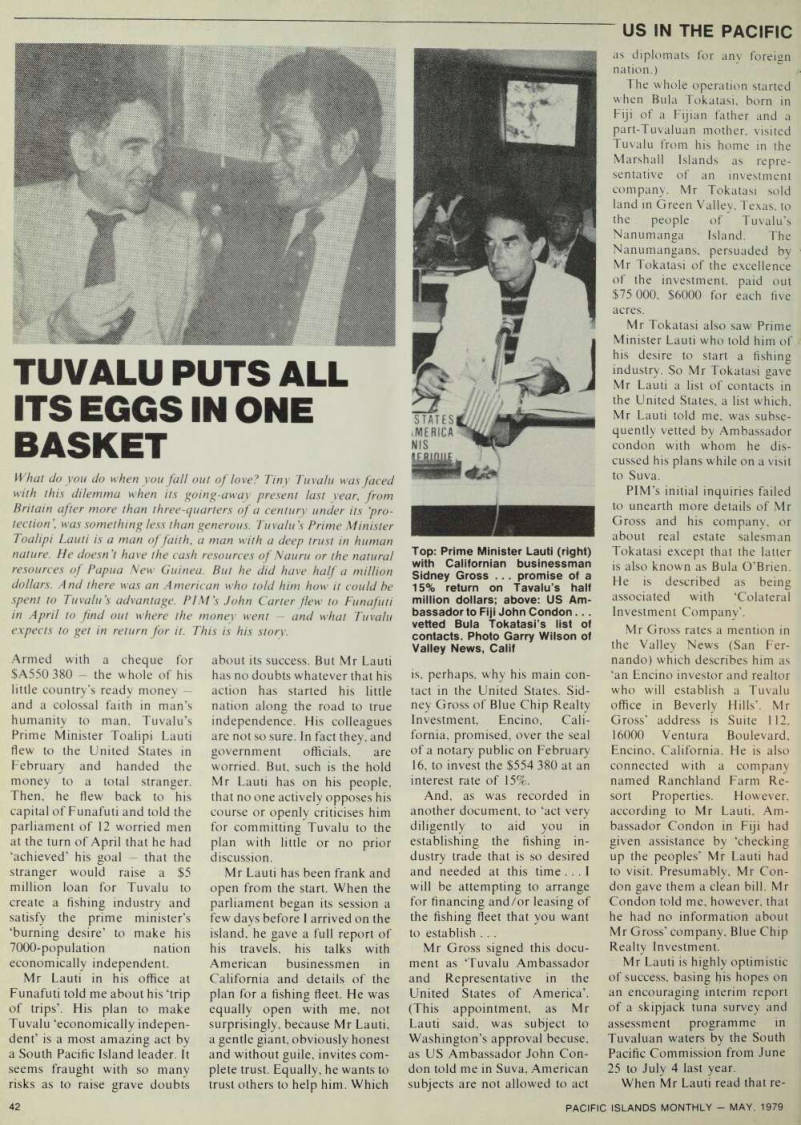
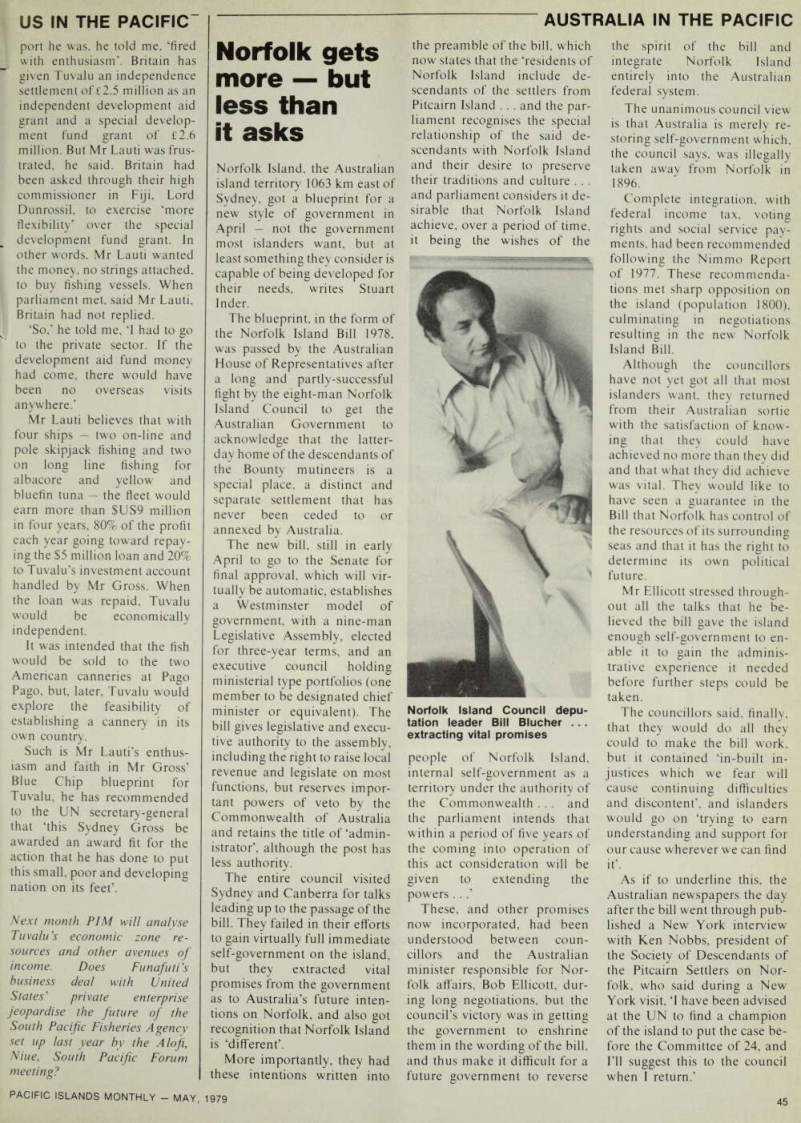
Top: Prime Minister Lauti (right) with Californian businessman Sidney Gross ... promise of a 15% return on Tavalu’s half million dollars; above: US Am bassador to Fiji John Condon ... vetted Bula Tokatasi’s list of contacts. Photo Garry Wilson of Valley News, Calif
port he was, he told me. ‘fired with enthusiasm’. Britain has
given Tuvalu an independence
settlement of £2.5 million as an independent development aid grant and a special develop ment fund grant of £2.6 million. But Mr Lauti was frus trated, he said. Britain had been asked through their high commissioner in Fiji, Lord Dunrossil. to exercise ‘more flexibility’ over the special development fund grant. In other words, Mr Lauti wanted the money, no strings attached, to buy fishing vessels. When parliament met, said Mr Lauti, Britain had not replied. ‘So.’ he told me, ‘I had to go to the private sector. If the development aid fund money had come, there would have been no overseas visits anywhere.' Mr Lauti believes that with four ships two on-line and
pole skipjack fishing and two
on long line fishing for albacore and yellow and bluefin tuna - the fleet would earn more than SUS 9 million in four years, 80% of the profit each year going toward repay ing the $5 million loan and 20% to Tuvalu’s investment account handled by Mr Gross. When the loan was repaid, Tuvalu would be economically
independent.
It was intended that the fish would be sold to the two American canneries at Pago Pago, but, later, Tuvalu would
explore the feasibility of
establishing a cannery in its own country.
Such is Mr Lauti’s enthus iasm and faith in Mr Gross’
Blue Chip blueprint for
Tuvalu, he has recommended to the UN secretary-general that ‘this Sydney Gross be awarded an award fit for the action that he has done to put this small, poor and developing nation on its feet’.
Next month PIM will analyse Tuvalu's economic zone re sources and other avenues of income. Does Funafuti's business deal with United States' private enterprise
jeopardise the future of the
South Pacific Fisheries Agency
set up last year by the Alofi, Niue, South Pacific Forum meeting?