the islands?
pp. 26-31 · Read in the full issue
How ‘duty free’ the islands?
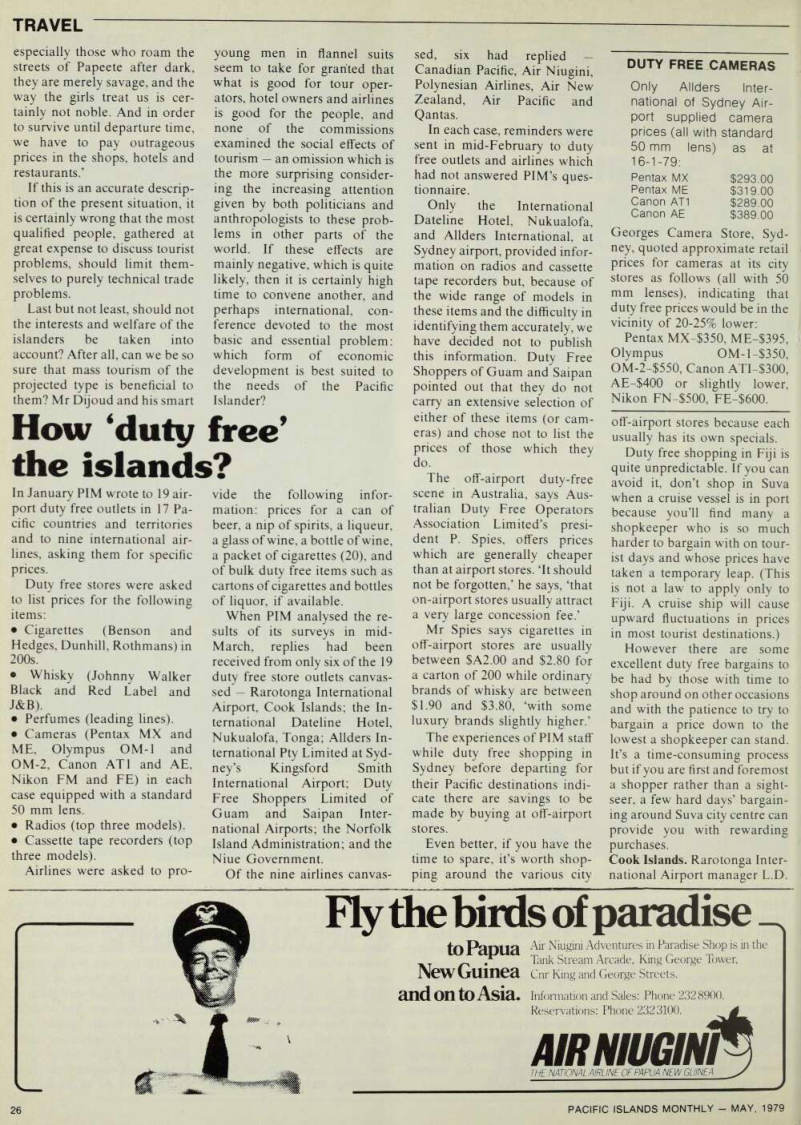
In January PIM wrote to 19 air port duty free outlets in 17 Pa cific countries and territories and to nine international air lines, asking them for specific
prices.
Duty free stores were asked to list prices for the following items: • Cigarettes (Benson and Hedges, Dunhill, Rothmans) in 200 s.
• Whisky (Johnny Walker
Black and Red Label and J&B). • Perfumes (leading lines). • Cameras (Pentax MX and ME, Olympus OM-1 and OM-2, Canon ATI and AE, Nikon FM and FE) in each case equipped with a standard 50 mm lens. • Radios (top three models). • Cassette tape recorders (top three models).
Airlines were asked to pro
vide the following infor mation: prices for a can of beer, a nip of spirits, a liqueur, a glass of wine, a bottle of wine, a packet of cigarettes (20), and of bulk duty free items such as cartons of cigarettes and bottles of liquor, if available.
When PIM analysed the re sults of its surveys in mid- March, replies had been received from only six of the 19 duty free store outlets canvas sed Rarotonga International Airport, Cook Islands; the In ternational Dateline Hotel, Nukualofa, Tonga; Allders In ternational Pty Limited at Syd
ney’s Kingsford Smith
International Airport; Duty Free Shoppers Limited of Guam and Saipan Inter national Airports; the Norfolk Island Administration; and the Niue Government.
Of the nine airlines canvas
sed, six had replied Canadian Pacific, Air Niugini, Polynesian Airlines, Air New Zealand, Air Pacific and Qantas.
In each case, reminders were sent in mid-February to duty free outlets and airlines which had not answered PlM’s ques tionnaire.
Only the International Dateline Hotel, Nukualofa, and Allders International, at
Sydney airport, provided infor
mation on radios and cassette tape recorders but, because of the wide range of models in these items and the difficulty in
identifying them accurately, we
have decided not to publish this information. Duty Free Shoppers of Guam and Saipan pointed out that they do not carry an extensive selection of either of these items (or cam eras) and chose not to list the prices of those which they do.
The off-airport duty-free
scene in Australia, says Aus
tralian Duty Free Operators
Association Limited’s presi dent P. Spies, offers prices
which are generally cheaper
than at airport stores. Tt should not be forgotten,’ he says, ‘that
on-airport stores usually attract
a very large concession fee.’
Mr Spies says cigarettes in
off-airport stores are usually
between $A2.00 and $2.80 for a carton of 200 while ordinary brands of whisky are between $1.90 and $3.80, ‘with some
luxury brands slightly higher.’
The experiences of PIM staff while duty free shopping in
Sydney before departing for
their Pacific destinations indi cate there are savings to be
made by buying at off-airport
stores.
Even better, if you have the time to spare, it’s worth shop ping around the various city
off-airport stores because each usually has its own specials.
Duty free shopping in Fiji is
quite unpredictable. If you can avoid it, don’t shop in Suva when a cruise vessel is in port because you’ll find many a shopkeeper who is so much harder to bargain with on tour ist days and whose prices have taken a temporary leap. (This is not a law to apply only to Fiji. A cruise ship will cause
upward fluctuations in prices
in most tourist destinations.) However there are some excellent duty free bargains to be had by those with time to shop around on other occasions and with the patience to try to bargain a price down to the lowest a shopkeeper can stand.
It's a time-consuming process but if you are first and foremost a shopper rather than a sight seer, a few hard days’ bargain ing around Suva city centre can
provide you with rewarding
purchases.
Cook Islands. Rarotonga Inter national Airport manager L.D.
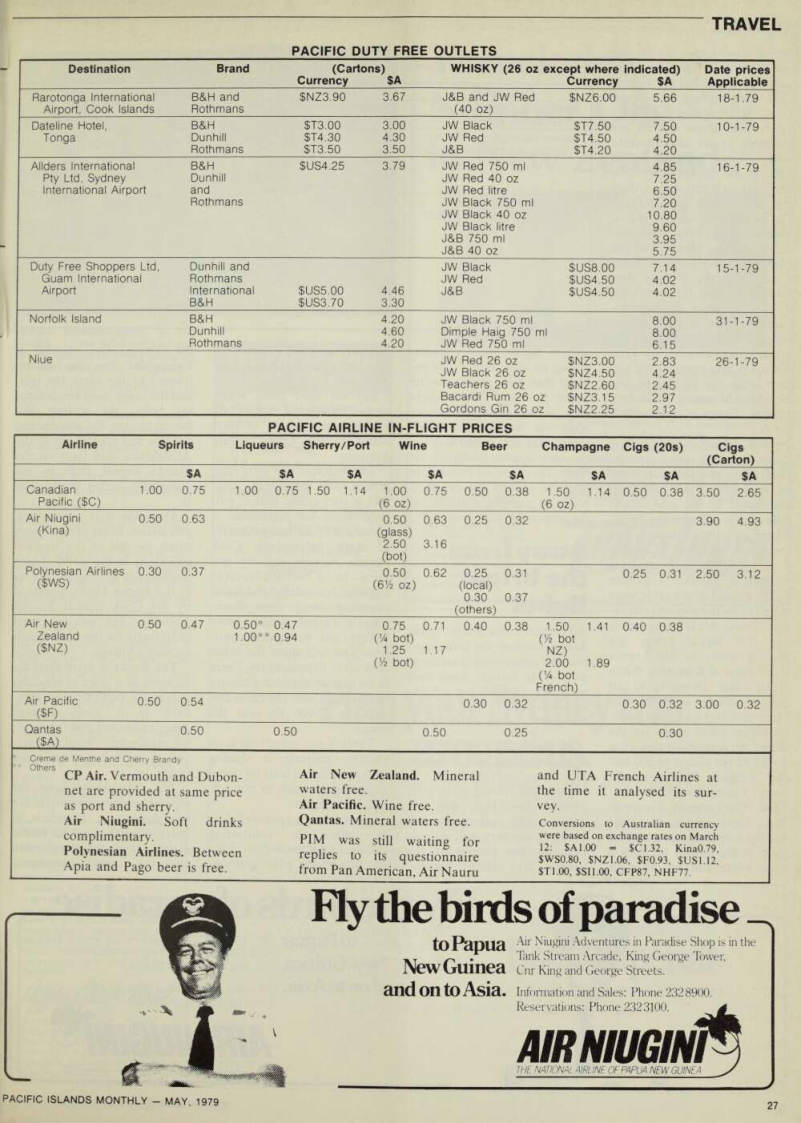
Pacific Duty Free Outlets
Pacific Airline In-Flight Prices
Creme de Menthe and Cherry Brandy Others CP Air. Vermouth and Dubon net are provided at same price as port and sherry.
Air Niugini. Soft drinks
complimentary.
Polynesian Airlines. Between Apia and Pago beer is free.
Air New Zealand. Mineral waters free.
Air Pacific. Wine free.
Qantas. Mineral waters free.
PIM was still waiting for replies to its questionnaire from Pan American, Air Nauru
and UTA French Airlines at the time it analysed its sur vey.
Conversions to Australian currency were based on exchange rates on March 12: SAI.OO = 5C1.32, Kinao.79,
Swso.Bo, Snzi.O6, 5F0.93, Susi.I2,
$71.00, $Bll.Oo, Cfpb7, Nhf77.
Destination Brand (Cartons) WHISKY (26 oz except where indicated) Date prices Currency $A
Currency
$A Applicable Rarotonga International B&H and
Snz3.90
3.67 J&B and JW Red $NZ6.00 5.66 18-1.79 Airport, Cook Islands Rothmans (40 oz) Dateline Hotel, B&H $13.00 3.00 JW Black $T7.50 7.50 10-1-79 Tonga Dunhill $14.30 4.30 JW Red $T4.50 4.50 Rothmans $13.50 3.50 J&B $T4.20 4.20 Allders International B&H $US4.25 3.79 JW Red 750 ml 4.85 16-1-79 Pty Ltd, Sydney Dunhill JW Red 40 oz 7.25 International Airport and JW Red litre 6.50 Rothmans JW Black 750 ml 7.20 JW Black 40 oz 10.80 JW Black litre 9.60 J&B 750 ml 3.95 J&B 40 oz 5.75 Duty Free Shoppers Ltd, Dunhill and JW Black $US8.00 7.14 15-1-79 Guam International Rothmans JW Red $US4.50 4.02 Airport International $US5.00 4.46 J&B $US4.50 4.02 B&H $US3.70 3.30 Norfolk Island B&H 4.20 JW Black 750 ml 8.00 31-1-79 Dunhill 4.60 Dimple Haig 750 ml 8.00 Rothmans 4.20 JW Red 750 ml 6.15 Niue JW Red 26 oz $NZ3.00 2.83 26-1-79 JW Black 26 oz $NZ4.50 4.24 Teachers 26 oz $NZ2.60 2.45 Bacardi Rum 26 oz $NZ3.15 2.97 Gordons Gin 26 oz $NZ2.25 2.12
Airline Spirits Liqueurs Sherry/Port Wine Beer
Champagne
Cigs (20s) Cigs (Carton) $A $A $A $A $A $A $A $A Canadian Pacific ($C) 1.00 0.75 1.00 0.75 1.50 1.14 1.00 (6 oz) 0.75 0.50 0.38 1.50 (6 oz) 1.14 0.50 0.38 3.50 2.65 Air Niugini (Kina) 0.50 0.63 0.50 (glass) 2.50 (bot) 0.63 3.16 0.25 0.32 3.90 4.93 Polynesian Airlines ($WS) 0.30 0.37 0.50 (6I/2 oz) 0.62 0.25 (local) 0.30 (others) 0.31 0.37 0.25 0.31 2.50 3.12 Air New Zealand ($NZ) 0.50 0.47 0.50* 0.47 1.00** 0.94 0.75 (% bot) 1.25 (Vfc bot) 0.71 1.17 0.40 0.38 1.50 (l/ 2 bot NZ) 2.00 ( 1 A bot French) 1.41 1.89 0.40 0.38 Air Pacific (SF) 0.50 0.54 0,30 0.32 0.30 0.32 3.00 0.32 Qantas 0.50 0.50 0.50 0.25 0.30
Lewis reports that ‘we do not operate a duty free shop in its accepted sense’ but the airport does have a ‘duty free liquor store’. Other spirits and wines apart from those quoted are available at the airport while other items, ‘normally avail able at an airport duty free
shop’ are on Rarotonga in ‘duty
free shops with various agen cies in most lines of goods’.
Guam. Gerald Bristow, merchandising manager of the Mid-Pacific Division of Duty Free Shoppers, stresses that ‘Guam is a duty free port with a good number of radio or camera specialty shops on the island. Only liquor and tobacco are not duty free. (Duty Free Shoppers also operates the air port shop on Saipan in the Northern Marianas, Trust Ter ritories. Guam is a US terri
tory.)
Norfolk Island. Administrator Desmond O’Leary reports: ‘Two shops operate under lease
at the airport a liquor shop
conducted by the administra tion and a refreshment booth where cigarettes are sold. But neither is ‘duty free’. (Customs duty on spirits on Norfolk is
$A3.00 a gallon.) Cigarette
prices quoted in the table were
supplied by the airport refresh
ment booth. Mr O’Leary points out that liquor prices are slightly lower at the Liquor Bond Store at Kingston, White Horse and Dewar’s 40 oz bottles selling at $7.70. On cigarettes, he says: ‘I am infor med that other shops on the island sell Australian cigarettes for $3.90 per carton of 200 and the English “International”
(long) variety for $4.80.’
Niue. Government Treasurer W.G. Davis reports that Niue has been operating a duty free shop at the airport for only a short while and ‘so far deals
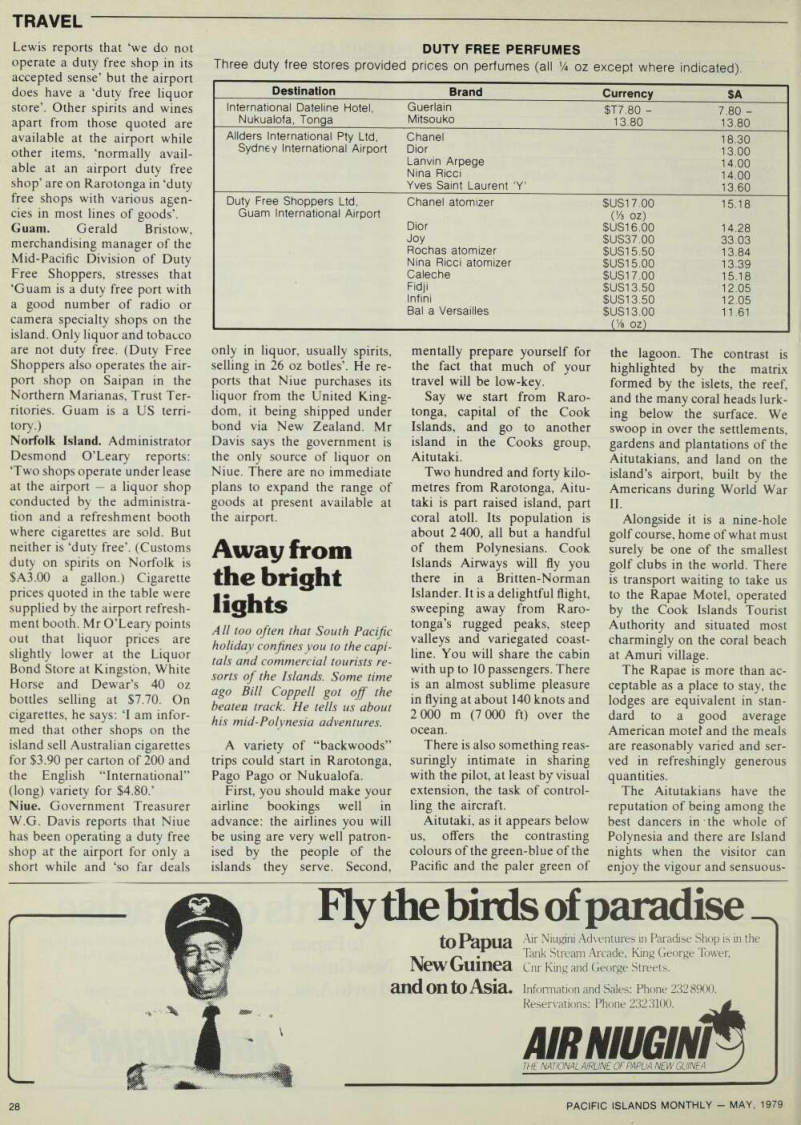
Duty Free Perfumes
Three duty free stores provided prices on perfumes (all 1 / 4 oz except where indicated).
only in liquor, usually spirits,
selling in 26 oz bodes’. He re ports that Niue purchases its liquor from the United King dom, it being shipped under bond via New Zealand. Mr Davis says the government is the only source of liquor on Niue. There are no immediate plans to expand the range of goods at present available at
the airport.
Away from
the bright
lights
A ll too often that South Pacific holiday confines you to the capi tals and commercial tourists re sorts of the Islands. Some time ago Bill Coppell got off the beaten track. He tells us about his mid-Polynesia adventures.
A variety of “backwoods” trips could start in Rarotonga,
Pago Pago or Nukualofa.
First, you should make your airline bookings well in advance: the airlines you will be using are very well patron ised by the people of the islands they serve. Second,
mentally prepare yourself for the fact that much of your travel will be low-key.
Say we start from Raro tonga, capital of the Cook Islands, and go to another island in the Cooks group, Aitutaki.
Two hundred and forty kilo metres from Rarotonga, Aitu taki is part raised island, part coral atoll. Its population is about 2 400, all but a handful of them Polynesians. Cook Islands Airways will fly you there in a Britten-Norman Islander. It is a delightful flight, sweeping away from Raro tonga’s rugged peaks, steep valleys and variegated coast line. You will share the cabin with up to 10 passengers. There is an almost sublime pleasure in flying at about 140 knots and 2 000 m (7 000 ft) over the ocean.
There is also something reas suringly intimate in sharing with the pilot, at least by visual extension, the task of control ling the aircraft.
Aitutaki, as it appears below us, offers the contrasting colours of the green-blue of the Pacific and the paler green of
the lagoon. The contrast is
highlighted by the matrix
formed by the islets, the reef, and the many coral heads lurk ing below the surface. We swoop in over the settlements, gardens and plantations of the Aitutakians, and land on the island’s airport, built by the Americans during World War 11.
Alongside it is a nine-hole golf course, home of what must surely be one of the smallest golf clubs in the world. There is transport waiting to take us to the Rapae Motel, operated by the Cook Islands Tourist Authority and situated most charmingly on the coral beach at Amuri village.
The Rapae is more than ac ceptable as a place to stay, the lodges are equivalent in stan dard to a good average American motel and the meals are reasonably varied and ser ved in refreshingly generous
quantities.
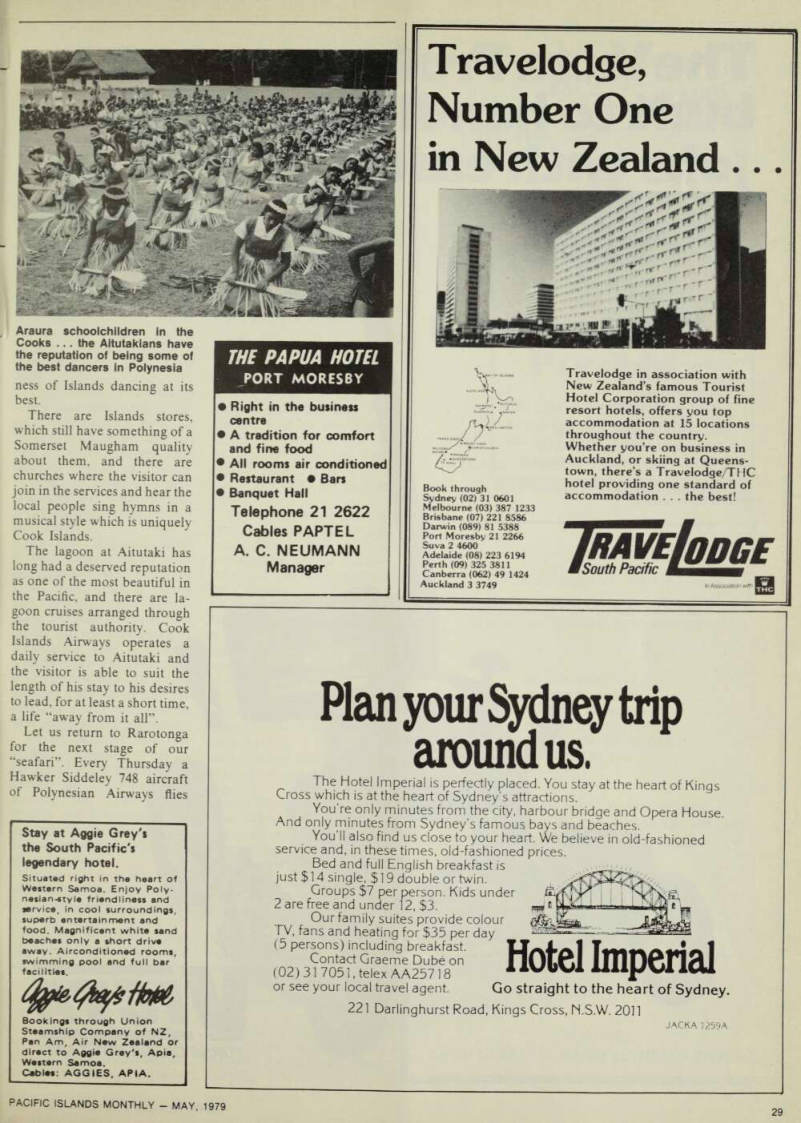
The Aitutakians have the reputation of being among the best dancers in the whole of Polynesia and there are Island nights when the visitor can enjoy the vigour and sensuous-
Destination Brand Currency $A International Dateline Hotel, Guerlain c cc rh- 7.80 - Nukualofa, Tonga Mitsouko 13.80 13.80 Allders International Pty Ltd, Chanel 18.30 Sydney International Airport Dior 13.00 Lanvin Arpege 14.00 Nina Ricci 14.00 Yves Saint Laurent ‘Y’ 13.60 Duty Free Shoppers Ltd, Chanel atomizer $US17.00 15.18 Guam International Airport (Vs oz) Dior $US16.00 14.28 Joy
Sus37.00
33.03 Rochas atomizer $L)S15.50 13.84 Nina Ricci atomizer $US15.00 13.39 Caleche $US17.00 15.18 Fidji $US13.50 12.05 Infini
Sus13.50
12.05 Bal a Versailles
Sus13.00
11.61
(Vs Oz)
ness of Islands dancing at its best.
There are Islands stores, which still have something of a
Somerset Maugham quality
about them, and there are churches where the visitor can join in the services and hear the
local people sing hymns in a
musical style which is uniquely Cook Islands.
The lagoon at Aitutaki has long had a deserved reputation as one of the most beautiful in the Pacific, and there are la goon cruises arranged through the tourist authority. Cook Islands Airways operates a daily service to Aitutaki and the visitor is able to suit the length of his stay to his desires to lead, for at least a short time, a life “away from it all”.
Let us return to Rarotonga for the next stage of our
“seafari”. Every Thursday a
Hawker Siddeley 748 aircraft
of Polynesian Airways flies
Araura schoolchildren in the Cooks ... the Aitutakians have the reputation of being some of the best dancers in Polynesia
from Rarotonga to Niue, a self
governing Polynesian island to
the west of Rarotonga. Niue has a population of about 4 000.
Again the flight is leisurely, the aircraft carries about 40 people, and the service from the Samoan hostesses is friendly, extremely helpful and informal.
Again the flight allows us to feel at peace with the ocean and the clouds that seem to march across the world below in step with us.
Niue, when it appears in sight, offers a complete con trast with most other Pacific Islands. The fringing reef is close to the shore, which is
dominated by high coral
cliffs.
The island, considerably larger than Rarotonga, is cir cular in shape and from the air looks to be almost flat. The ter rain is dotted with jagged coral outcrops that thrust through the coconuts, forests and plan tations of the Niuean people, which are spread over much of the island.
We land at Hanan inter national airport and the wait ing transport takes us to the Hotel Niue, which is owned and operated by the govern ment. The hotel is situated high on the cliff and look-outs give a panorama of sea, surf, beach and cliffs. The accommodation is very comfortable, the service pleasant and helpful, and the meals, if a little monotonous, well prepared and presented.
As the hotel has the best stocked and appointed bar on the island the evenings often
provide an opportunity for
meeting the local people,
Niuean and European, in an informal face-to-face way, and to find out some of the back ground to Niue.
For the sport-minded visitor, who wants to add to his score of unusual sporting venues the Niue Sports Club has a nine hole golf course, there are reg ular darts matches, and there are tennis courts. For the visi tor whose interests are aquatic it is possible to skin-dive and snorkel throughout the year.
However, it is Niue’s scenic attractions that hold out the greatest appeal. The coasts are bounded by coral cliffs, any
thing up to 70 m (200 ft) in height and there are gaps in these which give access to deep swimming pools, chasms, caves, grottoes and blow-holes.
In some places the water is still, translucent and deep. In others it gurgles and swishes, and in others again it thunders down upon the shore. To reach these water wonderlands one wanders along narrow tracks,
through coconut palms and
forest, and often scrambles down natural stairways. But there are no hordes of tourists
rushing to gain vantage points,
Niuean guides are not given to haste, and even the most sedate visitor can enjoy the stroll down to the coast.
The main township of Niue is Alofi. The street through the settlement has now been tar sealed. Alofi has one res taurant, a set of government offices, a church or two, an educational centre and three general stores. It is both a
capital city and a sleepy little
village.
If you want to see Niue at your own pace, perhaps you would like to hire a small motor-scooter as I did, and pot ter round the island through
the villages, stopping to
wander down to the coast as the fancy takes you. A driver’s li cence on Niue costs $l, and all that happens is that a rubber stamp is affixed to your own li cence.
The Niueans have estab lished a reputation for handi crafts, and in Alofi there is a shop run by a co-operative society, which sells woven bas kets, purses and wooden carv
ings.
Now whaf to do when the time comes to leave Niue?
There are several possibilities, depending on how you want to go on with your Polynesian odyssey. Perhaps, like me, you might like to fly on to Pago Pago and Apia in a Cessna Utililiner of South Pacific
Island Airways, or, having
learnt to admire the services of Polynesian Airlines, fly on to Apia or seize the chance to go on to Nukualofa, capital of
Tonga.
I made for Apia to stay a night or two at one of my favourite Pacific hotels, Aggie
Grey’s.