forgotten people
pp. 25-26 · Read in the full issue
Tourism talkfest’s forgotten people - the islanders and travellers
Travel
‘lt looked like a slow-motion television replay of the sort we see when a president is assassinated or the national football team scores the winning goal, ' wrote Marie-Therese and Bengt Danielsson when describing Papeete's latest ‘tourism conference' organised by French Minister for Overseas Territories Paul Dijoud to discuss ways of boosting tourism in France's three-and-a-half South Pacific pos sessions.
Only eight months after the big Pacific Islands Tour ist Development Council (PIDTC) conference, Papeete was again full of delegates attending yet another tourist conference, the only dif ferences being that this one was slower to get under way and it lasted longer.
As an opener, all 150 par
ticipants government
officials, politicians, travel agents and airline managers were presented with a basic paper, concocted by a Parisian marketing firm at the request of Mr Dijoud. Not unexpec tedly, it concluded that the only potential tourist market that the French Pacific territories can still tap is Europe, more specifically France, and that their best friend is and will always be the French airline UTA, which is so obliging as to run its Pacific services at a loss.
Alec Ata, former director of the local tourist board and pre sent minister of tourism in French Polynesia, who has more experience of these mat ters than anybody else present, boldly protested that the great untapped market is Japan. He also said that there are still hundreds of thousands of Americans and Canadians eager to visit the South Seas provided the French Govern ment and UTA agree to lower fares and lay on more charter
flights. But other delegates
were quite happy to do as they were told; they split up into four commissions to study the purely technical problems fea turing on the agenda drawn up in advance by Mr Dijoud’s smart Parisian collaborators. In any case, delegates had no
power to make decisions, only to volunteer polite sugges tions.
Having taken all these necessary precautions, Mr
Dijoud could safely fly off to
the Tuamotus and make a leisurely visit to the Leeward Islands, until it was time to come back and present the foregone conclusions; the problems are of such magni tude that they can only be solved in Paris by the com petent personnel in the various ministries. Mr Dijoud did not fail to use the occasion to lec ture his audience on a political problem that has plagued him ever since he took over the
ministry: the momentum being
gathered by all sorts of independence movements in New Caledonia and French
Polynesia. Mr Dijoud threa
tened that all French economic aid would be cut off if this dangerous trend continued. He added the further threat that no
foreign companies would
invest in the territories if independence appeared to be in the offing.
It was noticeable that neither Francis Sanford nor John Teariki, who declared not long ago (PIM March), that to work for independence is not a crime but a right guaranteed by the French constitution, seemed particularly upset at this.
What was most striking to the present writers, however,' was that none of the numerous delegates and government rep resentatives who addressed the conference over the five days of its duration had a word to say about the two categories of
people most directly affected
by their doings the tourists and the islanders.
For instance, is it really not worth inquiring into why it is that in Tahiti, the only French Pacific possession where a determined effort has been made over the past 15 years to
develop the tourist industry,
the number of visitors had by 1976 only reached a pitiful 92 000, and has since levelled off? A mere fraction of the huge sums spent on this con ference would have sufficed to send a couple of research workers to interview a cross section of tourists. We feel con fident that the results would not have been much different from those obtained by us by our not over-sophisticated
sampling techniques. Or, in
other words, that most tourists would say: ‘We came to Tahiti to share the primitive life of noble sav ages, to live in beautiful grass huts, to cavort with lovely hula girls and sail in slender outrig ger canoes over coral-studded, emerald lagoons. We have read about all these things in the ad vertisements, and seen them on colourful posters. But what do we find? Traffic jams, mad drivers, concrete houses, corru
gated iron roofs, noisy speed
boats and European palefaces
everywhere! As to the natives,
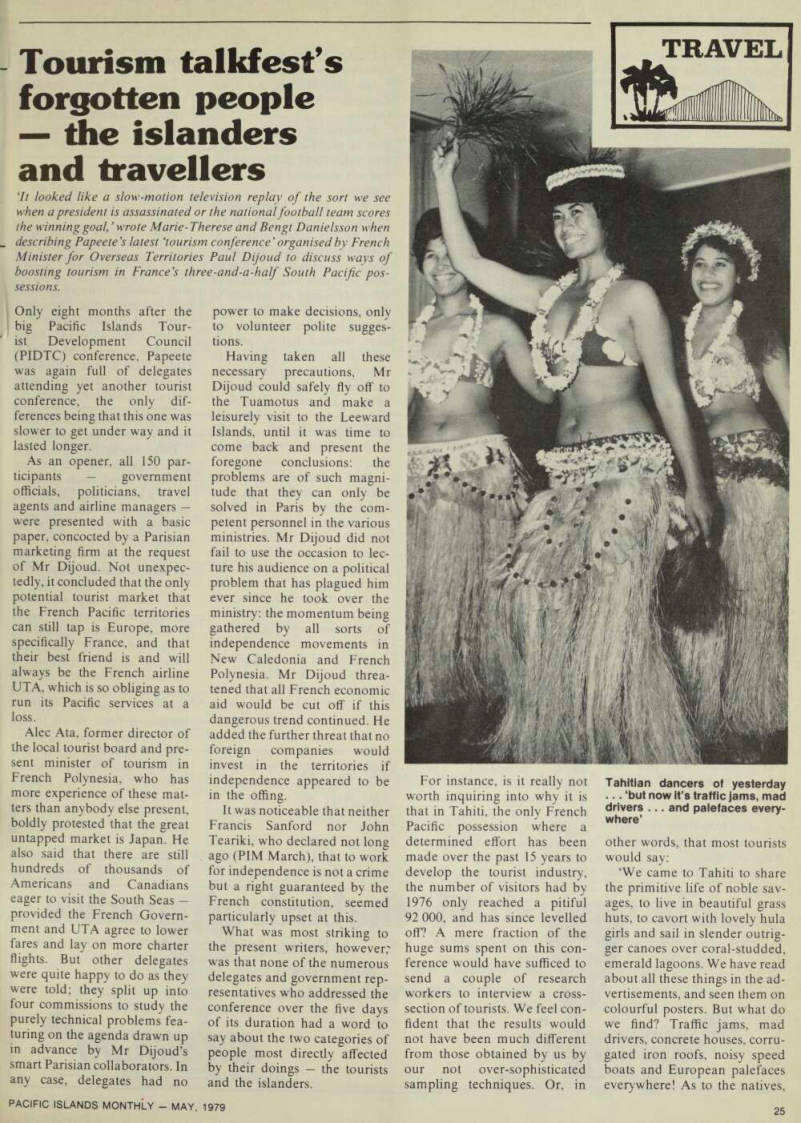
Tahitian dancers of yesterday ...‘but now it’s traffic jams, mad drivers... and palefaces every where’
especially those who roam the streets of Papeete after dark, they are merely savage, and the way the girls treat us is cer tainly not noble. And in order to survive until departure time, we have to pay outrageous prices in the shops, hotels and restaurants.’
If this is an accurate descrip tion of the present situation, it is certainly wrong that the most
qualified people, gathered at
great expense to discuss tourist problems, should limit them selves to purely technical trade
problems.
Last but not least, should not the interests and welfare of the islanders be taken into account? After all, can we be so sure that mass tourism of the projected type is beneficial to them? Mr Dijoud and his smart
young men in flannel suits seem to take for granted that what is good for tour oper ators, hotel owners and airlines is good for the people, and none of the commissions examined the social effects of tourism an omission which is the more surprising consider
ing the increasing attention
given by both politicians and
anthropologists to these prob
lems in other parts of the world. If these effects are mainly negative, which is quite
likely, then it is certainly high
time to convene another, and perhaps international, con ference devoted to the most basic and essential problem: which form of economic development is best suited to the needs of the Pacific Islander?