Currents
pp. 22-27 · Read in the full issue
Political
Petrol Bombs
On Banaba
Eight Banabans were gaoled in February following a wave of petrol bomb attacks on the
phosphate mining operations
on Ocean Island, their isolated Pacific homeland, writes a cor respondent who travelled from Fiji to Ocean Island with the Banaban ‘invasion’ party (PIM March). They were acting in protest at the British Govern ment’s decision to incorporate Banaba in the Gilbert Islands on their independence in July (PIM March), and against con
tinued mining operations by
the British Phosphate Com mission on the island.
Among those detained were the deputy chairman of the Banaban council of leaders, the Rev Kaitangare Kaburoro, a council member, Tekaie Tabuariki, and the council’s as sistant secretary. Teem Takoto.
Working to a detailed plan, groups of Banabans moved under cover of darkness to six target areas. Within half an hour flames lit the sky as petrol bombs were hurled at mining machinery and installations.
Surveying a still smoulder ing excavator, maintenance
superintendent Don Begbie
said: ‘l’ve never seen anything like this in the 18 years I’ve been on Ocean Island. The Banabans seem to have gone mad. There even seemed to be kids in the raiding parties. I was shaking like a leaf when I saw what had happened.’
Two Banabans were hurt.
The leader of one group injured a leg when he fell into a ravine while following the escape route from an attack site. Another member of his party also sustained leg injuries. Five Banabans were reportedly arrested after their car ran over a precipice. They scrambled from the vehicle as it went out of control and were apprehended soon after.
A council member told how the car he was driving was
ambushed by police, who
threw tear gas at it. The Banabans slipped away into
the night.
Anticipating trouble when Banaban council members arrived, local authorities called in 30 special constables to re inforce the island’s 10-man police force. As many as 300 additional men were hurriedly recruited after the Banaban attacks.
There were fears that the Gilbertese population, who work for the BPC, would launch a reprisal raid against the Banabans, but by morning tempers had calmed.
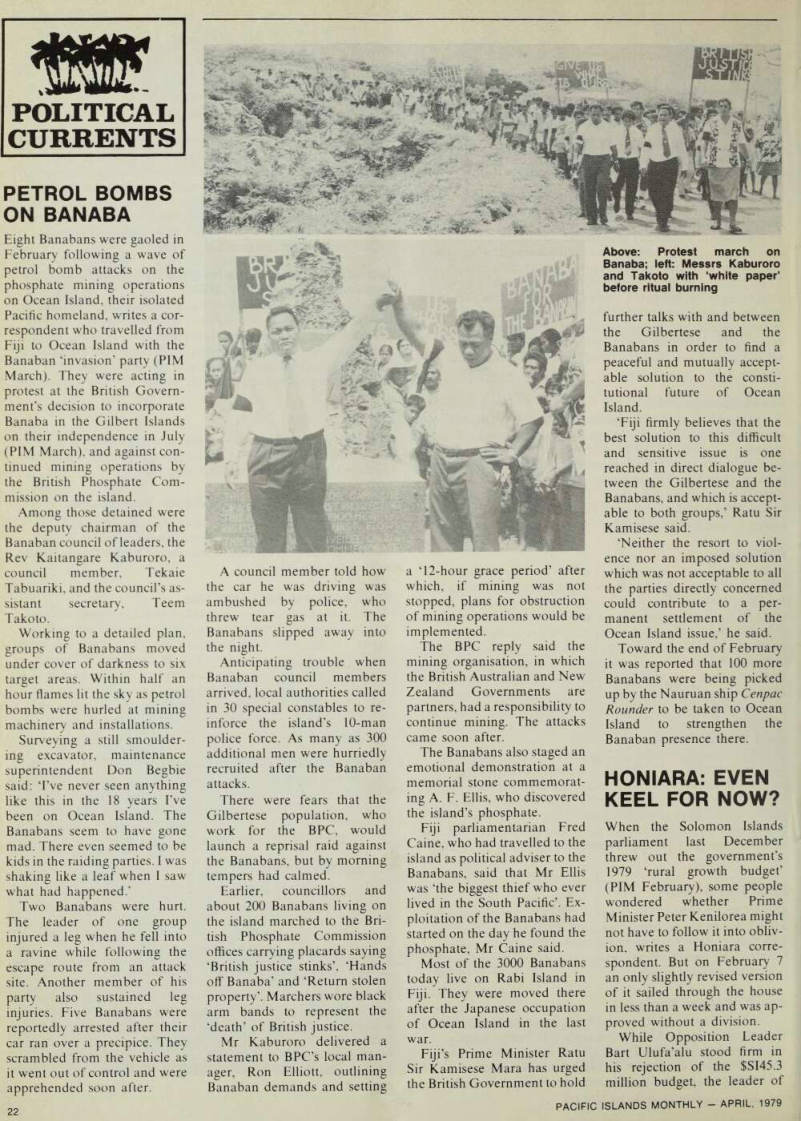
Earlier, councillors and about 200 Banabans living on the island marched to the Bri tish Phosphate Commission
offices carrying placards saying
‘British justice stinks’, ‘Hands off Banaba’ and ‘Return stolen property’. Marchers wore black arm bands to represent the ‘death’ of British justice.
Mr Kaburoro delivered a statement to BPC’s local man ager, Ron Elliott, outlining Banaban demands and setting
a T2-hour grace period’ after which, if mining was not
stopped, plans for obstruction
of mining operations would be
implemented.
The BPC reply said the
mining organisation, in which
the British Australian and New Zealand Governments are partners, had a responsibility to continue mining. The attacks came soon after.
The Banabans also staged an emotional demonstration at a memorial stone commemorat ing A. F. Ellis, who discovered the island’s phosphate.
Fiji parliamentarian Fred
Caine, who had travelled to the island as political adviser to the Banabans, said that Mr Ellis was ‘the biggest thief who ever lived in the South Pacific’. Ex ploitation of the Banabans had started on the day he found the phosphate, Mr Caine said.
Most of the 3000 Banabans today live on Rabi Island in Fiji. They were moved there after the Japanese occupation of Ocean Island in the last war.
Fiji’s Prime Minister Ratu Sir Kamisese Mara has urged the British Government to hold
further talks with and between the Gilbertese and the Banabans in order to find a
peaceful and mutually accept
able solution to the consti tutional future of Ocean Island. ‘Fiji firmly believes that the best solution to this difficult and sensitive issue is one reached in direct dialogue be tween the Gilbertese and the Banabans, and which is accept able to both groups,’ Ratu Sir Kamisese said. ‘Neither the resort to viol ence nor an imposed solution which was not acceptable to all
the parties directly concerned
could contribute to a per manent settlement of the Ocean Island issue,’ he said.
Toward the end of February it was reported that 100 more
Banabans were being picked
up by the Nauruan ship Cenpac Rounder to be taken to Ocean Island to strengthen the Banaban presence there.
Honiara: Even
Keel For Now?
When the Solomon Islands parliament last December threw out the government’s
1979 ‘rural growth budget’
(PIM February), some people
wondered whether Prime Minister Peter Kenilorea might not have to follow it into obliv ion, writes a Honiara corre spondent. But on February 7 an only slightly revised version of it sailed through the house in less than a week and was ap proved without a division.
While Opposition Leader Bart Ulufa’alu stood firm in his rejection of the $8145.3 million budget, the leader of
Above: Protest march on Banaba; left: Messrs Kaburoro and Takoto with ‘white paper’ before ritual burning
the larger Independent Group,
Willie Betu, urged parliament
to pass the budget to prevent further damage to the country.
All Solomon Islands secondary schools had been closed since the defeat of the budget.
To the surprise of many, the
changes suggested by the pub
lic expenditure committee, set up to probe into departmental estimates, were rather minor.
They do not go much beyond an estimated saving of about $2OO 000 by keeping 130-odd government posts vacant. In any case, this sum will be passed on in higher service grants to the provincial govern ments to enable them to spend more in the rural areas.
A major reason for the first budget’s defeat had been a strong feeling among members that, despite its title, the budget did not do enough for rural areas, where nine out of 10 Solomon Islanders live. There was also a feeling that the budget had been foisted on ministers by civil servants with out adequate consultation.
More than anything else, however, the December de feat reflected a growing disenchantment among mem bers with the government and the Prime Minister Kenilorea’s style and handling of various issues, in particular the West ern Province ‘breakaway’ ques tion.
But for all their misgivings about Mr Kenilorea, most members cannot see Oppo sition Leader Ulufa’alu hand
ling the job successfully.
Among other members outside the present government, the former minister of home affairs, Francis Hilly, who re signed last year over the PM’s handling of the Western Prov ince issue, looks a likely con tender but not quite yet.
With renewed backing from most of the house, the govern ment can face this year’s tasks with greater confidence than seemed possible a few weeks ago.
The economy is still going strong with exports and imports more or less in balance at just over $3O million each, and foreign reserves amount ing to almost $25 million at the end of last year.
The government recently
negotiated a major coconut/
cocoa development project
with the local Unilever sub sidiary. Now it must try to allay the fears of the rural areas by pushing ahead much more
effectively with rural develop
ment in its 1980-84 develop ment plan.
Three Faces
Of Migration
Two recent developments in New Zealand and on the west coast of the United States were designed to ease the lot of Pa cific Island immigrants in those countries. At the same time, the Australian Government an nounced new immigration
regulations which appeared to
be designed in part at least to keep the number of Pacific Islanders resident in Australia as low as possible.
Auckland in December saw the official opening of the SNZI.2 million Samoa House, which is designed to serve as a focal point for the business and cultural life of the city’s 20 000strong Samoan community, and also to serve as a bridge be
tween Pacific Island peoples in
general and the European
population.
The building houses the con sulates of Western Samoa and the Republic of Nauru, Polynesian Airlines and the Western Samoa Trust Estates
Corporation. Two shops at
street level of the five-level
building specialise in Samoan
produce, processed foods and
handicrafts.
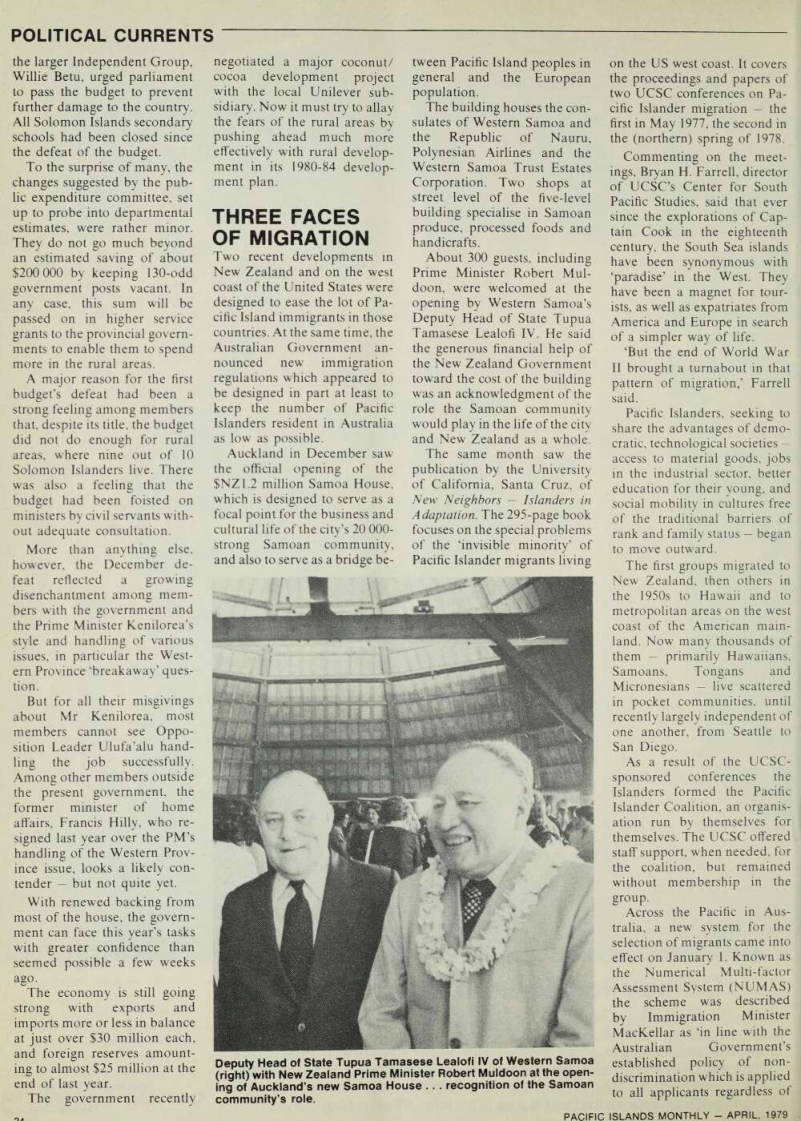
About 300 guests, including Prime Minister Robert Mul doon, were welcomed at the
opening by Western Samoa’s
Deputy Head of State Tupua Tamasese Lealofi IV. He said the generous financial help of the New Zealand Government toward the cost of the building was an acknowledgment of the role the Samoan community would play in the life of the city and New Zealand as a whole.
The same month saw the
publication by the University
of California, Santa Cruz, of New Neighbors Islanders in
Adaptation. The 295-page book
focuses on the special problems of the ‘invisible minority’ of
Pacific Islander migrants living
on the US west coast. It covers the proceedings and papers of two UCSC conferences on Pa cific Islander migration the first in May 1977, the second in the (northern) spring of 1978.
Commenting on the meet ings, Bryan H. Farrell, director of UCSC’s Center for South Pacific Studies, said that ever since the explorations of Cap tain Cook in the eighteenth century, the South Sea islands have been synonymous with ‘paradise’ in the West. They have been a magnet for tour ists, as well as expatriates from America and Europe in search of a simpler way of life. ‘But the end of World War II brought a turnabout in that pattern of migration,’ Farrell said.
Pacific Islanders, seeking to share the advantages of demo cratic, technological societies access to material goods, jobs in the industrial sector, better education for their young, and social mobility in cultures free of the traditional barriers of rank and family status began to move outward.
The first groups migrated to New Zealand, then others in the 1950 s to Hawaii and to metropolitan areas on the west coast of the American main land. Now many thousands of them primarily Hawaiians, Samoans, Tongans and Micronesians live scattered in pocket communities, until
recently largely independent of
one another, from Seattle to
San Diego.
As a result of the UCSC sponsored conferences the Islanders formed the Pacific Islander Coalition, an organis ation run by themselves for themselves. The UCSC offered staff support, when needed, for the coalition, but remained without membership in the group.
Across the Pacific in Aus tralia, a new system for the selection of migrants came into effect on January 1. Known as the Numerical Multi-factor Assessment System (NUMAS) the scheme was described
by Immigration Minister
MacKellar as ‘in line with the Australian Government’s established policy of non discrimination which is applied to all applicants regardless of
Deputy Head of State Tupua Tamasese Lealofl IV of Western Samoa (right) with New Zealand Prime Minister Robert Muldoon at the open ing of Auckland’s new Samoa House... recognition of the Samoan community’s role.
their race, colour, nationality, descent, national or ethnic ori gin or sex’.
But such claims cannot dis guise the fact that NUMAS represents a net of restrictions on entry into Australia so dense that only tiny numbers of Pa cific Islanders could ever hope to penetrate it.
Some of the factors con sidered under NUMAS are: the standard of work skills pos sessed by an applicant and the demand for those skills in Aus tralia; whether an applicant has a job waiting in Australia or has adequate resources to establish a business; and the
degree of fluency in English
and ability to communicate in the type of employment fol lowed.
‘Secret Plan’
A Hoax?
Nation Review, an Australian
weekly, in February published
the full text of what it claimed was a ‘Very Secret’ Indonesian intelligence document outlin ing plans for an Indonesian take-over of Papua New Guinea by 1984. The document was first referred to in the Aus tralian press in a December 1978 report in the Melbourne
daily, The Age. Photocopies
had been posted anonymously from Singapore to Australian
political figures who had
spoken against the policies of
Suharto government.
The document outlines ‘Op eration Bird of Paradise’ which began in 1975. In the first phase, from 1975 to 1979, Indonesian intelligence agents were to be placed in eight groups throughout PNG, co
ordinated from Jayapura, capi
tal of West Irian. They were to make monthly reports to Jakarta on progress. Aim of this stage was to win support,
through political propaganda,
for integration with Indonesia and, most importantly, to ‘cre ate cadres among the people so that leaders... will emerge who ... will form groups and a political power oriented towards Indonesia’.
One Australian political commentator, appearing to accept the authenticity of the document, has claimed that Indonesian agents are active in
the West Irianese exile com munity in PNG. He linked them with the arson at the PNG ministry of finance (PIM March). Responsibility for the fire has already been claimed by ‘sympathisers’ of Irian Jaya
freedom fighters.
A spokesman for the Indonesian embassy in Port Moresby has described the document as ‘a very cheap joke’. He denied that Jakarta had any such plans as those de scribed in the document, and
appealed to Papua New
Guineans to ignore it.
The spokesman accused the Australian Communist Party of supporting moves to create ‘another Indochina’ in the Asia-Pacific region. He called for support for present efforts by the Indonesian and PNG Governments to establish ‘cor dial and harmonious’ re lations.
One Australian source sug gested that the document could have been prepared by pro- Fretilin forces in Australia in an effort to widen the campaign of opposition to the Indonesian Government for its take-over of East Timor.
26 New Faces
In Apia’S Fono
There will be 26 new faces in the 47-member Legislative As
sembly which emerged from
the February 24 elections in Western Samoa. Among de feated candidates was Lilomaiava Niko, minister of education in the last govern ment.
Prime Minister Tupuola Efi held his seat of Aana Alofi No 2 against Tanuvasa Livigisitone by 94 votes to 26.
The minister of economic development, Asi Eikeni, retained his Faasaleleaga No 2 seat with 125 votes. His closest
challenger, Papalii Laupepa,
son of Western Samoa’s head of state, received 122 votes.
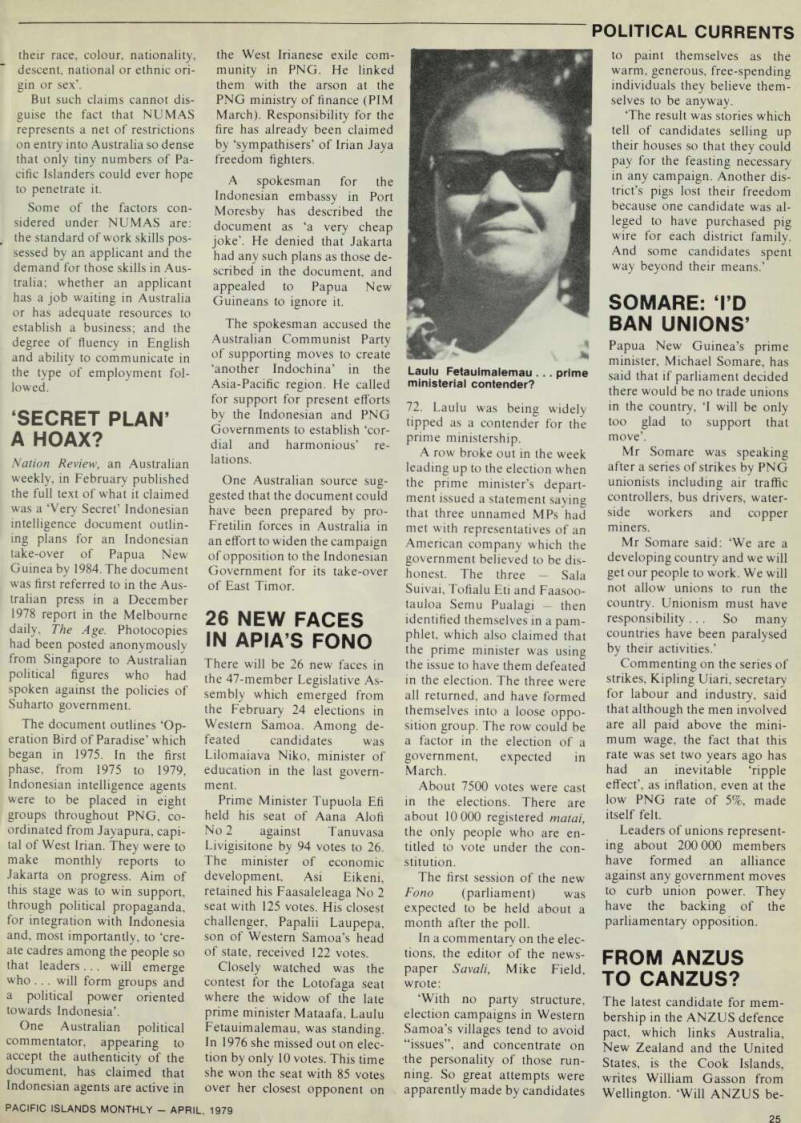
Closely watched was the contest for the Lotofaga seat where the widow of the late prime minister Mataafa, Laulu Fetauimalemau, was standing.
In 1976 she missed out on elec tion by only 10 votes. This time she won the seat with 85 votes over her closest opponent on
72. Laulu was being widely tipped as a contender for the
prime ministership.
A row broke out in the week leading up to the election when
the prime minister’s depart
ment issued a statement saying that three unnamed MPs had met with representatives of an American company which the government believed to be dis honest. The three - Sala Suivai, Tofialu Eti and Faasoo tauloa Semu Pualagi then identified themselves in a pam phlet, which also claimed that the prime minister was using the issue to have them defeated in the election. The three were all returned, and have formed themselves into a loose oppo sition group. The row could be a factor in the election of a government, expected in March.
About 7500 votes were cast in the elections. There are about 10 000 registered matai, the only people who are en titled to vote under the con stitution.
The first session of the new Fono (parliament) was expected to be held about a month after the poll.
In a commentary on the elec tions, the editor of the news paper Savali, Mike Field, wrote; ‘With no party structure, election campaigns in Western Samoa’s villages tend to avoid “issues”, and concentrate on •the personality of those run ning. So great attempts were
apparently made by candidates
to paint themselves as the warm, generous, free-spending individuals they believe them selves to be anyway, ‘The result was stories which tell of candidates selling up their houses so that they could pay for the feasting necessary in any campaign. Another dis trict’s pigs lost their freedom because one candidate was al
leged to have purchased pig
wire for each district family.
And some candidates spent way beyond their means.’
Somare: ‘I’D
Ban Unions’
Papua New Guinea’s prime
minister, Michael Somare, has said that if parliament decided there would be no trade unions in the country, ‘I will be only too glad to support that move’.
Mr Somare was speaking after a series of strikes by PNG unionists including air traffic controllers, bus drivers, water side workers and copper miners.
Mr Somare said: ‘We are a developing country and we will get our people to work. We will not allow unions to run the country. Unionism must have responsibility... So many countries have been paralysed by their activities.’
Commenting on the series of strikes, Kipling Uiari, secretary for labour and industry, said that although the men involved are all paid above the mini mum wage, the fact that this rate was set two years ago has had an inevitable ‘ripple effect’, as inflation, even at the low PNG rate of 5%, made itself felt.
Leaders of unions represent ing about 200 000 members have formed an alliance against any government moves to curb union power. They have the backing of the
parliamentary opposition.
From Anzus
To Canzus?
The latest candidate for mem bership in the ANZUS defence pact, which links Australia, New Zealand and the United States, is the Cook Islands, writes William Gasson from Wellington. ‘Will ANZUS be
Laulu Fetauimalemau... prime ministerial contender?
come CANZUS?’ asked the New Zealand Herald in Auckland in an editorial wel coming the attempt by the newly elected Premier Dr Tom Davis to make the islands stand on their own feet.
What Dr Davis suggested during a recent visit to New Zealand was that the 18 000 Cook Islanders commit them selves to the ANZUS treaty and relieve New Zealand of the task of defending the islands.
Officially, the Cook Islands is a self-governing nation in free association with New Zealand which looks after its defence and foreign affairs.
Dr Davis, whose affinity for the US developed while he worked there on space medi cine, apparently raised the issue with Prime Minister Robert Muldoon. He did not suggest the Cook Islands run to the economically debilitating extent of raising a standing military force, but said it could produce an army if required. ‘ln times of an emergency in the Pacific, we would supply forces as we did in the First World War,’ he said. (In the Second World War Cook Islanders travelled to New Zealand to enlist in the armed forces there.) While at first glance the idea of the tiny Cook Islands throw ing its weight into the ANZUS pact might seem to have little going for it, Dr Davis has pointed out to the strategically minded that the northern island of Penrhyn in the Cooks has a deepwater harbour ‘big enough for a whole fleet’.
Heavy aircraft could use the Cooks airfields on Rarotonga, Aitutaki and Penrhyn. ‘By doing this we feel we would be no less effective in defending ourselves than New Zealand would be without Australia,’ he said. ‘We don’t want to be bystanders in an emergency situation.’ The par allel is to the point, since New Zealand’s defence policy is bound up with Australia’s fate.
The attitude is that any attack on Australia would automati cally involve New Zealand.
A probable factor in Dr
Davis’ scientifically calculating
mind is the situation that would face the US if it were
pushed out of its base at Subic Bay in the Philippines. Should the US lose this toehold in the Southeast Asian region then
logically, according to some
American political scientists, it must fall back to defensive pos itions in the Pacific. Any size able piece of Pacific real estate with deepwater harbours and airfields thus becomes stra
tegically important.
Reaction from New Zealand’s foreign affairs officials was one of welcome, tempered by uncertainty as to how other ANZUS members might greet the idea.
New Moves In
N.H. Drama
Formation of yet another pol itical movement, a conciliatory gesture by the Vanuaaku Party in handing over to the govern ment a cheque for $A6852 representing the taxes levied by its now disbanded People’s Provisional Government, and continued doubt and hesitation among the moderate parties about the new government of national unity these were the main features of the lively New Hebrides political scene in
February.
The new movement is known as ‘Nakamal’, or ‘Meet ing house’. Its leading figures are Vincent Boulekone of Pen tecost who recently resigned as secretary-general of the UCNH (Union des Com munautes des Nouvelles Hebrides) (PIM December 1978), and who was minister of internal affairs in the Kalsakau government; and Maxime Carlot (Natatok Efate Alliance Party) of Efate, minister of internal affairs in the present government, and former speaker of the Representative
Assembly.
The two leaders have ex plicitly denied that Nakamal is
a new ‘political party’. They
said on Radio New Hebrides that their aim is to bring people together, whether they speak English or French, and regard less of religious persuasion.
They said the movement fully supports the work of the present government of national unity, and believes that its ministers should be given time to work at their jobs before
attempts are made to judge . . e aim to bring people
r ’r. not t 0 them
said Mr Boulekone, according to a report in the french/
islama fortnightly Nabanga.
e spoke of Nakamal as a p ace of reflection, a think tank open to people of all
pohtical tendencies.
He went on: ‘Away from partisan quarrels, we hope to reflect calmly on the questions that affect all Melanesians. The New Hebrides will soon be independent. But it’s only three years since we first discovered po itics. Now, we have to achieve awareness of our re sponsibilities. That s what we aim tp do within our move
mtl?t, 1 , .
i akama(rejects traditional
political labels, saying that in the view of the movement they should be re-examined. ‘We are neither moderates nor rad icals,’ said Mr Boulekone. ‘We want to be ourselves. We will be drawing up our programme out of contacts with the masses of Melanesians,’ Mr Boulekone said. This programme would not be designed to countereither the VP or the moderates. ‘lf we can reach agreement with them, we would ask for nothing more,’ said Mr Boulekone.
The repayment to the government by the VP of taxes raised by the People’s Pro visional Government removes one of the sorest spots in that party s relations with other pol itical groupings in the country,
The VP established the alterna
!| ve following its
bo y cott of the November 1977 elections. It was disbanded be fore talks began between the *wo sides in April 1978.
Following their demon strations and petitions at the end of January (PIM March), fo e moderate parties continued to show unrest at the course fol iowed by the new government.
An all-in meeting of the mod erate parties was held in mid- February in Santo to plan strategies for the coming meet jng Q f tbe Representative As
sembly
At t he same time two leaders of the moderate parties j ea n-Marie Leye of Tan Union , and Jack Kalotiti of Natatok Efate voiced their strong disa p prova i of the ‘breakaway’ Nakamal move ment. Mr Leye predicted new divisions among the moderate parties as a result of Nakamal’s appearance, and Mr Kalotiti could see no reason why another political movement should be formed on Efate> An attempt by moderate forces in mid-January to re move the sensitive broadcast fog, district and local administration portfolios from the VP was defeated. Localis ation of positions within the
bureaucracy by VP ministers
aroused criticism. But the pro cess went ahead , wit h Joe B omal Carlo being appointed director of the now unified Radio New Hebrides, and Alfok Noel and Godwin Ligo
respectively deputy director
and chief news reporter. For mer director of the unified ser vice, Jean Massias, is back in his previous job as director of the French residency infor mation service.
New Hebrides’ Deputy Chief Minister Father Walter Lini (right) shakes hands with French Minister for Overseas Departments and Territories Paul Dijoud during the minister’s February visit to Vila... a new confidence.