Wendt lives up
pp. 41-42 · Read in the full issue
Books
Wendt lives up to his promise
Albert Wendt’s second pubfished novel of Samoa represents, in its maturity and judgment, a ratification of the bright promise of his early works. It demonstrates this maturity in several ways, notably m the course it takes in
counting the cost, presenting
the account for that freedom with which Wendt’s soul seems largely concerned as he sculpts for us the aspirations, elsewhere seldom or more awkwardly expressed, of most of his contemhven his title, Pouliuli, stipulates the darkness the developmg day leaves behind it, only to return to a darker night. Wendt gives us a Samoa that occasionally struggles in the lax coils of
a serpent tradition, but not too forcefully, for tradition pro vides comfort within its restric tions, a comfort and security valid, that is, mainly for con ditions that have vanished, even though the tradition has appar
ently adjusted to a degree of
modernity,
He demonstrates the rule by presenting the exception, and to tell the truth I’ve never been more impressed by any island story of whatever origin. His introduction sets the scene: Early on a drizzly Saturday morning Faleasa Osovae the 76-year-old titled head of the Aiga Faleasa, faithful husband of a devoted Felefele, stern but generous father of seven sons and five obedient daughters, and the
most respected alii in the village of Malaelua woke with a strange bitter taste in his mouth to find, as he looked out to the rain and his village, and then at his wife snoring softly beside him in the mosquito net, and the rest of his aiga (about 60 bodies wrapped in sleeping sheets) who filled the spacious fa/e, that everything and everybody that he was used to and had enjoyed, and that till then had given meaning to his existence, now filled him with an almost unbearable feel ing of revulsion ... It would be madness to deny his position, the respect he commanded for quite significant achievements; it would be madness at his age to adopt other standards; it would be madness to challenge the might of traditions so Faleasa
feigned madness. ..
From this really wonderful beginning in the classic mould, Wendt develops a story ringing as true as it is original. What power it lays at his hands! Here he has reason to bring the
strength of legend into his plot,
and the exaggerations of child hood memories, and the hidden shames and flaunted glories of a limelighted life; here the assumption of madness can jus
tify changed allegiances. Here
the broken loyalties can show the strength of the Samoan norm.
Sheer enjoyment, perhaps, is
Wendt’s main offering. Like the greatest of writers he underlines his tragedy with comedy up roarious, masks the proud flesh of his sorrows with callosities, arms his placid innocents with diabolical cunning. But apart from the entertainment of truth he has given us what must surely be the best introduction ever de vised to ancient Polynesia and its still vibrant sinews.
Wendt is mentioned several times in South Pacific Images,
though, strangely enough, a ref
erence to this particular novel does not give its title, either in the text or in the notes, so I can only imagine it to have been read, and judged, in an early manuscript form. That is only one of the peculiarities of
Images.
In May 1977 the University of Queensland’s Department of English hosted a conference of the South Pacific Association for Commonwealth Literature
and Language Studies. Papers
read by 18 of the delegates now appear in a collection edited and introduced by Chris Tiffin, a teacher at the University who
edits the periodical Span.
Though the delegates came
from a limited number of universities to discuss a com mon subject I would be fair, I think, in describing the result as
heterogeneous. Some offerings,
indeed, are a long way off what most of us would accept as ‘South Pacific’ literature, though much could be squeezed in on the ground that Australia is part of the area.
For example, it’s difficult for me to accept that David Tacey’s review of Patrick White’s A Fringe of Leaves comes close in any way to the area most of us envisage with the words ‘South Pacific’. Tacey is writing a PhD thesis on White at the Univer sity of Adelaide or he was at the time and I assume there’s a close relationship between the two writings; also that the critic has thoroughly informed him self.
Something similar could be said of Bruce Bennett writing on Hal Porter and Randolph Stow, Norman Talbot on John Shaw Neilson and Gwen Har wood, Shirley Walker on Judith Wright’s poetry and several more. Most of them present excellent observations based on intensive studies and can hardly
be judged makeweights, but
they don’t help the serious reader who wishes to develop his interest in the strange, won
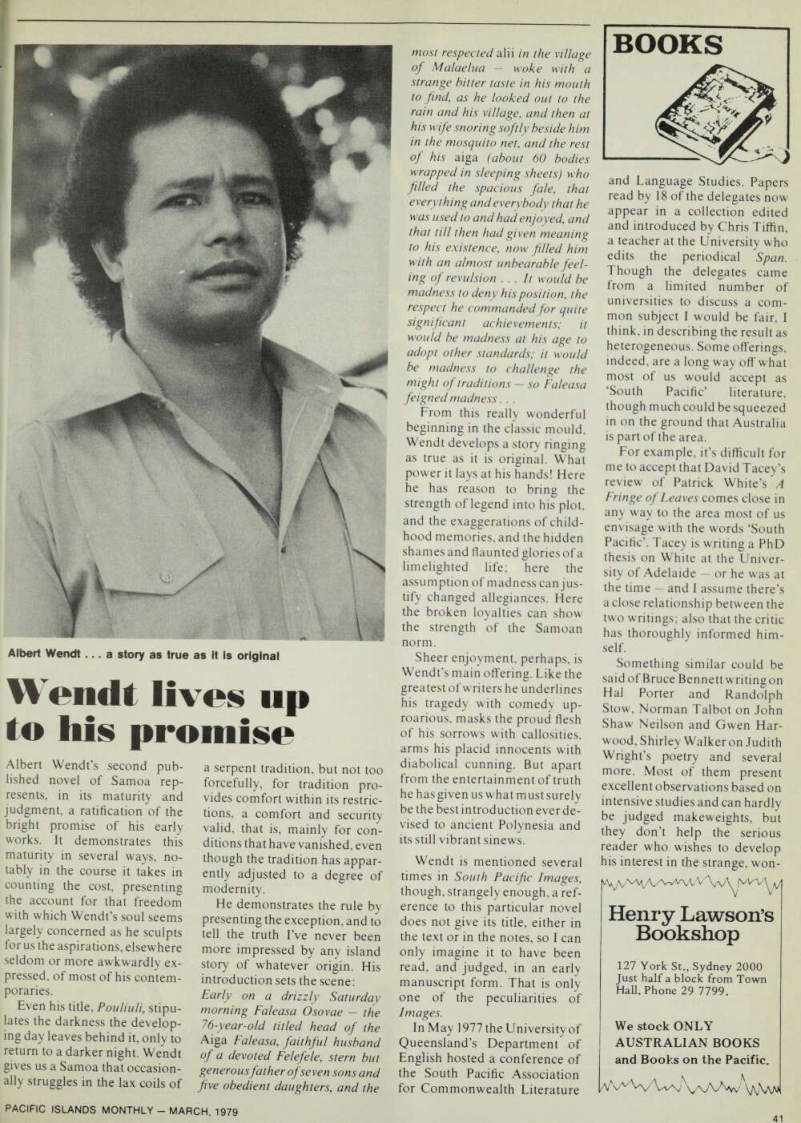
Albert Wendt ... a story as true as It is original
derful and exciting back
grounds and developments in
the Islands.
Colonialism, of course, gets a sound rub-a-dub-dub, without much clearance of the slung mud that exaggerates its (cer
tainly plentiful) internal grime.
It was pleasing to note Satendra Nandan, a lecturer from Fiji’s University of the South Pacific,
examining the healing function
of a local and largely indigenous literature in terms of the colonised.
Colonialism has been around a very long time and it hasn’t changed very much as, from the middle distance, Caedmon Cadwallader could testify. We are all of us inheritors of the assets of colonialism as well as its unsettled debits, and colonialism could well be a very happy influence in our history.
For creative writing in itself is a form of revolt, and a revolution ary has to have something to oppose. Out of revolution comes the consciousness of entity, a fact which, for example, the Constitution of the United States recognises and the literature of that country has responded vigorously to this. So it is good to see colonialism as a target for some such capable marksman as Nandan.
In the newer countries a con fusion has emerged between anti-colonialism and the gener ation gap, which is an antagon ism to tradition. Someone should ask, perhaps, whether English literature would ever have risen to its admitted height without England’s many ex
periences of being colonised;
and one can argue at least that its American branch dominated
and still dominates the whole vigorous tree because of the fierce resistance colonialism
engendered there.
Trinidad is also a long way from the South Pacific, but the inheritance of Nandan in Fiji, and of his subject, that great writer V.S. Naipaul in the Caribbean, have similarities, though each is qualified by a very different transplant ex perience. - Olaf Ruhen.
POULIULI. By Albert Wendt. Published by Longman Paul. Hardcover 5A6.95, paper
5A4.95. South Pacific Images. Ed.
Chris Tlflln. Published by the South Pacific Association for Literature and Language Studies. 5A7.50.
Of minor
moiipy
■unitors
Ray Parkinson was a public servant in Fiji for 23 years.
After his death in 1969 a mem orial fund was established to finance a recurrent series of lectures to ‘improve public and official understanding of basic economic principles and their relevance to public policy de cisions’. This book comprises the 1977 lectures plus several other papers which deal with monetary policy in small developing countries. It is edited by the professor of econ omics at the University of the South Pacific.
The book starts with two
articles by David Maynard.
The first a perfectly standard account of monetary policies
(policies influencing the vol
ume, cost and direction of credit) in developed econom ies. The second, dealing with small developing countries,
brings out several important
points. Some monetary policy measures are weak in develop ing countries: for example, the lending policy of the central bank may be of little influence if commercial banks do not borrow from it. On the other hand, direct controls may be very powerful in terms of res training credit because the small size of the economy means that alternative sources of credit do not exist. As the size and sophistication of the financial system grows, this
advantage will disappear. In
general, Maynard concludes,
meaningful monetary policy in
a small developing country is very difficult to achieve.
The next two papers on Fiji’s
Central Monetary Authority
are fairly unexciting but a sum mary of the authority’s credit policy 1976-77 indicates the difficulties of trying to stimu late activity via monetary pol icy while following a liberal
foreign exchange control pol
icy which imposes no limits on current payments.
The manager of Barclays Bank in Suva outlines some of
the operational problems of
profit-seeking organisations in
an environment where
development projects often are
long term and of an uncertain risk. He evaluates four
approaches to increasing pub
lic control over private banks nationalisation, increased local
participation in existing banks,
setting up a local bank in com
petition and through central
bank monetary policy. Not
surprisingly, the writer pushes
for a monetary policy allowing plenty of scope for market forces to operate.
The final narrative paper is
by Secretary of the Ministry of
Finance Savenaca Siwatibau and deals with the fiscal measures (control of taxation and government expenditure) available to meet government objectives. This paper is more incisive than its companions for the simple reason that fiscal policy itself is much more effective. There is an interest ing discussion of the elasticity of Fiji’s tax system (the ability of tax revenue to change more than in proportion to changes in gross domestic product, thus reducing the impact of both re cession and boom).
The editor notes that he be lieves this book is the first deal ing with monetary policy in small developing countries.
The reason for this, of course, is the limited effectiveness on monetary policy in this context and, as several contributors note, its greater influence as a restraining device rather than as an encouragement. Without the last paper linking monetary policy with fiscal policy, the positive contribution of the book would have been fairly small. Whilst it could plausibly be argued that the book has met its objectives, I feel that mention should have been made of policy objectives other than stabilisation and the scope for wages, prices and incomes policy and for exchange rate variations, especially in econ omies so vulnerable to inter national influences. G. T.
Harris, Agricultural Economics Research Unit, Lincoln College, New Zealand.
S. Schavio-Campo (ed) MONETARY POL
Icy In A Small Developing Country,
The Ray Parkinson memorial lectures, 1977, University of the South Pacific, Suva, 1978, 5F4.50.