Forgetting? No
pp. 34-36 · Read in the full issue


Yesterday
Guadalcanal
Forgiving? Yes
A merican and Japanese veterans are frequenty seen nowadays retracing their wartime steps on Solomon Islands' Guadal canal. Australian journalist Alan Gill recalls a meeting he had a couple of years back with a bunch of US Pacific War veterans.
Thirty-seven years ago on May 3, 1942 a Japanese naval force steamed unopposed into the deserted harbour at Tulagi, and transferred some weeks later (many sources give the date as July 1) to the north coast of Guadalcanal.
On August 7, an American task force counter-attacked. Ft was the prelude to one of the bloodiest campaigns of the Pacific war, in which 1 500 Americans and between 20 000 and 30 000 Japanese lost their lives.
Thirty-five years on, during
1977, the US defenders of Guadalcanal older, wiser, and, in most cases, fatter, proved themselves still a lively bunch. A group which came via
Australia on their way to the Solomons elected one of their number to scale the flagpole of the American consulate in Melbourne, as a result of which a certain diplomat is still won dering what became of his star spangled banner.
The pilgrims landed in the Solomons by courtesy this time of Air Pacific at the same Henderson airfield which they had valiantly defended so many years earlier.
A renovated artillery piece
still guards the arrivals and
departures lounge a simple
building with a sheet of paper headed “What’s On in Honiara” tacked to a wall, and a cordoned-off area reserved for VIPs.
Otherwise, the surrounding grassland and distant bush give no hint of the bloody battles that went on before.
The US defenders of Guadalcanal had a reputation for generosity. In peace and war they have lived up to it, as witness their gift of brass band instruments to the Solomons
police band.
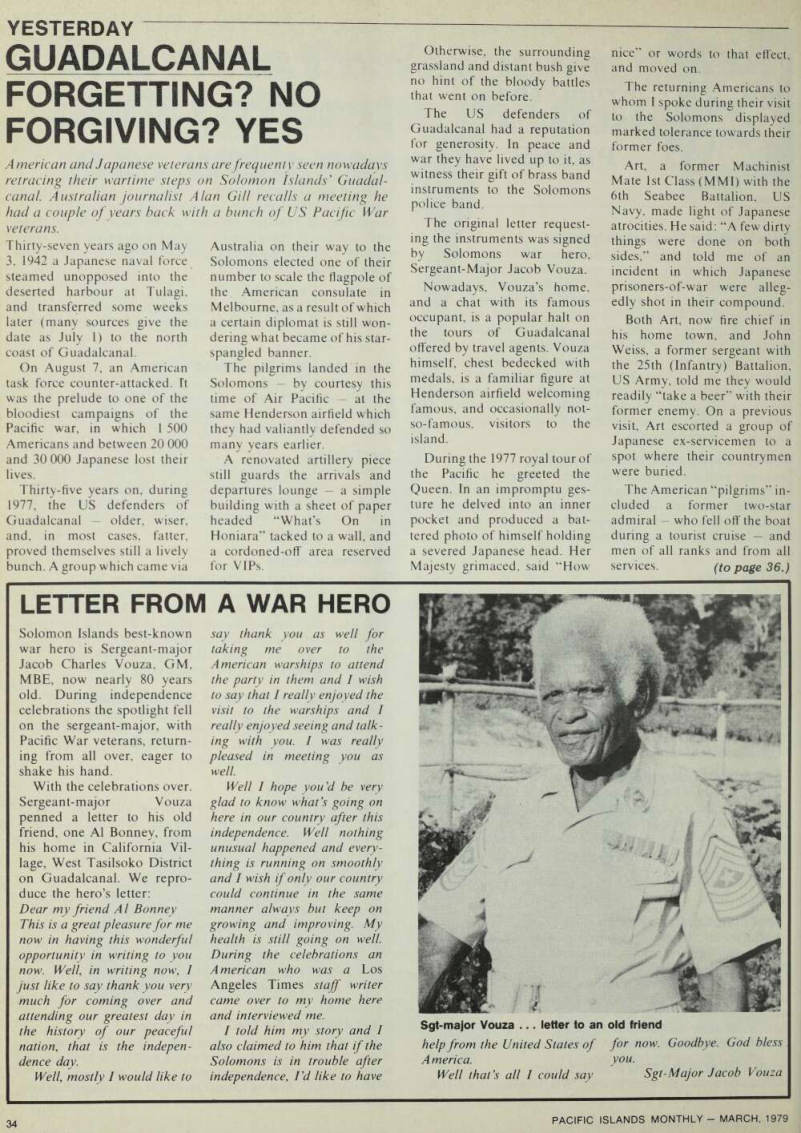
The original letter request ing the instruments was signed by Solomons war hero, Sergeant-Major Jacob Vouza.
Nowadays, Vouza’s home, and a chat with its famous occupant, is a popular halt on the tours of Guadalcanal offered by travel agents. Vouza himself, chest bedecked with medals, is a familiar figure at Henderson airfield welcoming famous, and occasionally not so-famous, visitors to the island.
During the 1977 royal tour of the Pacific he greeted the Queen. In an impromptu ges ture he delved into an inner pocket and produced a bat tered photo of himself holding a severed Japanese head. Her
Majesty grimaced, said “How
nice” or words to that effect, and moved on.
The returning Americans to whom I spoke during their visit to the Solomons displayed marked tolerance towards their former foes.
Art, a former Machinist Mate Ist Class (MMI) with the 6th Seabee Battalion. US Navy, made light of Japanese atrocities. He said; “A few dirty things were done on both sides,” and told me of an incident in which Japanese prisoners-of-war were alleg edly shot in their compound.
Both Art, now fire chief in his home town, and John Weiss, a former sergeant with the 25th (Infantry) Battalion, US Army, told me they would readily “take a beer” with their former enemy. On a previous visit. Art escorted a group of Japanese ex-servicemen to a spot where their countrymen were buried.
The American “pilgrims” in cluded a former two-star admiral who fell off the boat during a tourist cruise and men of all ranks and from all
services.
(to page 36.)
I was educated in the ways and customs of the Seabees by Art, and by Jim Trainer, from Cuba. Missouri, a former chief ship fitter with the 6th Seabee Battalion; his companion, Edward Anderson, a former Machinist Mate 2nd Class, from Omaha, Nebraska ribbed by his friends for his re semblance to an actor in the TV series “My Favourite Mar tian”; and Elmer Sommer, from Stone Lake, Wisconsin, formerly a gunner Ist class in the 26th Seabee Battalion.
Seabees were, certainly in the early stages, an all volunteer force of, in the main, older men whose technical skills were in great demand.
The term Seabee is derived from the initials CB Con struction Battalion, US Navy.
Its members had another term - “Confused bastards” to match the initials.
However, my contacts with the Seabees were as nothing to the friendship and cheer 1 received from John Weiss,
from Indianapolis, whose story was among the strangest of all.
One day in September, 1942, John and other members of his platoon were led to a cave where they had been told Japanese troops were in hid
ing.
There was a flash which is all John remembers. He woke up several days later, minus a
leg, in a military hospital Tn
Wellington, New Zealand.
John told me: “1 suppose the older we get the more sen timental we become. I have wanted for years to come back and find the spot where it hap
pened.”
He came well-armed with ordnance survey and other maps to assist him in his search.
As luck would have it he found a former scout who knew the cave. The same man had led one of eight Japanese survivors of the incident to the same spot a year earlier.
After it was all over 1 had a drink with John Weiss in
Honiara’s Hotel Mendana.
“Last night I lay awake for hours wondering ‘when the time comes would you really know the spot if you saw it?’ ”
He would now like to meet
the eight Japanese survivors.
“There’s no point in bitterness.
Us peasants are called in to do the dirty work fixed by govern ments. How you feel about it doesn’t change the outcome.”
John now works full-time for a disabled ex-servicemen’s as sociation which helps veterans with compensation and other benefit claims, and assists in the welfare and education of their children.
In front of the Hotel Men dana stands a tree used by Japanese snipers as a vantage point. Within a few metres of the hotel are roadside notices,
generally inserted discreetly
among flowerbeds, proclaim ing various landmarks and dates in the savage fighting in
this now tranquil setting.
Many of the returning
Americans were surprised at
the motor traffic and other “advances” on the island. John Weiss told me in mock horror “Why, it took me 10 minutes just to cross the road.”
Today the war is remem bered not only in travel agents’
outings to Sergeant-Major
Vouza and the “war museums” which have sprouted in resi dents’ gardens, but in the sur vival of certain songs there is a pidgin number called “Japani ha! ha! and a fond ness for American chewing gum.
At Honiara’s Point Cruz cin ema I saw an advertisement which stated; PK tru lang altogeta tais (PK’s taste lasts
longer).
The Japanese, also, have their pilgrimages and mem orials. A simple monument on Mount Austin, Guadalcanal, is inscribed in Japanese and English. The latter version states in a creditable effort at English: “This is a memorial of all country’s unknown soldiers died on these fields during the war.”