Political
pp. 27-31 · Read in the full issue

Currents
irresistible historical move ment, adding, however: ‘ln whatever way we look at it, independence should be achieved in a concerted, intelligent manner, after care ful preparations. I hope that each and every one of you is aware of the fact that disorder and chaos are not unavoid able.’
As usual, Sanford was more blunt. He declared, with gusto, that ‘to ask for independence is not a crime, or even an offence.
It is simply a right we have, a right guaranteed by the French constitution.’ It soon appeared, however, that he was not proposing an action pro gramme to be put into effect immediately, but rather warn ing the French Government that independence is not an un thinkable alternative if the pre sent statute does not give satisfaction. There is no secret that on many points for instance the exploitation of ocean wealth and the control of air traffic the French Government has hitherto in terpreted the often ambigu ously-worded 1977 statute in a much more restrictive manner than the Polynesian leaders. To which it should be added, the boss of all local public services is still the French high com missioner and not Sanford, which, of course, makes the whole ‘self-government’
scheme highly illusory.
Teariki’s and Sanford’s re affirmation of the Polynesian
Mara Rocks
Papeete Boat
When French Polynesia was granted a new statute in July 1977, giving wider powers to the islanders, the more or less avowed aim of the French Government was to halt, or at least to delay, all further move ments towards independence, write Marie-Therese and Bengt Danielsson from Papeete. The main reason independence was and still is a completely unac ceptable alternative to France is of course the imperative need to continue the testing of nuclear weapons at Mururoa for many years to come.
For a while, this belated con cession to the Polynesian ma jority parties Pupu here aia and Te ea api seemed to pay off, for the two party leaders, John Teariki and Francis Sanford, who became masters of the ter ritorial assembly and the government council, had their hands full with all the social and economic problems brought about by the impo sition of a huge ‘nuclear strike force’ and the arrival of 20 000 French metropolitan settlers.
The despatch of a new, soft spoken, suave high com missioner, Paul Cousseran, also greatly helped to foster the image of a perfect entente cor diale. Then, suddenly, in December 1978, the taboo word ‘independence’ was once
more on everybody’s lips.
The most disturbing thing
from the French point of view was that those who raised the supposedly dead issue were not young hotheads with limited following, but the very key men in the new government structure - Teariki and San ford. The occasion was the opening of the budgetary session of the territorial as sembly on November 30.
Teariki’s approach was quite philosophical. He talked simply of independence as an
people’s right to take their des tiny into their own hands was
particularly well received by
the leaders and members of the local socialist party, la mana te nunaa, who held their annual convention two days later. In the general elections of March 1978, they had taken a strong anti-colonial stand. Nobody was therefore much surprised when the convention delegates unanimously came out for independence and followed up with another resolution asking for the immediate cessation of all nuclear tests.
The direction taken by events seemed so alarming to the French Government that Prime Minister Raymond Barre decided to intervene per sonally. His admonition took the unprecedented form of an ‘answer’ from the tribune of the French national assembly in Paris to a question that he had permitted Gaston Flosse, the Gaullist deputy for French Polynesia, to ask right in the middle of a national debate.
What Flosse sought to dis cover, in a remarkably in sidious formulation, was ‘if the government was determined to maintain the existing bonds be tween France and Polynesia, as defined by the 1977 statute, or if it was ready to let the terri tory gradually slide towards
independence, although every
body knows this will mean economic ruin?’ Barre, of
course, thought independence
totally unwarranted and ex-
pressed his firm belief that the territory would remain French forever.
This was a clear signal for the local Gaullists and the French-controlled mass media in Tahiti to launch a vigorous campaign against indepen dence, describing it as the surest path to ‘economic suicide’. One councillor went so far as to promise to prevent, by all means, such a tragic out come for the innocent Polynesian people. This was too much for Francis Sanford, who asked publicly, without receiving any clear answer, whether this meant even re course to violence.
As often before, Fiji was specifically mentioned by San ford’s adversaries as definite proof that independence equals abject poverty and racial strife. The reason for this
great animosity towards Fiji
(extending also since 1975 to Papua New Guinea) is, of course, the Fiji Government’s frequent protests against French nuclear tests and its unflagging support of all UN resolutions in favour of com plete decolonisation. In both instances, the stand of the Fiji government is condemned as intolerable meddling in internal French affairs. Very conveniently this time, Ratu Sir Kamisese Mara, had just offered an excellent pretext for a new attack by reaffirming in a parliamentary debate on December 6 his government’s policies.
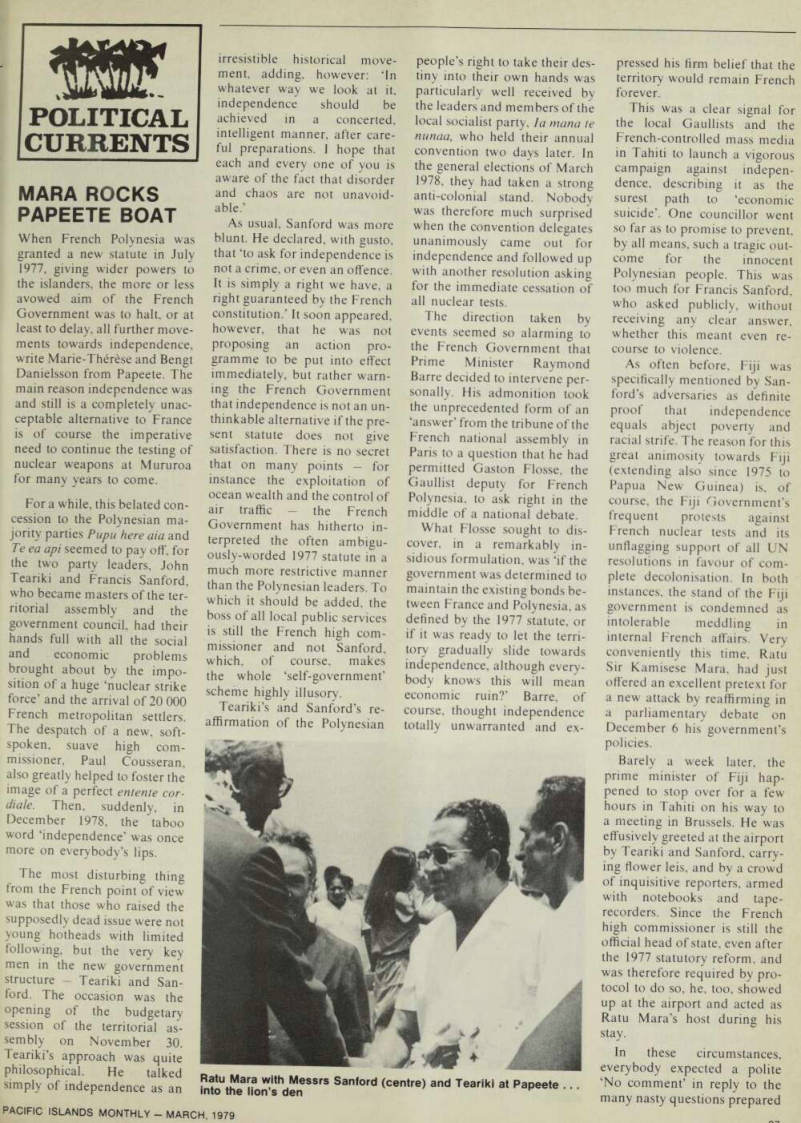
Barely a week later, the prime minister of Fiji hap pened to stop over for a few hours in Tahiti on his way to a meeting in Brussels. He was effusively greeted at the airport by Teariki and Sanford, carry ing flower leis, and by a crowd of inquisitive reporters, armed with notebooks and tape recorders. Since the French high commissioner is still the official head of state, even after the 1977 statutory reform, and was therefore required by pro tocol to do so, he, too, showed up at the airport and acted as Ratu Mara’s host during his stay.
In these circumstances, everybody expected a polite ‘No comment’ in reply to the many nasty questions prepared
Rafu Mara with Messrs Sanford (centre) and Teariki at Papeete ... into the lion’s den
by the newspapermen. But it turned out that Ratu Mara was perfectly willing to repeat his most recent statements. He even had the gall to add that Fiji and Papua New Guinea were fine examples of success ful decolonisation, thanks to the positive attitude and gener ous assistance of their former colonial masters.
It took the French Govern ment several days to find
something even remotely
resembling a repartee. It took the form of a long telegram from the honorary French Charge d’Affairs in Fiji Ber nard Malandain, and was dis tributed to all local mass media. In this dispatch, Mr Malandain blamed the Fiji Sun for having printed a wrong ver sion of Ratu Mara’s speech in
the Fiji parliament on
December 6. Sure enough, the
‘correct’ version, supplied by
the enterprising Mr Malan dain, is worded quite dif ferently. But the message is the same, so it is difficult to under stand why so much money was spent on this long telegram.
In another bulletin, issued five days after the Fijian PM’s short stopover in Tahiti, the French high commissioner tried a similar trick. He sud denly revealed that Ratu Mara, behind closed doors, ‘had con firmed that the statements attributed to him had been completely distorted. He assured me that when he had declared that Fiji was for the independence of all peoples, he had not mentioned French
Polynesia by name’.
The ruckus had now reached such proportions that Minister for French Overseas Terri tories Paul Dijoud flew in from New Caledonia. In a suc cession of meetings with local politicians and government officials he told everybody to go back to square one and henceforth play the game strictly in accordance with the rules laid down by the French Government in 1977.
To make French intentions crystal clear, a commando of
gendarmes prevented a group
of demonstrators led by Front de Liberation de la Polynesie (FLP) party president Oscar Temaru, from displaying a
banner at the airport when Mr
Dijoud stepped off the plane.
The text on the confiscated banner read: Tndependance Front de Liberation de la Polynesie’. A week later, the French high commissioner wound up the great 1978
independence debate by point
ing out how terribly all other peoples in the Pacific have suf fered since they got indepen dence. He said: Tn all these scattered Pacific islands, as a rule, only a few privileged individuals profit from [their] independence which is more apparent than real, as they completely lack economic re sources, whereas French Poly nesia alone is flourishing.’
Fiji: Sugar
Politics Again
Sugar industry politics erupted
in Fiji in December-January as opposing factions of the Indian-dominated National Federation Party clashed over the acceptance or rejection of a new 10-year harvest contract between nearly 18 000 mainly Indian growers and the
government-controlled milling
company, the Fiji Sugar Cor
poration (FSC).
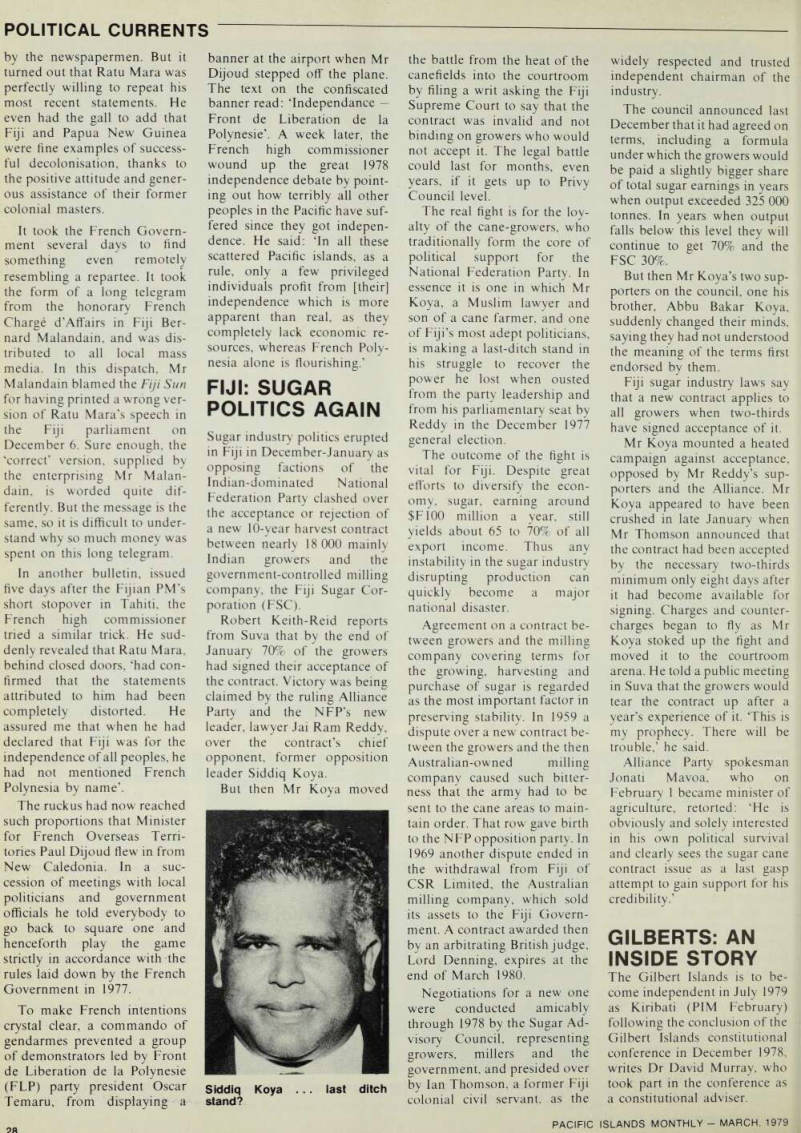
Robert Keith-Reid reports from Suva that by the end of January 70% of the growers had signed their acceptance of the contract. Victory was being claimed by the ruling Alliance Party and the NFP’s new leader, lawyer Jai Ram Reddy, over the contract’s chief opponent, former opposition leader Siddiq Koya.
But then Mr Koya moved
the battle from the heat of the canefields into the courtroom by filing a writ asking the Fiji Supreme Court to say that the contract was invalid and not binding on growers who would not accept it. The legal battle could last for months, even years, if it gets up to Privy Council level.
The real fight is for the loy alty of the cane-growers, who traditionally form the core of political support for the National Federation Party. In essence it is one in which Mr Koya, a Muslim lawyer and son of a cane farmer, and one of Fiji’s most adept politicians, is making a last-ditch stand in his struggle to recover the power he lost when ousted from the party leadership and from his parliamentary seat by Reddy in the December 1977
general election.
The outcome of the fight is vital for Fiji. Despite great efforts to diversify the econ omy, sugar, earning around SFIOO million a year, still yields about 65 to 70% of all export income. Thus any instability in the sugar industry
disrupting production can
quickly become a major
national disaster.
Agreement on a contract be tween growers and the milling company covering terms for
the growing, harvesting and
purchase of sugar is regarded as the most important factor in preserving stability. In 1959 a dispute over a new contract be tween the growers and the then
Australian-owned milling
company caused such bitter ness that the army had to be sent to the cane areas to main tain order. That row gave birth to the NFP opposition party. In 1969 another dispute ended in the withdrawal from Fiji of CSR Limited, the Australian milling company, which sold its assets to the Fiji Govern ment. A contract awarded then by an arbitrating British judge.
Lord Denning, expires at the end of March 1980.
Negotiations for a new one were conducted amicably
through 1978 by the Sugar Ad
visory Council, representing growers, millers and the government, and presided over by lan Thomson, a former Fiji colonial civil servant, as the
widely respected and trusted independent chairman of the
industry.
The council announced last December that it had agreed on terms, including a formula under which the growers would
be paid a slightly bigger share
of total sugar earnings in years when output exceeded 325 000 tonnes. In years when output falls below this level they will continue to get 70% and the
Fsc 30%.
But then Mr Koya’s two sup porters on the council, one his brother, Abbu Bakar Koya,
suddenly changed their minds,
saying they had not understood the meaning of the terms first endorsed by them.
Fiji sugar industry laws say that a new contract applies to all growers when two-thirds have signed acceptance of it.
Mr Koya mounted a heated
campaign against acceptance,
opposed by Mr Reddy’s sup porters and the Alliance. Mr Koya appeared to have been crushed in late January when Mr Thomson announced that the contract had been accepted by the necessary two-thirds
minimum only eight days after
it had become available for
signing. Charges and counter
charges began to fly as Mr
Koya stoked up the fight and moved it to the courtroom arena. He told a public meeting in Suva that the growers would tear the contract up after a year’s experience of it. This is my prophecy. There will be trouble,’ he said.
Alliance Party spokesman Jonati Mavoa, who on February 1 became minister of agriculture, retorted: ‘He is
obviously and solely interested
in his own political survival and clearly sees the sugar cane contract issue as a last gasp attempt to gain support for his
credibility.’
Gilberts: An
Inside Story
The Gilbert Islands is to be come independent in July 1979 as Kiribati (PIM February) following the conclusion of the Gilbert Islands constitutional conference in December 1978, writes Dr David Murray, who took part in the conference as a constitutional adviser.
Siddiq Koya ... last ditch stand?
In closing the two-and-half week conference, the British Minister of State Lord Goronwy-Roberts spoke of it as potentially the most difficult of the constitutional con ferences over which he had had to preside, but that the basis for the Gilberts’ independence had been agreed.
The difficulties arose pri marily from the question of whether Banaba Island should remain part of the Gilberts, but there was also a problem in how to treat the novel financial circumstances of the Gilberts.
There was a less explicit prob lem, but one that was perceived as important, of how to prevent other aspects of the nego tiations and discussions from
detracting from the overriding
aim of ensuring the establish ment of constitutional govern ment in the independent state of Kiribati.
With Banaban represen tatives taking full part along with delegations from the Gil berts and the United Kingdom, the future of Banaba Island was taken as the first issue in the conference. This was con sidered in plenary session, in committee and informal meet ings for a full week. The Gil berts Government restated its
existing policy that Banaba
Island formed part of the Gil berts and, though it was willing to introduce or maintain
special safeguards for
Banabans, the island was to re main within the Gilberts. The
Banaban delegation similarly
restated its demand that Banaba Island be taken out of the Gilbert Islands. The British Government sought to pro mote an agreed compromise, but when one failed to emerge at the end of a week’s dis cussions, Lord Goronwy- Roberts formulated and stated the British Government’s de cision on the matter; that Banaba Island should remain part of the Gilberts, but that there would be special safe guards for the Banabans de signed to ensure that the rights guaranteed them when they were settled on Rabi Island.
Fiji, in 1947 would be pre served.
As an observer of these dis cussions it seemed clear to me that the outcome was affected
by the relative effectiveness of Gilberts’ Chief Minister, leremia Tabai and of Sir Ber nard Braine, a British MP act ing as spokesman for the Banabans. The British minister went into the conference un committed. Previously stated policy and the obvious precedents were against the re moval of Banaba Island, but the minister was undecided on the right course. He started with an open mind, sought to hear reasoned arguments, and was evidently concerned to find out whether there was room for an agreed outcome, leremia Tabai approached the discussions in a spirit of quiet reasonableness. He displayed an understanding of the Banabans’ worries and a con cern to reassure them that was
convincingly encouraging of
trust; he refused to rise to Ber nard Braine’s provocations and
showed a continuing willing
ness to explore any alternatives short of excluding Banaba Island.
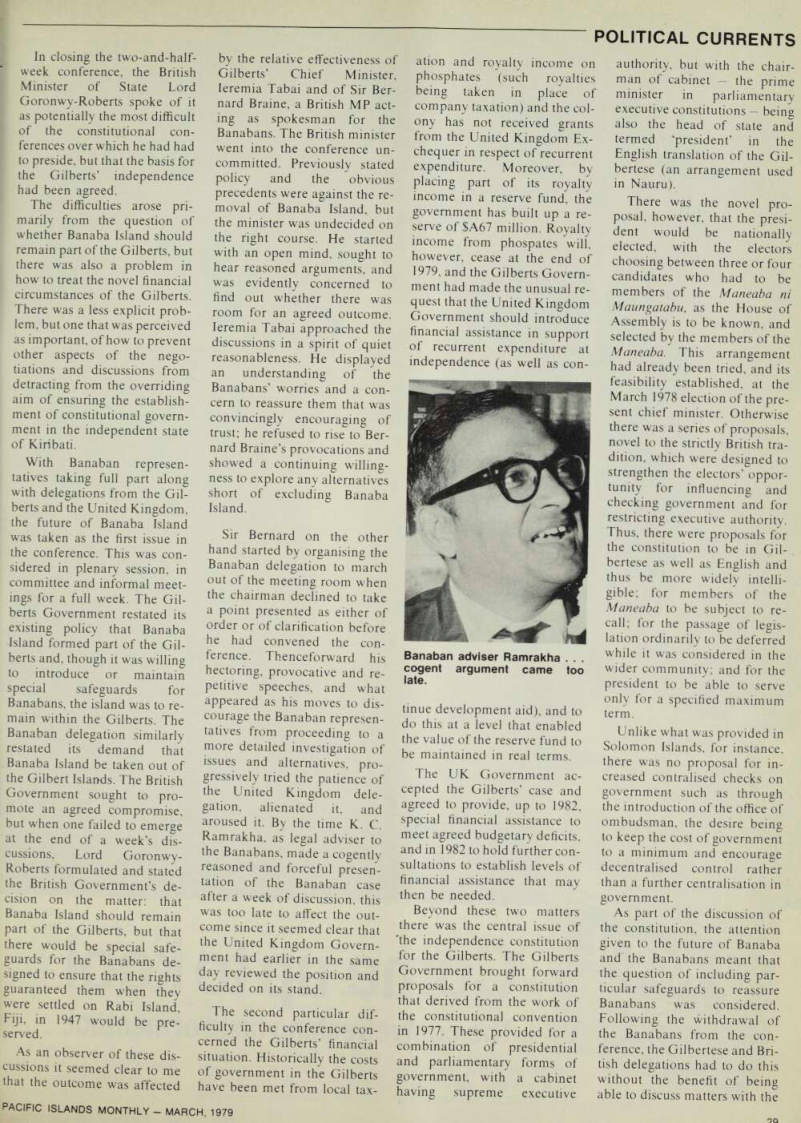
Sir Bernard on the other hand started by organising the Banaban delegation to march out of the meeting room when the chairman declined to take a point presented as either of order or of clarification before he had convened the con ference. Thenceforward his hectoring, provocative and re petitive speeches, and what appeared as his moves to dis courage the Banaban represen tatives from proceeding to a more detailed investigation of issues and alternatives, pro gressively tried the patience of the United Kingdom dele gation. alienated it, and aroused it. By the time K. C.
Ramrakha, as legal adviser to the Banabans, made a cogently reasoned and forceful presen tation of the Banaban case after a week of discussion, this was too late to affect the out come since it seemed clear that the United Kingdom Govern ment had earlier in the same day reviewed the position and decided on its stand.
The second particular dif ficulty in the conference con cerned the Gilberts’ financial situation. Historically the costs of government in the Gilberts have been met from local tax
ation and royalty income on phosphates (such royalties being taken in place of company taxation) and the col ony has not received grants from the United Kingdom Ex chequer in respect of recurrent expenditure. Moreover, by placing part of its royalty income in a reserve fund, the government has built up a re serve of SA67 million. Royalty income from phospates will, however, cease at the end of 1979, and the Gilberts Govern ment had made the unusual re quest that the United Kingdom Government should introduce financial assistance in support of recurrent expenditure at independence (as well as con-
tinue development aid), and to do this at a level that enabled the value of the reserve fund to be maintained in real terms.
The UK Government ac cepted the Gilberts’ case and agreed to provide, up to 1982, special financial assistance to meet agreed budgetary deficits, and in 1982 to hold further con sultations to establish levels of financial assistance that may then be needed.
Beyond these two matters there was the central issue of 'the independence constitution for the Gilberts. The Gilberts Government brought forward proposals for a constitution that derived from the work of the constitutional convention in 1977. These provided for a combination of presidential and parliamentary forms of government, with a cabinet having supreme executive
authority, but with the chair man of cabinet the prime minister in parliamentary executive constitutions - being also the head of state and termed ‘president’ in the English translation of the Gil bertese (an arrangement used in Nauru).
There was the novel pro posal, however, that the presi dent would be nationally elected, with the electors choosing between three or four candidates who had to be members of the Maneaba ni Maungatabu, as the House of Assembly is to be known, and selected by the members of the Maneaba. This arrangement had already been tried, and its feasibility established, at the March 1978 election of the pre sent chief minister. Otherwise there was a series of proposals, novel to the strictly British tra dition, which were designed to strengthen the electors’ oppor
tunity for influencing and
checking government and for
restricting executive authority.
Thus, there were proposals for the constitution to be in Gil bertese as well as English and thus be more widely intelli gible; for members of the Maneaba to be subject to re call; for the passage of legis lation ordinarily to be deferred while it was considered in the wider community; and for the president to be able to serve only for a specified maximum term.
Unlike what was provided in Solomon Islands, for instance, there was no proposal for in creased contralised checks on government such as through the introduction of the office of ombudsman, the desire being to keep the cost of government to a minimum and encourage decentralised control rather than a further centralisation in government.
As part of the discussion of the constitution, the attention given to the future of Banaba and the Banabans meant that the question of including par ticular safeguards to reassure Banabans was considered.
Following the withdrawal of the Banabans from the con ference, the Gilbertese and Bri tish delegations had to do this without the benefit of being able to discuss matters with the
Banaban adviser Ramrakha . . . cogent argument came too late.
■ Banabans themselves. In the event, the safeguards decided upon were as outlined in PIM
in February.
It was recognised as unfor tunate that the way time had been spent appeared to rel egate discussion of the consti tution in the scale of priorities, and it was appropriate that in his final address the British
minister began by emphasising
the importance of the consti tution and the decisions of the conference on it.
Dijoud Wins
Out In Noumea
France’s State Secretary for Overseas Territories Paul Dijoud arrived in Noumea on December 18 to face some op position, writes Andre Chaville. From early December the press had been publishing letters from local
politicians, mainly Europeans
worried about statements by ethnologist Jean Guiart, who had been suggesting, among other things, that the white population of New Caledonia should be ready to pack up and leave. Mr Guiart had been regarded, in Noumea, as an adviser to Mr Dijoud.
There had also been a marked fall-out from French
politics. With Jacques Chirac,
leader of the Gaullist party in France, threatening President Giscard D’Estaing with with drawal of support, it seemed
only natural for Jacques
Lafleur, leader of the local Gaullist group, to do the same to Mr Dijoud, President Gis card’s spokesman on overseas territories.
To add to the apparent op position, Jean-Gabriel Eriau, after five years of service as high commissioner, left the ter ritory 24 hours before Mr
Dijoud’s arrival. Although it
was rumoured that Mr Eriau had asked to be withdrawn be cause of his disapproval of Mr
Dijoud’s plans, the high com
missioner never revealed such feelings in public. But it was significant that for the first time in the history of New
Caledonia, the departing high
commissioner and his suc cessor, Claude Charbonniaud, held a private meeting at La
Tontouta airport.
Millionaire-parliamentarian
Jacques Lafleur also dropped a bombshell early in the month by announcing that he thought New Caledonia would eventu ally and inevitably become a department of France. His ar gument was that the territory could no longer support the cost of its inflated public ser vice, nor could it offer com plete social security to its inhabitants.
But many New Caledonians, white and black, are not keen on such an idea. Although will ing to remain within the French sphere of influence, they are determined to see the island maintain and improve its present advantages of autonomy and tax-free incomes. This attitude has not been favourable to the Lafleur group as it has given Lionel Cherrier, New Caledonia’s representative in the French Senate, the opportunity to take a firm stand in favour of the Dijoud plan. He is supported by the moderate parties even though he took up his post on the death of Mr Lafleur’s father. Also the teenage Gaullist movement has split, some of its members following the senator.
To add to the general atmo sphere of unpleasantness
accompanying Mr Dijoud’s
arrival, the evening of his first day was marked by dramatic events in Orly Square. Pro independence leaders, includ
ing Yann Celene Uregei,
attempted to organise an im promptu demonstration against Mr Dijoud’s visit.
Though they received little support, the violence of police shocked many bystanders. The meeting was broken up by a truncheon charge at spm and witnessed by many shoppers on their pre-Christmas buying spree.
The demonstration was too late. Mr Dijoud had already practically won the battle that morning in his speech to the territorial assembly. He told councillors he did not believe that the Melanesian pro independence movement was important. But, on the other hand, he considered that there was an urgent need to improve the Melanesians’ standing within the community. He was
critical of the belligerent atti tude of the die-hard ‘Cal doches’ and said that any attempts to provoke armed racial feuds would be severely restrained by the high com missioner under his authority.
Mr Dijoud considered most people were not in favour of extremists of either group. He also criticised political squab bling in the assembly among the numerous parties. He an nounced that he would suggest a change in the system of elec tion to both the assembly and the government council so that the territory would be gov
erned by a large majority,
chosen by the electors. But he also praised the attitudes of some politicians, such as Jean- Pierra Aifa, and hoped that the ‘moderate’ parties would unite.
These parties, in fact, are sup porting Giscard in France and, consequently, the Dijoud pol icy for New Caledonia.
Mr Dijoud said Mr Guiart was not his adviser, nor was he, Dijoud, supporting Union Caledonienne. His attitude was to listen to all opinions and suggestions before coming to his own conclusions.
Surprisingly enough, Mr
Dijoud has the full support of the moderate parties, encouragement from the Union Caledonienne, and the approval of the socialists. Only the pro-independence Fulk and Palika are openly hostile, while Mr Lafleur is forced to
give reserved and grudging
approval.
Finally, Mr Dijoud submit
ted a 23-point plan to the as
sembly, saying he hoped that
both the assembly and the government council would adopt his proposals. If not, he said he might ask the popu lation itself for an opinion. It appeared to be a veiled threat to organise a referendum.
Mr Dijoud’s plan is not a cal culated programme. It is more like a philosopher’s declaration of rights, using vague terms such as the development of mutual respect for each com munity’s culture, the pro motion of tourism, and the
development of agriculture
and light industry. It is a pro posal for a long-term contract, a plan which would maintain the territorial status of New
Caledonia with France, in turn, guaranteeing the cultural, social and professional welfare of all inhabitants, whatever their origin.
Hebrides ‘No’
To Refugees
The council of chiefs of the New Hebrides island of Maewo has spoken out strongly against an offer by Na Griamel’s president Jimmy Moli Stephens to resettle 2300 Vietnamese refugees on the island, according to a report in New Hebrides News, published by the British residency in Vila.
In making the offer to a Catholic lay organisation in Brisbane, Australia, Mr Stephens claimed to be the paramount chief of Maewo. He said that in this capacity he would be prepared to resettle all 2300 refugees stranded aboard the freighter Tung Han in Manila Bay, Philippines.
The council of chiefs of Maewo denied that Mr Stephens was the paramount chief of Maewo, said he was not from that island, had no relatives there, and claimed that the island was not a mem ber of Na Griamel and con tained only two villages that supported Stephens’ party.
New Hebrides’ Chief Minis ter Gerard Leymang said, in a broadcast statement, that the New Hebrides Government was not aware of Mr Stephens’ offer. Deputy Chief Minister and Minister of Social Services Father Walter Lini said; ‘Such an offer made by a member of the public could cause disunity among the people of the New Hebrides and might disrupt future relations with overseas countries.’
Walter Lini . . . refugees could cause ‘disunity’.