The Awkward
pp. 9-14 · Read in the full issue
Oceanian
Trying to help or is it conscience money?
The Region
Staff writer Malcolm Salmon reports on a PIM investigation into the hearings and report by the Australian Senate Committee on Foreign Affairs and Defence on the subject, Australia and the South Pacific.
There was no lack of paper on the streets of central Sydney on that hot January day: a strike
by city council garbage collec
tors had left the town littered with bits of old newspapers and other rubbish.
PIM picked its way through the mess in search of still more
paper: the 1473-page transcript
of evidence given to the hear ings on A ustralia and the South Pacific held in 1977 by the Sen ate Standing Committee on Foreign Affairs and Defence.
But disappointment lurked ahead: at the Pitt Street offices of the Australian Government Publishing Service the counter
attendant, languid despite the
air conditioning, leant casually
on a filing cabinet flicking through a card index. ‘We don’t get all of the transcripts of those inquiries,’ he said. Then; ‘No, we haven’t got that one.
We’ve never had it.’
He motioned with a limp arm to a shelf: ‘Have a look over there,’ he told PIM. ‘That’s all we’ve got in that line.
Tve got to go to lunch.’
PIM did indeed examine the contents of the shelf: sure enough, there were volumes
containing the evidence given
to the Senate committee at earlier inquiries into the ‘Soviet threat in the Indian Ocean, md the problems posed by
Vietnamese refugees. But de
;pite the fact that they had seen published many months )efore, there was not a sign of he volumes of evidence given o the committee’s inquiry into he problems of relations be ween Australia and the South J acific.
It was an inauspicious begin ling to PlM’s efforts to analyse he impact of the committee’s ln April 1978 PIM had
carried a highly perceptive pre view of the committee’s report, which, when the report actually appeared shortly afterwards, did not seem to require further elaboration by us. In November 1978 PIM reported what seems to be the main practical consequence to have flowed so far from the com mittee’s work: the Australian Government’s offer, made at the September meeting of the South Pacific Forum on Niue, to fund for five years a trade commission in Australia to promote Island exports in the country. For the rest, the com mittee’s activities seemed to have been very much a lead balloon.
Such an idea was certainly confirmed by the fact that the office of the AGPS in Sydney, Australia’s largest city, set on the shores of the Pacific, where interest in the region is" prob ably higher than in most other Australian cities and whose business houses certainly profit relatively more from Australia- Pacific trade than firms based in other centres, had not even seen fit to stock the com mittee’s transcript of evi dence.
PIM quickly took corrective action: a phone call to Can berra, and the assistance of the staff of committee member Senator John Knight, ensured that the two volumes of the transcript were soon in our hands.
Interest in the report flared briefly in the Senate last August when it was finally the subject of debate.
Three main points emerged from the Senate discussion: • Complaints about the long delay in debating the report. • Criticism of the fact that
the committee in its work was unable to visit the South Pa cific, parliamentary regulations restricting its travel rights to journeys within Australia. (Three of the committee’s six members had actually visited some Island countries in the re cent past, but not in their ca pacity as committeemen.) One committee member. Senator Mclntosh (Labor, Western Australia), said; ‘I believe that on one occasion a committee, member, talking about the committee’s report, was held up as a laughing stock when he was asked whether the com mittee had visited the Pacific Islands. He could only say no.’ • A related criticism which suggested that the committee’s report was the result of a lot of white men talking to each other since, throughout its deliber ations, it had received evidence from only two indigenous Island people. Both happened to be temporarily attached to Australian universities at the time of the committee’s sit
tings. (They were Sione
Tupouniua, of Tonga, a lec turer at the University of the South Pacific, who was doing post-graduate work at the Aus tralian National University and Tupeni Baba of Fiji also a USP lecturer, who was
similarly occupied at
Macquarie University, Sydney,
Mr Baba’s evidence to the com mittee was prominently fea tured in PIM February 1978.) The transcript of evidence was not PlM’s only resource for an analysis of the committee’s work. In preparation for the project, as long ago as last November, PIM wrote to the 80 or so people who gave evi dence to the committee, seek ing their opinions on its report, The letter has so far drawn 25 replies, a better than 25 per cent response, which can’t be counted too bad in view of the intervention of the Christmas-
New Year holiday period.
Of the 25, 15 - well over half - declined to make any com ment at all on the report. All nine Commonwealth public
Australia
Andthe
South
Pacific
Report from the Seriate Standing Con.mittee on Foreign Affairs and Deface
servants among the respon dents were in this category, which also included an execu tive of one of the major Aus tralian trading firms active in the Pacific.
Two respondents promised
later replies which have not come to hand at time of
writing.
Eight respondents did com
ment, several of them at some length. Of these, four were prepared to have their com ments attributed to them by name, and four were not, although they were happy for their remarks to be pub lished.
But first, in fairness to the committee, and in order to help
understanding of respondents’
comments on its work, its 10
principal policy recommenda
tions, appearing on pp 3-4 of its report, are here reproduced in full: • It is recommended that Aus tralia’s initiatives should con vey the message that close and friendly relations are desired equally with all South Pacific countries and that no one country should predominate in Australia’s diplomacy. While Australia has responsibilities towards Papua New Guinea this does not relegate other countries to a secondary pos ition in our considerations. • The committee believes that it is important for Australia to encourage and welcome further diplomatic represen tation from the region in Aus tralia and recommends that assistance should be given to the establishment of this rep resentation where possible.
The committee notes that Aus tralia has recently increased its diplomatic missions and extended its representation in the region and recommends that this high level of represen tation be maintained and kept under review. • The committee understands
that some problems may be developing within the Development Assistance Bu reau and the Department of Foreign Affairs with respect to staff resources handling re lations with the South Pacific area. While heavy emphasis continued to be placed on
Papua New Guinea, quite
properly, limited resources appear to be available to deal with development assistance or other policy matters relating to the South Pacific. In the con text of its overall inquiry and the recommendations made, the committee believes this matter is one of great sig nificance. Accordingly it is recommended that a review be undertaken of staff resources available in both the bureau and the department to deal with the South Pacific. The purpose of this review should be to examine whether staff re sources are currently adequate and if there are problems then action should be taken as a matter of some urgency to ensure that adequate staff and other facilities are available to
implement Australia’s policies,
recent important initiatives and future developments, including those recommended in this report, in Australia’s re lations with the South Pacific. • As well as the present econ omic relations and develop ment assistance programme which Australia has with South Pacific countries, it is recom mended that Australia should increase its efforts to broaden and develop its relations to take into account political, diplomatic, social, cultural and sporting considerations. Aus tralia, in partnership with South Pacific countries, must work to promote more wide
spread and frequent exchanges
between people at all levels. • At this stage the introduction of a ‘guest worker’ scheme in Australia for people from South Pacific countries appears to be impractical. However it is recommended that the pro posal should not be dismissed and when economic circum stances in Australia change, the scheme should be reassessed, if
requested by Pacific Island
governments. • There is a need to correct the impression that Australia’s im
migration policy is discriminat ory. The policy should be fully and widely explained and it is recommended that particular attention be given to this task.
In particular, efforts should be made to ensure that the admin istration of the policy be handled with sensitivity and discretion in view of the im portance of our relations with the people of the South Pa cific. • To improve accessibility to the Australian market for South Pacific products it is strongly recommended that an examination be conducted into quarantine restrictions apply ing to Island fruits and vege tables. Doubts have been expressed on whether all these
restrictions are justified and the results of this examination should be circulated widely in Australia and throughout the South Pacific. • It is recommended that the existing Australian system of tariff preferences and market ing advice facilities (par
ticularly the service provided
by the Market Advisory Sec tion, Department of Trade and Resources) be kept under per iodic review and a comprehen sive promotion of how South Pacific countries can derive the most benefit from these ser vices be a feature of Australia’s official trade relations in the
region.
• While Australia’s commer cial image in the South Pacific region is improving, it is recommended that close liaison between the Australian Government and Australian
firms operating or intending to establish businesses in the South Pacific be promoted.
Intending firms should be made aware of the host govern ment’s guidelines to ensure that an acceptable code of business conduct is main tained. • To help overcome the rela
tively short term experience
and lack of representation of many South Pacific countries in international trade meetings and marketing promotion, it is recommended that Australia, if the Island governments re quest, consider: (a) presenting Island views at international
trade meetings and/or inviting
Island representatives to ac company Australian missions and delegations as observers; (b) attaching Island trainees or officers to Australian trade commissioner offices overseas
for training and promoting
their countries’ products in countries where they are not
represented; (c) assisting where
appropriate with the marketing
of Island goods but taking into account the interests of Aus
tralian producers.
Two quite radical, and quite different, appraisals of the re port came from respondents: representing the younger and older generations of Australian: students of Pacific Island affairs.
One was from lan Mac donald, 29, who, when he gave; evidence to the committee, was? research assistant to Senator George Georges (Labor,, Queensland), and who is now\ a professional research officer with the attorney-general ofl New South Wales. The other was from W. D. Forsyth, whoc celebrated his seventieth birth day this year and who, among a long list of other diplomatic posts, served as the firstt secretary-general of the Southr Pacific Commission, fromr 1948-51.
In deference to his years and experience, PIM presents Mn Forsyth’s comments first. He wrote: ‘Among my opinions on the Senate report are the follow
ing;
‘We should stop trying to lead the Islanders up a garden path we know from our own experience, or ought to know\
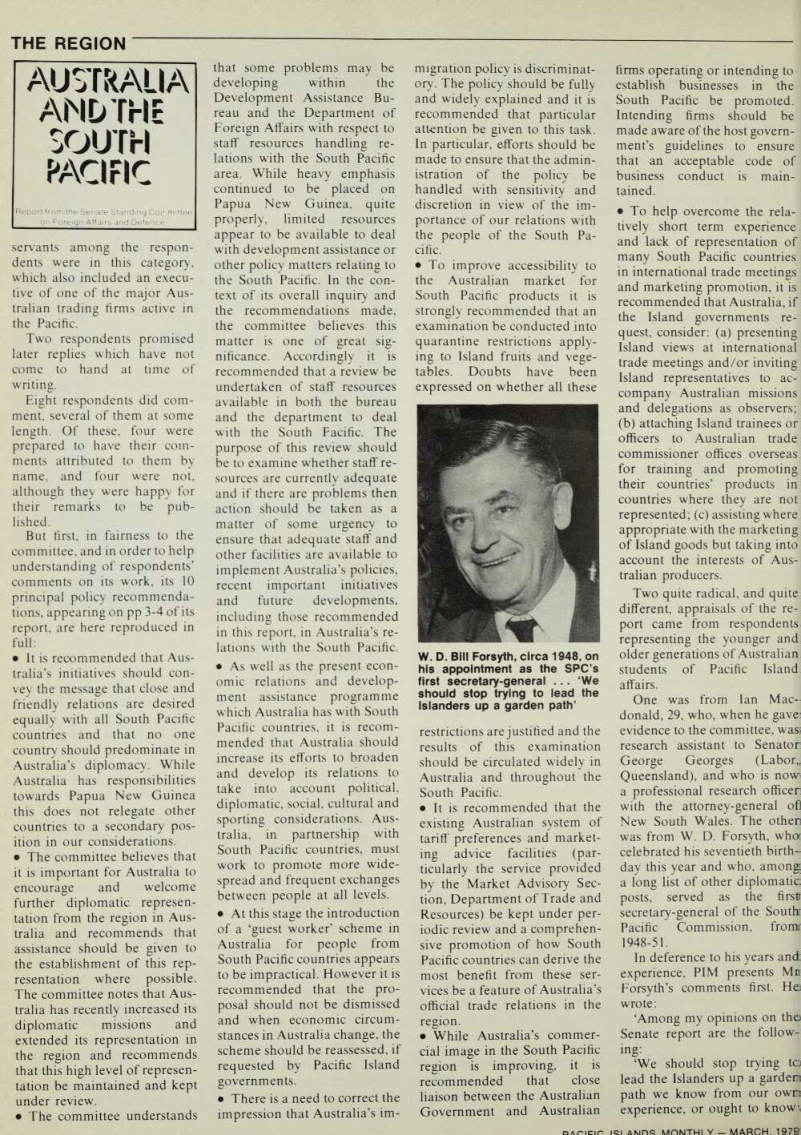
W. D. Bill Forsyth, circa 1948, on his appointment as the SPC’s
first secretary-general . . . ‘We
should stop trying to lead the Islanders up a garden path’
is a blind alley, that is, the path of multiplication of material
consumption.
‘Our approach should be along the lines of promoting a world of interdependent cul tural units, not of ingratiating ourselves for purposes of some futile strategic formula which most likely is already outdated in the nuclear age. ‘The best thing any country could do for the Pacific Islanders would be to help them sit out the phasing-out period of the present form of Euro-American “civilisation” - so to speak, help to tide them over the decline of the present Western style of acquisitive, would-be affluent, society.
They have kept enough of their
own cultures both above ground and under to be able to reconstruct a good form of their own way of life, which was well adjusted to their own special environment, and could again in future afford their race a satisfying way of life. Sharing rather than greed was its key note. ‘Australia cannot in my opinion do much to help them in this because its own values are unformed and it really has little influence compared with that of Europe and America. ‘We can however contribute in two ways if we want to; (a)
by helping the Islands to pre serve their culture and their environment, and (b) by facili tating Island interchange, which would strengthen their chances of surviving Western
material “values” by fostering
the Pacific Way. ‘ Both can best be promoted
through the established regional
organs in which the various Island peoples can thrash out what they want to do and where we can learn what will and what will not be helpful. ‘I support the committee recommendations which work in those directions. My disap pointment was that some of them don’t. ‘I was disappointed also be cause the opportunity to work out a comprehensive and co herent policy was passed up in favour of the usual material istic concatenation of prag matic “solutions” to
insufficiently analysed “prob
lems”. ‘Even on purposes the report gave no clear answer. Why do we want to give aid to Pacific Islands? Is it conscience
money, danegeld, bribery,
“national interest”, profit, or altruism? ‘But without clear purpose, aid is waste of money and men. ‘The committee produced
some nice sentiments and interesting suggestions but almost nothing of what is most needed at this stage, hard
thought.’
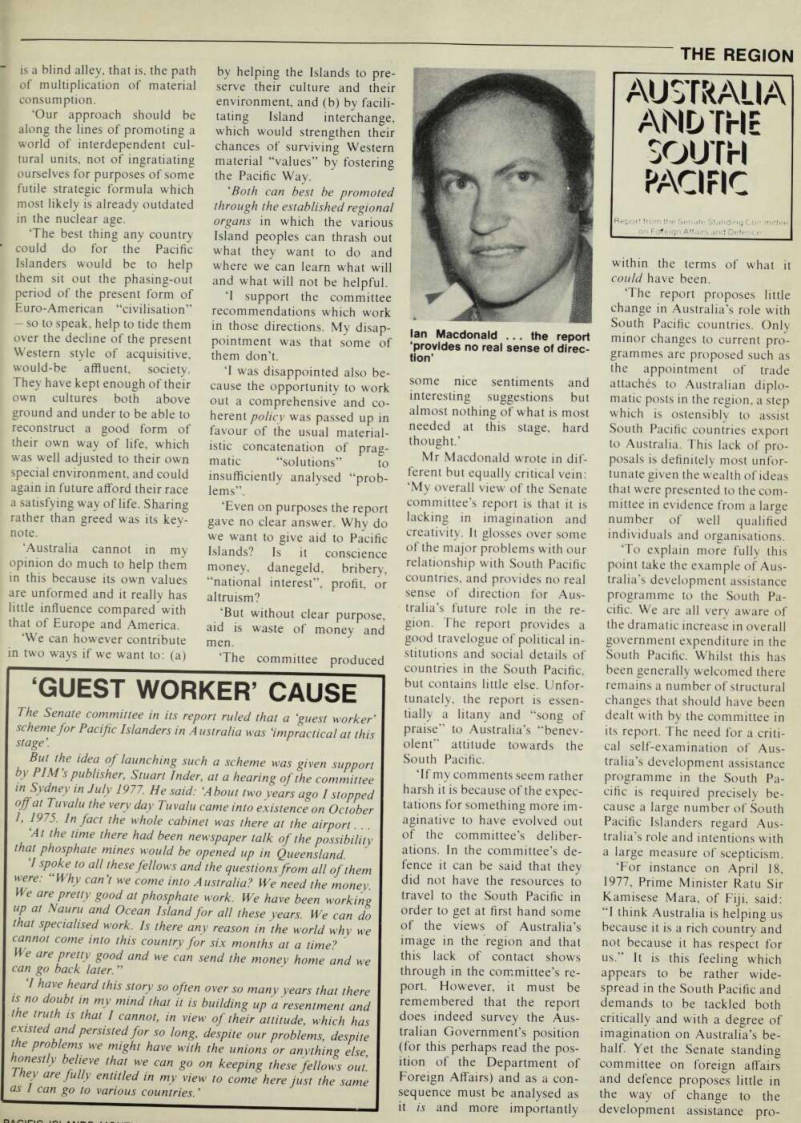
Mr Macdonald wrote in dif ferent but equally critical vein; ‘My overall view of the Senate committee’s report is that it is
lacking in imagination and
creativity. It glosses over some of the major problems with our relationship with South Pacific countries, and provides no real sense of direction for Aus tralia’s future role in the re gion. The report provides a good travelogue of political in stitutions and social details of countries in the South Pacific, but contains little else. Unfor tunately. the report is essen
tially a litany and “song of
praise” to Australia’s “benev olent” attitude towards the South Pacific. ‘lf my comments seem rather harsh it is because of the expec tations for something more im aginative to have evolved out of the committee’s deliber ations. In the committee’s de fence it can be said that they did not have the resources to travel to the South Pacific in order to get at first hand some of the views of Australia’s image in the region and that this lack of contact shows through in the committee’s re port. However, it must be remembered that the report does indeed survey the Aus tralian Government’s position (for this perhaps read the pos ition of the Department of Foreign Affairs) and as a con sequence must be analysed as it is and more importantly
Australia
And The
South
Pacific
Report from the Senate Standing Con mitlee on Foteiqn Attairs and Detnnc e
within the terms of what it could have been.
The report proposes little change in Australia’s role with South Pacific countries. Only minor changes to current pro grammes are proposed such as the appointment of trade attaches to Australian diplo matic posts in the region, a step which is ostensibly to assist South Pacific countries export to Australia. This lack of pro posals is definitely most unfor tunate given the wealth of ideas that were presented to the com mittee in evidence from a large number of well qualified individuals and organisations.
To explain more fully this point take the example of Aus tralia’s development assistance programme to the South Pa cific. We are all very aware of the dramatic increase in overall government expenditure in the South Pacific. Whilst this has been generally welcomed there remains a number of structural changes that should have been dealt with by the committee in its report. The need for a criti cal self-examination of Aus tralia’s development assistance programme in the South Pa cific is required precisely be cause a large number of South Pacific Islanders regard Aus tralia’s role and intentions with a large measure of scepticism. ‘For instance on April 18, 1977, Prime Minister Ratu Sir Kamisese Mara, of Fiji, said: “I think Australia is helping us because it is a rich country and not because it has respect for us.” It is this feeling which appears to be rather wide spread in the South Pacific and demands to be tackled both critically and with a degree of imagination on Australia’s be half. Yet the Senate standing committee on foreign affairs and defence proposes little in the way of change to the development assistance pro-
Ian Macdonald ... the report ‘provides no real sense of direc tion’
Australia
Amdthe
South
Pacific
Report from the Sennle Standing Committee on Foreign Affairs and Defence
gramme, and more particularly proposes no improvements in the assistance delivery system that would enable South Pacific Islanders themselves to more actively participate in the decision-making process. This is the core of the committee’s failure in relation to the South Pacific. No sense of partnership is proposed for the development assistance programme, Australia continues to pull the
strings.
‘lt is a report full of complacency on the issue of development assistance and indeed towards several other areas of Australia’s role in the South Pacific. ‘The neo-colonialist relationship of Australia to the South Pacific is ignored. There are no proposals contained in the report dealing with the
problems created by Australian
investment in the region. We cannot escape the fact that Australian investment in the New Hebrides, Fiji, Solomon Islands and Papua New Guinea is large and has major
effects on these countries, es pecially on local economic pro grammes, resources utilisation and on the lifestyles of the
indigenous peoples. Yet the
committee in its report chose to
ignore proposals designed to
regulate Australian business activity such as the implemen tation of a “code of ethics” for companies operating in the re
gion.
‘Further, the report does not point out that Australian companies such as W. R. Car penter, Burns Philp, Steam
ships Trading Company,
Qantas and the National Bank tend to dominate the economic lives of South Pacific Islands
through diversified subsidiary
holdings and takeovers of local companies. The net effect of this business activity in the South Pacific has led to what I described in my submission to the committee as a “block-out effect”. The spread of
Australian-owned companies
within the indigenous econom ies has tended to block out local initiative and industry formation. In the face of these problems the committee chose to ignore or avoid proposing changes which could limit Aus tralia’s economically dominant role in the economies of the South Pacific. South Pacific local ownership and control, with some overseas economic investment and assistance, should have been the direction aimed at by Australia. Yet the
report fails to point towards this concept decisively and
clearly.
‘These are my basic criti cisms of the report. I feel that the committee has treated the
topic with a large degree of
complacency and little crea tivity. The report will serve as a guide for higher school cer tificate students but will tell us nothing of how Australia’s re lations with the developing Pa cific Island countries will or should proceed. It proposes little change as we enter the 1980 s. Australia the paternalist is the spirit of the report, rather than, dare we suggest, Aus tralia as a full partner.’
Australia’s heavy economic clout in the South Pacific was also evoked by another respon dent, who wrote: i am not so sure that Australia realises the extent to which it has influence through businesses in the South Pacific. Nor am I sure that Australia is likely to give away much, for example, in the civil aviation sphere if for no other reason than that it must deal bilaterally with the emerg ent Island states and they themselves are overly sus picious of each other. ‘To do something for one
would possibly cause problems
with the others, at the same time weakening the Australian
airline’s position.
‘To do nothing much at all is the easy line. To concentrate on helping with communi cations will also facilitate the activities of Australian businesses as much as Island ones probably more so until
Australia makes it easier for Island imports into Australia in
competition with locally pro
duced items. ‘I think the committee was honest enough to admit that there is considerable self interest in the aid given, and that it is not exactly what the Islanders themselves want. But to get that want defined exactly is a very difficult process.’
Improvements in Australia’s economic performance, with
special emphasis on the
importance of the concept of partnership raised by Mr Mac donald, were the main concern of an executive of an Aus tralian manufacturing firm active in the Islands. He wrote: ‘Given the wide scope of the in vestigation, which embraced the major part of the South Pa cific region, I felt the com mittee’s report was a creditable one. My main concern is that the inquiry was, in fact, too am bitious, resulting in many of its
elements lacking depth.
‘The conclusions and recom mendations reached by the committee are heavily directed towards social issues and inter governmental relations, at the expense, I felt, of any real attempt to analyse the econ omic potential of the region and the help Australia might contribute towards commercial
development. The original
Senate resolution of Sep tember 23, 1976, referred to “the need for an increased Aus tralian commitment towards development in the South Pa cific’’. This commitment was examined by the committee more in terms of diplomatic re lations, aid, environment, edu cation, health, welfare, etc, than in terms of basic economic realities. ‘ln the evidence presented on behalf of my own company, I endeavoured to bring out the value of the partnership ap proach to commercial ventures in developing countries ... We
have applied this philos
ophy ... and have found it of immense value to have a sig nificant local equity which is active in the business. If, com bined with this, there is a
meaningful relationship be
tween dividends paid out and funds ploughed back into the business, then a basis exists for
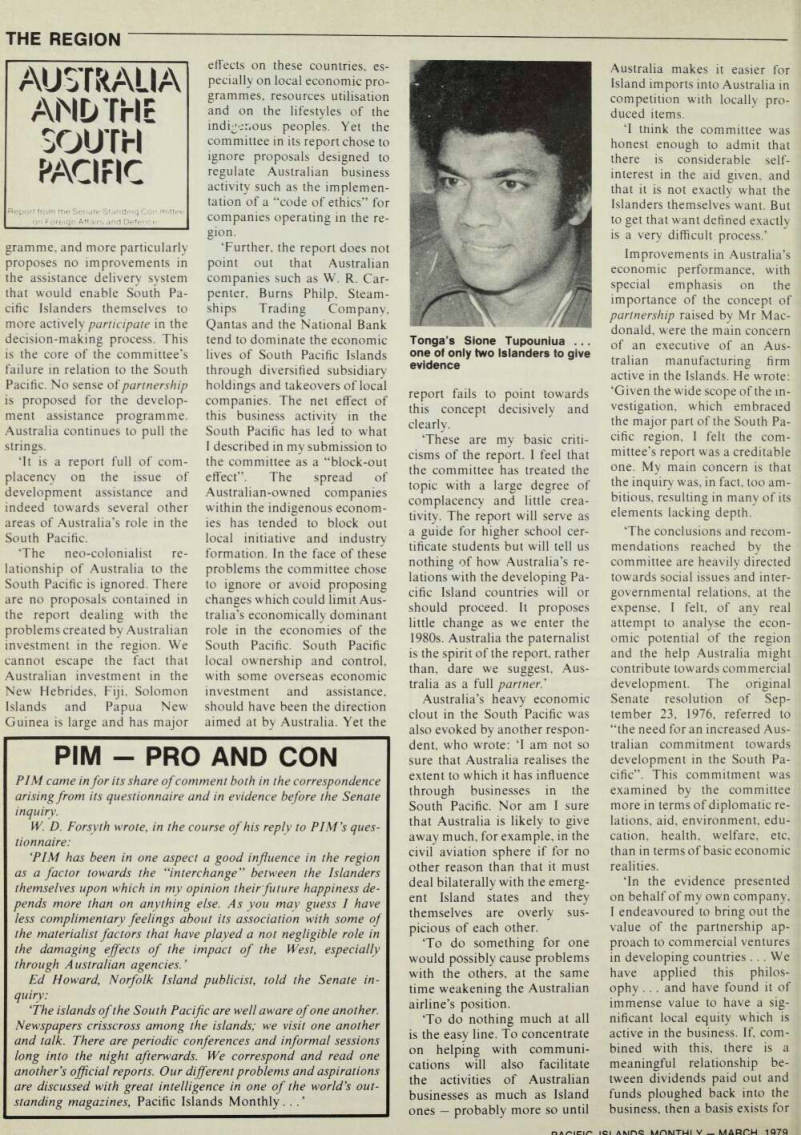
Tonga’s Slone Tupouniua ...
one of only two Islanders to give evidence
a constructive contribution by an outside corporation to local economic development. The committee might perhaps have addressed itself to some of these matters with a view to providing some support and impetus for the larger Aus tralian companies to look more
closely at regional economic
development.
‘As a general overview of the South Pacific, the report is ad equate and well prepared.
However, in terms of develop mental help by Australian industry, the report dealt only with the status quo and did not provide any useful leads for the future.’
Ed Howard, editor of the Norfolk Island News, wrote at length, voicing his ‘serious con cern and disapproval’ at the re port. He said: ‘My testimony, briefly, was that Australia’s re lations with South Pacific Islands are importantly af fected by Australia’s observ able attitudes toward its one remaining South Pacific Island territory, Norfolk Island. I sug gested that these observable attitudes spoke louder than words, and that Australia in its own interest ought to take a more enlightened, less col onial, stance toward Nor folk . . . ‘The committee’s report re
sponded to my testimony in a quite extraordinary way; Nofolk Island has simply been eliminated. It doesn’t exist, except for my name in the list of those who gave evidence, and the island’s location on the map inside the back cover.. .
Whatever the reason for the omission, it was made, as can be seen from the list of all South Pacific countries and ter ritories on page 7. After Niue comes Papua New Guinea.
Norfolk Island doesn’t exist...
The trouble is that Norfolk Island has not vanished ... ‘lf you wish to weigh the genuineness of the report’s brotherly sentiments toward the Islands and peoples of the South Pacific, you may like to ask the committee whether it proposes to apply the prin ciples it espouses in the case of the one South Pacific island where it can put them into practice if it in fact believes them. ‘What will Australia actually do, in the event? A parliamen tary bill has been introduced to bestow on Norfolk the right to administer its roads, drains and noxious weeds on Australia’s behalf, and to reaffirm Aus tralia’s colonial control over all meaningful governmental mat ters. This proposed new form of administration would draw
its authority not from the free will of those governed, but by Australian fiat. ‘Throughout the South Pa cific and elsewhere, thoughtful individuals who are concerned to know what Australia’s real policies toward the Islands are will be able to observe a re markable moment in history. A simple question can the peoples of the Islands safely rely on Australia’s word? is about to be answered, defi nitely, on Norfolk Island.’
Finally, two respondents took up with vigour problems raised in the August Senate de bate: the lack of opportunity for the committee as such to visit South Pacific countries, and the consequent lack of evi dence from Islanders.
An academic wrote: ‘One basic deficiency of the report. 1 feel, was that the committee was unable to talk directly with Pacific Islanders in any num ber and therefore the com mittee’s comments do seem to accept that there is relatively little criticism of Australia’s activities in the Pacific from within the Pacific. ‘lt seems to me that this is the public official view of many Pacific governments. But if one speaks to people off the record, when they feel that their com ments will not adversely affect their aid grants, etc, then one hears deeply-felt criticisms.
These do not necessarily sur face on the cocktail circuit, but anyone who spends any length of time in close contact with Pa-
Australia
And The
South
Pacific
Report from the Senate Standing Coi> mittee on Foreign AM,ms and Defence
cific Islanders soon uncovers many resentments against Aus tralia’s past and present role in
the region.’
A representative of a volun tary aid body active in the South Pacific made a similar point; ‘Perhaps if the com mittee had had the advantage of more input from the Islanders themselves it would have proved of greater value in our understanding of the pre sent situation of our relation ship with the area.
‘Although I ploughed
through the transcript recorded
in a Hansard publication, and found this to be most educational and enlightening, I did not consider that the report itself reflected to any great degree the concerns expressed in evidence by many of the witnesses at Australia’s attitude towards the South Pacific region. In fact, I found most of the criticism of business houses, government, and Australian tourists was not emphasised, and I would venture to say that our relation ship with the region will not be enhanced by the majority of
the findings.
in regard to my own evi dence, enough said. I was sur prised at much of the
aggressive questioning by some
of the Senators (not all), when one was only present in the hope of assisting. Also I found the general knowledge among the committee of the econom ies and cultures of the diverse peoples in the region to be of a very poor standard.
Mr P. C. Best, group general manager of Burns Philp & Co Ltd, while finding the Senate inquiry ‘timely’, lashed out at the failure by the Australian Government to take the slight est follow-up action on its find
ings. His seven-point reply
said: ‘l. It was timely for the Aus-
Burns Philp’s Philip Best... the Australian Government will lose much in goodwill
Australia
Amd The
South
Pacific
Report from the Senate Standing Con mittee on Foreign-Atfairs and Defence
tralian Government to assess ds position in respect of its relations with the countries of the Pacific region. We say “timely” because with the recent independence of Solomon Islands, Papua New Guinea, Ellice Islands (Tuvalu), and the
approaching independence of
the New Hebrides and the Gilbert Islands, the reference point for an exchange of views
has been progressively changed
from absentee governments to those of the people. In a short 10 years almost all of the islands of the South Pacific are now self-governed, with in-
dependent thought and pur-
pose. ‘2. Australia plays a dominant role in these areas because of its proximity, its economic dominance through Australian-owned commercial enterprises, and as a supplier of
the major portion of food and
allied products.
‘3. The report and most sub missions to the committee emphasised this fact but did not, in reality, confirm whether it was good or bad and whether Australia and the people of the region might expect the pos ition to remain the same. ‘4. We are disappointed that the committee did not see fit to make directives for the atten tion of the ministries of foreign affairs, trade, transport, indus trial relations and immigration to investigate those areas of criticism covering those minis tries. ‘5. We are disappointed that we, as one of the major Australian-based companies in the region, have not been in vited by the Australian Government to amplify some of the views expressed and suggestions made in our sub mission. ‘6. There is no evidence to suggest that the Australian Government, through its ministries, has made any effort to utilise the information con tained in the report, or to seek, by invitation, the views of the Island governments and people on the constructive aspects of the report.
‘7. Although the major shareholding of the Burns
Philp companies is domiciled
in Australia, we see our oper ations in the South Pacific working for the benefit of the economic development of those countries in which we trade and to align our businesses in the direction of the individual government’s wishes. The Australian Government, as distinct from
Australian companies, will lose much in goodwill and the ability to keep itself informed if it remains aloof from this ad ditional source of input.’
Mr Best adds; ‘We said in the beginning that the need for this committee was timely, but what happens next? Is any benefit to accrue from this effort by members of the Sen ate? We think not and more is
the pity.’