Letters
pp. 5-6 · Read in the full issue
‘Thank-You,
Don O’Bryan’
’ In August 1977 I spent two weeks on the island of Raro tonga. One of the reasons for my visit was to meet Tom Neale, the ‘hermit of Suwar row’, with whom I had been corresponding for a number of years. At the time of our meet ing, a most memorable one for me, Tom was in hospital undergoing treatment for can cer to which he finally succum bed on November 30, 1977, aged 75.
In September of 1978 I revisited Rarotonga'and one of the first things I did was search out the grave of my friend Tom. It is in the Veterans’
Cemetery right across the road from the airport. I visited the grave several times and, though rather spartan in appearance, it was obvious that someone who cared was looking after things.
That someone is Don O’Bryan, long with the Cook Islands
Trading Corporation, who was
Tom’s staunchest friend. Over the years it was Don who handled all of Tom’s business affairs in Rarotonga and saw to it that supplies and mail were put on the yachts and trading schooners that were scheduled to call in at Suwarrow.
I have seen Tom’s letters to Don and it is quite obvious that Tom would have had an extremely difficult time with out Don’s devotion to the wel fare of his friend. Don’s allegiance did not end with Tom’s death. In accordance with Tom’s will, Don was appointed trustee of the estate and upon him fell the responsi bility of retrieving Tom’s per
sonal belongings from
suwarrow along with arrang
ing the details of Tom’s burial.
M that time, in a letter to me, 3on wrote: ‘Tom now lies in vhite sand as he would have vished, and close to the sea.’
The grave when I saw it was without a headstone but a few
days before my departure I learned that Tom’s two chil dren, Stella and Arthur, had arrived from New Zealand with a headstone for their father’s grave. It was my good fortune to meet these two young people on the eve of my departure. Don assured them that the headstone would be
properly set.
I wish to take this oppor tunity to pay tribute to Don for his many years of dedication to Tom, and I’m sure that I speak for Tom’s many friends around the world when I say ‘Thanks,
Don O’Bryan.’
Byron W. Hart
Boulder Colorado USA
Not Enough
Said
It is of interest to note and com pare the two front covers of PIM December 1978 (Colonial
Hangover) and January 1979
(Somare, the Great Survivor).
Need I say more?
Paul Garvan
Kieta, North Solomons Province, Papua New Guinea (We would appreciate it if you would say more. Editor)
Sick Sic
... Tsk, Tsk!
The item in PIM January con cerning John Champion is of such meanness and stupidity that it does not even deserve to be dwelt upon. However, since the writer has thrown into question the professional integrity of the director and editor-in-chief of Nabanga, neither of us is prepared to ignore it, or the malice sur
rounding it.
What’s it about? Announc ing the departure of Mr John
Champion, your magazine
refers to the farewell interview with the former British Resi dent Commissioner which we published in our issue of November 7, 1978 ( Nabanga No. 91). PIM starts by devoting a few lines to Mr Champion’s remarks and then rapidly leaves them - as if they were not the substance of the matter! to offer Nabanga’s editors a lesson in journalism as gratu itous as it was derisory.
We were guilty, we are told.
of an unfortunate lapse of taste because we retained an ex pression in bad French used by Mr Champion. To support his case, our brilliant teacher might at least have quoted the incriminating passage: PIM readers would then have been able to judge the matter for what it was. Some knowledge of French and a minimum of intelligence would have suf ficed to show that there was ab solutely no harmful intent on our part. On the contrary.
If we retained the expression circuler la cervelle, put it in quotation marks and ac companied it with a sic, it was not because the expression was incorrect but because the
image thus employed by John
Champion had a lively charac ter in French that we ourselves would not have been able to achieve. In doing what we did, we wished only to pay tribute to the manner in which John Champion uses French. If the writer of your item did not understand this he (or she) should go to school.
We wish to point out that the whole of the interview with J.
Champion was tape-recorded.
The ex-British resident com missioner spoke in French, a language he speaks very well but in which quite naturally he makes numerous mis takes, just as when J. M. Laf font or J. Massias speak
English they make errors.
Where is the man anyway who can express himself as well in a foreign language as in his own? We listened to the
recording and, doing our duty
as journalists, we went right
through it correcting the slight
mistakes Mr Champion had made, with the exception and for the reasons already stated of the one which aroused the ire of the PIM writer.
We hope that these few re marks will dispel any misun derstanding about the so-called impropriety of which we are said to have been guilty. They would suffice in themselves if the PIM writer had not seen fit to go on and draw the lesson of the story. According to him such a ‘lapse of taste’ is a per fect illustration of the men tality inherited from the condominial organisation of
the New Hebrides. From this it is only a short step to claiming that we sought to play a ‘lousy trick’ on Mr Champion.
This imputation of evil motive, expressed in scarcely veiled terms, is not only insult ing but degrading to a maga zine which has built for itself a reputation throughout the Pacific region for its serious ness of approach. Before giving lessons, one needs to take some oneself. One of the first taught in the field of journalism is the need to separate fact from comment. The PIM writer con cerned appears to have for gotten this. He draws conclu sions from an unimportant detail and barely mentions the rest.
The truth is that N abanga No. 91 devoted four (not three) of its 20 pages to the departure of Mr Champion, with one photograph covering two thirds of its front page, and seven other photographs in the body of the interview. Further, our artist spent many hours drawing a black and white portrait of Mr Champion, which was pubished on page 8.
This ‘honour’ had not pre viously been accorded to any one but Mr Dijoud [French minister for overseas depart ments and territories] himself.
The lines with which we introduced the interview ex pressed quite unequivocally the affection and admiration felt by us for John Champion.
Certain phrases could well have been quoted, such as: • he was able to cope with
(circumstances) as they arose
without passion, and maintain the notion of a correct balance, even if this attitude sometimes involved personal risks. Pos sessed of a cool and clear head, his gaze turned firmly towards the future, anxious to con tribute to the unity of the country in peace and moder ation, John Champion served the New Hebrides well.’
Compared with ours, your presentation of the facts thus appears as incomplete and biased. More serious: it could damage the image of our publi
cation through the charges
made against two of its editors.
We are convinced that PIM will be true to the mission of information which it has
always espoused by printing the full text of this letter in its next issue.
Please accept, Mr Editor, our brotherly, saddened, greet ings.
J. MASSIAS, director, J. M. LAFFONT, editor-in-chief.
Nabanga.
Vila, New Hebrides (Copy to Mr John Champion.)
Fulfilling its mission of infor
mation, PIM has happily shouldered the task of translat ing this long letter on a matter that ‘does not even deserve to be dwelt upon ’. For the rest, we are unrepentant, despite the
ingenuity of the explanation
offered by Messrs Massias and Laffont. PIM believes that if these gentlemen had been much concerned to bring out the
‘liveliness ’ of Mr Champion’s
expression (which translates into English roughly as ‘lt makes the brain circulate’, whereas he meant something much closer to the English ex pression ‘lt keeps the mind active’) they would have taken much more trouble to explain themselves than simply putting quotation marks around the words and adding the word sic.
They should well understand that in this wicked world this little Latin tag is most often used to convey an impression of ridi cule of the words just cited. As a final comment, we would like to express our great satisfaction at the friendly terms in which Mr Massias and his colleague
now speak of Mr Champion.
Things have certainly changed
over the past 15 months or so,
for example, since November
1977, a period described by Mr
Champion in the Nabanga
interview as ‘the least agreeable ’ of his time in the New Hebrides.
At that time, among his other activities, Mr Massias rushed
out a special edition of Nabanga
a week before its due publication date in order, among other things, to maximise Mr Cham
pion’s political discomfiture
arising from the behaviour of
some British police personnel
during a civil disturbance in Vila on November 29. (Mr Mas sias could no doubt tell us whether this particular exercise in over-enthusiastic Gallic twist ing of the British lion’s tail rep resented one of those bavures, or botches, in the recent French re
cord in the New Hebrides which were criticised by Mr Dijoud during his visit to Vila last August.) But perhaps we should let Mr Champion have the final word on this matter. He told Messrs Massias and Laffont: ‘But I don’t want to go into this subject of November 1977. It’s already old history and I won 7 go back to it . . .’
Loyalty
Figures
In your article on the Loyalty Islands (PIM January) there are a few errors which I wish to correct.
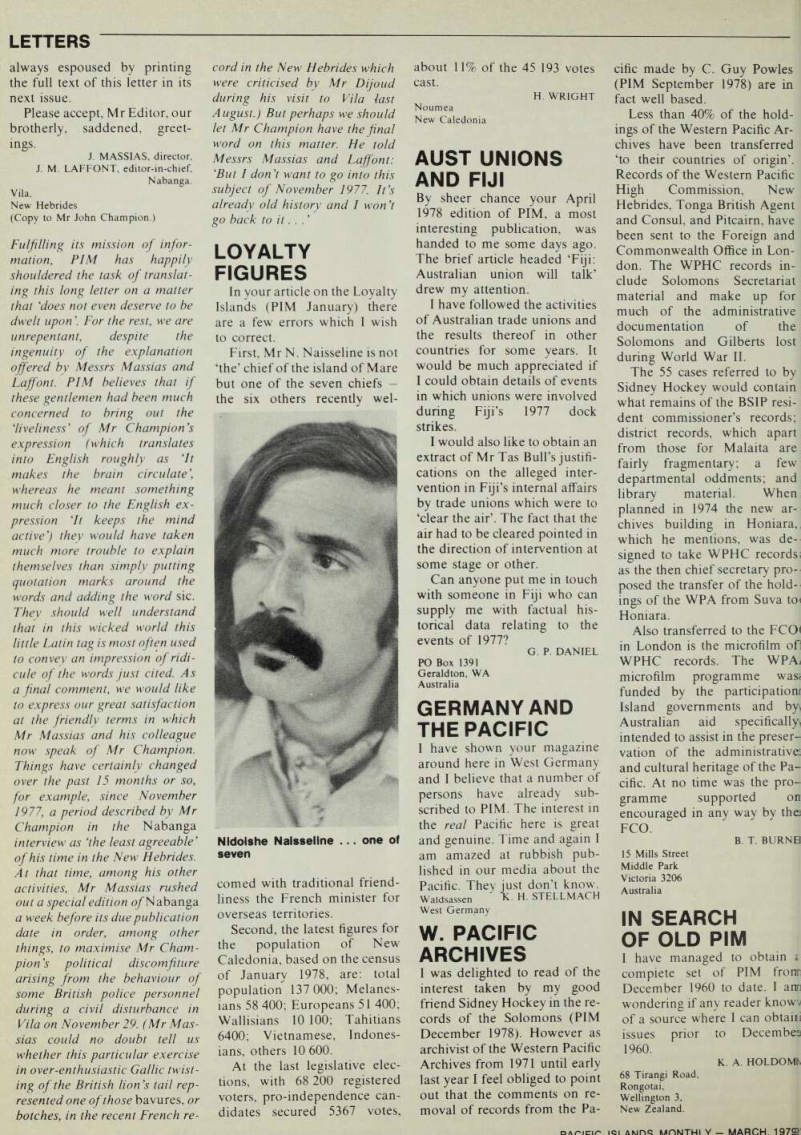
First, Mr N. Naisseline is not ‘the’ chief of the island of Mare but one of the seven chiefs the six others recently wel-
corned with traditional friend liness the French minister for overseas territories.
Second, the latest figures for the population of New Caledonia, based on the census of January 1978, are: total population 137 000; Melanes ians 58 400; Europeans 51 400; Wallisians 10 100; Tahitians 6400; Vietnamese, Indones ians, others 10 600.
At the last legislative elec tions, with 68 200 registered voters, pro-independence can didates secured 5367 votes,
about 11% of the 45 193 votes cast.
H. Wright
Noumea New Caledonia
Aust Unions
And Fiji
By sheer chance your April 1978 edition of PIM, a most
interesting publication, was
handed to me some days ago.
The brief article headed ‘Fiji: Australian union will talk’ drew my attention.
I have followed the activities of Australian trade unions and the results thereof in other countries for some years. It would be much appreciated if I could obtain details of events in which unions were involved
during Fiji’s 1977 dock
strikes.
I would also like to obtain an extract of Mr Tas Bull’s justifi cations on the alleged inter vention in Fiji’s internal affairs by trade unions which were to ‘clear the air’. The fact that the air had to be cleared pointed in the direction of intervention at some stage or other.
Can anyone put me in touch with someone in Fiji who can supply me with factual his torical data relating to the events of 1977?
G. P. Daniel
PO Box 1391 Geraldton, WA Australia
Germany And
The Pacific
I have shown your magazine around here in West Germany and I believe that a number of persons have already sub scribed to PIM. The interest in the real Pacific here is great and genuine. Time and again I am amazed at rubbish pub lished in our media about the Pacific. They just don’t know.
Waldsassen K H. STELLMACH West Germany
W. Pacific
Archives
I was delighted to read of the interest taken by my good friend Sidney Hockey in the re cords of the Solomons (PIM December 1978). However as archivist of the Western Pacific Archives from 1971 until early last year I feel obliged to point out that the comments on re moval of records from the Pa
cific made by C. Guy Powles (PIM September 1978) are in fact well based.
Less than 40% of the hold ings of the Western Pacific Ar chives have been transferred ‘to their countries of origin’.
Records of the Western Pacific High Commission, New Hebrides, Tonga British Agent and Consul, and Pitcairn, have been sent to the Foreign and Commonwealth Office in Lon don. The WPHC records in clude Solomons Secretariat material and make up for much of the administrative documentation of the Solomons and Gilberts lost during World War 11.
The 55 cases referred to by
Sidney Hockey would contain
what remains of the BSIP resi dent commissioner’s records; district records, which apart from those for Malaita are
fairly fragmentary; a few
departmental oddments; and library material. When planned in 1974 the new ar chives building in Honiara,, which he mentions, was de signed to take WPHC records; as the then chief secretary pro posed the transfer of the hold ings of the WPA from Suva to< Honiara.
Also transferred to the FCO< in London is the microfilm of] WPHC records. The WPAi microfilm programme was<
funded by the participation!
Island governments and by\ Australian aid specifically intended to assist in the preser vation of the and cultural heritage of the Pa cific. At no time was the pro gramme supported on encouraged in any way by the
Fco.
B. T. Burnh
15 Mills Street Middle Park Victoria 3206 Australia
In Search
Of Old Rim
I have managed to obtain * complete set of PIM from December 1960 to date. I am wondering if any reader knowv of a source where I can obtaiii issues prior to Decembea 1960.
K. A. Holdom
68 Tirangi Road, Rongotai, Wellington 3, New Zealand.
Nidoishe Naisseline ... one of seven