Maze Of Ifs, Buts
pp. 71-77 · Read in the full issue

New Caledonia
Land Distribution - A
And Maybes
Traditional Melanesian ties to the land of New Caledonia and the im position of colonial law and regu lations has resulted in a worrying situation over land ownership and distribution. Andre Chaville in Noumea has a stab at putting the
problem into perspective.
Melanesia 2000, the popular festival of 1975, was the first official recog nition of Melanesian culture in New Caledonia. But Poindimie, in 1977, marked the beginning of another rev olution against a system of land own ership which is almost medieval.
Ancestral rights are difficult to determine. Geographically, New Caledonia is in Melanesia, but does this automatically mean that the land belongs to the Melanesians?
The French declaration of posses sion in 1853 created a colony out of what had in the past been a collec tion of tribes, separated from one another by a no-man’s land which modern ecologists would call a recreation reserve or green belt.
The possession by the French nation was demonstrated by the traditional raising of colours in an isolated spot on the northern tip of the mainland, with little knowledge of the natural boundaries of the new colony.
The first governor, whose prin cipal role was to create a naval base, declared two years later that his country would respect the bound aries of land occupied by the Melanesians, and rendered illegal all conveyancing previously negoti ated in exchange for beads or tools.
The unoccupied land became the property of the French state.
In 1859, French settlers were per mitted to take possession of land in “unprotected areas”, holdings to be between 50 and 100 hectares, and on the condition that the land was not occupied by the Melanesians.
They were encouraged to create groups of settlements for their mutual protection. By 1868, Euro peans held some 850 hectares of land, while a decree passed in the previous year confirmed recogni tion of tribal rights. Technically, the Melanesian groups did not have title to the land, but were recognised as permanent lease-holders of land within a French colony.
The greatest resistance was en countered in the outlying islands, and the state accepted undivided
occupation of the Loyalty Islands, of the Belep group and of half of the Isle of Pines. When the penal settle ment was closed down, the rest of the island was handed back to the resident tribes.
By 1878, the gradual penetration of the European settlers led to the first revolution. The Melanesians’ efforts to resist compression and the invasion of their reserves by the cat tle of the European farmers ended with a slaughter. But the greatest tragedy was the displacement of some tribes, particularly those of the west coast, towards other reserves.
Even today, the descendants of these
of the special concessions which were occasionally granted, the largest of which was 26 000 hectares and corresponds roughly to the pre sent Lafleur holding at Ouace. This was the start of the speculation in land which continues even today.
The administration proposed to create a special tax on unimproved land as early as 1884 but a decision was put off. It is still being discussed
today.
By 1897, the estimated Melanesian population was 20 000, or less than half the number believed to have been living in New Caledonia when France took possession. Governor Feuillet. considering that the race would shortly disappear, decided on a new programme of settlement, and more than 500 settlers with little or no agricultural experience, came to take possession of the new grants that were allocated. Properties were be tween 10 and 25 hectares, of which
migrants are still considered as strangers in the community. It was also the first opportunity to en courage, two years later, the estab lishment of organised European set tlements on the wide plains of the west coast, with their easier com munications with Noumea. The can didates were carried to their farm, generally of around 25 hectares, and were granted a block of land in the nearest village on which a house was erected by the colonial adminis tration. They were given six months’ supply of food, tools, seeds and oxen or horses, while the villages had rudimentary agricultural equipment which was lent out to each farmer in turn. The farmer received free title four years later, if he had proof that his land had been cleared and, at least, partially planted.
This movement was independent
five hectares were planted to coffee.
To obtain free title the farmer had four years in which to cover at least one half of his concession with coffee trees. Ten years later, many had re turned to France or emigrated to Australia, but those who stayed were to constitute the backbone of the pre sent “Caledonian” population.
The following year, the governor was granted power to take posses sion of any land that was necessary for the “economic development of the colony”. At that time, the Melanesians occupied roughly 130 000 hectares, one-third of the land occupied today.
Unfortunately, this legislation allowed the authorities not only to repossess unused land, but also to displace tribes, their villages and their crops, from their ancestral and traditional land. In this way
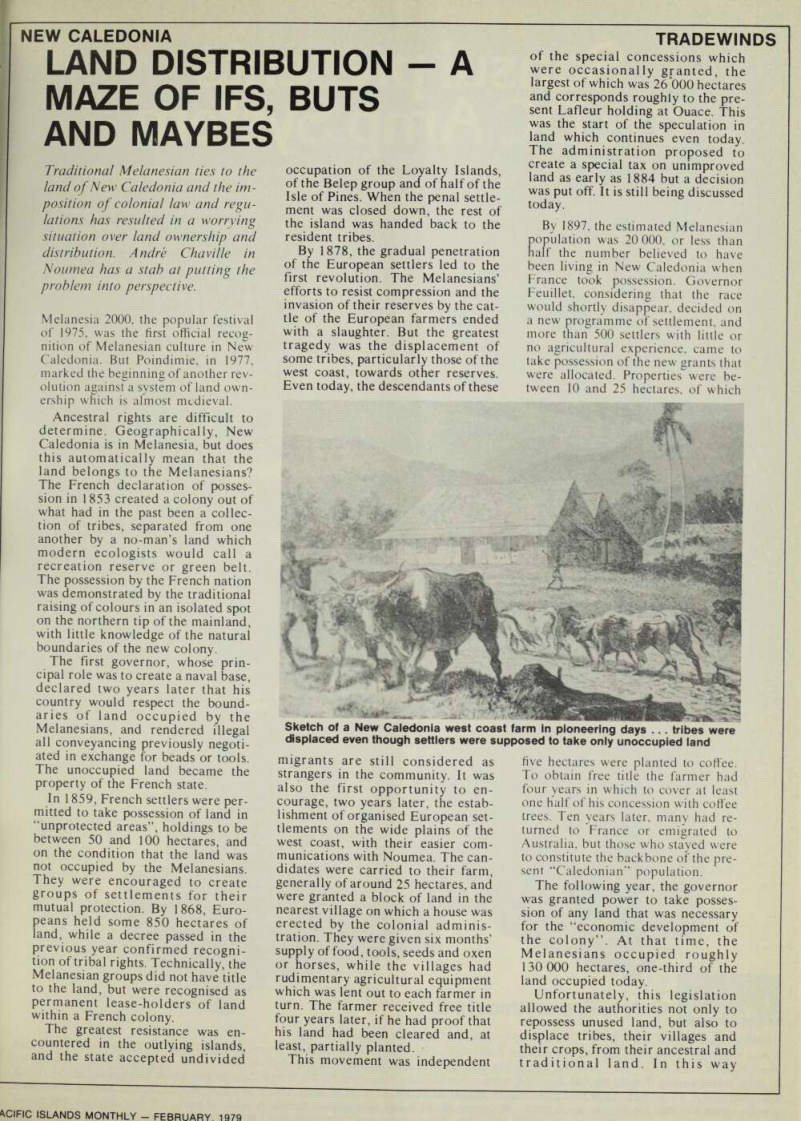
Sketch of a New Caledonia west coast farm In pioneering days . . . tribes were displaced even though settlers were supposed to take only unoccupied land
different groups were transferred to defined areas, a sort of local govern ment constituted by a Big Chief, ap pointed by the governor, and who had authority over the Little Chiefs, leaders of the independent com munities. The Melanesian was not permitted to leave his reserve with out the permission of the gendarme, a rough equivalent of the US marshall, but with greater powers.
The 1917 revolt on the northern east coast was a second demon stration against the penetration of the European settlers. This was now the stronghold of the natural tribes, and also those who had been driven from the west coast. Three years later, and for the first time, the size of the reserves was increased, but in many cases the grants were for land on the lower slopes of the central chains of mountains, while the Europeans took possession of the rich, narrow plains. However, it was at this point that there was a reversal of policy, after another fruitless at tempt, in 1925, to encourage pioneers from the north of France to come to grow cotton.
After World War II and perhaps because of the universal claim for human rights, the status of the Melanesian changed. In 1946, he was permitted to travel freely within the territory, and in 1951 became a French citizen with the right to vote.
An attempt to introduce expatriates from Algeria in 1962 failed because of the resistance from the European population as a whole, and the land owners in particular.
Today, the two communities own roughly 370 000 hectares each, while the Melanesian community has increased to more than 50 000 people. Steady immigration has rais ed the European community to the same level. But for the moment out spoken protest has come only from a minority of Melanesians.
Perhaps before taking any incon siderate initiatives, the French Government should examine the problem very closely. While the present Melanesian reserves are basically dependent on the tradition of the clan, they are not always situ ated on the actual land which is con sidered as the ancestral inheritance.
For the traditional Melanesian, his inheritance is closely associated with the environment of his ances tors, and the trees, rocks and rivers of his reserve are his parents. Very frequently, these magic sites are now in the middle of properties held by a European neighbour.
While the authorities are en couraging the reserves to produce crops which will in turn create a revenue for the community, some reserves may be too small, or un suitable. But in other cases, reserve land is also left unused.
The young Melanesians have been absorbed by the state education system, whose principal role is to educate the individual to permit him to carry out a trade or a professton for his personal profit and satisfaction. With the economic recession, there are few jobs, and, by tradition, whatever his training, he is considered as unskilled and unstable labour.
The young Melanesian thus returns to the community, whose social structure has many ad vantages but ignores personal ambition.
If he cultivates his land, or builds upon it, there is no guarantee that his children will inherit. On his death, the fruits of his labour will be redistributed as the council of elders thinks fit.
It is thus important to decide whether the problem is traditional, racial or economic.
The Caledonian is usually considered as the rich entrepreneur, the white Rhodesian of the Pacific. As far as the rural community is concerned this is quite untrue, and it is only through fear of disturbing the present social structures that at least part of the European population has not joined the clamour of protests.
One half of the rural land-owners, u farmers, own only 15 000 hectares, an average of 10 hectares per property. The land is rarely fertile, and the standard of living is much lower than the general average.
The larger properties are generally devoted to extensive, semi-controlled cattle breeding.
Very few properties are developed, the land is poor, and subject to erosion drought, flooding and pollution from discharge from the nickel mines. These properties are the lands of the “barons”, the old ramifies who hang on to their in-
heritance or those who have in vested the capital earned in mining or building.
In conformity with French tradi tion, land is the most obvious dis play of wealth. A man’s importance is not judged by what he produces, but by the extent of sterile, rocky, weed-studded land he has fenced in.
Some large properties receive the weekly visit of their owner, in a dust-covered Mercedes or Range- Rover. Guests are invited to the homestead for a week-end of fishing or hunting deer or wild pigs.
The monthly anti-tick dip is the opportunity to carry out a rough count of the herd and decide how many cattle will be sent to the slaughterhouse. There is little initia tive in a land where the beef produc ed must be bought by the Territorial Meat Marketing Board, at a high price, whatever the quality. The pre sent economic recession has eroded many incomes and as a result the “weekend property” is now provid ing an extra income by selling beef, much to the regret of the Noumea consumer.
Unproductive land during a very long economic recession will naturally attract the hungry eye. For the first time in the history of the territory, the two largest land owners are splitting up their proper ties for sale. Perhaps the best solu tion today is to ensure that this will not be a source of new speculation, where profits or losses will be ex agerated by political uncertainty.
This is the golden opportunity to ensure that for the first time New Caledonia has an opportunity to produce its own primary necessities and attract the young people, whatever the colour of their skin, away from the tempting security of the public service or the nickel smelter.
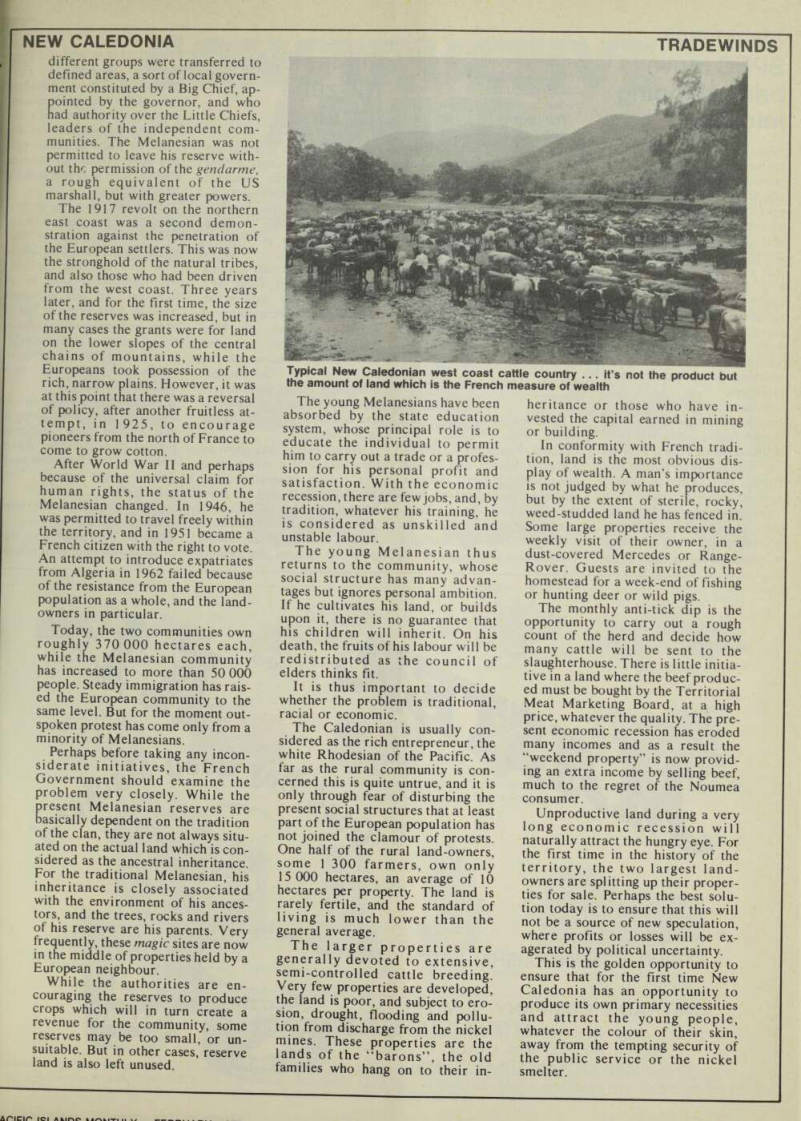
Typical New Caledonian west coast cattle country ... it’s not the product but the amount of land which is the French measure of wealth
SPEC move to
bring shipping
into line
With the aim of establishing uniform maritime standards across the Pacific, a South Pa cific Bureau for Economic Co
operation (SPEC) advisory
committee came up with sev eral ideas at a recent meeting in Honiara, Solomon Islands.
It was suggested that: • a Pacific regional certifi cation structure for officers should be established, based on accepted international stan dards, with countries issuing national certificates to trainees
reaching prescribed common
standards. • uniform syllabuses should be prepared for various grades of Pacific region certificates by a sub-committee. (It was decided that Fiji, Solomon Islands and Papua New Guinea should
appoint representatives to a
sub-committee to report to the next session of the advisory committee.) • length should be used as the
measure of a ship’s size, rather than tonnage, with tonnage considered only if a vessel
traded beyond the region.
The committee argued that acceptance of uniform stan dards would create a favour able climate for rationalising training facilities within the re
gion.
SPEC arranged the Honiara meeting after decisions on shipping by the South Pacific
Forum Regional Shipping
Council and the South Pacific Forum at Niue in September last year. Members of the coun cil are Australia, Cook Islands, Fiji, Gilbert Islands, Nauru, New Zealand, Niue, Papua New Guinea, Solomon Islands, Tuvalu, Tonga and Western Samoa.
Representatives from Aus tralia, Fiji, Nauru, New Zealand, Papua New Guinea, Solomon Islands and Tuvalu attended the Honiara meeting.
Observers were present from the Economic Social Com mission for Asia and the Pacific and the International Maritime
Consultative Organisation.
Fiji looks to
NZ zone
for tuna
Fiji is looking for access to his torical fishing grounds in New Zealand’s 200-mile economic zone to provide sufficient tuna to enable it to expand its fish
canning industry, writes
William Gasson in Welling ton.
At present the tuna canning plant earns Fiji from SF7 million to $lO million in exports a year. The question of access to some of New Zealand’s surplus tuna re sources came in recent talks be tween a Fiji Government
delegation led by Secretary of
Foreign Affairs Jioji Kotobal
avu and New Zealand officials
in Wellington.
‘New Zealand has given an assurance that it will look at our request sympathetically,’
Mr Kotobalavu said, ‘so there will be further discussions.’
At the end of December, how ever, a foreign affairs official said no request for fishing
access had been received fromr
the Fiji Government. Fiji’s'
point is that it has fished im some of the waters now encom-i passed by New Zealand’s far-i reaching economic zone foi( some 10 years. In Fijian eyes; this gives them an historic] claim at least to return to those,
fishing areas.
‘We would now like to safe-; guard the right of access to oun fleet to the resources of youm waters which are surplus to
your own catching capacity,V
Mr Kotobalavu said in am interview. ‘ln our economioi zone we have skipjack but im order to support our canneries; we have to have access to other; species of tuna like albacor© which are found in New* Zealand waters.’
In 1977 Fiji had about 30 long-line tuna vessels fishing im and around New Zealand’s' present economic zone which! only came into force this yean They caught about 7000 tonnes.
Last year the vessels were fishing outside the zone although Mr Kotobalavu wasi not exactly sure of their where-;
I abouts but with the canning I factory’s demand for albacore I expected to climb to 10 000 I tonnes by 1980, the Fijian I Government is keen to cross into the economic zone.
Fiji operates its canning fac-
I tory through a joint fishing
I venture with a Japanese company which charters mainly Taiwan and South Korean vessels to catch tuna.
While New Zealand is likely to be sympathetic to the Fijian fishing request, the use of Taiwan fishing vessels presents a problem since Taiwan is not
recognised by the New
Zealand Government.
Then again New Zealand officials will need to prescribe a licensing formula for the South Korean fishing boats used by Fiji that fits in with licences already issued to South Koreans.
New Zealand at present finds it difficult to establish an allowable catch for foreign tuna vessels because it does not know enough about tuna stocks within its economic zone.
Mr Kotobalavu said that Fiji
was developing its own tuna fishing fleet which in time would also seek access to his torical fishing grounds.
The growth of the fishing industry in Fiji reflects the im portance placed on its future economic role. ‘Our prospects in agriculture are good but for us the development of marine resources is even more import ant in the coming years,’ Mr Kotobalavu said,
Qjg textile plant
\Jiu3Iti
The first major manufacturing
company to locate on Guam for more than three years is expected to open a factory in mid-1979, writes Paul Addison from Agana.
The South Seas Trading Company, which has offices in New York and a factory in the Philippines, is in the final stages of buying land and a building on the island. The company expects to employ about 200 persons at first and up to 2000 within five years.
They will manufacture gloves.
shirts, pants and other textile products, according to company officials.
The company has adopted the local name ‘Guamsons’ and hopes to bring in about 50 trainers from the Philippines early in 1979 to instruct workers m textiles skills. It is planned that training will be earned out in the recently CoTe e ° Uam C ° mmUnity e £ e ' ... .
Guam already has a number of small textile plants but has been hindered in attracting large plants by US import regulations. Although company president Osvay Lipetz said his company has been thinking of relocating on Guam for years, deteriorating political conditions in the Philippines were apparently major factors in the timing of the decision.
I .. incentive for
Tongan copra
Oil Mills of Tonga Ltd’s pressing factory is in production and, barring the unforeseen, unprocessed copra has been
exported for the last time, The director of Oil Mills, Charles Kerry, said that the last shipment of copra left Tonga in November with all future pro duction being held for crush
ing.
Commenting on an apparent d of about 2000 tonnes in )978 against , 977 production> Mr K said that oi , Mills were offering local growers an incentive payment of 5% above wha( ~h e world ice wou|d warrant’ K He said; ‘ We are buying all our co P ra from the Commodi des Board but when the copra quantity is handed over to us we are P a y in g more for it.
That • • must be passed on in full t 0 the growers ..
Mr Kerry said there was ‘an
incredible variety of products’
to be made out of copra and copra oil and while ‘I don’t know today what we are going to produce two or three years from now... I guarantee there will be lines we haven’t even thought of which we are going to manufacture’.